Parshat Bereshit6 min read

Adam Gathered His Sons and Michael Promised the Body Would Rise

Nine hundred and thirty years old, Adam tells his weeping children the sixth day has come, and an angel keeps his body for a promised return.

Curated by Arthur · Told by Maggid ·
Table of Contents
  1. The Day Michael Had Counted Out
  2. The Sky That Could Not Watch
  3. The Throne Promised in the Dust
  4. The First Burial in Paradise
  5. The Penance That Bought Back the Image

Nine hundred and thirty years pressed down on him, and Adam felt the last of them give way. A heaviness settled into his chest that no rest could lift. He had carried it before, long ago, when the angel had counted out the days for him. Now the count was finished.
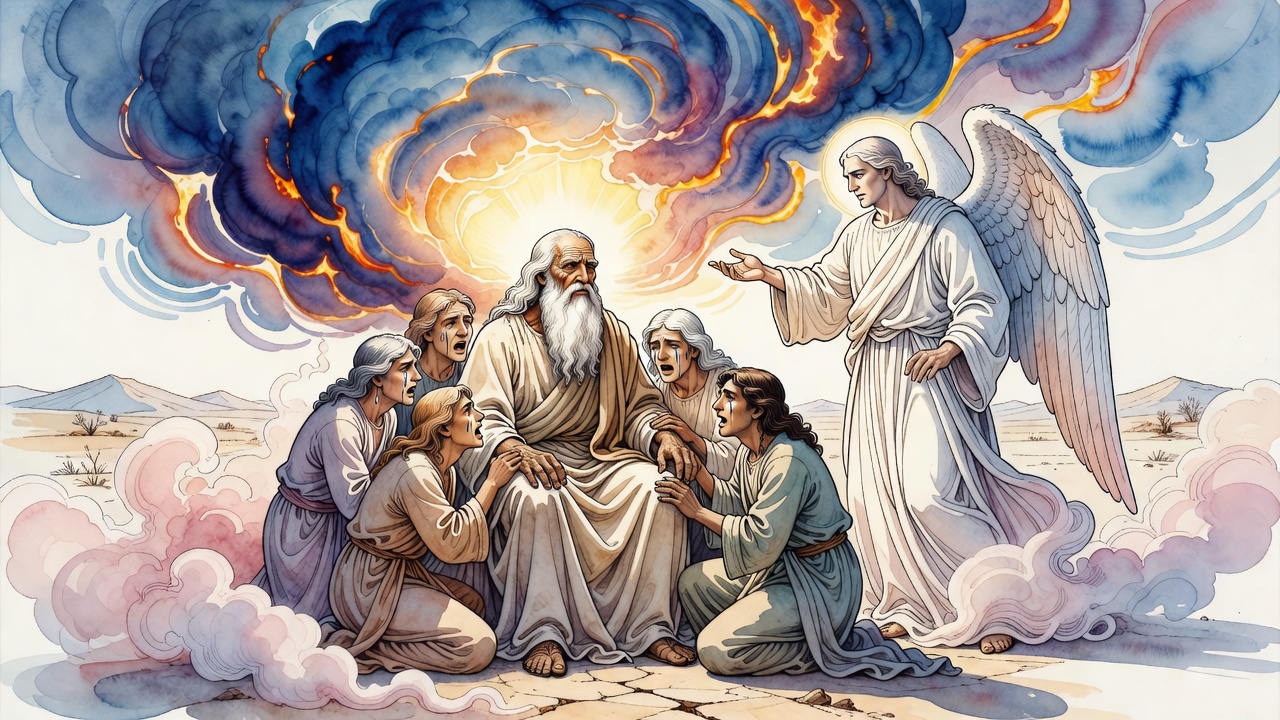
He gathered his sons. Not one or two of them, but all of them, the whole crowd of children that had come from him and from Eve across the long years of exile. They filled the room and the doorway and spilled into the field beyond, and they looked at the old man on the ground and understood, before he said a word, that he was leaving.

The Day Michael Had Counted Out

"Six days," Adam told them. "The archangel Michael stood before me and said it would take six days. This is the sixth."

They begged him to be mistaken. He was certain. He had watched the days arrive one after another exactly as they had been promised, and he knew the shape of a promise kept. He had felt the first cold of it in the morning and the deeper cold by noon.

"I am old," he said. "When I am dead, carry me toward the place where the sun comes up. Lay me in the field near the house." His voice thinned. The room leaned in to catch the words. Then the breath went out of him and did not come back.

The Sky That Could Not Watch

The sun went black. The moon vanished with it. Every star pulled itself out of the sky and hid, and the darkness held for seven days, as though the whole machinery of the heavens refused to keep turning while the first man lay still.

Seth threw himself across the body and would not let go. Eve sank to the ground and folded her hands over her head and pressed her face into the dust they had both been made from. Around them the children wept until they had no voice left for weeping.

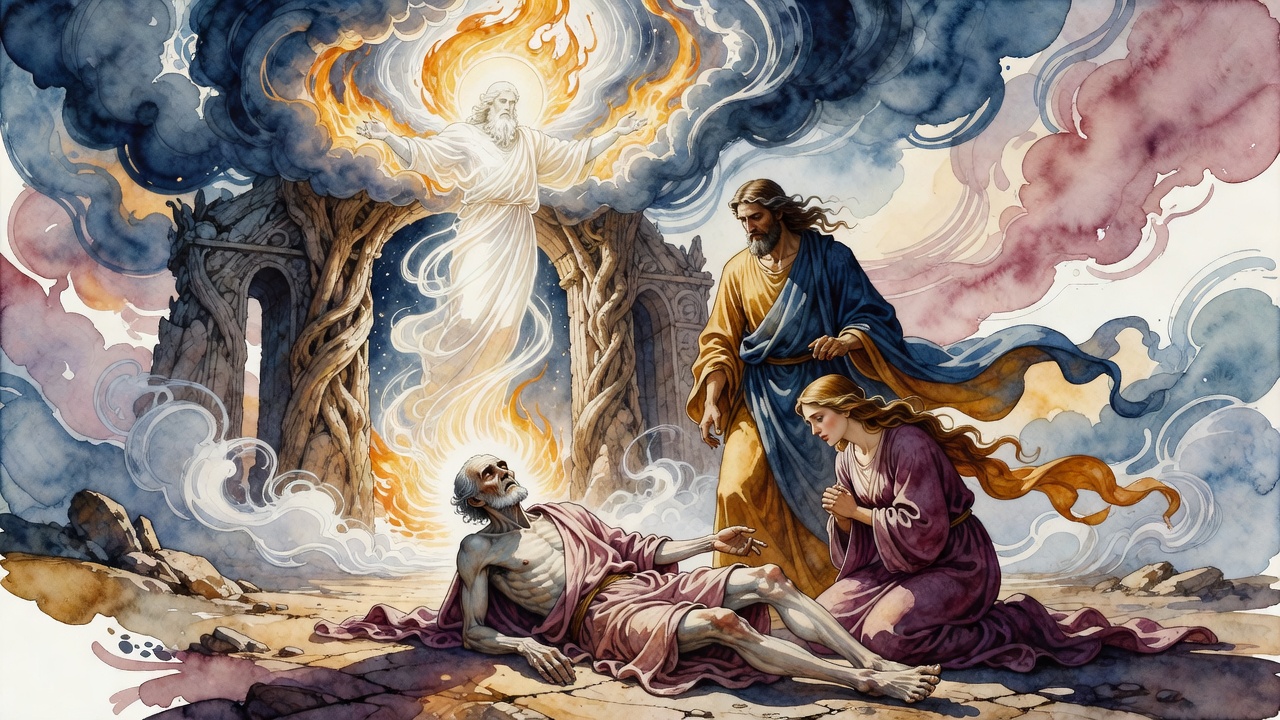
Into that darkness Michael came. He stood at the head of the body where the breath had been, and he spoke to the boy clinging to his father. "Rise up from him," he said. "Come and see what the Lord has decided. This is his creature. God has had pity on what He made."

The Throne Promised in the Dust

Trumpets sounded across the whole height of heaven. Every angel cried out together, "Blessed are You, Lord, for You have had pity on Your creation."

Then a hand came down. Seth watched it stretch out of the dark and close around his father, and the hand passed Adam over to Michael with a charge spoken so all the angels could hear it. "Keep him until the Day of Judgment. In the last days I will turn his grief into joy. He will sit on the throne of the one who deceived him. The deceiver will be thrown down to watch him seated there, and the anguish of that one will have no end."

So the first death was not an ending. It was a handing-over. The body that had been pulled from the ground was given to an angel to hold, like a deposit left with a trusted man, against a day when it would be asked for again.

The First Burial in Paradise

God sent for fine linen, three cloths of byssus, and ordered them spread over Adam, and more cloths brought for Abel, whose blood had soaked into a field long before. The angelic host marched ahead of the body in solemn order. Uriel came to help, and the two angels carried Adam and his murdered son into Paradise itself and laid them in the ground there, while Seth and his mother watched and no one else did.

"As you have seen us do," Michael told them, "so bury your dead from now on." The sleep of the dead had been consecrated. The pattern was set for every grave that would ever be dug.

The Penance That Bought Back the Image

Eve knew the whole story by then, and she would tell the children before her own end came. This was the wage of a single transgression in the garden, the death that would now run down through all of them. But Adam had not gone quietly into that sentence. When the decree first fell on him, when he understood that he had brought death into a world that had not known it, he had sat down in the river and fasted for a hundred and thirty years. He raised welts of fig leaves on his own flesh. He turned away from his wife and would not touch her.

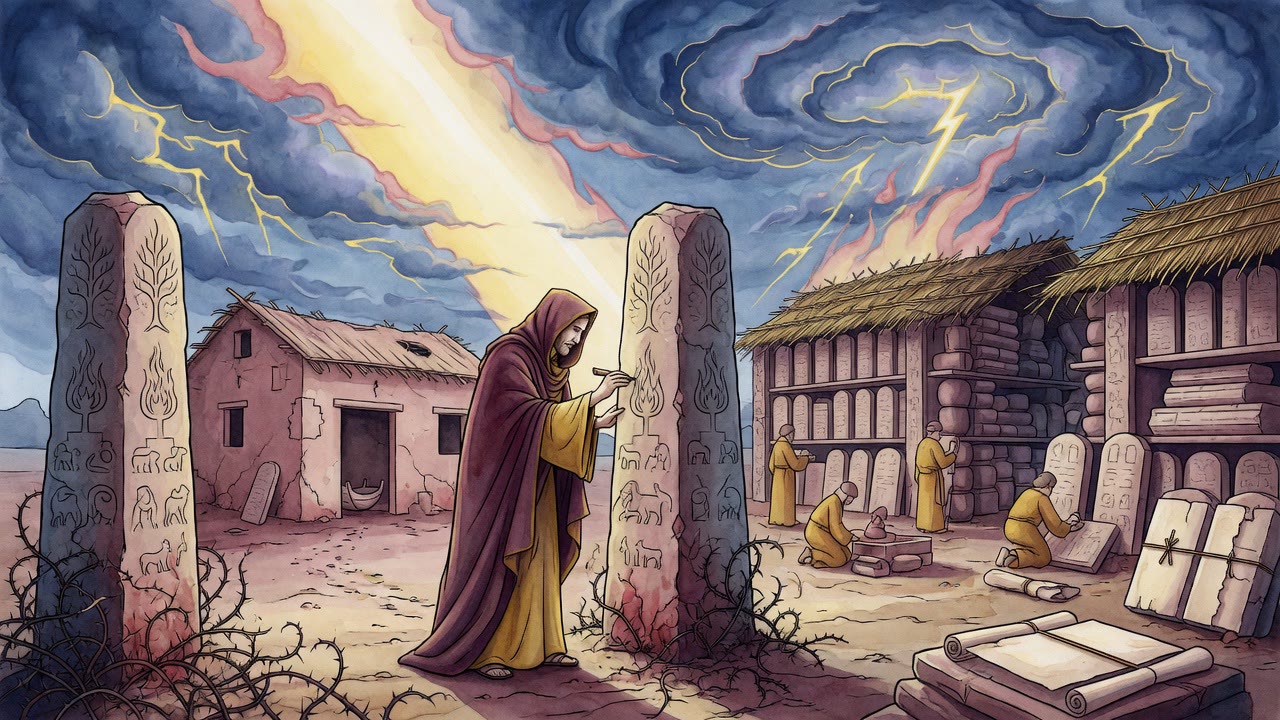
Across those years of mourning, the rabbis remembered, a darker harvest came out of him against his will, spirits and demons and night-creatures fathered in grief. Only when the penance was complete did Seth come, a son in Adam's own likeness and image, born circumcised, the first child to carry the father's true stamp. Through Seth the line of the righteous would run. Through Seth the story would be written on tablets of stone and clay so that neither flood nor fire could erase it.

The grave in Paradise was filled. The promise lay folded inside it like the linen around the body. Somewhere an angel was holding a deposit, and would hold it, until the day God asked for the first man back.


← All myths
From the tradition

Sources

2 sources

The texts this telling draws on, in full. Open a card to read inline, or expand it for a wider, quieter read.

Vita 45-51Life of Adam and Eve

Six days. That was how long the archangel Michael had said it would take. And on the sixth day, exactly as foretold, Adam died.

When Adam felt the hour of death closing in, he gathered all his sons around him one final time. "I am nine hundred and thirty years old," he said. "When I die, bury me toward the sunrise, in the field near our dwelling." He finished speaking. Then he gave up his spirit.

The sun went dark. The moon disappeared. The stars hid themselves for seven days. As if the cosmos itself were mourning the first man.

Seth threw himself over his father's body, embracing it from above. Eve knelt on the ground, her hands folded over her head. Every one of their children wept bitterly.

Then Michael appeared. He stood at the head of Adam's body and spoke to Seth: "Rise up from your father's body. Come and see the judgment the Lord God has pronounced over him. He is God's creature, and God has pitied him."

Every angel in heaven blew their trumpets and cried out: "Blessed are You, O Lord, for You have had pity on Your creation!"

Seth saw the hand of God stretch out and take hold of Adam. God handed him to Michael with these words: "Let him be in your keeping until the Day of Judgment. In the last days, I will turn his sorrow into joy. He will sit on the throne of the one who deceived him. That deceiver will be cast down and will watch Adam enthroned above him -- and his anguish will be without end."

Then God commanded Michael and Uriel: "Bring three linen cloths of fine byssus. Spread them over Adam. Bring other cloths for Abel, his son. Bury them together."

All the angelic powers marched before Adam's body. The sleep of the dead was consecrated for the first time in the history of the world. Michael and Uriel buried Adam and Abel in Paradise itself, before the eyes of Seth and his mother -- and no one else. Then Michael said: "As you have seen us do, so shall you bury your dead from this day forward."

Six days after Adam's death, Eve knew her own end was near. She assembled all her children -- Seth and his thirty brothers and thirty sisters -- and spoke to them.

"Hear me. I will tell you what the archangel Michael told your father and me when we transgressed God's command. Because of your parents' transgression, God will bring judgment on the human race. First by water. Then by fire. By these two, the Lord will judge all humanity."

Then Eve gave her children a command that would echo across all of history: "Make tablets of stone and tablets of clay. Write on them everything about my life and your father's life -- everything you have heard and seen from us. If God judges the world by water, the clay tablets will dissolve but the stone tablets will survive. If He judges by fire, the stone tablets will shatter but the clay tablets will be baked hard and preserved."

Two materials. Two disasters. Either way, the story would survive.

When Eve finished speaking, she stretched her hands toward heaven in prayer. She bent her knees to the earth. She worshipped the Lord and gave thanks. And in that posture -- kneeling, praying, grateful despite everything -- she gave up her spirit.

Her children buried her with loud lamentation. They mourned for four days. Then Michael appeared one last time and said to Seth: "Man of God, do not mourn your dead more than six days. For on the seventh day is the sign of resurrection and the rest of the age to come. On the seventh day, the Lord rested from all His works (Genesis 2:2). On that day, God rejoices -- and we angels rejoice with Him -- over every righteous soul that has passed from the earth."

Seth obeyed. He made the tablets -- stone and clay -- and inscribed upon them the entire story of Adam and Eve, from the glory of Paradise to the bitterness of exile, from the Adversary's deception to God's promise of resurrection. Two copies of the truth, built to outlast any catastrophe the world could throw at them.

The first family was buried. The story was preserved. And the promise of return -- to Paradise, to glory, to the presence of God -- burned like a flame that no flood or fire could extinguish.

Full source
Yalkut Shimoni on Torah 42:1Yalkut Shimoni on Torah

(Genesis 5:2) "Male and female He created them." Rabbi Elazar said: Any man who has no wife is not a man, as it is said, "Male and female He created them," and so forth. (Genesis 5:3) Rabbi Elazar ben Azaryah said: During all those years that the first Adam was under the ban, he begot demons, spirits, and night-demons, as it is said, "And Adam lived a hundred and thirty years and begot a son in his likeness, after his image", which implies that until now he did not beget in his image. They raised an objection: Rabbi Meir used to say, the first Adam was a great pious man; once he saw that death had been decreed because of him, he arose and sat in fasting for a hundred and thirty years, and raised growths of fig leaves upon his flesh, and separated from his wife. We speak here of the seed that issued from him against his will.

"And Adam lived a hundred and thirty years and begot in his likeness, after his image." From here you learn that Cain was not of his seed, nor of his likeness, nor of his image, until Seth was born. Rabbi Shimon says: From Seth arose and were traced all the generations of the righteous, and so forth. Rabbi Meir says: it was the uncovering of the flesh of nakedness; they walked about like beasts, and so forth. Rabbi Yehoshua says: the angel is a flaming fire, yet the fire enters into intercourse with flesh and blood and does not burn the body; only from the hour that they fell from their place of holiness, their strength and their stature became like that of human beings, and their garments a clod of earth. Rabbi Tzadok says: from them the giants were born, "the Nephilim were in the earth" (Genesis 6:4). Rabbi Yehoshua ben Korchah says: Israel are called sons of God, "You are sons" (Deuteronomy 14:1), and the angels are called sons of God, as it is said (Job 38:7), "When the morning stars sang together," and so forth; and these, while they were in their place of holiness, were called sons of God.

"And he begot in his likeness." This teaches that he was born circumcised.

Full source