Parshat Bereshit5 min read

Adam Hides Where He Sinned Among Eden's Trees

After the fruit, Adam and Eve stay among the same trees, God knocks like a guest, and a question that sounds like location is really grief.

Curated by Arthur · Told by Maggid ·
Table of Contents
  1. The Middle of the Trees
  2. A Knock at the Dwelling
  3. Where Are You
  4. Sin Loves the Scene of the Crime
  5. The Door That Will Not Close
Adam Hides Where He Sinned Among Eden's Trees Click for full size

The Middle of the Trees

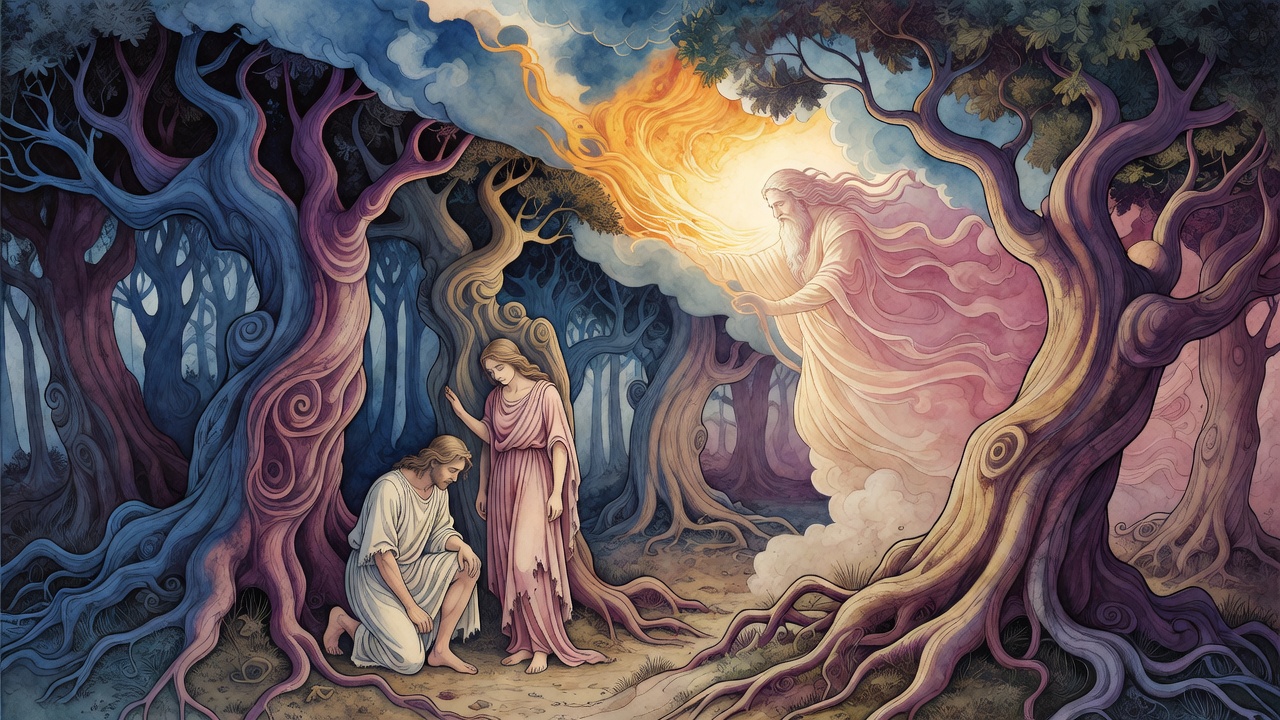
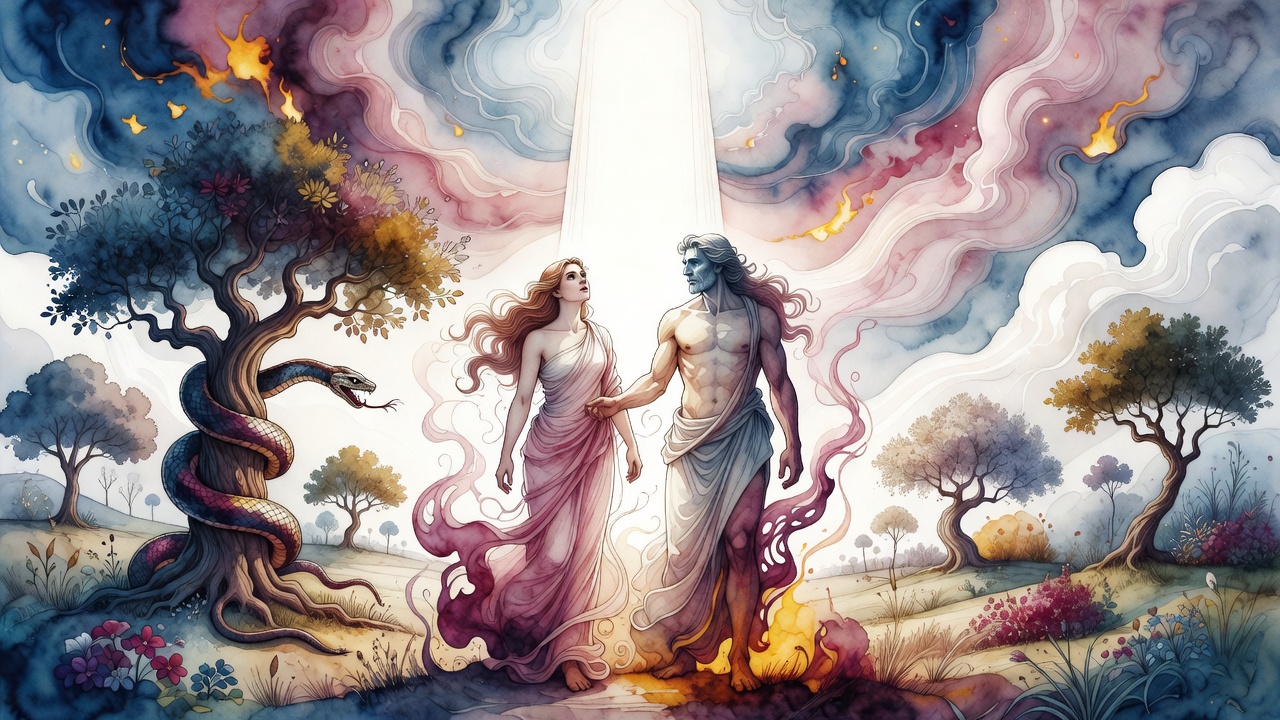
Adam did not run for the far edge of the garden. He stayed in the middle of the trees of Paradise, in the same green that had watched him reach for the fruit and heard the first lie taste like wisdom. Eve stood with him. Leaves that had been shade became a screen. The place of the act became the place of the hide, as if proximity to the crime could confuse the Judge who had planted the scene.

Thieves often make the same mistake. They fix on the prize and forget the One who already sees the hand mid-reach. Adam and Eve were not criminal geniuses. They were the first people to discover that guilt prefers familiar cover and hates the open path that would require a full turn of the body toward the voice.

The garden kept its weather. Light still fell in bars through the leaves. Birds that had not yet learned human fear continued their noise. That ordinary music made the hide more absurd. Nothing in the scenery had changed except the knowledge in two chests, and knowledge is heavier than any branch.

A Knock at the Dwelling

God did not smash the branches aside like a raiding king. In one telling He knocked before entering Adam's dwelling, as if the Maker of the ground still honored a threshold He Himself had framed. The courtesy made the fear worse. A shout can be answered with panic and a sprint. A knock forces the body to choose whether to open, and choice is exactly what they had already misused.

They did not open as hosts. They pressed deeper into leaf and shadow, as if bark could cancel a commandment and fig leaves could invent a new law of privacy. Eve looked at the fruit's tree and saw no new thorn. The change was inward and therefore harder to flee. Adam pressed a palm to bark and felt only wood. He wanted the wood to answer for him. Wood is loyal to silence.

Where Are You

The question came next: "Where art thou?" (Genesis 3:9). It sounded like geography. It was not geography. God did not lack a map of His own garden. The call was a lament shaped like a question, the way a parent calls a child's name into a dark house after a crash of pottery and a long stillness. Location was the thin skin over grief.

Adam heard the words and answered with clothing and blame. Fig leaves first. Then the woman's gift. Then the serpent's speech. Every sentence moved the failure one step farther from his own mouth, as if distance in speech could become distance in guilt. Eve pointed at the serpent. The serpent had no one left to point at except the dust that would soon become its sentence.

Sin Loves the Scene of the Crime

Why stay among those trees? Because sin does not think in straight lines toward safety. It thinks in appetite and habit. The mind that grabbed the fruit still wanted the orchard that framed the grab. Flight would have been wiser. Flight would have required admitting the garden was no longer home. They chose the middle instead, the place where the wound and the comfort shared one root system and the air still smelled like the afternoon of the fall.

Even later, when the voice pressed closer, the first couple's logic stayed small: hide the body, hide the face, keep the old branches. The world outside the trees had not yet been invented as exile. They invented exile by refusing to walk toward the voice that already knew their coordinates.

In Philo's reading, this is what desire does. It narrows the field of vision until the only place that feels real is the place where the desire was satisfied, even when that place has become a trap.

The Door That Will Not Close

God kept speaking after the hide failed. The serpent received its belly and its dust. Eve received pain in birth and a longing that would complicate every later love. Adam received the ground that would fight him for bread. Then the gate of Eden turned, and cherubim took up a fire that cut both ways so no clever return through the same trees could be arranged.

Still the first question hangs over every later hiding place in every later generation. Where are you? Not because heaven lost the coordinates. Because a relationship keeps knocking after the fruit is already swallowed and the leaves are already sewn. The middle of the garden taught the first lesson of flight: you cannot hide in the scene of the crime from the One who made the scene.

Evening would come differently now. Shadows that once meant rest would mean exposure. Adam would learn the names of fear the way he had once learned the names of beasts, one by one, without the comfort of dominion. Eve would hear every later footstep on leaves and wonder if the knock had returned. The garden's middle was lost, but the habit of hiding would travel with them past the flaming sword into fields that fought back.


← All myths
From the tradition

Sources

4 sources

The texts behind this telling. Some cards carry a translation of the source; others are our own retelling of it, and each card says which. Every card links out to the original.

The Midrash of Philo 8:8The Midrash of Philo

Retold in our words. Read the original at the link below.The Works of Philo Judaeus, trans. C. D. Yonge, London, H. G. Bohn, 1854-1890 · Public Domain

Why Adam and Eve Hid Among the Trees is the question behind this passage from The Midrash of Philo.

No. They hid "in the middle of the trees of the Paradise" (Genesis 3:9). In the very place they committed the act.

Why?

Philo, a Jewish philosopher from Alexandria, writing in the first century CE, grapples with this very question. He sees in their baffling choice a deeper truth about human nature, particularly the nature of sin. He offers us a powerful insight – one that resonates even today.

Philo suggests that sinners aren't exactly criminal masterminds. They don't operate with flawless logic or strategic brilliance. He paints this vivid picture: thieves so focused on their immediate prize, on the act of stealing, that they completely forget there's a power, a "Deity who presides over the world," watching over them. They are so consumed by the act, they are blind to the bigger picture.

And that blindness, according to Philo, is what traps Adam and Eve. They should have fled. They should have sought refuge far from the scene of their transgression. But their sin, their act of defiance, had a kind of gravitational pull. It held them captive, right there in the Gan Eden (Garden of Eden).

"They still were arrested in the middle of the Paradise itself," Philo writes, "in order that they might be convicted of their sin too clearly to find any refuge even in flight itself."

Philo isn’t just talking about Adam and Eve, of course. He's using their story as an allegory. He sees their actions as a microcosm of the human condition. He's suggesting that wickedness itself becomes a refuge for the wicked. That those consumed by their passions actually flee to those passions for safety. How often do we see people doubling down on their mistakes, clinging to destructive behaviors, not because they’re unaware of the consequences, but because, on some level, those behaviors offer a twisted sense of comfort, of familiarity? It is a dark sort of shelter, a place to hide from the light of accountability and change.

Philo’s commentary invites us to ask ourselves: Where are we hiding? What “trees” in our own personal “paradise” are we clinging to, even though they offer no real protection?

And perhaps, most importantly, what would it take to step out of the shadows and into the open?

Full source
The Midrash of Philo 9:1The Midrash of Philo

Retold in our words. Read the original at the link below.The Works of Philo Judaeus, trans. C. D. Yonge, London, H. G. Bohn, 1854-1890 · Public Domain

The Midrash of Philo preserves this as a question on Scripture, not a finished ruling:

Why God asks Adam, "Where art thou?" when he knows everything: and why he does not also put the same question to the woman? (Genesis 3:10).

The entry records the question Philo poses. It does not supply an answer the source does not give.

Source: The Midrash of Philo 9:1.

Full source
The Midrash of Philo 9:2The Midrash of Philo

Retold in our words. Read the original at the link below.The Works of Philo Judaeus, trans. C. D. Yonge, London, H. G. Bohn, 1854-1890 · Public Domain

That feeling isn't exactly new. to a fascinating interpretation of a very famous moment: God calling out to Adam after he ate from the Tree of Knowledge in the Garden of Eden. The familiar version gives us the line: "Where are you?" (Genesis 3:9). Simple question. But what if it's not really a question?

The Midrash of Philo offers a compelling take. It suggests that God wasn't asking for Adam's location in a literal sense. Instead, "Where art thou?" was more like a cosmic, "What have you done?" It’s a lament. A statement of Adam's fall from grace. "Where are you now, O man?" the midrash (rabbinic interpretive commentary) echoes. "From how many good things are you changed? Having forsaken immortality and a life of the most perfect happiness, you have become changed to death and misery in which you are buried." Ouch. it’s not just about physical location; it's about Adam’s spiritual location. He’s lost his way. He's wandered into a dark place. And God isn't just asking where he is, but mourning what he has lost.

What about Eve? The Midrash of Philo points out that God doesn't even bother to question her directly. Why? Because she's seen as the instigator, the one who led Adam astray. She's the "guide to her husband to a life of shame." Harsh. But there's another layer here, a more allegorical one. Philo sees Adam as representing the "principal part," the mind, possessing the masculine principle. Eve, on the other hand, represents the "outward sense," the feminine aspect. The idea is that when the mind (Adam) listens to the senses (Eve) without proper discernment, it introduces a flaw, a vulnerability. The senses, untamed by reason and spiritual insight, can lead us down the wrong path.

The internal struggle between reason and desire, between the spiritual and the material. It's a struggle we all face.

" echoing in your mind – whether from a divine source or just your own conscience – maybe it's not about your physical location at all. Maybe it's a call to examine where you are on your own spiritual journey. Have you, like Adam, lost your way? And if so, what will you do to find your way back?

Full source
Legends of the Jews 2:61Legends of the Jews

Retold in our words. Read the original at the link below.The Legends of the Jews by Louis Ginzberg (1909) · Public Domain

The air is thick with the scent of flowers you can't even name, and the light shimmers with an impossible brilliance. And then, a voice. Calm, resonant, but laced with…disappointment? "Where art thou, Adam?"

It's one of the most famous questions in the Torah, and it's often interpreted as a scolding. But, as Ginzberg recounts in Legends of the Jews, it was actually an act of divine courtesy. God, standing at the gate of Paradise, was modeling proper etiquette: never enter another's dwelling unannounced.

Let's be honest, there's more to it than just manners. According to Ginzberg, that simple question, "Where art thou?" carried the weight of Adam's fall. It highlighted the chasm between what Adam was and what he had become. a being of supernatural size, now diminished. A creature under God's dominion, now under the sway of the serpent.

Here’s the truly heartbreaking part. God, in His infinite mercy, was offering Adam a chance to repent. A chance to turn back. A chance to be forgiven.

But what did Adam do? He blamed God!

When asked, "Hast thou eaten of the tree whereof I commanded thee thou shouldst not eat?" he didn't confess. Instead, he deflected. "O Lord of the world!" he whined, "As long as I was alone, I did not fall into sin, but as soon as this woman came to me, she tempted me."

Can you hear the petulance? The lack of ownership?

God, understandably, wasn't having it. "I gave her unto thee as a help, and thou art ungrateful when thou accusest her, saying, 'She gave me of the tree.' Thou shouldst not have obeyed her, for thou art the head, and not she."

It's a stinging rebuke, and it gets to the heart of the matter. Adam, the leader, the one entrusted with responsibility, abdicated his role and then blamed someone else for his failure.

The story goes even deeper. God, knowing all things, had foreseen this very scenario. As Ginzberg tells us, God hadn't created Eve until Adam specifically asked for a helpmate, so that he wouldn't have a valid excuse to blame God for creating woman. Talk about playing 4D chess!

So, what are we left with? A story about temptation, yes. But also a story about responsibility, about blame, and about the missed opportunity for teshuvah (repentance), repentance. It’s a reminder that even when faced with the consequences of our actions, we always have a choice: to own our mistakes, or to pass the buck. And as the story of Adam so vividly illustrates, choosing the latter often leads us further away from the gates of Paradise.

Full source