5 min read

Adam Was Exiled to a Land With No Sun and Stood in the River

The gate shut and the sword turned every way he went. Where Adam came down there was no sun, and nobody there to argue with about death.

Curated by Arthur · Told by Maggid ·
Table of Contents
  1. The Gate Shuts Behind Him
  2. A Land Where the Sun Never Came
  3. What He Could Not Stop Going Over
  4. He Walks Into the Gihon
  5. The Ground He Was Made From
Adam Was Exiled to a Land With No Sun and Stood in the River Click for full size

The Gate Shuts Behind Him

Adam turned around once and the way back was already closed.

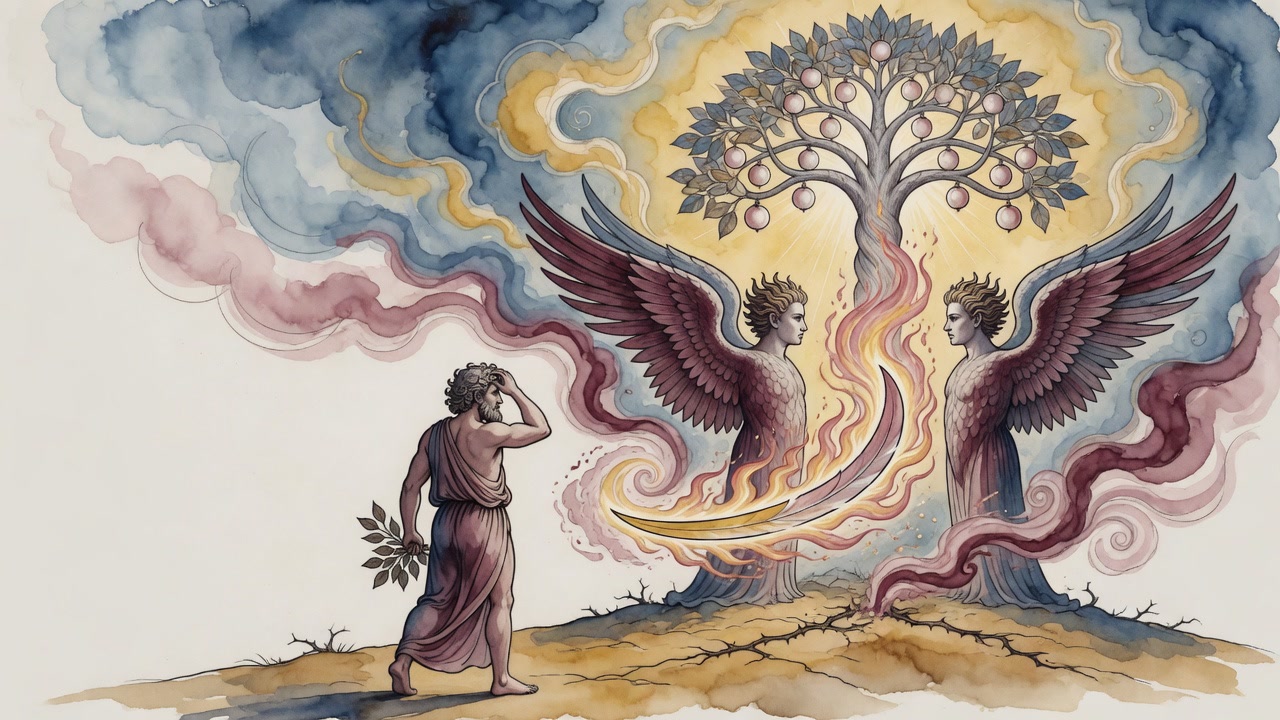
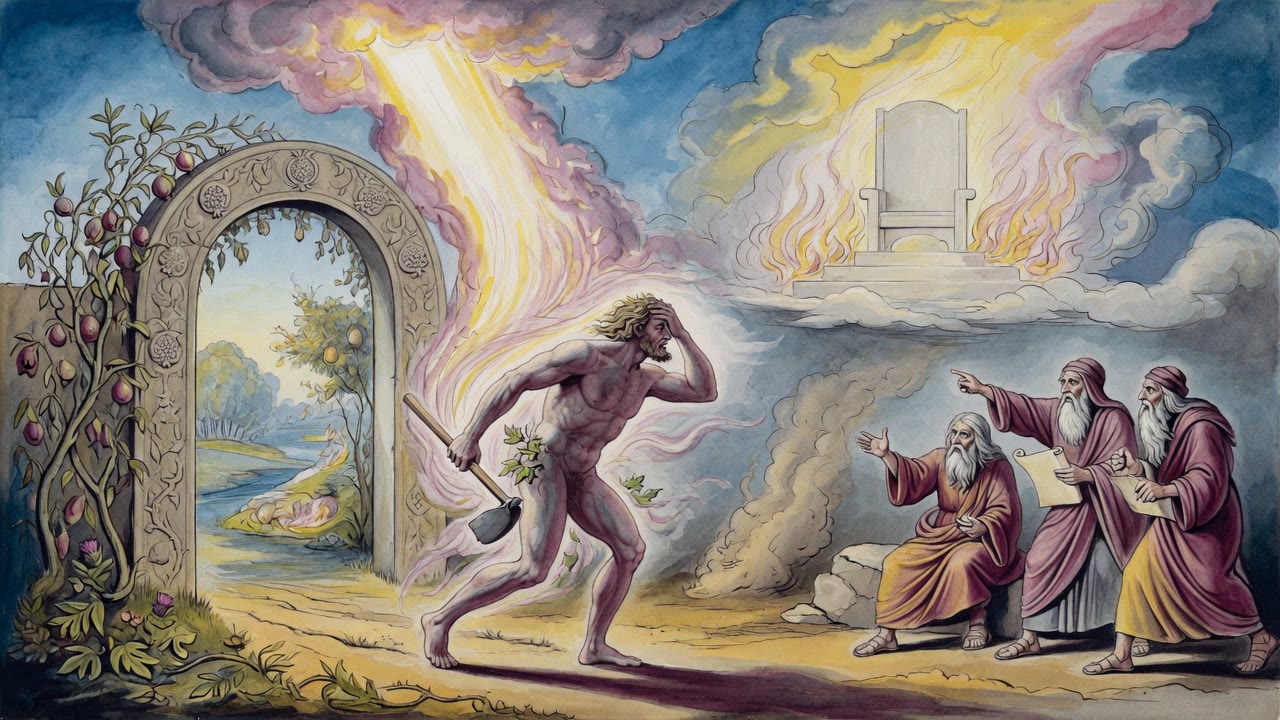
Cherubim at the entrance, and in front of them a sword of fire turning and turning, never settling on one direction. He tried east. The blade was there. He walked along the wall and tried again, and the blade swung around to meet him, and again. It was not guarding one road. It was guarding all of them at the same time.

He was not wandering. He was exiled, and the sword behind him made it permanent. So he went out into the country on the other side.

A Land Where the Sun Never Came

The world had been split in two at the start. One half was made to be lived in, and it was drawn as a circle, and at the center of that circle lay the land God chose, and at the center of that land the city, and at the center of the city the room where the Divine Presence would come down and stay.

The other half was desert. Nothing was going to grow there. It belonged to the Other Side, and much later a whole nation would spend forty years crossing it, losing ground every time it lost its nerve.

Adam came down in a country called Eretz, and Eretz had no sun.

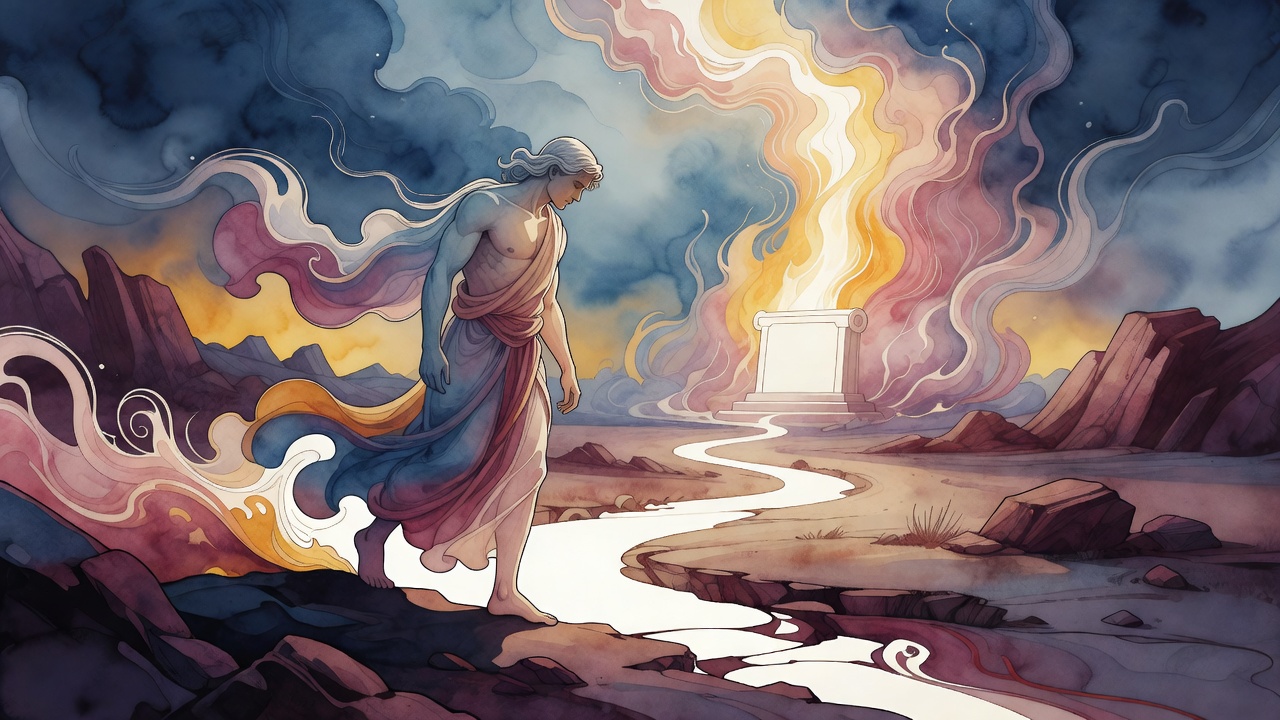
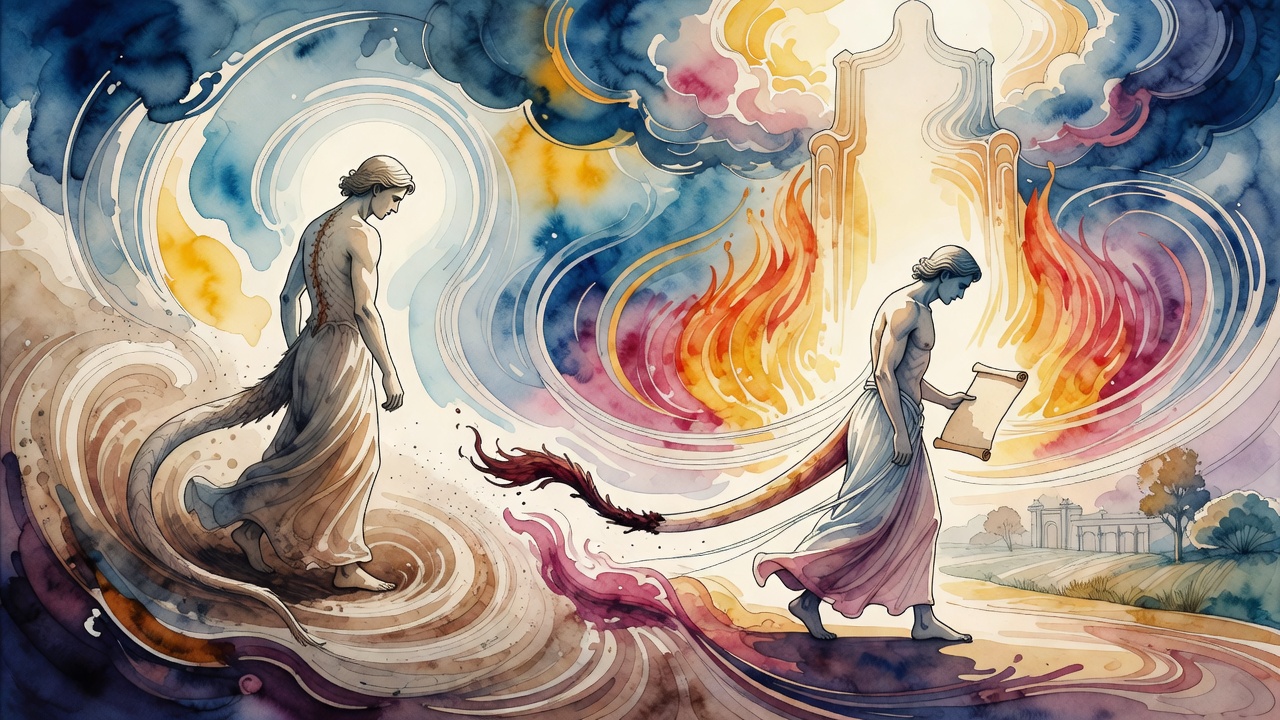
Not night. Night ends. This was a dark that had never had anything to end, a land nobody had lit, and he stood in it unable to tell how much time was going by or which direction anything lay in. Behind him the sword kept turning. It threw the only light he had.

What He Could Not Stop Going Over

Fear first. Then the shaking. Then a heaviness he had no word for, because nothing in the garden had ever needed one.

He went over all of it. The tree. The eating. The voice walking in the evening. He hated every part of it, and he hated the being sent out, but in the dark the thing he kept coming back to was worse than either.

He had brought death in.

Not onto himself only. Onto every person who had not been born yet. Every one of them was going to die, and each one was going to die because of something he did in an afternoon, and there was nobody in that country to argue with about it.

He Walks Into the Gihon

There was a river.

He went down the bank into it and did not stop at his knees or at his waist. He went until the water came up under his chin, and then he stood still.

He was not washing. He was not drowning. He was putting his whole body where it could be seen exactly how sorry he was, and he intended to stay in it until that registered somewhere.

The current went past him. He did not move.

Grief that gets through does not stay down in the dark. Even out of Gehenna (the realm of judgment after death) a light will rise sometimes and cross into the garden, and it never means more than one thing, which is that the weeping underneath has been heard and whoever is doing it is about to be moved.

The Ground He Was Made From

God brought him up out of Eretz.

Not back through the gate. There was no going back through the gate. He was taken instead to a different land with a different name. Adamah, which is the word for soil, which is the word sitting inside his own name. He had been scooped out of it once. Now he was set down on top of it and told to work it.

There, on ordinary dirt, in ordinary light, he was finally at peace.

The other country did not go anywhere. It stayed dark and it kept its name. One generation later God passed sentence on Adam's older son for what he had done to his younger son, and the sentence was to be a restless wanderer in eretz. Cain went out to serve it in the land his father had been let out of.


← All myths

From the tradition

Sources

5 sources

The texts behind this telling. Some cards carry a translation of the source; others are our own retelling of it, and each card says which. Every card links out to the original.

Zohar 1:253bZohar

Retold in our words. Read the original at the link below.Sefaria-hosted English translation · CC-BY

It wasn't just a simple "pack your bags and leave," it was a journey into something far more profound.

In some fascinating strands of Jewish tradition, Adam’s exile didn't end with a new address. He first found himself in a place called Eretz. Eretz, meaning "land" in Hebrew, wasn't exactly a paradise. In fact, it was the opposite: a desolate, dark realm, perpetually devoid of sunlight. No matter which way he turned, he was confronted by the blazing, ever-turning sword, a direct echo of (Genesis 3:24), guarding the path back to Eden and, more importantly, trapping him in his despair. It was a land of consequence, the embodiment of grief itself.

You might notice that Eve isn’t mentioned in this part of the story. The Genesis narrative tells us they were together, so why the omission? This absence strongly hints that Eretz isn’t a literal place, but an allegorical one, a representation of the intense sorrow and regret that paves the way for teshuvah (repentance), repentance.

The myth paints a picture of Adam overwhelmed by panic and fright. The familiar, peaceful boundaries of his existence had vanished, replaced by terrifying unknowns. Melancholy and fear became his constant companions, symptoms of his fallen state. He bitterly regretted his sin, his expulsion, and especially the introduction of death into the world, condemning himself and all his descendants to mortality.

But here's where the story takes a turn. It wasn't permanent. Relief came when Adam finally turned his thoughts toward repentance. As we learn in the Zohar Hadash, one version says he stood in the river Gihon, neck-deep in the water, as a sign of his remorse. And then, God brought him out of Eretz.

He was led to another place, another “land”, this one called Adamah. Now, Adamah means “ground” or “soil.” And there, at last, he found peace.

Why these two specific "lands"? Why Eretz as a place of suffering, and Adamah as a place of peace? Well, the Torah gives us a clue. Remember in (Genesis 3:23), after the expulsion, God banished Adam "to till the soil (adamah) from which he was taken"? There's a deep connection between Adam and Adamah; he was formed from the dust of the earth, after all, a link underscored by their similar names.

Eretz, on the other hand, appears in a very different context. In (Genesis 4:12), it’s the place where Cain is condemned to wander, a land of restless exile.

The ever-turning fiery sword, that recurring image from Genesis, is key here. It’s not just barring Adam from Eden, it's trapping him in Eretz, in his own bitter remorse. It represents all the limitations that now defined his existence, a prison built of regret. The Zohar (1:253b) and Midrash Rabbah elaborate on these themes, painting a vivid picture of Adam's internal struggle. Ginzberg, in his Legends of the Jews, masterfully weaves these threads together, creating a compelling narrative of post-Edenic sorrow and eventual redemption.

So, what does this story tell us? Perhaps it's a reminder that even after mistakes, even after experiencing the darkest "lands" of our own making, repentance and a return to our roots, to the Adamah from which we came, can lead us back to peace. It's a powerful message of hope, whispered through the ages, reminding us that even in exile, redemption is always possible.

Full source
Zohar 2:157a-bZohar

Retold in our words. Read the original at the link below.Sefaria-hosted English translation · CC-BY

Some stories tell us it all started with a division. A grand sorting.

The tradition says when God created the world, it wasn't a uniform, homogenous blob. No, no. It was divided right from the get-go. One part became habitable, teeming with potential for life. The other? A desolate, unforgiving desert. Two sides of the same coin, forever distinct.

The story doesn't end there. God, in His infinite wisdom, wasn't finished shaping things. He took that habitable part and re-divided it, forming a circle. And at the very heart of that circle? The Holy Land. It gets even more specific: at the center of the Holy Land is Jerusalem, and at the center of Jerusalem? The Holy of Holies, the most sacred space in the Temple. It's here, tradition tells us, that the Shekhinah, the divine presence, dwells.

But what about that desert? That desolate other half? Well, that too has a story. It was that desert, the most terrible and sinister, where the Israelites wandered for forty long years. According to tradition, this was the domain of the Sitra Ahra, "the Other Side" – the side of evil.

The Israelites, fresh from slavery, facing not only physical hardship but a spiritual battle as well. The narrative suggests that had they been consistently worthy, had they maintained their faith and avoided provoking God, they might have broken the power of the Other Side forever. But, alas, they stumbled. Each time they angered God, the Sitra Ahra gained ground, tightening its grip. They became subject to its influence.

It wasn't until those long forty years had passed, a period of intense trial and tribulation, that the Israelites finally managed to break the Other Side's hold and reclaim their destiny. That's when they found their way back to the Holy Land.

So, what does it all mean? On one level, it’s a creation myth, explaining how the world, and especially the Holy Land, came to be. Medieval maps often depicted Jerusalem as the "navel of the world," evidence of this belief. You can find more about these myths of the Holy Land in various collections.

But it's also more than just a history lesson or a geographical description. It's a kabbalistic allegory, a symbolic representation of the eternal struggle between good and evil, holiness and impurity. God and the Shekhinah on one side, the Sitra Ahra and figures like Lilith on the other. As Ginzberg retells it in Legends of the Jews, these opposing forces are always active, constantly vying for influence. The world, and perhaps even our own lives, are a stage for this cosmic drama.

The Midrash Rabbah paints a vivid picture of this duality. It's a battleground, and we all have a role to play in choosing which side we empower. Are we drawn to the light of the Holy Land, or do we succumb to the allure of the desert and the Sitra Ahra? The choice, it seems, is perpetually ours.

Full source
Zohar 1:182a, 2:175aZohar

Retold in our words. Read the original at the link below.Sefaria-hosted English translation · CC-BY

Jewish tradition often speaks of a profound connection between the heavens and the earth – “as above, so below,” as the Kabbalists say. But what happens when tragedy strikes here? Does it resonate in the celestial realms?

There's a powerful story about the destruction of the Temple in Jerusalem that suggests it absolutely does. But it's not just about the earthly Temple. The tale, as told in the Zohar, explores what happened in the heavens when God made that fateful decision.

In this tradition, when God decided to destroy the Temple, He didn't just target the physical structure. He first "put aside the Holy Land above," the supernal Jerusalem. And, crucially, He cut it off from the sacred heavens that nourished it.

What was the impact? The angels, witnessing this severing, wept bitterly. Why? Because it signified the exile of the Shekhinah (the Divine Presence). The Shekhinah (שְׁכִינָה) – the divine feminine presence, the immanent glory of God – was being sent away.

This is where it gets really interesting. The story suggests that God's judgment works from the top down. As we find in the tradition, "When He wishes to judge the world, He first passes judgment on the world above, and only then does He pass judgment on the world below. That our earthly trials might be reflections of a divine process already underway.

And it wasn't just the Shekhinah who suffered. According to the Zohar (2:175a), even God Himself was changed. His light, it says, no longer shone as brightly. Why? Because blessings, that divine flow, exist only where male and female are together. The Zohar (1:182a) even provides a prooftext from Genesis (5:2): "Male and female He created them and blessed them." This reinforces the Kabbalistic idea of the union of the divine masculine and feminine principles as essential for divine blessing. The destruction of the Temple, the exile of the Shekhinah, the severing of the celestial Jerusalem – all of this impacted the very light of God. As a result, from that day forward, the heavens did not shine with their usual brilliance.

The story concludes with a glimmer of hope. The light of the heavens, we're told, will not be restored until the End of Days. When? When the Bride and Groom – representing, perhaps, the reunited divine masculine and feminine or God and Shekhinah – dwell together again as one.

Many myths surrounding the heavenly Temple emphasize its eternal nature, a stark contrast to our earthly Temple's destruction. But this story, as Isaiah Tishby points out, is different. It claims God actively cut off the heavenly Temple's nourishment. Tishby suggests this myth from the Zohar is actually more about the exile of the Shekhinah than the heavenly Jerusalem itself. It emphasizes the heavenly parallels to the human condition, emphasizing that central Kabbalistic tenet, "as above, so below.”

What does this all mean? Perhaps it's a reminder that our actions, our tragedies, and our triumphs resonate far beyond our earthly realm. That the divine, too, is affected by our world. And that ultimately, healing and restoration, both here and in the heavens, depend on unity, on the coming together of seemingly disparate forces.

Full source
Zohar Hadash Bereshit, 17bZohar Hadash

Retold in our words. Read the original at the link below.Sefaria-hosted English translation · CC-BY

We That phrase, those words, speak to the very heart of God's power. absolute, utter nothingness transformed into… everything. The stars, the earth, the buzzing of a bee, you and me.

How did it all begin? The Zohar Hadash Bereshit, 17b, offers us a glimpse. It tells us that God created the world, bringing it into being from absolutely nothing. But what was God thinking? What divine spark ignited this cosmic explosion? It's a question that dances on the edge of comprehension.

Some sages, like Nachmanides (Ramban) in his Perush Ramban al ha-Torah on (Genesis 1:1), suggest a subtle nuance. Perhaps, they say, only the body of heaven was created from nothing, while its form was fashioned from a pre-existing divine light. It's like a sculptor using raw clay (nothing) to give shape to an idea (light).

Regardless of the specific mechanism, one thing remains clear: God is the Cause. God is the sustainer. Sforno, commenting on (Exodus 34:6), reminds us that nothing can exist unless it emanates from God. Existence itself is a divine gift, a constant flow of creative energy.

This idea of ex nihilo, creation from nothing, isn't just a quaint theological point. It's a powerful assertion of God's absolute mastery. The Akedat Yitzhak, in its commentary on Genesis 18, emphasizes this. God's ability to create something from nothing emphasizes His complete control over every element of creation and existence.

It highlights the idea that God isn't just a skilled craftsman working with pre-existing materials. No, God is the ultimate artist, the source of all materials, the very architect of reality itself.

But maybe, just maybe, the real message here is not just about God's power, but about the potential within us all. If God can create something from nothing, what can we create with the resources we've been given? What acts of kindness, what works of art, what moments of connection can we bring into being, transforming the nothingness around us into something beautiful and meaningful?

Full source
Zohar 2:211bZohar

Retold in our words. Read the original at the link below.Sefaria-hosted English translation · CC-BY

Zohar turns to The Light Of Gehenna.

You might imagine Gehenna as a place of utter, unremitting darkness. But there’s a stunning image in the Zohar (2:211b) that flips that idea on its head. Sometimes, a light shines out of Gehenna and into the Garden of Eden – Gan Eden (the Garden of Eden, paradise), paradise itself!

What does this light signify? It's a sign that God has heard and accepted the grief of a soul undergoing its… well, its spiritual detox. The soul's remorse, its deep and genuine contrition, warrants a transfer, a promotion, if you will. It’s earned its entry into Gan Eden, where suffering transforms into delight. Incredible. This myth, if we can call it that, is a powerful counterpoint to the idea of endless torment. It directly confronts what you might call "The Darkness of Gehenna." It shows us that God, even in the midst of this place of intense spiritual correction, continues to monitor the grief of those within. He's prepared, at a moment's notice, to accept sincere repentance and liberate them from their punishments. Tzidkat ha-Tzaddik (a righteous person) 153 and Toldot Ya'akov Yosef, Sifram Shel Tzaddikim (the righteous) echo this sentiment.

That’s a pretty big deal. In Jewish tradition, the time a soul spends in Gehenna is limited. Tradition says a maximum of twelve months. Twelve months to work through things, to truly repent, and to find your way back to the light.

There's an even grander, more hopeful vision: When the Messiah comes, Gehenna itself will cease to exist. It’s not meant to be a permanent fixture in the cosmos, but a temporary, albeit intense, stage in the journey of the soul. Even in the depths of what seems like the most hopeless situation, a glimmer of hope remains. God's compassion is ever-present, waiting for that spark of genuine remorse to ignite and illuminate the path back to redemption. As Ginzberg retells it in Legends of the Jews, the divine presence is never truly absent, even in the darkest corners (though Ginzberg doesn't specifically mention the light of Gehenna here). We find similar ideas in Midrash Rabbah, where divine compassion often overrides strict judgment.

So, the next time you feel like you're in a Gehenna of your own making, remember that even there, a light can break through. And that light, that potential for transformation, might just be the most powerful force in the universe.

Full source