Parshat Bereshit7 min read

Adam Refused the Animals Who Came to Worship Him

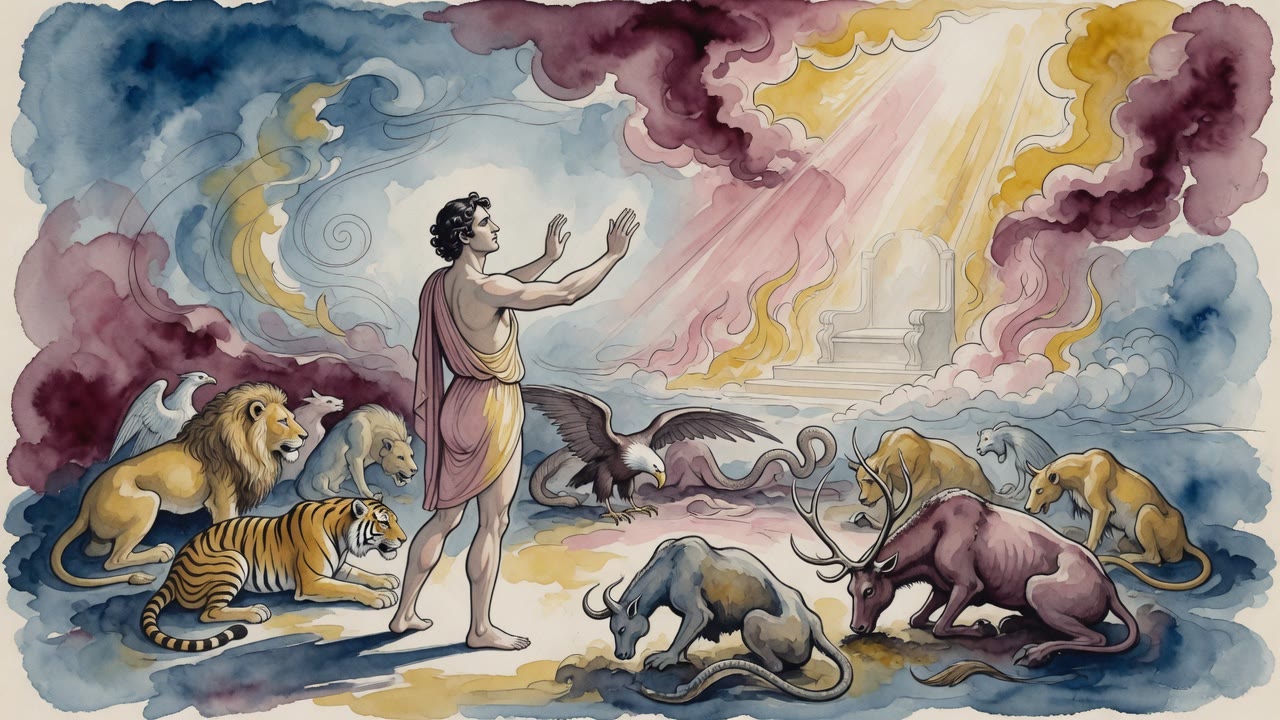
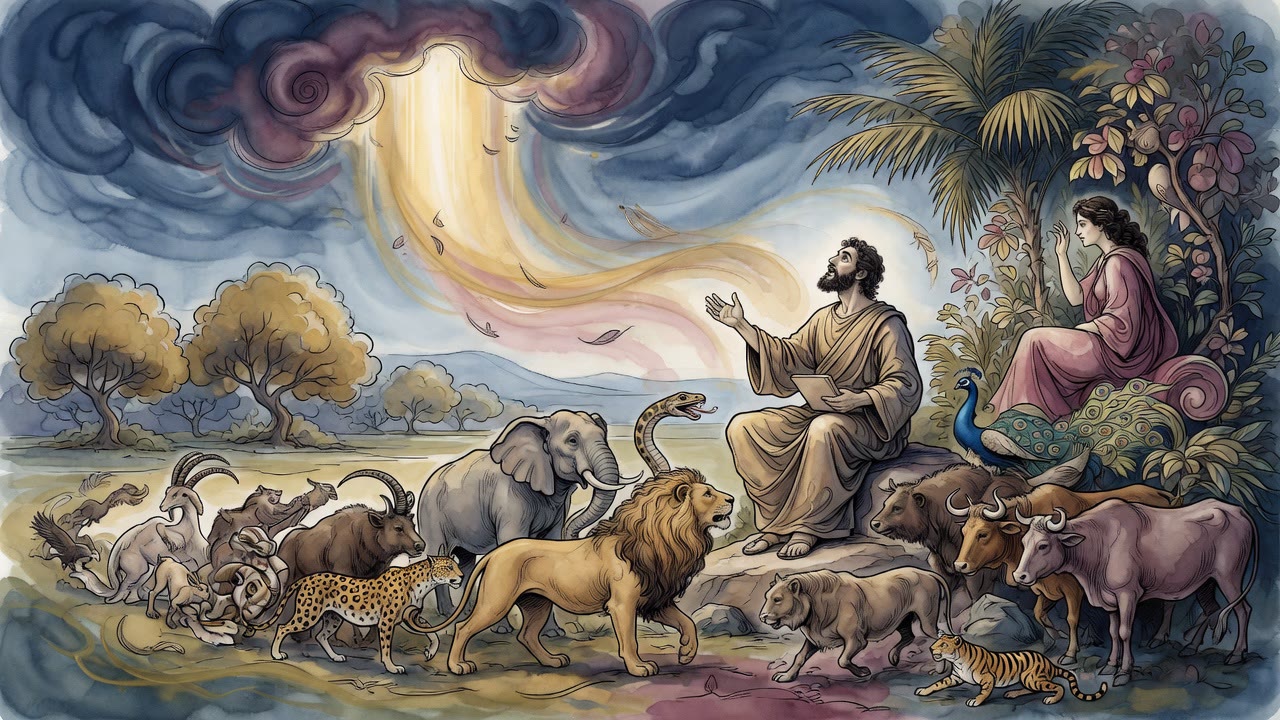
Every creature in the garden drew into a ring around the first man and went down on its knees. He had been alive for less than a day.

Curated by Arthur · Told by Maggid ·
Table of Contents
  1. The Ring That Closed Around the First Man
  2. The Bird on the Golden Statue
  3. Hadrian Came Home and Asked to Be Worshipped
  4. Three Men in His Court Answered Him
  5. His Wife Named the Deposit
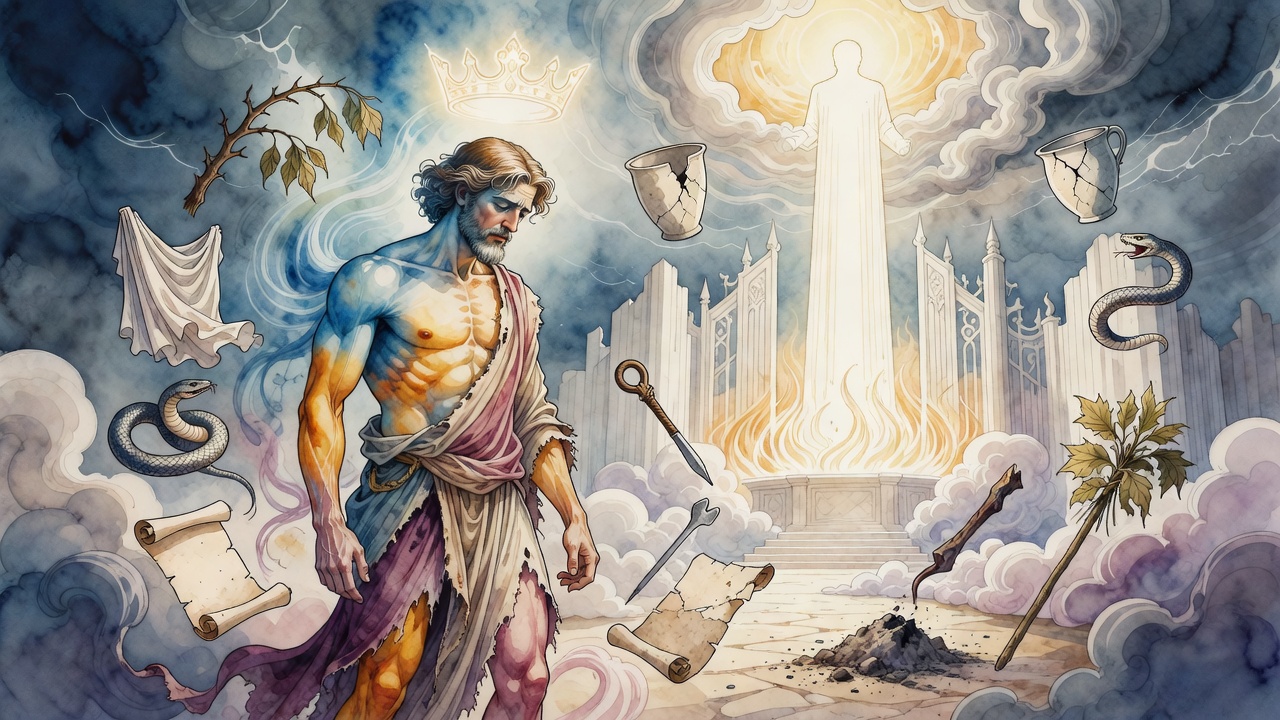
Adam Refused the Animals Who Came to Worship Him Click for full size

The Ring That Closed Around the First Man

The first thing Adam did with his eyes was use them. Green, and more green, and a sky over it, all of it moving.

"How great are Thy works, O Lord!"

That was his opening line, spoken to nobody he could see, before hunger, before loneliness, before he had a name for a single thing in front of him. And the works of the Lord heard it.

Birds came down off the branches. Cattle left the grass. The small things that live under leaves and stones came out and crossed open ground toward him, and the ring around him tightened and tightened without ever becoming a threat. They had looked at the tall one with speech coming out of his mouth, and they had drawn the obvious conclusion.

Then they bowed.

He could have let them. One breath, one second of silence, and every living thing on earth would have spent the rest of its existence facing the wrong direction, and the man who let it happen would have owned a world before his first sunset.

"Why do you come to worship me?" he said. "Nay, you and I together will acknowledge the majesty and the might of Him who hath created us all." And then, because they were still down and still waiting: "The Lord reigneth. He is apparelled with majesty."

Feathers settled. Hooves shifted in the dirt. The ring opened and the garden went back to grazing.

The Bird on the Golden Statue

Adam built on that ground afterward, and Cain and Abel built there after him, and when the flood had finished with the world and the water went down, Noah came off the ark and put up an altar on the same spot. God blessed him there and set him over the world exactly as Adam had been set over it. Later the sanctuary in Jerusalem would stand on that patch of dirt.

The ruling was the easy part. Holding the shape God had made was not.

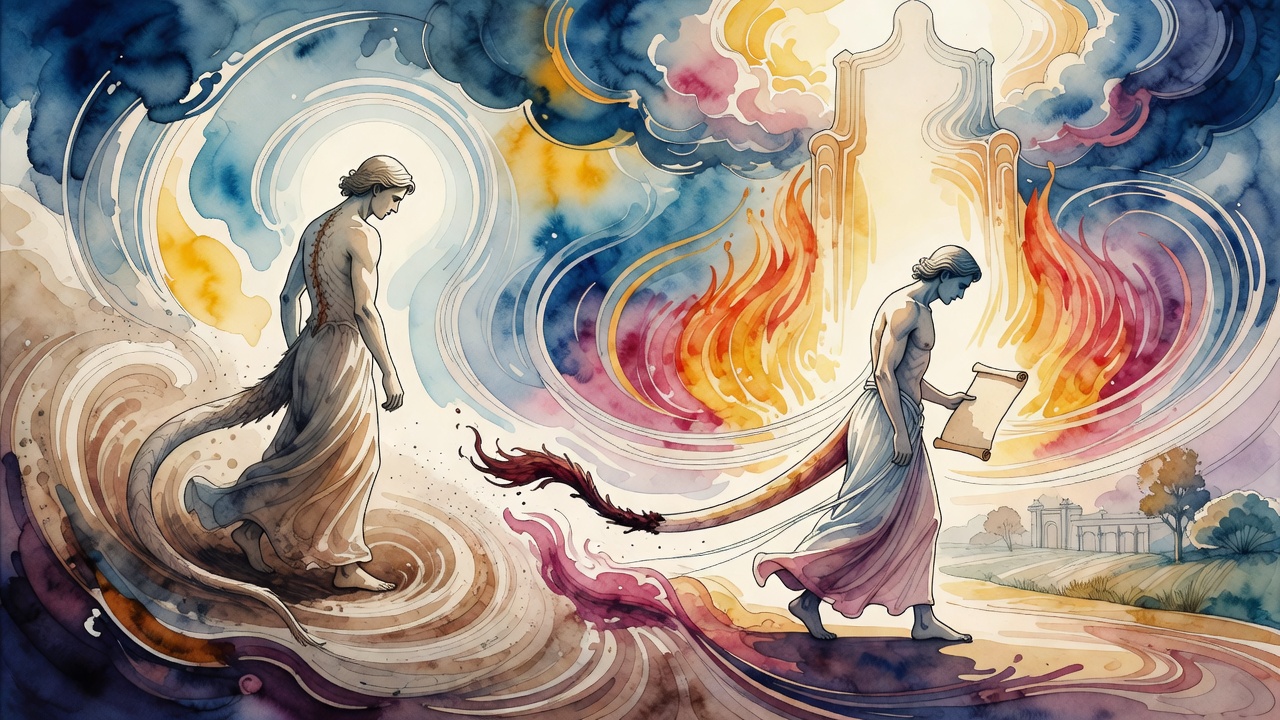
A king once had a likeness of himself cast in gold and stood it in his courtyard. A bird came down on it and fouled it. Man was fashioned upright, and then something inside him climbs up onto the work and ruins the face.

Hiram of Tyre came out of the mold perfect in his ways from the day he was made, and wickedness turned up in him anyway, and he was put out. The generation after the flood had one language and one speech, and what they did with it was agree to build a tower with its top in heaven. Heaven came down to look at the city they had built, and scattered them across the earth, and left a proverb behind about them. What a strap, out of such a hide.

Hadrian Came Home and Asked to Be Worshipped

Rome's turn came a long way down the line, and Hadrian took it the way the tower builders had, which is to say from the top.

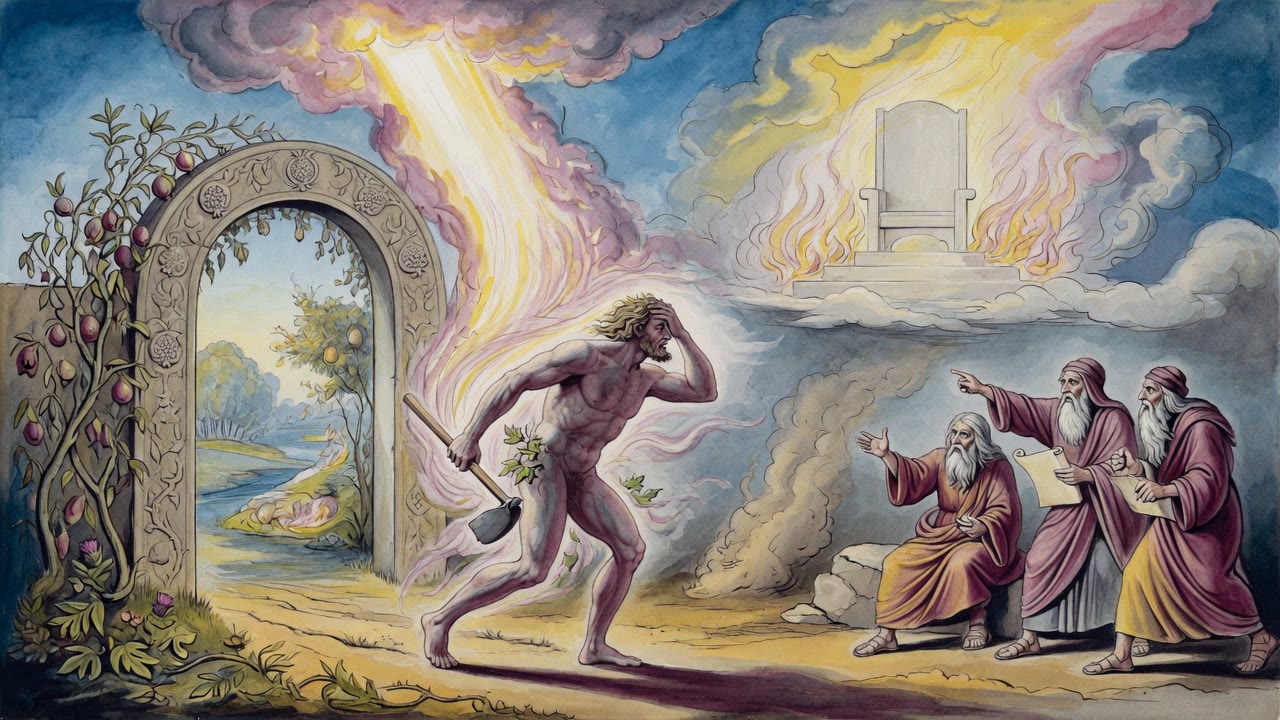
He had conquered the world. He came back and told his courtiers so. "I command you to acclaim me a divine being, for I have subjugated the entire world."

They had one objection, and it was not a moral one. "You do not rule the Holy City and the Temple."

So he went and took the Holy City. He pulled the Temple down and sent the people who served in it out of the country, and then he came back to Rome and stood in front of the same men.

"Now I have destroyed His house, burned down His holy palace, and exiled His people. Worship me as a divine being."

Three Men in His Court Answered Him

Three philosophers lived in Hadrian's court, and he got a different answer from each of them.

The first was procedural. A man cannot mount a revolt against a king while he is living inside the king's own house. Step outside the palace first, and then declare yourself. "He fashioned the heavens and created the earth. Now depart from them, and you shall be a divine being."

The second quoted the sentence already written for cases like his. The gods that have not made the heaven and the earth shall perish from the earth and from under the heavens.

The third asked for a favor. "Help me, I implore your assistance."

Hadrian, who liked being asked, leaned in. "What is the trouble?"

"I have a ship three miles out at sea, and it is stranded, and all my possessions are in it."

"I will send my legions and my ships to rescue it."

"Sire, why send your ships and legions? Send forth a blast of wind and save it."

The room waited. "From whence should I have a blast of wind to send?"

"If you are unable to send forth a blast of wind, how can you call yourself a god?"

His Wife Named the Deposit

He went into his own house badly shaken, and his wife took his side.

Those men were mocking him, she said. Of course he could make himself a god. He was a mighty and powerful king and everything belonged to him. There was only one thing left to do. Return His deposit to Him, and it would be finished.

"What is His deposit?"

"Your soul."

"But if my soul departs from me, how shall I survive?"

"If you cannot control your soul, how can you call yourself a god? You are merely a mortal and not a god."

Every man who ever wanted this built his house on water, and the water was always the answer. Pharaoh raised a palace in the middle of the Nile and dammed the river so it would not run out to sea, and said, my river is my own. The water came up under the foundations, lifted the building off them, and carried it away, and later the same element closed over him and his army. Sennacherib set his palace in Lebanon between two high mountains with every protection an engineer could design, and wells broke out of the mountains and tore it loose. Hiram put his between the Adriatic and the Mediterranean and went down into the pit with the rest of them.

The only man who was ever actually offered it stood in a garden with every animal on earth kneeling in front of him. He refused, and told the animals to get up and face the other way.


← All myths
From the tradition

Sources

3 sources

The texts behind this telling. Some cards carry a translation of the source; others are our own retelling of it, and each card says which. Every card links out to the original.

Legends of the Jews 2:40Legends of the Jews

Retold in our words. Read the original at the link below.The Legends of the Jews by Louis Ginzberg (1909) · Public Domain

Not as a baby, but as a fully formed being, suddenly aware of a world bursting with color, sound, and life.

That's what it must have been like for Adam.

What was his first reaction? According to Legends of the Jews, as retold by Ginzberg, he didn't just blink in confusion. No, he immediately burst into praise: "How great are Thy works, O Lord!" A natural response to such overwhelming beauty, wouldn’t you agree?

Here's where the story takes a fascinating turn. It wasn’t just Adam who was impressed. The other creatures, seeing this magnificent being, made a huge mistake. They assumed he was their creator!

All the animals, the birds, the insects, gathering around Adam, ready to worship him. What a temptation that must have been. Talk about an ego boost!

But Adam, in his wisdom, in his very first moments of existence, understood something profound. He refused the adoration. He didn't claim the glory. Instead, he redirected their worship to the true source, to God.

"Why do you come to worship me?" he asked. "Nay, you and I together will acknowledge the majesty and the might of Him who hath created us all."

And then, he proclaimed: "The Lord reigneth, He is apparelled with majesty." Adam's first act wasn't one of self-aggrandizement, but of humble acknowledgment. Adam, the first human, could have become a god in the eyes of the creatures around him. He had the opportunity to seize power and control. But instead, he chose humility, he chose to point towards something greater than himself.

What does this tell us about the nature of humanity? What does it tell us about the responsibility that comes with being created in God's image? Perhaps it suggests that true greatness isn't about receiving worship, but about directing it towards the divine.

Perhaps it's a reminder that even in our own lives, when we're tempted to take credit for our accomplishments, we should remember Adam's example and acknowledge the source of all creation. We should remember that we are all, in our own way, creations, and that our purpose is not to be worshipped, but to worship.

Full source
Legends of the Jews 4:62Legends of the Jews

Retold in our words. Read the original at the link below.The Legends of the Jews by Louis Ginzberg (1909) · Public Domain

Noah, his family, and all the animals are finally stepping off the ark, blinking in the sunlight, the world utterly transformed. The very first thing Noah does? He builds an altar. Not just any altar,. According to Legends of the Jews, Ginzberg tells us it was erected on the very same spot where Adam, Cain, and Abel offered their own sacrifices. A place that would, much later, become the sanctuary in Jerusalem.

So, what did Noah offer? Well it was an ox, a sheep, a goat, two turtle doves, and two young pigeons. Quite the spread! But why these animals? Noah, in his wisdom, chose them because he believed they were specifically designated for sacrifice. After all, God had instructed him to bring seven pairs of each of these creatures onto the ark. It suggests a pre-existing understanding of which animals were considered acceptable for offerings.

What happened after the sacrifice? God blessed Noah and his sons. He essentially reinstated them as rulers of the world, just as He had with Adam before the flood. And He gave them a crucial command: "Be fruitful and multiply upon the earth." Why this emphasis on procreation? Because, as the story goes, during their time in the ark, a certain level of restraint was observed. The text explains that during times of public calamity, continence is appropriate even for those untouched by the immediate disaster. Self-control and discipline in the face of chaos.

Alas, not everyone followed this principle. Legends of the Jews also reveals that Ham, along with a dog and a raven, broke this rule. And there were consequences. Ham's punishment, according to this tradition, was that his descendants would be men of dark-hued skin. Now, it's important to acknowledge the deeply problematic nature of this particular passage. It’s a reflection of outdated and harmful racial theories that have been used to justify discrimination and oppression for centuries. We must approach these texts with critical awareness, recognizing the cultural context in which they were written and rejecting any interpretation that promotes prejudice or hatred.

This story of Noah's sacrifice offers a glimpse into the origins of ritual and the complex relationship between humanity and the Divine. It also reminds us that even in the most foundational stories, there are elements that require careful examination and critical reflection. What does this story tell us about ourselves, our history, and the way we understand the world?

Full source
Midrash Tanchuma, Bereshit 7Midrash Tanchuma

Retold in our words. Read the original at the link below.Townsend 1989 translation of Midrash Tanhuma, S. Buber Recension · CC-BY

And the Lord said: Behold, man has become one of us (Gen. 3:22). Scripture states elsewhere in allusion to this verse: Behold, this only have I found, that God made man upright (Eccles. 7:29); that is, the Holy One, blessed be He, who is called righteous and upright, created man in His own image so that he might be upright and righteous like Him. However, if you should ask: Why did He create the evil inclination, concerning which it is written: The inclination of man’s heart is evil from his youth (Gen. 8:21)?, you say thereby: Since man is evil, who can make him good? The Holy One, blessed be He, contends: You make him evil! Why is it that a child of five, six, seven, eight, or nine years of age does not sin, but only after he reaches the age of ten and upward does the evil inclination begin to develop in him?

If you should insist that no man is able to guard himself from the evil inclination, the Holy One, blessed be He, replies: That is not so. You caused yourself to become evil. When you were a child, you did not sin, but when you grew up, you did sin. There are many things in this world that are harsher and more bitter than the evil inclination, yet you know how to alter them. For instance, there is nothing more bitter than lupine, yet when you boil it in water seven times it becomes sweet and edible. Similarly, you sweeten mustard and capers and numerous other things. If you are able to sweeten the bitter things that I have created to satisfy your needs, how much more so are you able to control the evil inclination within you.

Thus you find that though I created Hiram, king of Tyre, righteous and upright, as it is said: Perfect in thy ways from the day that thou wast created (Ezek. 28:15), wickedness finally appeared in him and he was banished.

It is written of the generation of the separation: And the whole earth was of one language and of one speech (Gen. 11:1), but later they sought to ascend into the firmament, as is said: Come, let us build us a city and a tower with its top in heaven (ibid. v. 4). Hence it is written: The Lord came to see the city and the tower which the children of men had builded … so the Lord scattered them (ibid. v. 5). What a strap from such a hide!

To what may this be compared: To a king who fashioned a golden statue of himself and had it erected in the courtyard of his palace. Soon thereafter, a bird lighted upon it and defaced it. Similarly, the Holy One, blessed be He, fashioned man righteous, but the evil inclination arises within him and despoils him. Hence we read: Ye are godlike beings, and all of ye sons of the Most High; nevertheless, you shall die like men (Ps. 82:6–7).

Son of man, say unto the prince of Tyre: Thus saith the Lord God: Because thy heart is lifted up, and thou hast said: I am a god, I sit in the seat of God, in the heart of the seas; yet thou art man, and not God (Ezek. 28:2). Scripture states elsewhere in allusion to this verse: Be not rash with thy mouth, and let not thy heart be hasty to utter a word before God; for God is in the heavens and thou art upon the earth; therefore, let thy words be few (Eccles. 5:1). It says also: He loveth transgression that loveth strife, he that lifteth his gate seeketh destruction (Prov. 17:19). Should this verse not state that “he who lowereth his gate seeketh destruction,” since everyone who lowers his gate causes people to stumble and to be destroyed: What then is the meaning of he that lifteth his gate seeketh destruction? This means that one who opens his mouth and utters words that are unseemly brings on his own destruction, for the Holy One, blessed be He, will destroy him. Therefore, it is said: Be not rash with thy mouth (Eccles. 5:1).

Observe that the weakest of the weak above vanquished the mightiest person below, as it is written: And a certain woman cast an upper millstone upon Abimelech’s head and broke his skull (Judg. 9:53). How much more so is that true of our God in heaven.

After Hadrian, the king of Edom, conquered the entire world, he returned to Rome and told his courtiers: “I command you to acclaim me a divine being, for I have subjugated the entire world.” Whereupon they replied: “You do not rule the Holy City and the Temple.” He went there, conquered the Holy City, demolished the Temple, and exiled the Israelites. Upon his return to Rome he said: “Now I have destroyed His house, burned down His holy palace, and exiled His people; worship me as a divine being.”

R. Berechiah tells us that three philosophers resided in Hadrian’s court. The first one said to him: “Surely a man is unable to revolt against a king while he resides in the king’s palace. Depart from his palace and then proclaim yourself a god. He fashioned the heavens and created the earth; now depart from them and you shall be a divine being.” The second one told him: “You are not able to become a god, because He has already informed his prophets: Thus you shall say unto them: The gods that have not made the heaven and the earth, these shall perish from the earth, and from under the heavens (Jer. 10:11)”. The third one said to him: “Help me, I implore your assistance.” “What is the trouble?” he inquired. “I have a ship three miles out at sea,” the philosopher replied, “and it is stranded, and all my possessions are in it.” Hadrian answered: “I will send my legions and my ships to rescue it.” Thereupon the philosopher declared: “Sire, why send your ships and legions? Send forth a blast of wind and save it.” “From whence should I have a blast of wind to send?” asked Hadrian. To this the philosopher replied: “If you are unable to send forth a blast of wind, how can you call yourself a god, since it is written of God: Thus saith God the Lord: He that created the heavens and stretched them forth, He that spread forth the earth and that which cometh out of it, He that giveth breath to the peoples upon it, and spirit to them that walk therein (Isa. 42:5)?”

Thereupon, Hadrian entered his home greatly distressed. His wife said to him: “Surely these philosophers are mocking you; certainly you are able to make yourself a god. You are a mighty and powerful king, and everything belongs to you. Let me suggest one thing to you: Return His deposit to Him and then you will have made yourself a god.” “What is His deposit?” he asked. “Your soul,” she replied. “But if my soul departs from me, how shall I survive?” he retorted. Thereupon, she answered: “If you can not control your soul, as it is written: There is no man that hath power over the spirit to retain the spirit; neither hath he power over the day of death (Eccles. 8:8), how can you call yourself a god? You are merely a mortal and not a god.”

The Holy One, blessed be He, declared: I restore the dead to life, and Elijah likewise restored the dead to life, but he did not say: “I am a god”; I caused the rain to descend, and so too did Elijah; I withheld the rain, and Elijah did likewise, as it is said: There shall not be dew nor rain these years but according to my word (I Kings 17:1); I caused fire and brimstone to descend upon Sodom, and Elijah did the same, as it is said: If I be a man of God, let fire descend from heaven (II (Kings 1:1)0). Nevertheless, he did not say “A god am I,” yet you say: A god am I: In the dwelling-place of God I sit (Ezek. 28:2). If you would claim “A god am I” because you have lived for so many years, He lives and will live until the dead are revived. Concerning the Holy One, blessed be He, it is written: His throne was fire and flames (Dan. 7:9), and of Elijah it is said: There appeared a chariot of fire and horses of fire (II (Kings 2:1)1). It is written elsewhere concerning the Holy One, blessed be He: The Lord is in the whirlwind, and in the storm is His way (Nahum 1:3), and about Elijah Scripture says: And Elijah went up in a whirlwind to heaven (ibid. 2:11); nevertheless Elijah implored: O Lord, take away my life (I Kings 19:4). But you claim: A god am I, in the dwelling place of gods, I sit in the midst of the sea (Ezek. 28:2). Jonah descended into the deep, as it is written: Thou didst cast me into the depth, into the heart of the seas (Jonah 2:4). Finally, he (changed his mind) and pleaded for death, saying: Therefore, now, O Lord, take, I beseech Thee, my life from me; for it is better for me to die than to live (ibid. 4:4). But you presume to say: A god am I; in the dwelling-place of gods I sit, in the midst of the sea (Ezek. 28:2).

Observe that everyone who desired to be worshipped as a divine being constructed a palace for himself in the midst of the sea. Pharaoh erected a palace in the midst of the water and dammed up the water of the Nile to keep it from flowing into the Mediterranean. However, the water rose, undermined the foundations of the palace, lifted it up, and bore it away, as it is said: Speak, and say: “Thus saith the Lord God: Behold, I am against thee, Pharaoh, king of Egypt, the great crocodile that lieth in the midst of his rivers, that hath said: My river is my own” (Exod. 29:3). The Holy One, blessed be He, rebuked him: O wicked one, you were proud upon the waters; through the waters you shall perish, as it is written: But overthrew Pharaoh and his hosts in the Red Sea (Ps. 136:15).

Sennacherib erected his palace in Lebanon with certain protective devices, between two lofty mountains, but wells sprang forth out of the mountains, tore the palace from its foundations, and bore it away, as it is said: Behold, the Assyrian was a cedar in Lebanon with fair branches, and with a shadowy shroud, and of a high stature, and its top was among the thick boughs. The water nourished it; the deep made it grow (Ezek. 31:3–4). And it says also: Thus was it fair in its greatness, in the length of its branches; for its root was by many waters (ibid. v. 7), and it states: I have digged and drunk waters, and with the sole of my feet have I dried up all the rivers of Egypt (Isa. 37:25). What was his ultimate end? Thus said the Lord God: in the day when he went down to the netherworld I caused the deep to mourn and cover itself for him (Ezek. 31:15).

Hiram constructed his palace between the Adriatic and the Mediterranean Sea with certain protective devices (but to no avail), as it is said: And they shall take up in lamentation for thee and say to thee: How art thou destroyed, that was peopled from the seas, the renowned city, that was strong in the sea (ibid. 26:17). Still, you claim: A god am I; in the dwelling-place of gods I sit, in the midst of the sea (ibid. 28:2). Whereupon the Holy One, blessed be He, said to him: For thus saith the Lord God: And I shall make thee a desolate city, like the cities that are not inhabited; and I shall bring up the deep upon thee, and the great waters shall cover thee (ibid. 26:19). (This will be your fate, and) you will descend to your comrades, as it is written: Then I will bring thee down with them that descend into the pit to the people of old times, and will make thee to dwell in the nether parts of the earth (ibid. v. 20). The nether parts of the earth refers to Gehenna. Hence we read in Scripture: Thou wast the far-covering cherub; and I set thee, so that thou wast upon the holy mountain of God; thou has walked up and down in the midst of stones of fire … and I have destroyed thee, O covering cherub, from the midst of the stones of fire (ibid. 28:14–16). Concerning Israel, however, Scripture states: When thou passest through the waters, I will be with thee, etc. (Isa. 43:2).

Full source