Akiva Saved a Queen with Jacob's Peeled Rods
An Arabian king nearly killed his wife for bearing a white son. Rabbi Akiva pointed to white images in the house and to Jacob's flocks at the troughs.
Table of Contents
 Click for full size
The King With a Sword in His Voice
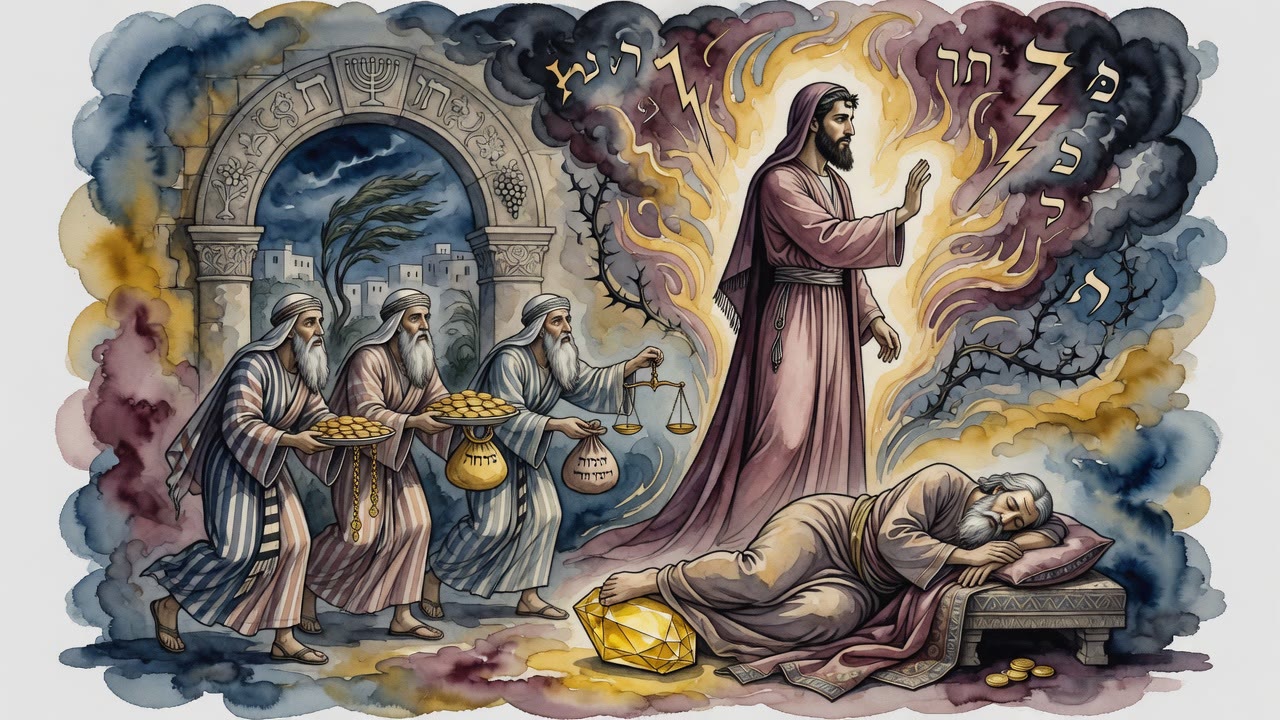
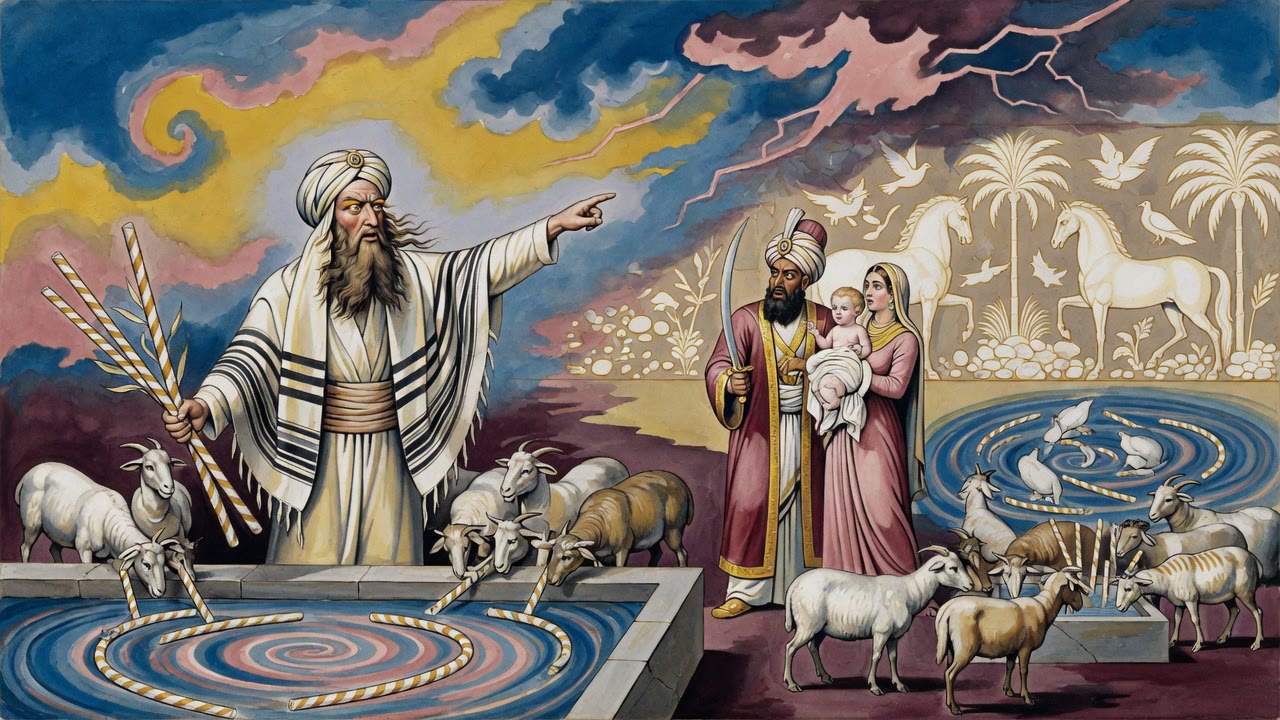
The king of the Arabs came to Rabbi Akiva in fury. I am black, he said. My wife is black. She has borne me a white son. Shall I not kill her for her harlotry?
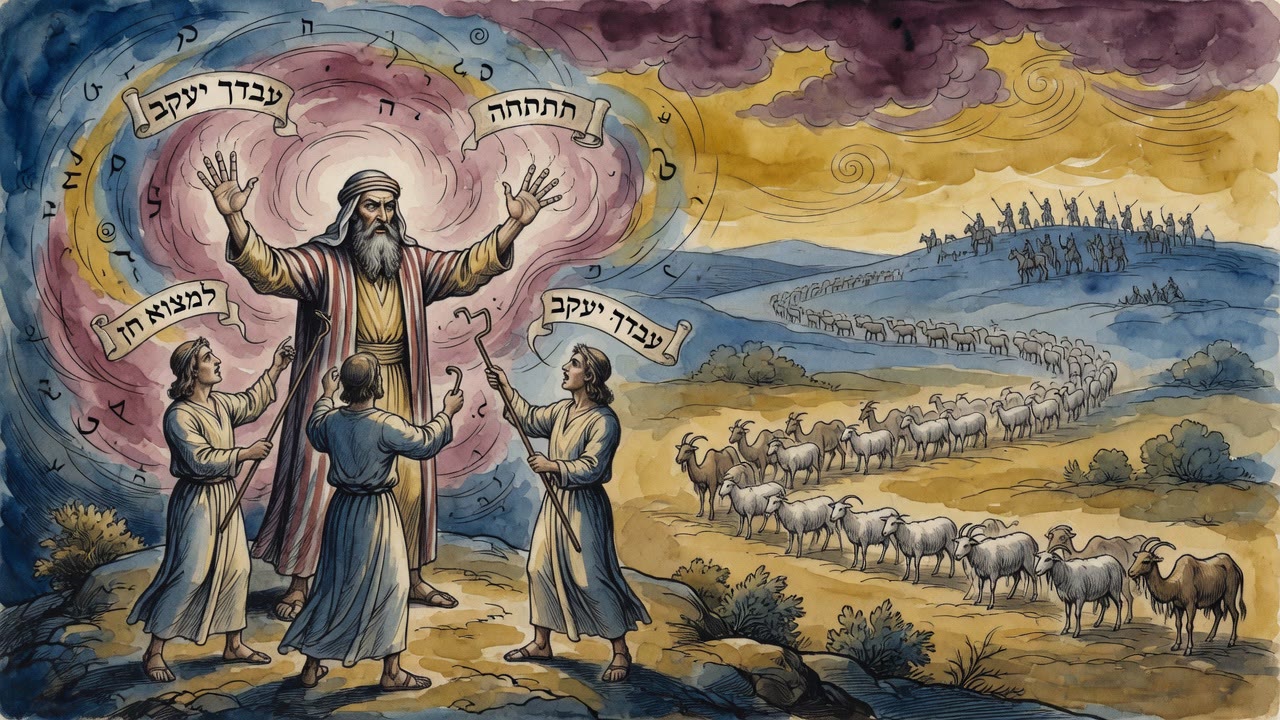
Akiva did not flinch. Have you images in your house? I have. White or black? White. When you were with her, her eyes were on those white images, and she bore a child like them. And if you marvel, learn from the flocks of Jacob, who conceived before the peeled rods at the watering troughs.
The king acknowledged the truth and let his wife live. One sentence about household statues and one memory of a patriarch's sheep saved a woman from a husband's blade.
What the Eyes Hold at the Trough
The sages taught a hard thing about the marriage bed. A woman alone with her husband, while he is with her, who fixes her eyes on another man in that very moment, there is no graver adultery, for the prophet cries against the wife who takes strangers instead of her husband. Beneath her own husband she betrays him, her body here and her heart elsewhere.
Akiva turns the same principle toward mercy. Eyes can shape what the body brings forth. Jacob set peeled rods before the strong of the flock, and the young came out streaked and spotted as the rods had taught them to see. The Arabian king had hung white beauty on his walls and then blamed his wife for a child who looked like the room.
Every wife who joins her husband in holiness, the midrash continues, raises up righteous children. Witness Hannah, who came to her husband in holiness, and the Holy One did not withhold her wage but gave her a son like Moses, the child Samuel, of whom she sang, For this child I prayed. Because he was sown in holiness. God declared, I have chosen Israel as a choice vine of true seed, and in the world to come I will choose none but this holy seed.
Space Between the Droves
As Jacob readied his gift to appease his brother Esau, he did not herd the animals together in one teeming mass. He sent them drove after drove, each flock alone, so that the greedy eye might be sated again and again, gift answering gift. The sages hear something deeper in the words, and you shall put a space between drove and drove. The Hebrew rewach means not only a gap of distance but a breathing-space, a relief.
They place a prayer upon Jacob's lips. Master of the universe, when troubles come upon my children, the children of Israel, do not let them fall all at once. Send them one after another, this trouble and then that, and set a space of rest between them, a respite from their troubles. The ordering of flocks before a fearful brother becomes a model of mercy. Jacob asks that his descendants never be crushed beneath a single avalanche of sorrow.
Akiva gave the Arabian king a space of the same kind. Between the cry of harlotry and the swing of judgment he set a different image, white statues and peeled rods, so the household would not drown in one wrong conclusion.
Three Blessings in the Mouth
Resh Lakish takes the threefold promise to Abraham and maps it onto the opening words of Jewish prayer. I will make you a great nation becomes the God of Abraham. I will bless you becomes the God of Isaac. I will make your name great becomes the God of Jacob. Three blessings, three fathers, woven into the first words a Jew speaks while standing before God.
If all three patriarchs are named at the start of the prayer, why does the benediction close with only one of them? The verse adds a fourth phrase, and be a blessing, spoken to Abraham alone. That extra word settles it. The blessing opens by remembering all the fathers, yet it seals with Abraham, the first to carry the promise.
A single verse spoken to one man at the dawn of his journey opens the prayer his descendants recite three times a day. Akiva's courtroom of mercy sits inside that same blessing. The God of Abraham, Isaac, and Jacob is the God who let Jacob's rods teach the flock, and who let a white image on a wall explain a white child without blood.
The Queen Who Walked Out Alive
The king went home. The child stayed in his arms. The images stayed on the walls, no longer evidence for a death sentence. Somewhere in the academy Akiva returned to his students as if he had only answered a simple question about sheep and sight.
A household almost became a crime scene over the color of a newborn. Torah answered with eyes, rods, and the long patience of a patriarch who knew how to put space between one danger and the next.
← All myths