Retold in our words. Read the original at the link below.The Minor Tractates of the Talmud, trans. A. Cohen, Soncino Press (1965) · CC-BY
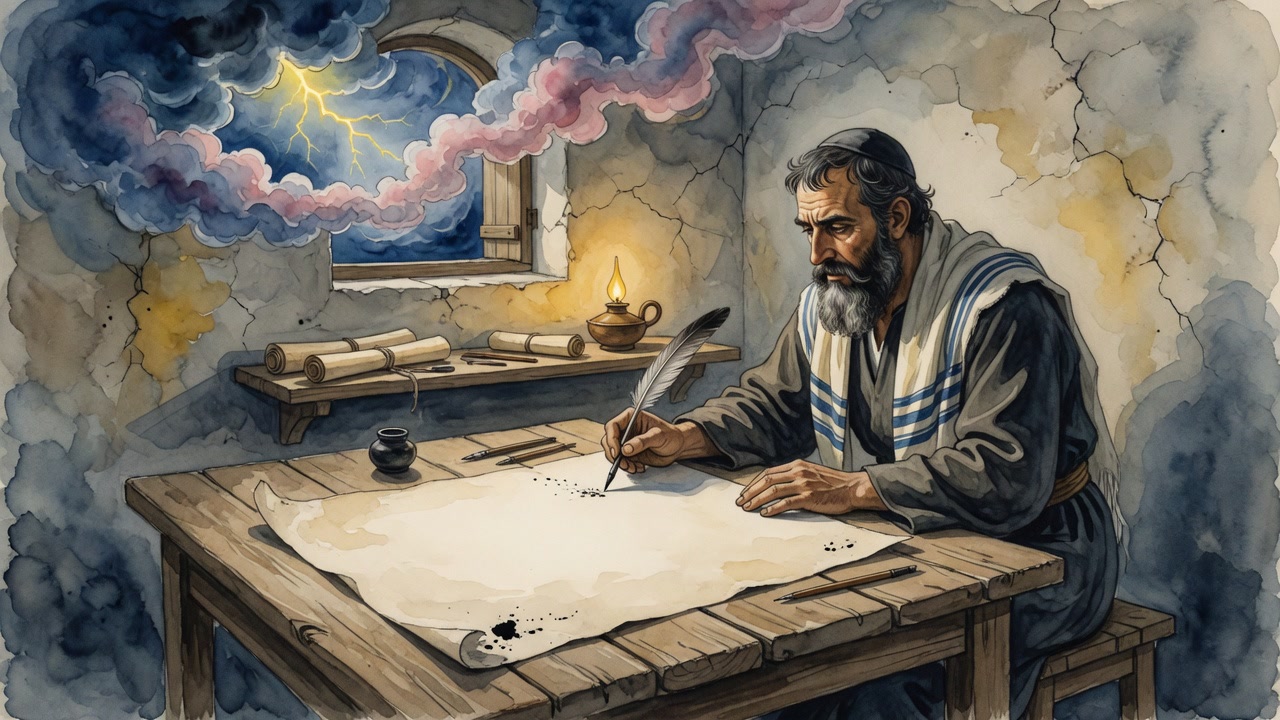
R. SIMEON SAID: THERE ARE THREE CROWNS: THE CROWN OF THE TORAH, THE CROWN OF THE PRIESTHOOD, AND THE CROWN OF ROYALTY; BUT THE CROWN OF A GOOD NAME EXCELS THEM ALL.1Aboth 4:17 (Sonc. ed., IV, 13, p. 51). As to the crown of the priesthood, how is it? If a man were to offer all the silver and gold in the world, he would not be given the crown of the priesthood; for it is stated, And it shall be unto him, and to his seed after him, the covenant of an everlasting priesthood.2Num. 25, 13. The priesthood is strictly hereditary. As to the crown of royalty, if a man were to offer all the silver and gold in the world he would not be given the crown of royalty, for it is stated, And David My servant shall be their prince for ever.3Ez. 37, 25. But with the crown of the Torah it is not so, for labour in the Torah [is open to all]; whoever is minded to take it up may do so, as it is stated, Ho, every one that thirsteth, come ye for water.4Is. 55, 1. Water is homiletically interpreted as the Torah; cf. B.Ḳ. 17a (Sonc. ed., p. 76).Toil in the study of the Torah, and do not occupy yourself with idle matters. It is related that R. Simeon b. Yoḥai was visiting the sick, and met a man who was swollen and afflicted with intestinal disease, uttering blasphemies against the Holy One, blessed be He. R. Simeon addressed him, ‘Worthless one!5Reḳah, ‘empty one, good-for-nothing’, the equivalent of ‘Raca’ in Matt. V, 22. Pray rather for mercy for yourself; but instead you utter blasphemies!’ The other said to him, ‘May the Holy One, blessed be He, remove [these sufferings] from me and lay them on you!’ Thereupon R. Simeon said, ‘Justly has the Holy One, blessed be He, dealt with me, since I neglected the study of the Torah and occupied myself with idle matters’.6R. Simeon censured himself for having wasted his time with this blasphemer. It is nevertheless strange to note that R. Simeon regarded the visiting of the sick as an ‘idle thing’ and a neglect of the Torah. In MS. E. the reading is: ‘Justly has the Holy One, blessed be He, dealt with you since you neglected the study of the Torah and occupied yourself with idle things’. R. Simeon accordingly censured the sick person, whom he apparently knew to be a worthless person occupied with idle things.It is related that R. Simeon b. Eleazar7Cf. Ta‘an. 20a-20b (Sonc. ed., pp. 100). There the name is reversed, ‘R. Eleazar b. R. Simeon’. was returning from his master’s house in Migdal-eder8A village near Bethlehem; cf. Gen. 35, 21. riding on an ass along the sea-shore when he met a man who was extremely ugly. He said to him, ‘Worthless man! How ugly you are! Are all the men of your town as ugly as you?’ The other replied, ‘What can I do? Go to the Craftsman Who made me and say to Him, “How ugly is this vessel which Thou hast made!” ’ When R. Simeon realized that he had done wrong, he dismounted from the ass, prostrated himself before the man and said, ‘I apologize to you, forgive me’. But the man answered, ‘I will not forgive you until you say to the Craftsman Who made me, “How ugly is the vessel which Thou hast made!” ’ R. Simeon ran after him for three miles [until he reached his town]. When the people of the town came out to meet him, greeting him with the words, ‘Peace be unto you, Master’, the man asked them, ‘Whom do you address as Master?’ They replied, ‘Him who follows you’. He said to them, ‘If this man is a master, may there not be many like him in Israel!’ ‘Heaven forbid!’ they exclaimed; ‘what did he do to you?’ He answered, ‘This is how he behaved towards me’. They said to him, ‘Nevertheless, forgive him’. The man replied, ‘I will forgive him, but on condition that he will never again act in this manner’. That same day R. Simeon entered his great House of Study and lectured: At all times a man should be pliant as a reed and not hard like a cedar. Now what is the feature of the reed? Though all the winds come and blow upon it, it gives and bends with them; but when the winds are stilled it again stands upright in its place. And what happens to the reed in the end?9So according to MS. E. and a variant reading. V has ‘therefore the reed is privileged’, etc. It is privileged that of it a pen is made for writing a Torah scroll. The cedar, on the other hand, cannot stand in its place [against the winds], for when the south10A variant is ‘north’. wind blows upon it, it uproots and overturns it. And what happens to the cedar in the end? Lumbermen come and cut it up, and it is used for roofing houses while the residue is cast into the fire. Hence [the Sages] said: A man should be pliant as a reed and not hard like a cedar.
Three different tributes are paid to men [for their acts of charity]. He who gives alms, a blessing be upon him; he who lends is better than he; but he who provides [the poor man with money to do trade] sharing the profits with him11lit. ‘for half (profits) or more’. Cf. GRA. is the best of all.12For by his act he enables the poor man to retain his self-respect.
There are three types of disciple: he who asks questions and also makes answer is wise; he who asks but cannot answer is inferior to him; but he who can neither ask nor answer is lowest of all.
There are three kinds of sweat which are beneficial to the body: sweat caused by sickness, by a bath and by work. The sweat caused by sickness brings healing, and the sweat caused by a bath has no equal [as a cure].
There are six kinds of tears, three of them beneficial and three harmful. [Tears brought on] by weeping, by smoke, and in the privy are harmful; [tears brought on] by unguents, by laughter, and by [pungent] fruits are beneficial.13Cf. Shab. 151b (Sonc. ed., p. 774). A variant reading is: ‘Tears produced by an unguent, and those brought about by taking mustard are good for the eyes, but tears caused by laughter are best of all’.
There are three characteristics of an earthenware vessel: it absorbs, it does not exude, and it does not taint what is in it.There are three characteristics of a glass vessel: It neither absorbs nor exudes, it exposes to view whatever is in it,14Being transparent. and in a hot place it is hot while in a cold place it is cold.
At four times it is harmful to cohabit: on returning from a journey, on leaving a surgeon15lit. ‘the barber’; he also functioned as a surgeon. GRA reads ‘the cupper’. [after blood-letting], on rising from an illness, and on being released from prison.16Cf. Giṭ. 70a (Sonc. ed., p. 333).
Whoever undertakes to observe these four rules is accepted as an Associate:17Heb. ḥaber, the opposite of ‘am ha-’areẓ; one who is scrupulous in the observance of the Torah, particularly in relation to laws of ritual purity and the separation of the priestly and levitical dues. Cf. Demai II, 3 (Sonc. ed., pp. 57f) and Tosiftha Demai II, 1. he does not enter a graveyard,18Lest he defile himself by the dead. he does not rear small cattle,19In Israel. Because small cattle like sheep and goats have the habit of straying into the fields of others and causing damage to the sown fields. Cf. B.Ḳ. VII, 7 (Sonc. ed., p. 453). he does not give heave-offering20Heb. terumah; cf. Num. 18, 8f. to a kohen (a priest) who is an ‘am ha-’areẓ,21An illiterate or uncultured man, particularly one careless in the observance of the laws of ritual purity and priestly and levitical dues. he does not handle clean things in the proximity of an ‘am ha-’areẓ,22Lest they contract uncleanness. and he eats his ordinary food in conditions of cleanness.23So making a habit of it, and he has no difficulty in dealing with consecrated food. The list of requirements has obviously been extended since the passage enumerates five rules; and it is difficult to establish the four original requirements. Cf. Demai loc. cit.
24The passage which follows is defective since it only deals with two items whereas the preceding paragraphs deal, for the most part, with subjects each comprising three items. The text here is restored from Mekilta, Beshallaḥ (ed. Lauterbach) II, pp. 139f, Pes. 87b (Sonc ed., pp. 464f), II ARN XLVII and GRA.[Three things returned to their original place: Israel, Egypt’s wealth, and the heavenly writing. Israel returned to their original place,25To Babylon. as it is stated, Your fathers dwelt of old time beyond the River,26Josh. 24 2. Israel’s ancestry emanated from beyond the River, i.e. Babylon. and it is also stated, And carried the people away into Babylon.27Ezra 5, 12. GRA quotes instead Jer. 28, 22, They shall be carried to Babylon.] Egypt’s wealth returned to its original place,28To Egypt. as it is stated, And they despoiled the Egyptians,29Ex. 12, 36. and also And Joseph gathered up all the money;30Gen. 47, 14. and it is also stated, And it came to pass in the fifth year of king Rehoboam, that Shishak king of Egypt came up against Jerusalem; and he took away the treasures of the house of the Lord.311 Kings 14, 25f. The heavenly writing32The divine writing (cf. Ex. 32, 16) upon the tablets which Moses broke (ibid. 19). returned to its original place,33To heaven; cf. above II, 3, p. 21. as it is stated, Wilt thou set thine eyes upon it? It is gone; for it certainly takes to itself wings, like an eagle that flieth toward heaven.34Prov. 23, 5. So lit., E.V., for riches certainly make themselves wings. Homiletically the verse is interpreted as referring to the heavenly script on the tablets which flew back to God.
R. JUDAH B. TEMA SAID: BE STRONG AS A LEOPARD, SWIFT AS AN EAGLE, [34b] FLEET AS A DEER AND BRAVE AS A LION TO DO THE WILL OF YOUR FATHER WHO IS IN HEAVEN.35From Aboth 5:23 (Sonc. ed., V, 20, p. 73).
He used to say: Love God36lit. ‘Heaven’. and fear God, trembling and rejoicing at all the commandments.37The text of this sentence is corrupt and makes no sense as it stands. The reading adopted is that of MS. E. and as found in DEZ II (see below, p. 571). The meaningless words in the text, הדרוש של, are a misreading of חרד ושש על, ‘trembling and rejoicing at’. If you have done a little wrong to your neighbour let it seem to you large; and if you have done him a big kindness let it seem to you small. If your neighbour has done you a little kindness let it seem to you large, and if he has done you a great wrong let it seem to you small.A sponge and a glazed vessel describe the scholars;38Who absorb everything and retain it in their minds. a funnel and a hollow tube describe the wicked [disciples].39Whatever they hear goes in one ear and out through the other. This sentence is apparently out of place here and belongs to XL, 8 above, p. 200.Be like a skin bottle which has no opening to let the wind in.40Cf. DEZ I, below p. 567. The meaning may be: Be reserved, and give no ear to the idle talk and slanderous words of others.Learn to receive suffering and forgive an offence against you.
The things which were made and later hidden away are:41Cf. Hor. 12a (Sonc. ed., p. 85), Ker. 5b (Sonc. ed., pp. 35f), and Yoma 52b (Sonc. ed., p. 245). the Tent of Meeting and the vessels contained therein, the ark and the broken tablets, the jar of manna,42Cf. Ex. 16, 33. the staff [of Moses], the flask of anointing oil, Aaron’s rod with its almonds and blossoms,43Cf. Num. 17, 23, 25. the robes of the priesthood,44Probably the robes of the senior officials in the priesthood. It can hardly refer to the garments of the ordinary priests. the robes of the anointed [High] Priest; but the mortar of the House of Abṭinas,45They were experts in compounding the incense for the Temple and used a mortar which had special properties; cf. Yoma III, 11 (Sonc. ed., p. 175). the table,46On which lay the Shewbread; cf. Ex. 25, 30. the candelabrum, the veil47The curtain which hung before the Holy of Holies. The sacrificial blood was sprinkled in its direction on special occasions; cf. Yoma 57a (Sonc. ed., p. 266). and the [High Priest’s] head-plate are still located in Rome.
It is related48This passage is out of place here and should be transferred to IV, 2, where it belongs. that R. Ṭarfon was sitting and teaching his disciples when a [poor] bride passed before him. He gave instructions for the bride to be taken to his house, and said to his mother and wife, ‘Bathe her, anoint her, adorn her, and dance before her until she arrives at the house of her husband’.
49This passage is also out of place and belongs to XXXVI, 5.The following, so the Sages ordained, have no portion in the world to come: five kings and six [commoners] who sought power; [the latter being:] Cain, Korah, Balaam, Ahithophel, Doeg and Gehazi.50Cf. above XXXVI, 5, p. 182 and Sanh. X, 2 (Sonc. ed., p. 602) where the text reads: ‘Three kings and four commoners’. The five kings would be Jeroboam, Ahab, Ahaz, Ahaziah and Amon; cf. Sanh. 103b (Sonc. ed., pp. 702f).
R. Jose said: The thoroughly righteous will have no refining,51Reading מצרפין for מצטרפין throughout. The righteous need no refining process to purify them, but will be inscribed for everlasting life forthwith. Cf. R.H. 16b (Sonc. ed., p. 63). and the thoroughly wicked will also have no refining.52The wholly wicked will at once go to their doom. Who, then, will be refined? The intermediate ones,53Those whose good and bad deeds are equal. For a short while they will be refined by the fires of Gehinnom (the place of spiritual purification after death) and then become worthy of enjoying everlasting life. [who cry:] I beseech Thee, O Lord, deliver my soul:54Ps. 116, 4. i.e. from the judgment of Gehinnom. Beth Shammai say:55The words in the text, שמא אם, are a corruption of בית שמאי אומרים. They will go down to Gehinnom and be refined56The word in the text is unknown in Heb. and is corrupt. The translation is based on the reading in MS. E., ונצרפין, ‘and are refined’. A variant is ומצפצפין, ‘and shriek in pain’; cf. R.H. 17a (Sonc. ed., p. 64). there, then they will burst forth and come up again, as it is stated, And I will bring the third part through the fire, and will refine them as silver is refined, and will try them as gold is tried.57Zech. 13, 9. The third part alludes to the intermediate ones. But Beth Hillel say: They will not see it58i.e. Gehinnom. at all, as it is stated, For Thy loving kindness is better than life; my lips shall praise Thee.59Ps. 63, 4. And it further declares, And spare them according to the greatness of Thy mercy:60Neh. 13, 22. The verse reads me not ‘them’. that they may be saved from the judgment of Gehinnom.
61Quoted from Aboth 6:11 (Sonc. ed., p. 91), the concluding words of the Tractate.WHATSOEVER THE HOLY ONE, BLESSED BE HE, CREATED IN HIS WORLD, HE CREATED ONLY FOR HIS GLORY, AS IT IS STATED, EVERYTHING THAT IS CALLED BY MY NAME, IT IS FOR MY GLORY I HAVE CREATED IT; I HAVE FORMED IT, YEA, I HAVE MADE IT.62Is. 43, 7. E.V., Every one … and whom I created for My glory … formed him … made him. AND IT DECLARES, THE LORD SHALL REIGN FOR EVER AND EVER.63Ex. 15, 18.
R. Ḥananiah b. ‘Aḳashia said: The Holy One, blessed be He, was pleased to grant merit to Israel; therefore He multiplied for them Torah and precepts,64God gave Israel the Torah as a mark of love so that through its numerous precepts Israel could the more readily acquire merit. Cf. the interpretation of Maimonides (at the end of his Commentary on Mishnah (the earliest code of rabbinic law) Makkoth): ‘It is one of the fundamentals of our faith that if a man perform but one of the 613 commandments in the proper manner, with sincerity and devotion and from pure love of it, he thereby acquires life in the world to come’. as it is stated, The Lord was pleased for His righteousness’ sake, to make the Torah great and glorious.65Is. 42, 21, E.V., the teaching great. The words for His righteousness’ sake are interpreted homiletically ‘to make him (Israel) righteous’. This paragraph, found at the end of Makkoth, is recited after the reading of each chapter of Aboth.

 Click for full size