4 min read

Angels Left Heaven for the Daughters of Cain

Flaming servants looked down on Cain's painted daughters, took them as wives, and the world tilted toward flood water while Seth's house kept counting years.

Curated by Arthur · Told by Maggid ·
Table of Contents
  1. The Gaze That Broke the Height
  2. Cain House Below the Gaze
  3. Judges Who Must Search Well
  4. Water Against a House of Fire and Flesh
Angels Left Heaven for the Daughters of Cain Click for full size

The Gaze That Broke the Height

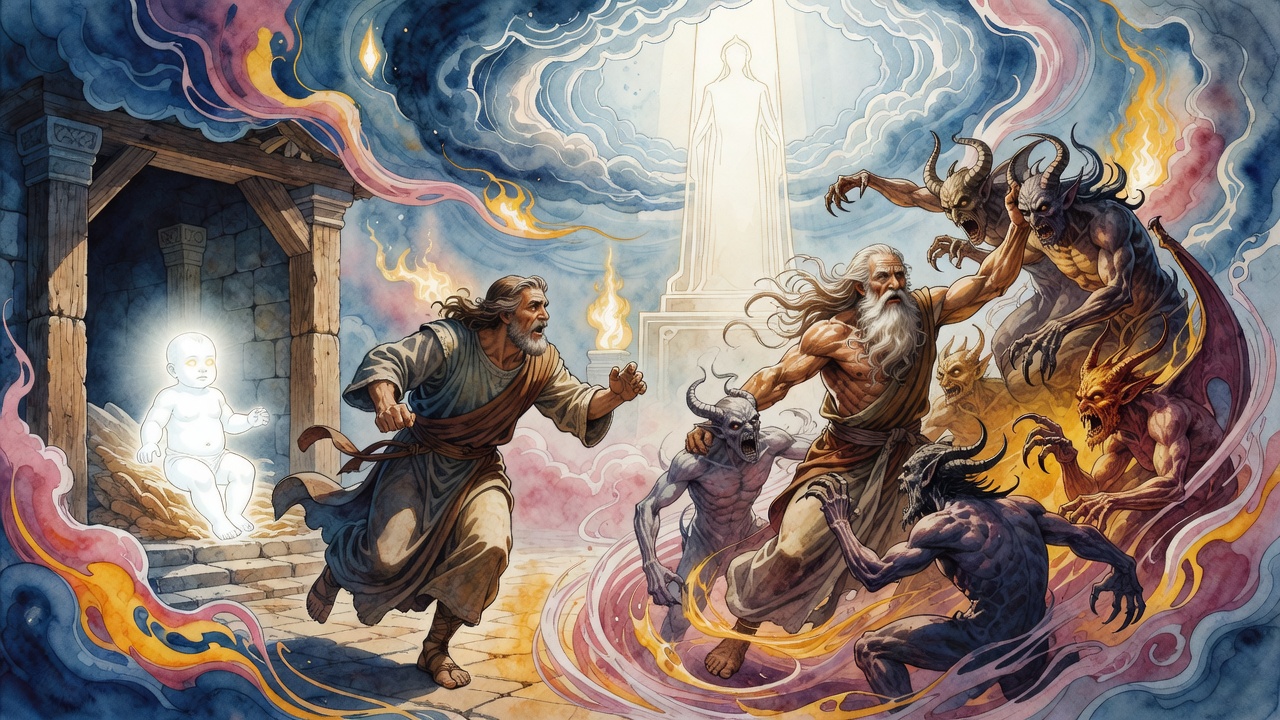
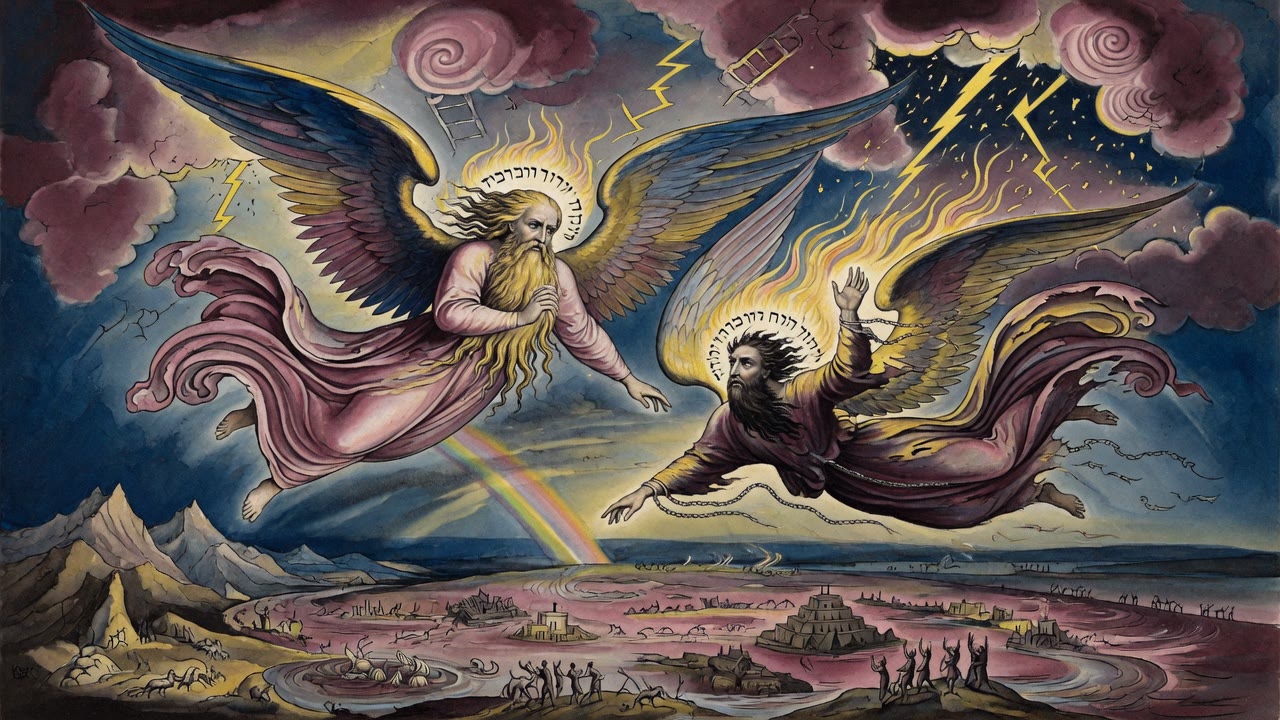
The angels were flaming fire, servants of heat, not soft travelers of air. From their height they looked down and saw the daughters of Cain walking naked, eyes painted, beauty worn like a net. The verse says the sons of Elohim saw that the daughters of men were fair and took wives of all they chose (Genesis 6:2). In this telling the fair ones stand in Cain line, and the taking is not gentle courtship. It is hunger that forgot heaven.
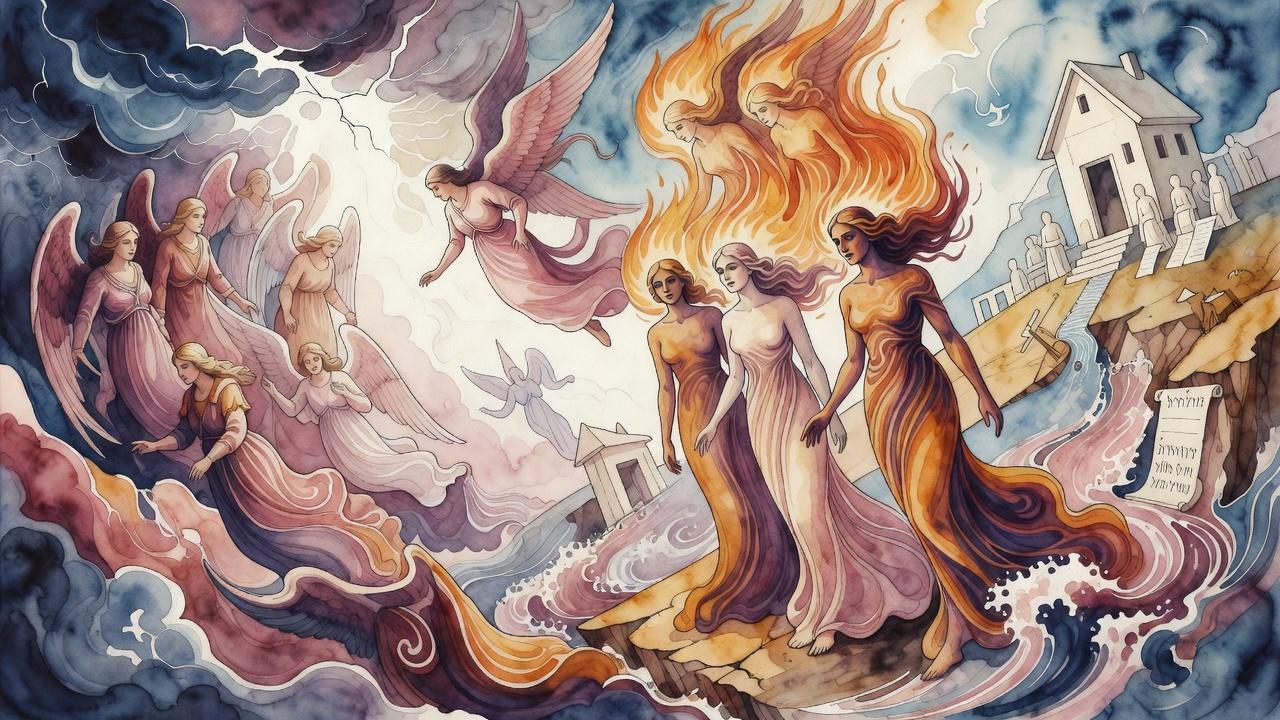
How does fire join flesh? Rabbi Joshua does not deny the flame. He says fire came with the coition of flesh and blood and did not consume them as ordinary fire consumes. The union held. Heaven servants stepped into blood-heat and did not burn the women away. The world below gained children who should not have been ordinary.

On the ground the painted eyes did not look up in fear. They looked up as if the sky owed them company. That confidence was part of Cain inheritance, a style of living that treated limits as insults.

Cain House Below the Gaze

Cain kingdom had already chosen display. Adornment. A walk that called watchers down. The angels did not fall in a war against God. They left their post for desire. That difference matters. They still belong to the story as a warning, not as a second throne.

Meanwhile the line of Seth kept counting years from Adam. One hundred thirty years to Seth. Then Enosh, Kenan, Mahalalel, Jared, Enoch. The chronicle numbers lives the way a man counts beads, holding to a different house while Cain daughters drew fire from the sky. Adam long years framed both lines.

Eve name still sat under both houses. The first wound of exile had split into two styles of surviving it. Cain style glittered. Seth style counted. The angels chose glitter and paid for the choice in water that would not negotiate.

Judges Who Must Search Well

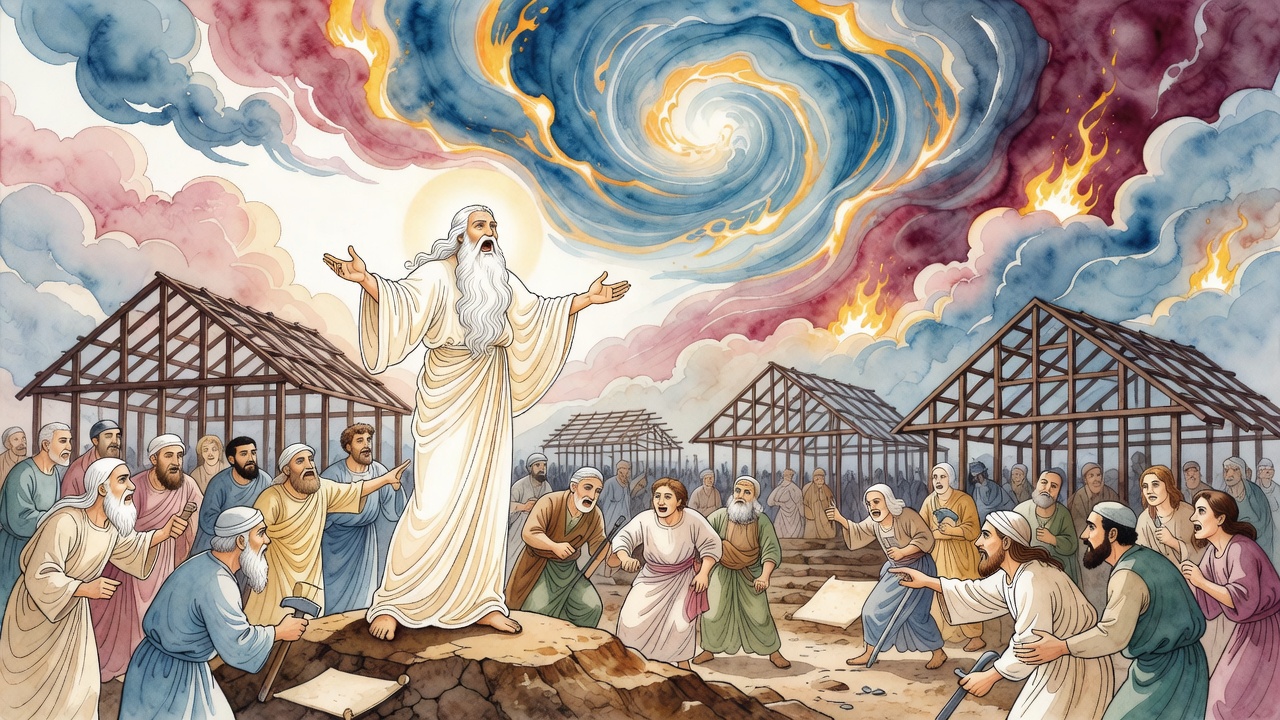
Later law would teach judges to inquire well, to search, to ask until a matter is clear. Heaven servants in this older scene did not inquire well. They saw and took. The contrast is bitter on purpose. Human courts are commanded a patience the flaming ones abandoned in a glance. "And the judges shall inquire well" (Deuteronomy 19:18) becomes a rebuke aimed backward at desire that refused investigation.

The children of those unions grew large in story and heavy on the earth. Violence began to feel normal to those who lived inside it. God looked and did not call it culture. He called it ruin. The painted eyes could not unsee the flood once the windows of heaven opened.

Cain himself was long in the ground, but his style of city still walked. Markets of appetite. Songs that made taking sound like destiny. The daughters did not invent the gaze from above. They inherited a world that treated desire as law. The angels only made the inheritance cosmic.

Water Against a House of Fire and Flesh

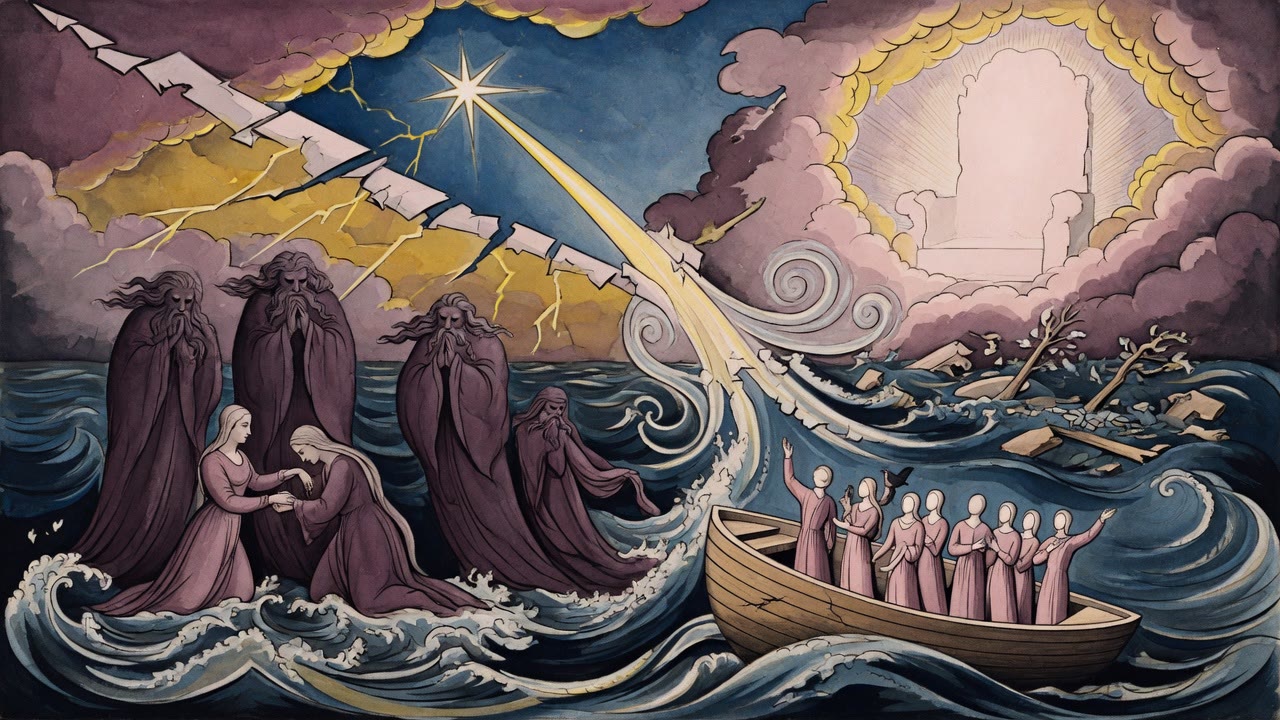
When the deep rose, fire that had joined flesh could not dry it. Noah, from the line that kept counting, sealed pitch while markets still opened under a darkening sky. The angels descent and Cain display and the water arithmetic sit on one chain. Desire without boundary. Display without shame. Rain without mercy for those who treated boundaries as toys.

In Seth tents a father marked another birth year on a stick of memory and refused to paint his daughter eyes for the road. The refusal looked small beside flaming descent. Small refusals are how a remnant begins. When the first heavy drops hit, someone in Cain city laughed and called it good for the gardens. Laughter of that kind is blindness.

A remnant climbed into wood. The rest learned that heaven servants can leave their height and still not own the end of the story. God does. Beauty can call fire down. Fire can forget its post. Water answers both. The chronicle of Seth years becomes, after the water, a thin rope of names the world is allowed to keep.

The ground kept its old heat under new decisions that could not be postponed until a softer season.

A crow called once from a ridge and the sound fell into the same pressure as every human word spoken there.


← All myths

From the tradition

Sources

3 sources

The texts behind this telling. Some cards carry a translation of the source; others are our own retelling of it, and each card says which. Every card links out to the original.

Pirkei DeRabbi Eliezer 22:5Pirkei DeRabbi Eliezer

Retold in our words. Read the original at the link below.Pirke de Rabbi Eliezer, trans. Rabbi Gerald Friedlander, London (1916) · CC-BY

The Rabbi, in this telling, lays it out plainly: the angels, once dwelling in heavenly purity, gazed down and saw the daughters of Cain. Not just saw them, but saw them adorned, "walking about naked, with their eyes painted like harlots." It was too much. They were drawn in, seduced. The verse from Genesis, "And the sons of Elohim saw the daughters of men that they were fair; and they took them wives of all that they chose," (Genesis 6:2) becomes, in this light, a story of celestial downfall triggered by earthly beauty and, perhaps, earthly vice.

Rabbi Joshua takes this a step further. He reminds us that angels are not what we might imagine. "The angels are flaming fire," he says, referencing (Psalm 104:4), "His servants are a flaming fire." So, how could they possibly mingle with humans?

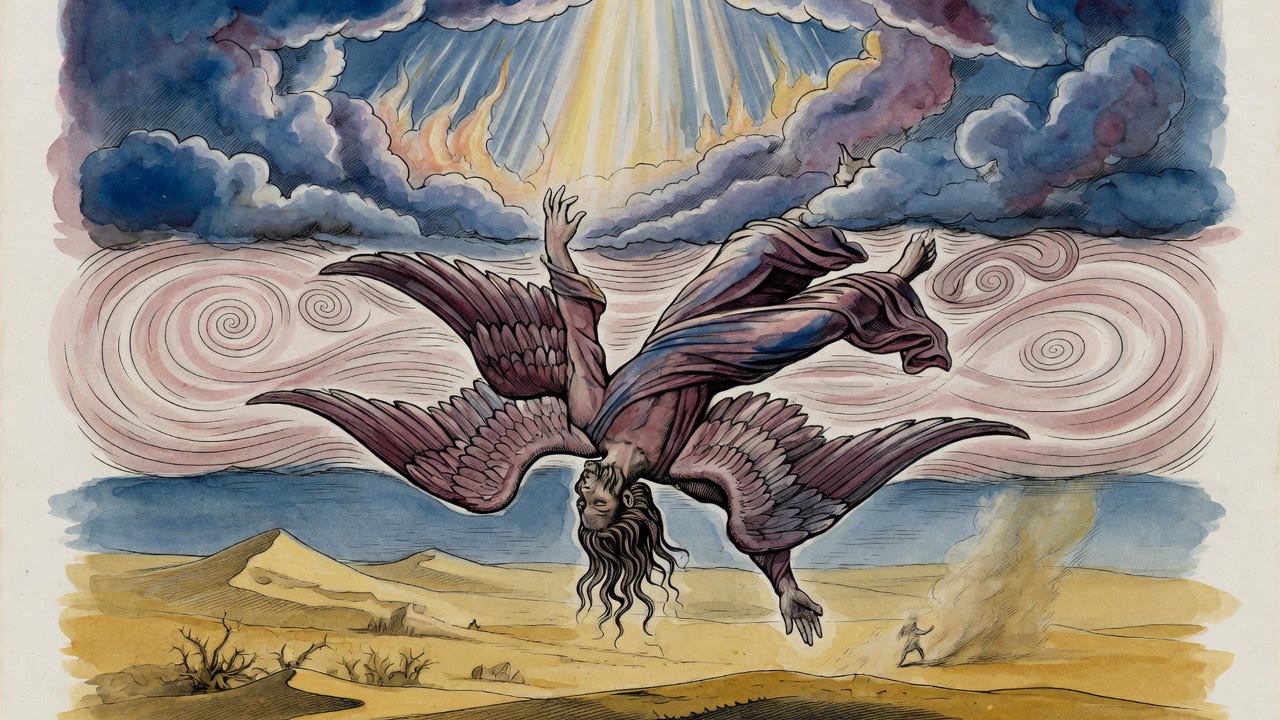
Rabbi Joshua offers a compelling answer: "fire came with the coition of flesh and blood, but did not burn the body; but when they fell from heaven, from their holy place, their strength and stature (became) like that of the sons of men, and their frame was (made of) clods of dust." They changed. They lost their fiery essence, becoming flesh and blood, susceptible to the same desires and limitations as humans. Their punishment, in a way, was to become what they lusted after. He even quotes (Job 7:5), "My flesh is clothed with worms and clods of dust," emphasizing the stark contrast between their former glory and their earthly fate.

This isn't just a story about angels gone wild. It's a story about temptation, about the corrupting influence of the material world, and about the profound consequences of choices. It forces us to consider: what does it truly mean to be human? And what are we willing to sacrifice for desire? Is it possible to fall from grace, even when you're made of fire?

Full source
Seder Olam Zutta 2:2Seder Olam Zutta

Translation of the source text.Seder Olam Zuta, Rabbi M. Grossberg. London, 1910 + JewishMythology.com faithful English Beta translation · Public Domain

Adam lived one hundred and thirty years until Seth was born. That was the year 130 from Creation, and the years of his life were 930. Seth lived one hundred and five years until Enosh was born. That was the year 235 from Creation, and the years of his life were 912. Enosh lived ninety years until Kenan was born. That was the year 325 from Creation, and the years of his life were 905. Kenan lived seventy years until Mahalalel was born. That was the year 395 from Creation, and the years of his life were 910. Mahalalel lived sixty-five years until Jared was born. That was the year 460 from Creation, and the years of his life were 895. Jared lived one hundred and sixty-two years until Enoch was born. That was the year 622 from Creation, and the years of his life were 962. Enoch lived sixty-five years until Methuselah was born. That was the year 687 from Creation. Enoch walked with God three hundred and sixty-five years, and he was no more, for God took him. That was the year 987 from Creation. Methuselah lived one hundred and eighty-seven years until Lamech was born. That was the year 874 from Creation, and the years of his life were 969. Lamech lived one hundred and eighty-two years until Noah was born. That was the year 1,056 from Creation, and the years of his life were 777. When the Flood came, Noah was six hundred years old. That was the year 1,656 from Creation. Noah lived three hundred and fifty years after the Flood. It follows that Noah, the tenth generation, died in the year 2,006 from Creation, ten years after the Dispersion. Behold, ten generations.

Full source
Sifrei Devarim 190:7Sifrei Devarim

Retold in our words. Read the original at the link below.Sifrei by Rabbi Shraga Silverstein · CC-BY

Our tradition grapples with this, especially when it comes to justice. to a fascinating piece from Sifrei Devarim, a collection of legal teachings connected to the Book of Deuteronomy. It's all about how judges are supposed to grill witnesses, to really get to the heart of the matter.

The verse in (Deuteronomy 19:18) says, "And the judges shall inquire well." Then, in chapter 13, verse 15, we read, "And you shall inquire, and you shall search out, and you shall ask well," and again in chapter 17, verse 4, "And it be told to you, and you hear, and you shall search it out well." Notice the repetition? The word "well" keeps popping up.

The rabbis of the Talmud were masters of connection. They saw patterns where others didn't. Here, they use a method called gezeirah shavah (גזירה שוה), which means "equal rule." It's like saying, "Aha! This word appears in multiple places, so the rules in those places must be connected!" Because "well" appears in all these verses, the Sifrei Devarim tells us that a witness is subject to seven inquiries, or chakiroth (חקירות). These are intense cross-examinations, digging deep into the details of the testimony.

Is that enough? Is questioning alone sufficient to reveal the truth?

The text goes on. What about bedikoth (בדיקות), or "examinations," factual reviews of the evidence? Where do we learn about those? From (Deuteronomy 19:18), "...and, behold, true and correct is the thing." This implies a thorough checking of the facts, not just the witness's words.

And what happens if, after all that inquiry and examination, the witness is found to be lying? Well, (Deuteronomy 19:18) also tells us that "...behold, a false witness is the witness." This verse establishes the consequence: the witness is branded as "false."

So, what does all this mean? It means that the pursuit of justice isn't just about taking someone's word for it. It requires rigorous questioning, careful examination of the facts, and a willingness to hold people accountable for their words. It's a system designed to protect the innocent and ensure that truth prevails. Perhaps the real wisdom lies not just in knowing what to believe, but in knowing how to believe.

Full source