5 min read

Balak Hired Bilam and Could Not Buy a Curse

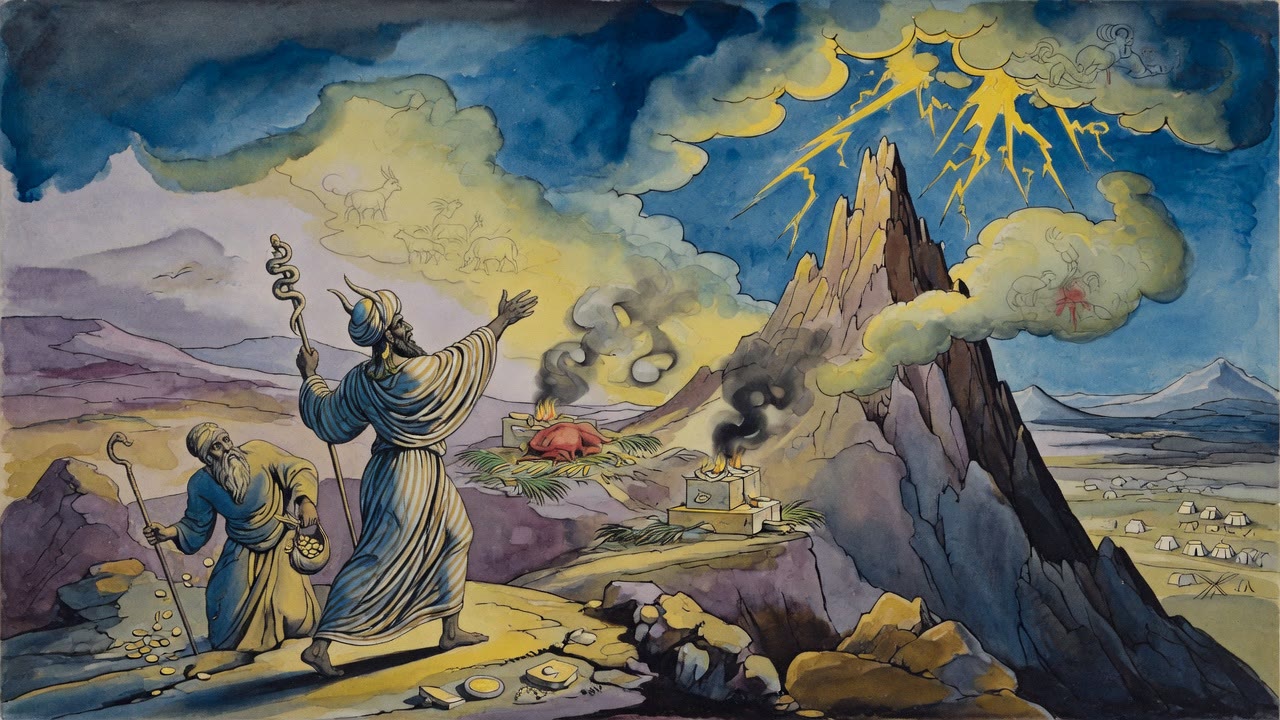
Bilam swore no house of silver and gold could move him. Then he stayed another night anyway, hoping God would change the answer.

Curated by Arthur · Told by Maggid ·
Table of Contents
  1. A King Waiting at the Border
  2. Silver, Gold, and Three Ugly Virtues
  3. Blessings Forced Through a Hostile Throat
  4. When the Sword Fails, Teach Sin
  5. What Could Not Be Purchased
Balak Hired Bilam and Could Not Buy a Curse Click for full size

A King Waiting at the Border

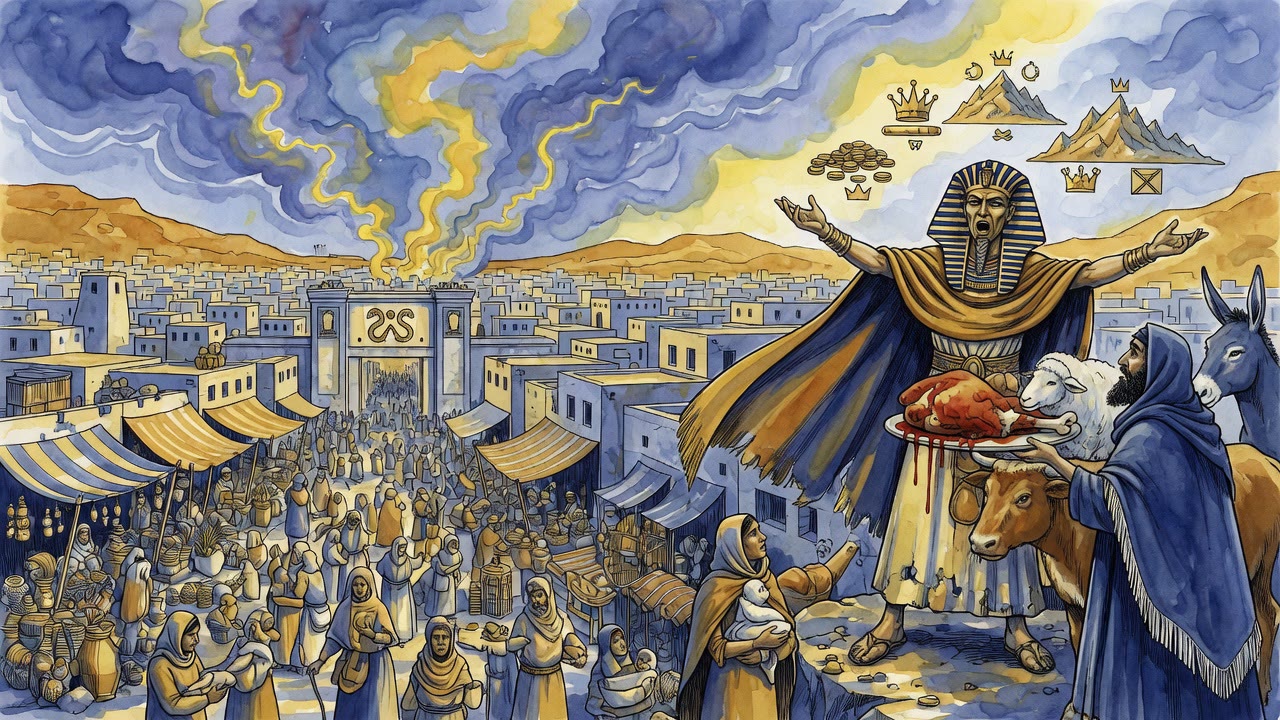
Balak did not lounge in a palace while the prophet traveled. He sent watchers, then went out himself to the city of Moab, to the edge of his land, because borders mattered to him more than ceremony. From the days of Noah, nations had lines meant to keep swords sheathed. Israel had already crossed the realms of Sihon and Og. Balak wanted Bilam to see the trespass and turn it into a curse.

"Did I not send to you to summon you? Why did you not come to me? Am I not able to honor you?" The question sounded like wounded pride. The midrash hears a prophecy inside it: Bilam would leave him in disgrace. Honor offered as bait already smelled of failure.

Silver, Gold, and Three Ugly Virtues

Bilam answered with piety that revealed him. "If Balak were to give me his house full of silver and gold, I would be unable to violate the directive of the Lord my God" (Numbers 22:18). Bamidbar Rabbah strips the sentence bare. Evil eye: he lifts his eyes to harm what he sees. Haughty spirit: he speaks as if God had refused him a favor rather than commanded him. Greedy soul: only a man starved for treasure names a house of metal so carefully.

He stayed another night hoping for a different word. He told the messengers they too would leave frustrated. He wanted the job and the gold and the reputation of obedience all at once. Heaven would not sell him any of the three on his terms.

Blessings Forced Through a Hostile Throat

On the heights Balak built altars and pointed Bilam at Israel's tents. Each attempt to curse came out as blessing. The prophet who had marketed his mouth as a weapon discovered that the weapon belonged to God. Israel dwelling by tribes under an open sky could not be rewritten by a hired tongue.

Balak's rage was political. He had paid for ruin and received poetry. Bilam's rage was personal. He had wanted to be the man who stopped a nation with a sentence. Forced blessing is a humiliation worse than silence.

When the Sword Fails, Teach Sin

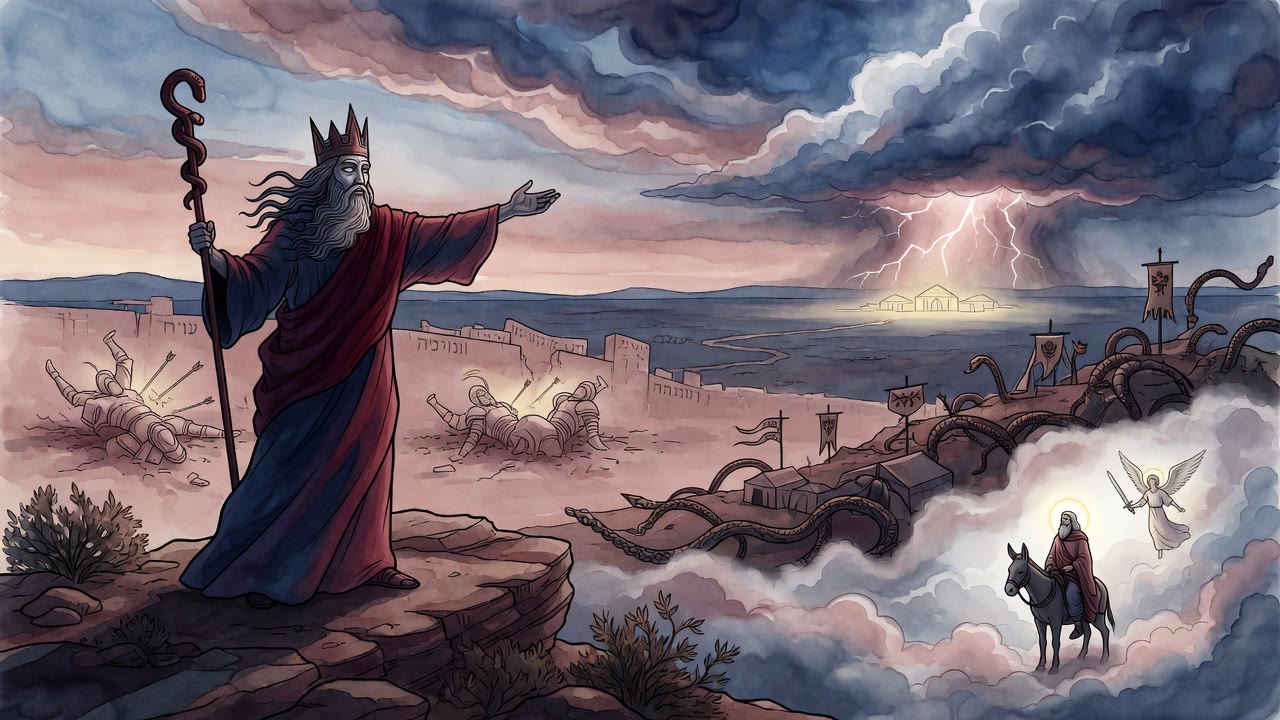
Unable to curse, Bilam advised another war. Not spears. Seduction. Midianite and Moabite women at Peor, the worship that unravels a people from the inside. Kozbi daughter of a Midianite prince became the public face of that strategy. Plague followed. Phinehas answered with zeal that stopped the dying.

Then the Torah ordered, "Assail the Midianites and smite them" (Numbers 25:17). Rabbi Shimon taught why the spiritual assault ranks worse than open steel: the killer takes a life in this world; the one who causes sin kills in this world and the next. Egypt and Edom met Israel with swords and later found a path toward limited reconciliation. Ammon and Moab taught transgression and were barred from the congregation forever.

What Could Not Be Purchased

Balak bought a prophet and received a mirror. Bilam sold fear and discovered he could not deliver it. Borders drawn since Noah did not authorize a curse on the camp God had numbered. Gold filled no mouth that heaven had closed.

The story ends with two kinds of war on the record. One fails in public under Bilam's unwilling blessings. The other almost succeeds in private tents until a priest's spear and a later war answer it. Israel learns to fear the second more than the first.

Every generation meets a Balak who wants a religious excuse for panic and a Bilam who wants payment for saying no to God with style. The midrash keeps both names sharp so neither role looks glamorous. Evil eye, proud phrasing, and greed still travel together. They still call themselves professionalism.

When Bilam finally left, Balak had no curse and no clean conscience. The border he guarded with speeches had not moved. The people he feared still marched under cloud and fire. Only the strategy had changed, from bought words to rented desire, and heaven was already counting that debt.

Honor offered at a city gate, silver named in a refusal, altars built for malice, and women sent as weapons: one campaign, many masks. God refused the first mask and judged the second. That is the whole war of Balak in a single ledger.

Balak's politics were not stupid. A migrating nation that had toppled two Amorite kings looked like a flood. Hiring a famous mouth was cheaper than raising another army. The error was theological. He treated God as a local weather system that a skilled consultant could redirect with fees.

Bilam's night negotiations show a man trying to keep one foot in prophecy and one foot in the market. He would go only if God said go. He would also keep asking until the answer matched the contract. That doubled posture is why the donkey saw the angel before the rider did in the wider tradition: animals notice obstacles that greed edits out.

Peor's aftermath is the bill for the failed curse. When words fail, corrupt the camp's heart. The command to assail Midian is not random vengeance. It is the legal memory of a spiritual ambush. Israel must learn which enemies come with swords and which come with invitations.


← All myths
From the tradition

Sources

4 sources

The texts behind this telling. Some cards carry a translation of the source; others are our own retelling of it, and each card says which. Every card links out to the original.

Legends of the Jews 6:14Legends of the Jews

Retold in our words. Read the original at the link below.The Legends of the Jews by Louis Ginzberg (1909) · Public Domain

A powerful one. So powerful, in fact, that Balak, the King of Moab, got seriously worried when he saw the Israelites camped out nearby. He thought, "Uh oh, these guys are going to be trouble," and decided he needed to nip things in the bud. His solution? Hire Balaam to curse them.

Balak sends messengers to Balaam, practically begging him to come and curse the Israelites. But Balaam, after consulting with God, tells them he can’t. God has made it pretty clear that these Israelites are blessed, not cursed.

Balak, persistent as he is, doesn’t give up. He sends an even more impressive delegation the second time around, offering Balaam even greater riches and honors. And Balaam doesn’t outright refuse this second embassy either. Instead, he says, "I cannot go beyond the word of the Lord my God, to do less or more. Now therefore I pray you, tarry ye also here this night, that I may know what the Lord will speak unto me more."

The first reading, it sounds like Balaam is just being cautious. Checking with God again to be absolutely sure. But according to the Sages, there's much more to it than meets the eye.

His words, "I cannot go beyond the word of the Lord," were, according to the tradition, a coded message. He was essentially saying that he couldn't possibly undo the blessings that God had already bestowed upon Israel. It was beyond his power.

And that phrase, "Tarry ye also here this night"? Another prophecy, the Sages suggest! It implied that this second embassy, despite all its pomp and circumstance, would be just as unsuccessful as the first. Balaam might accompany them this time, but he still wouldn't be able to curse Israel. He would only bless them.

Finally, that little addendum, "What the Lord will speak unto me more," wasn't just a throwaway line. It was, according to tradition, a hint that God was actually going to use Balaam to heap even more blessings upon the Israelites! Talk about a plot twist!

So, what do we take away from this story? And sometimes, the very people who are sent to harm us can end up being the instruments of our greatest good.

Full source
Bamidbar Rabbah 20:10Bamidbar Rabbah

Retold in our words. Read the original at the link below.The Sefaria Midrash Rabbah, 2022 · CC-BY

The story, as it unfolds in the Book of Numbers, centers on Balak, king of Moab, who is terrified by the approaching Israelites. He hires Bilam, a non-Israelite prophet known for the power of his curses, to curse them. Balak promises Bilam great honor and riches: "For I will honor you greatly, and anything that you say to me I will do, only please go curse this people for me" (Numbers 22:17).

What kind of person was Bilam? The Midrash (rabbinic interpretive commentary), specifically Bamidbar Rabbah 20, offers a scathing character assessment based on his own words. It dissects his response to Balak's initial offer, revealing some deeply unflattering truths.

Bilam, in (Numbers 22:18), famously proclaims, "If Balak were to give me his house full of silver and gold, I would be unable to violate the directive of the Lord my God, to perform a small or a great matter.” The Midrash pounces on this statement, arguing that it reveals three damning characteristics: an evil eye, a haughty spirit, and a greedy soul. First, the evil eye. The Midrash points to (Numbers 24:2), "Bilam lifted his eyes, and saw Israel dwelling according to its tribes." Why does it specify "lifted his eyes"? Bamidbar Rabbah argues it wasn't just observation; it was a jealous, malevolent gaze, an attempt to inflict harm through the power of his negative energy. It would have been sufficient to write that he saw, but the extra words demonstrate his jealousy and intent. That's the picture being painted here.

Next, a haughty spirit. Remember, Bilam had already been told by God not to go with Balak. Yet, Bamidbar Rabbah picks up on Bilam's phrasing when he says, "As the Lord refused to allow me to go with you." He subtly implies that God was doing him a favor, almost as if God needed Bilam's permission! This wasn't obedience; it was a puffed-up ego masquerading as piety.

Finally, and perhaps most damning, a greedy soul. Bilam's elaborate denial – "Were Balak to give me his house full of silver and gold…" – only serves to highlight his obsession with wealth. The Midrash even suggests a clever line of reasoning on Bilam's part: If Balak needed to hire armies to defeat the Israelites, wouldn't it be worth giving Bilam everything he wanted to secure a guaranteed victory through curses?

This insatiable desire, this constant craving for more, is a core element of Bilam's character. It's not just about the money; it's about the power and status that come with it.

Even his (forced) prophecies get a cynical twist. When Bilam says, "I would be unable to violate," Bamidbar Rabbah interprets this as a begrudging acknowledgement that he can't undo the blessings already bestowed upon Israel. He's not being virtuous; he's admitting his limitations!

And finally, consider Bilam's request in (Numbers 22:19): "Now, please, you, too, remain here this night, and I will know what more the Lord will speak to me.” The "you, too" is dripping with sarcasm. According to the Midrash, Bilam is essentially saying, "You'll end up frustrated, just like the first delegation." He knows he shouldn't be pursuing this, but he can't resist the allure of potential gain. That final line – "I will know what more the Lord" – is seen as Bilam prophesying that God will actually add more blessings for Israel through him, a truly ironic and unwanted outcome for the would-be curser!

So, what are we left with? Bilam, as portrayed in Bamidbar Rabbah, isn't just a villain; he's a cautionary tale. He embodies the dangers of unchecked ego, insatiable greed, and the corrosive power of envy. He serves as a reminder that our motivations matter, and that even apparent piety can mask a deeply flawed character. It begs the question: how often do we, perhaps on a much smaller scale, fall prey to similar temptations, allowing our own "evil eyes," haughty spirits, and greedy souls to cloud our judgment?

Full source
Bamidbar Rabbah 21:4Bamidbar Rabbah

Retold in our words. Read the original at the link below.The Sefaria Midrash Rabbah, 2022 · CC-BY

The Torah gives us some pretty strong clues, and it all boils down to how they chose to attack us.

Think about the story of Balaam and Balak. Remember that? Balak, the King of Moab, hired the prophet Balaam to curse the Israelites. Instead, Balaam wound up blessing them (much to Balak's frustration!). But the story doesn't end there. Balaam, unable to directly harm the Israelites, advised Balak to use a different tactic: seduction.

That brings us to the passage in Bamidbar Rabbah 21, which focuses on the commandment: “Assail the Midianites and smite them” (Numbers 25:17). The text connects this command directly to the incident of Peor, and the story of Kozbi, the Midianite princess. “For they assailed you, with their deceits that they deceived you in the matter of Peor, and in the matter of Kozbi daughter of the prince of Midian, their sister, who was slain on the day of the plague in the matter of Peor” (Numbers 25:18).

The Bamidbar Rabbah asks a crucial question: why this harsh command to "assail" the Midianites? The answer lies in their method of attack. "For they assailed you" – and from here, the Sages deduced a vital principle: "One who comes to kill you, kill him first." Seems pretty straightforward. Self-defense.

But Rabbi Shimon takes it a step further. He asks, "From where is it derived that one who causes a person to sin is worse than one who kills him?" His reasoning is powerful: "It is because one who kills, kills in this world, but he has a share in the World to Come, but one who causes him to sin kills him in this world and in the World to Come." In other words, physical death is finite, but spiritual death? That has eternal consequences.

The Bamidbar Rabbah then draws a comparison: Two nations, Egypt and Edom, greeted Israel with the sword. "The enemy said: I will pursue, I will overtake…I will draw my sword" (Exodus 15:9). And, "Edom said to him: You will not pass through me, lest I come out toward you with the sword" (Numbers 20:18). Two other nations, Ammon and Moab, attacked with transgression, leading Israel into sin. The Sifrei Bemidbar 131 even points out that Ammonite women were involved in the harlotry at Shittim.

Now, here's the kicker: Regarding those who attacked with the sword, it is written: "You shall not despise an Edomite…you shall not despise an Egyptian" (Deuteronomy 23:8). There's a possibility of reconciliation, of forgiveness, down the line. But regarding those who used transgression to cause Israel to sin: "An Amonite or a Moavite shall not enter…even the tenth generation…forever" (Deuteronomy 23:4).

The difference is stark. Physical aggression, while terrible, is seen as less damaging in the long run than the insidious act of leading someone astray, corrupting their morals, and severing their connection to the Divine.

So, what's the takeaway? It's not just about physical survival, but about spiritual integrity. The Torah teaches us to guard ourselves not only against those who would harm our bodies, but even more so against those who would corrupt our souls. It’s a powerful reminder that the choices we make, and the influences we allow into our lives, have consequences that extend far beyond this world.

Full source
Bamidbar Rabbah 20:16Bamidbar Rabbah

Retold in our words. Read the original at the link below.The Sefaria Midrash Rabbah, 2022 · CC-BY

Balak heard that Bilam had come,” the verse tells us. But Bamidbar Rabbah points out this wasn't just some casual overhearing. No, no. Balak had sent emissaries, messengers, specifically to keep tabs on Bilam's progress. He was anxiously awaiting the arrival of this… well, let’s just say complicated individual.

Get this: Balak didn’t just wait for Bilam in his palace. "And went out to meet him, to the city of Moav," the text continues, but Bamidbar Rabbah specifies it was to the metropolis – the main city. So why the border? Why meet him there, of all places? That’s where things get interesting.

Bamidbar Rabbah suggests that Balak was deeply concerned about borders. He saw these boundaries, established all the way back in the time of Noah, as sacred agreements between nations, designed to prevent conflict and maintain order. And here come the Israelites, seemingly threatening to tear those agreements apart!

He was basically saying to Bilam, “Look at what they’ve done! They’ve already crossed the borders of Sihon and Og!” He was subtly complaining, laying the groundwork for his request that Bilam curse the Israelites. It’s a clever piece of political maneuvering, wouldn't you say?

Then comes the pointed question: “Balak said to Bilam: Did I not send to you to summon you? Why did you not come to me? Is it true that I cannot honor you?” It sounds like a simple inquiry, but the rabbis of Bamidbar Rabbah see something deeper here. They interpret this as a prophecy – Balak, unknowingly, is predicting that Bilam will ultimately leave him in disgrace! Talk about foreshadowing.

And Bilam’s response? It’s cagey, to say the least: “Behold, I have come to you; now, will I be able to speak anything?" In other words, “I’m here, but don’t get your hopes up. I don’t have permission to say whatever I wish.” This is Bilam hedging his bets, reminding Balak – and perhaps himself – that he's not entirely in control.

What does this all mean? It’s a reminder that even in the most seemingly straightforward narratives, there are layers of meaning, political intrigue, and divine influence at play. Balak's fear of disrupted borders, his anxiety about the Israelites, and Bilam's ambiguous position – it all sets the stage for a story that continues to resonate with us today.

Full source