5 min read

Be Ready for a Day No Nation Understood Well

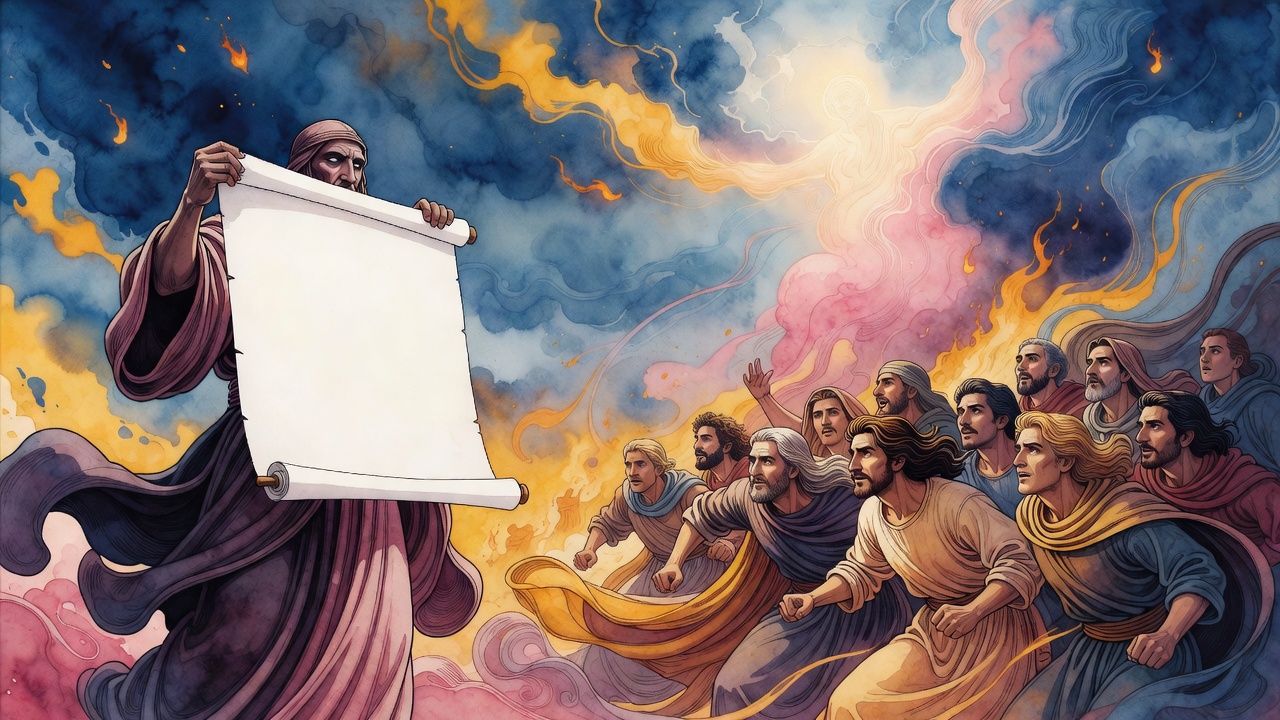
Haman posted an edict that said only Be ready, while Israel already knew the day was for vengeance, not for dying.

Curated by Arthur · Told by Maggid ·
Table of Contents
  1. Two Prophecies, One Date
  2. Thirteen Years in a Cave
  3. What "Be Ready" Demands
  4. After the Gates Open

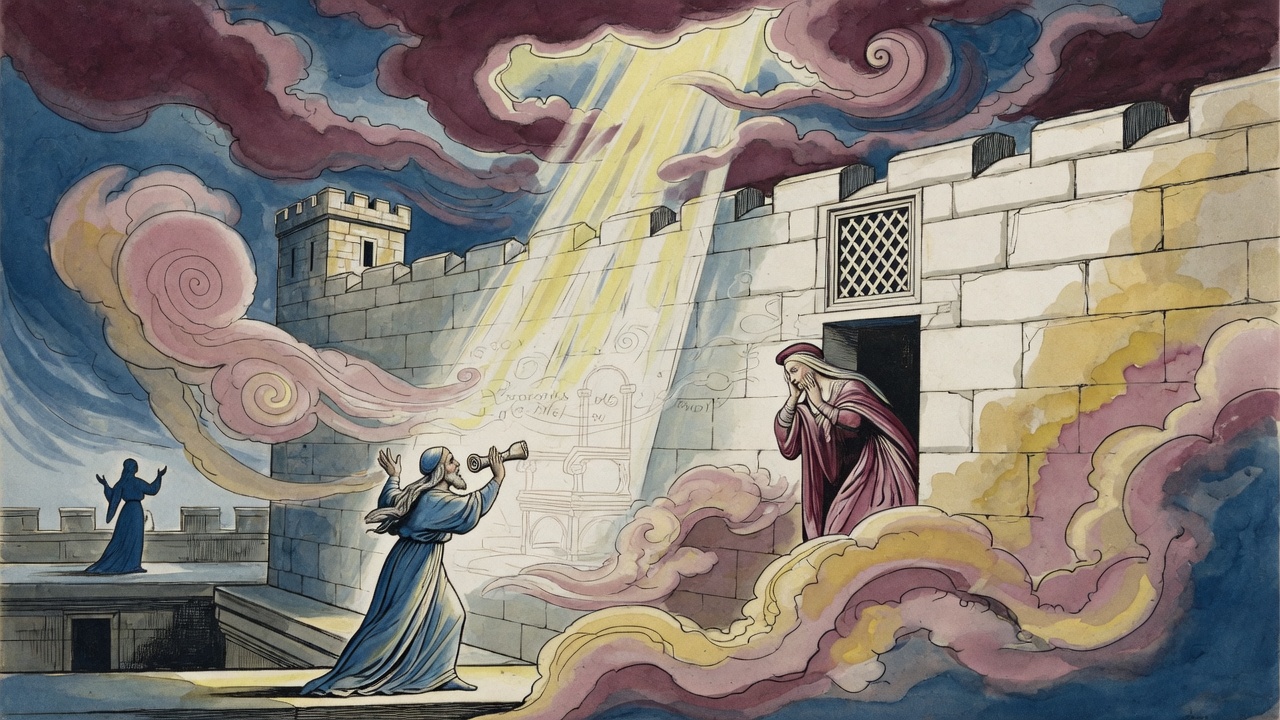
Copies of the edict went up in every province. "Be ready for that day," the text said, and the nations read it without knowing whether they were being told to kill or to die. Rabbi Levi compared them to a traveler who sprained his ankle on a hard road and prayed for a donkey. A Roman passed with a newborn foal and ordered him to carry it on his shoulders. The prayer was answered in the wrong direction. Relief arrived as a burden with small hooves.

Be Ready for a Day No Nation Understood Well Click for full size

Two Prophecies, One Date

For the nations the prophecy was fog posted on walls. For Israel the later decree was sharp: the Jews were to be ready for that day to take vengeance on their enemies (Esther 8:13). Same calendar square. Opposite meanings. Haman's clerks posted readiness as threat, ink still wet with empire confidence. Heaven, in the midrash's ear, was already posting readiness as reversal, waiting for the second seal that would rewrite the first without erasing the date.

Ahashverosh sits in the same critique as Cyrus in another midrash: kings who begin with gestures toward Jerusalem or toward Jewish survival and end in folly. Cyrus limited return once the first wave had crossed the Euphrates, saying those who had crossed could stay and those who had not should not cross. Ahashverosh signed death and later signed defense, swung by advisers and wine. Empire speech is often half a promise, full of noise, thin on covenant.

Thirteen Years in a Cave

Another generation of readiness looked like hiding rather than posting. Under persecution Rabbi Shimon ben Yochai and his son Rabbi Elazar lived thirteen years in a cave, eating carobs and dates until sores rose on their flesh. When they emerged, blinking, Shimon watched a bird-catcher spread a trap. A heavenly voice said "freedom," and a bird escaped into open air. The voice said "killing," and another bird was caught mid-flight. "Even a bird does not fall without decree," he said. "All the more so we."

They went down to the hot springs of Tiberias to heal what the cave had done to their skin. Then they built a market and sold cheap, as Jacob had done good for a city where he camped, turning arrival into benefit. Survival was not only escape from a decree. It was repair for the place that held them while sores dried and law returned to their mouths.

What "Be Ready" Demands

Readiness in Esther is not panic alone. It is a people that already knows its story while the empire posts riddles in every marketplace. Readiness in the cave is patience under a decree that kills birds and sages by the same mouth of Heaven, measured and not random. Both scenes refuse the traveler's mistake: praying for relief without asking what form relief will take, then cursing the foal you asked for without precision.

Haman's posters still look efficient. Short words. Public display. The midrash smiles with bare teeth: efficiency without knowledge is a foal on your shoulders, a readiness that does not know whether the day belongs to the sword or to the throat.

After the Gates Open

When the day came, the nation that had been targeted became the nation that stood. The midrash does not pretend every empire turns kind, or that every cave opens into a market of peace. It insists Jewish prophecy, at its best, is not fog. "For the Jews to be ready" is a sentence with a subject. The nations' "be ready" is a blank the violent fill as they like until history fills it otherwise and the blank becomes their own fear.

Shimon leaving the cave and Esther's generation leaving the shadow of the gallows share a posture: listen for the decree, then act as if life is still commanded, as if readiness means more than waiting to be told which way the blade faces. The edict on the wall said "be ready." The people who knew their God already were.

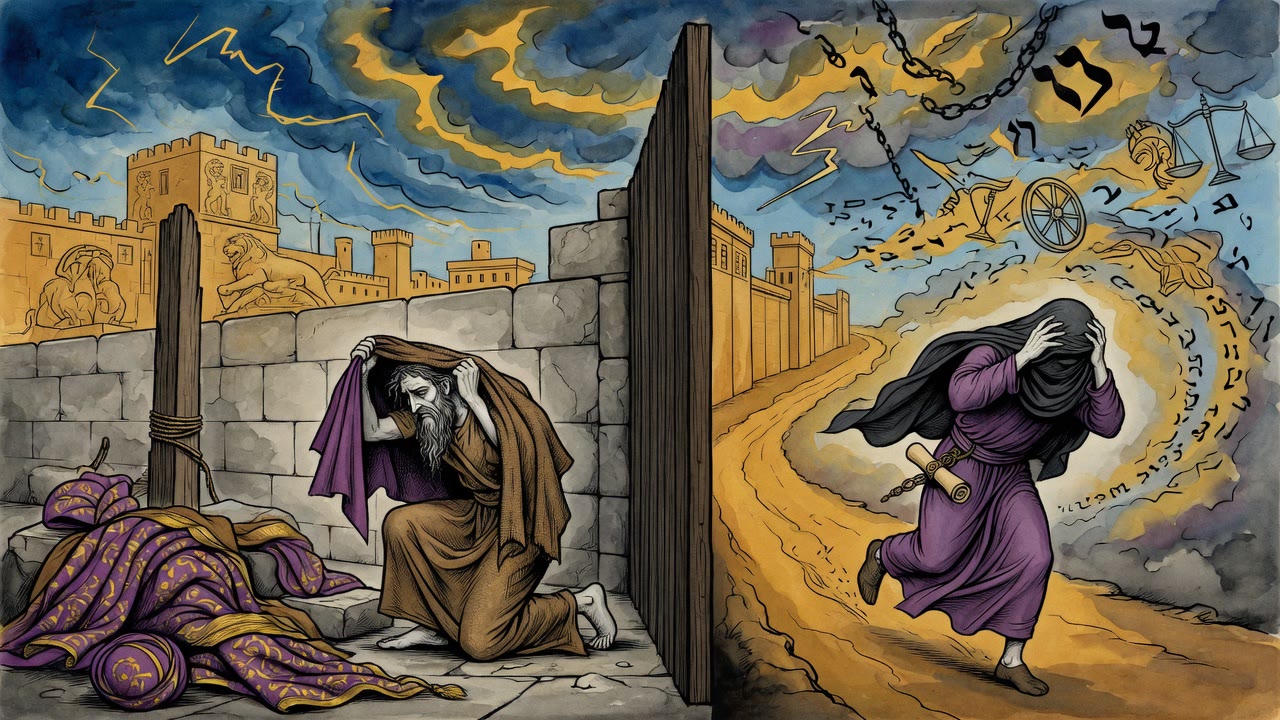
In Shushan the posters looked final. Clerks who did not know Jewish names still knew how to hang paper that made markets quiet. In the cave, Shimon and Elazar measured time by sores and carobs, not by posted days. Both rooms were schools of readiness. One taught how empire writes fog. The other taught how a decree from Heaven can free a bird and catch a bird with equal calm, and how a sage must learn to live under that calm without becoming cruel.

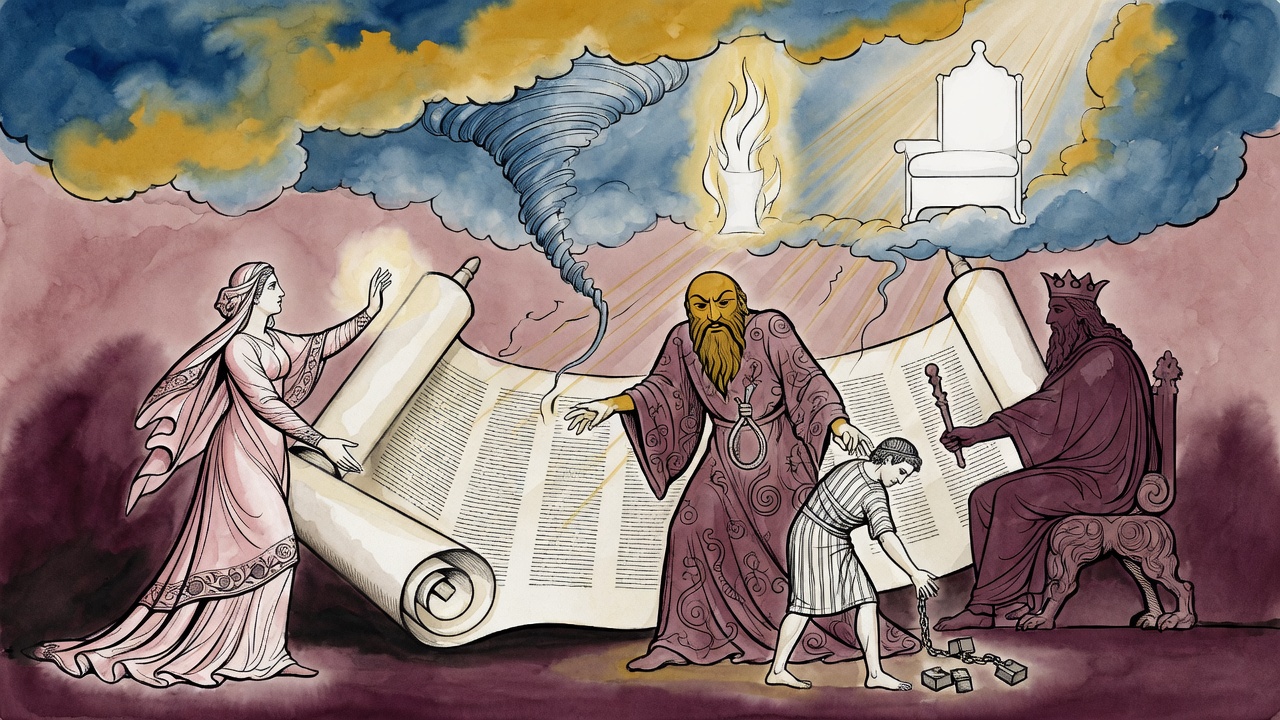
Cyrus and Ahashverosh remind the midrash that royal mouths are weather. They blow toward Jerusalem, then reverse. They host banquets, then sign death, then sign survival. A people that waits only on kings will always carry foals on its shoulders. A people that knows its own day can still use a king's seal, as Esther did, without mistaking the seal for the source of the year.


← All myths

From the tradition

Sources

3 sources

The texts behind this telling. Some cards carry a translation of the source; others are our own retelling of it, and each card says which. Every card links out to the original.

Esther Rabbah 7:24Esther Rabbah

Retold in our words. Read the original at the link below.The Sefaria Midrash Rabbah, 2022 · CC-BY

“The text of the document was that an edict be issued in every province, to be publicly displayed to all the peoples: Be ready for that day” (Esther 3:14). “The text of the document” – an exact copy of the document. That an edict be issued in every province, to be publicly displayed to all the peoples: Be ready for that day.” Rabbi Levi said: The prophecy of the nations of the world is obscure, and they do not know whether it [the edict] is to be killed or to kill. This is analogous to a person who was walking along the way, and from the rigor of the way he sprained his ankle. He said: ‘If only I had a donkey.’ A Roman whose donkey had just given birth to a foal passed by him and said to him: ‘Take this foal and carry it on your shoulders.’ He said: ‘My prayer was answered, but I didn’t ask appropriately, whether it was to ride or to be ridden by.’ So is the prophecy of the nations of the world: “Be ready for that day,” but they do not know whether it is [for them] to kill or to be killed. For Israel, however, their prophecy is explicit: “For the Jews to be ready for that day, to take vengeance against their enemies” (Esther 8:13).

Full source
Esther Rabbah 3:7Esther Rabbah

Retold in our words. Read the original at the link below.The Sefaria Midrash Rabbah, 2022 · CC-BY

Another interpretation: “From people [mimtim] by Your hand” – who are these courageous men who took theirs from under the hand of God? And who was that? That was the generation of religious persecution. “From people [mimtim] by your hand” – killed [mumatim] by your hand. “From the world [meḥeled]” – those who had sores [ḥaludaot] arise in their flesh for the sanctification of Your name. Who were they? Rabbi Shimon ben Yoḥai and his son Rabbi Elazar, who went into hiding in a cave for thirteen years due to religious persecution until there arose sores in their flesh. They ate carobs and dates. At the end of thirteen years, Rabbi Shimon bar Yoḥai emerged and sat at the entrance to the cave. He saw a trapper spreading his trap to trap birds. He heard a divine voice say ‘freedom,’ and it was freed. A second time he heard a divine voice, it said ‘killing,’ and it was caught. He said: ‘Even a bird does not escape without a divine decree; that is all the more so true regarding us. Let us go and be healed in the hot springs of Tiberias.’ They went down and were healed in the hot springs of Tiberias. They said: ‘We must do good and benefit these residents of the place, just as Jacob our patriarch did, as it is stated: “He encamped [vayiḥan] before the city” (Genesis 33:18) – he established a market and sold to them at low prices. They established a market and sold to them at low prices.David said before the Holy One blessed be He: ‘Master of the Universe, say that I have a place with them in the World to Come.’ The Holy One blessed be He said to him: ‘David, is it not [written] “your hidden treasures will fill their bellies?” Their hidden treasures will fill your belly is not written here, but rather, “your hidden treasures will fill their bellies.” The entire people partakes of what is left over from your wealth.’6David’s merit is the source of the benefit of the entire nation. David received tidings that he had a portion in the World to Come. He said before Him: ‘Master of the universe, these come based on Torah, mitzvot, and good deeds that they have to their credit, but I, “I shall see Your face in righteousness” (Psalms 17:15) forever.’

Full source
Kohelet Rabbah 10:13Kohelet Rabbah

Retold in our words. Read the original at the link below.The Sefaria Midrash Rabbah, 2022 · CC-BY

Kohelet Rabbah turns to Kingdom of Cyrus.

Who is this verse talking about? Kohelet Rabbah, a fascinating collection of rabbinic interpretations on the Book of Ecclesiastes, offers us a couple of compelling, if not slightly harsh, candidates.

First up: Cyrus, the Persian king who initially allowed the Jews to return to Jerusalem and rebuild the Temple. Seems like a good guy. Well, Kohelet Rabbah isn't so sure. It points to Cyrus’s declaration in (Ezra 1:3): “He is the God, who is in Jerusalem.” The interpretation here is cutting: implying that Cyrus believed God’s power was limited to Jerusalem alone. This, according to Kohelet Rabbah, was the "foolishness" at the beginning.

It gets worse! The text goes on to say that "the end of his mouth is evil debauchery." Why? Because, as Kohelet Rabbah states, Cyrus "recanted and abrogated his decrees." He reversed his decision, effectively saying: "Whoever has crossed the Euphrates has crossed, and whoever has not crossed shall not cross." Meaning, those who had already returned to Jerusalem could stay, but no one else was allowed to go. A pretty significant reversal! The initial promise of freedom and rebuilding turned into a limited, conditional permission. Was this evil debauchery? Perhaps a bit strong, but certainly a disappointment.

But wait, there's another contender! Kohelet Rabbah then throws another name into the ring: Ahashverosh. Yes, the very same Ahashverosh of the Purim story! The one whose foolish decisions and susceptibility to bad advice almost led to the annihilation of the Jewish people.

The text reminds us: “And in the reign of Ahashverosh, at the beginning of his reign, they wrote libel [against the inhabitants of Judah and Jerusalem]" (Ezra 4:6). This, Kohelet Rabbah argues, was the beginning of his foolishness. He listened to slander and accusations against the Jews.

And "the end of his mouth [is evil debauchery]?" Because, as Kohelet Rabbah emphasizes, Ahashverosh "arose and abrogated the labor of the construction of the Temple." He stopped the rebuilding. He continued to prevent its rebuilding for the remainder of his reign.

So, what’s the takeaway here? Is it simply a historical critique of these two Persian kings? Perhaps. But it’s also a powerful reminder about the importance of consistency, of keeping one’s word, and of the lasting consequences of both foolish words and evil actions. And perhaps a warning: Be careful of how you start, but be even more careful of how you finish. Because ultimately, it's the end that defines the story.

Full source