5 min read

Betzalel Got Credit for Every Vessel He Loved

Craftsmen filled the Tabernacle, yet every verse named only Betzalel. Heaven counted the devotion that sat inside his hands.

Curated by Arthur · Told by Maggid ·
Table of Contents
  1. The Name That Swallowed the Work Crew
  2. The Rough Covering and the Cloud
  3. Curls Black as a Raven
  4. What the Credit Was Really For

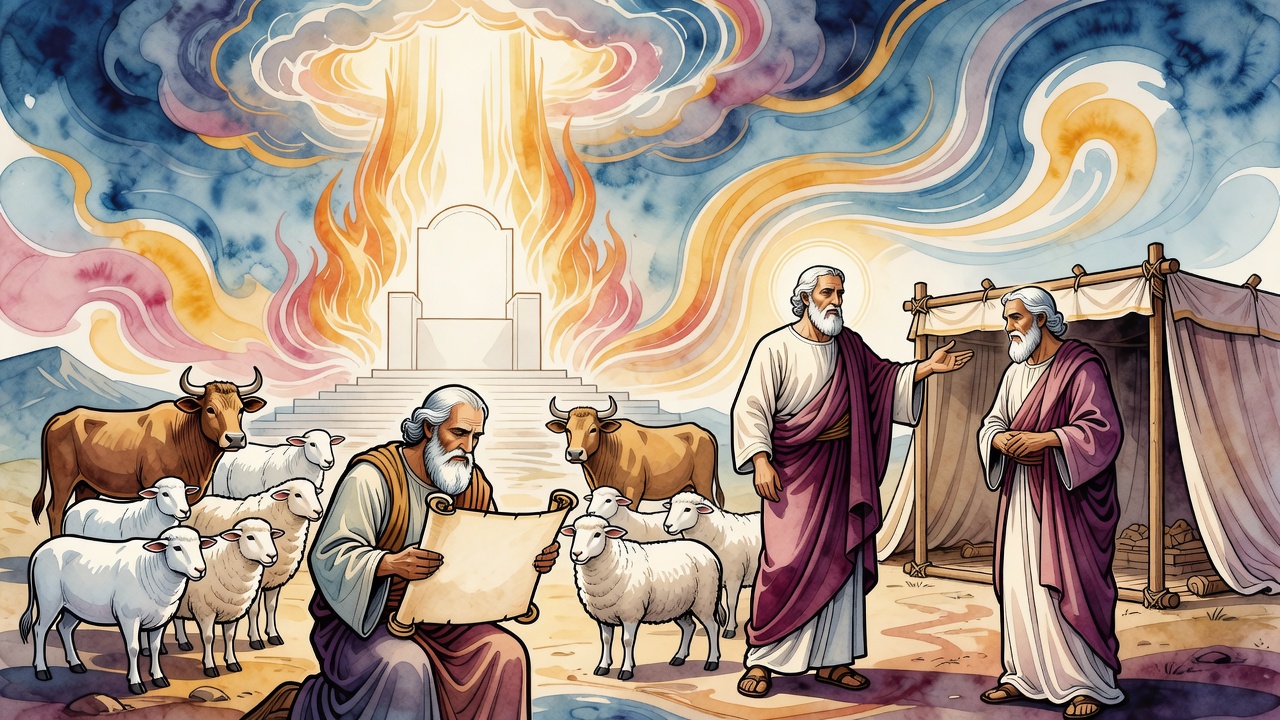
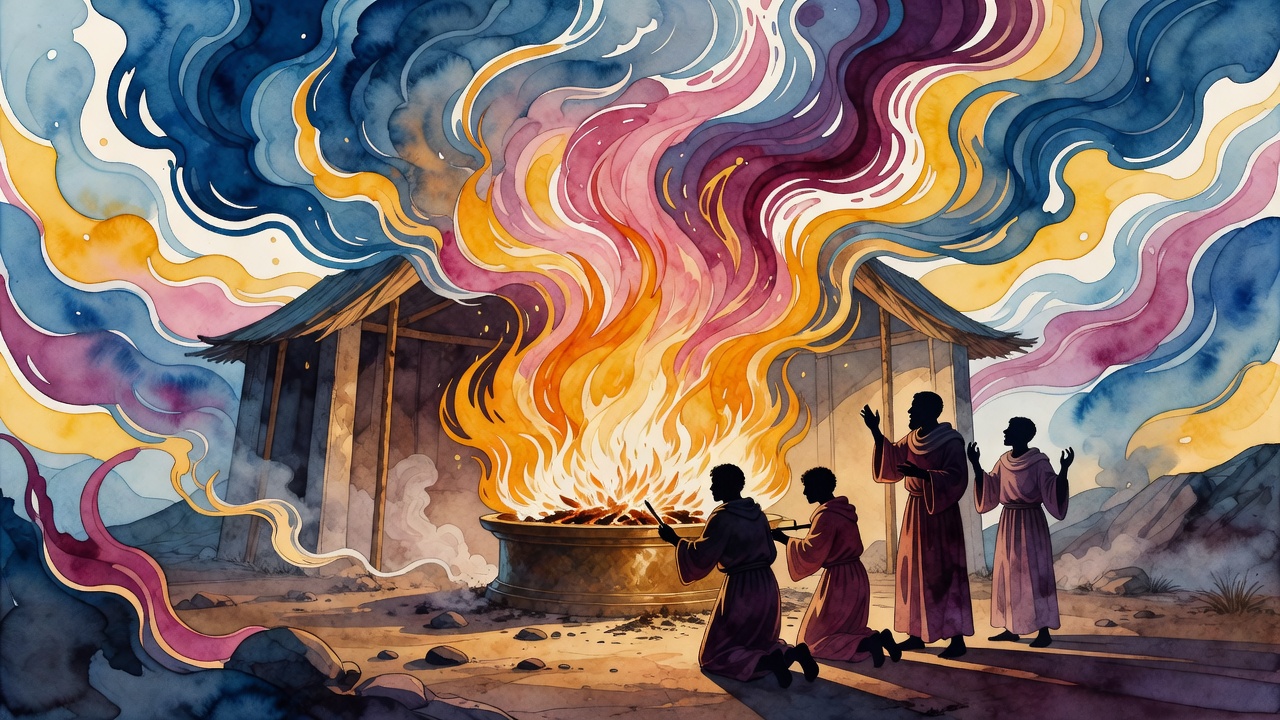
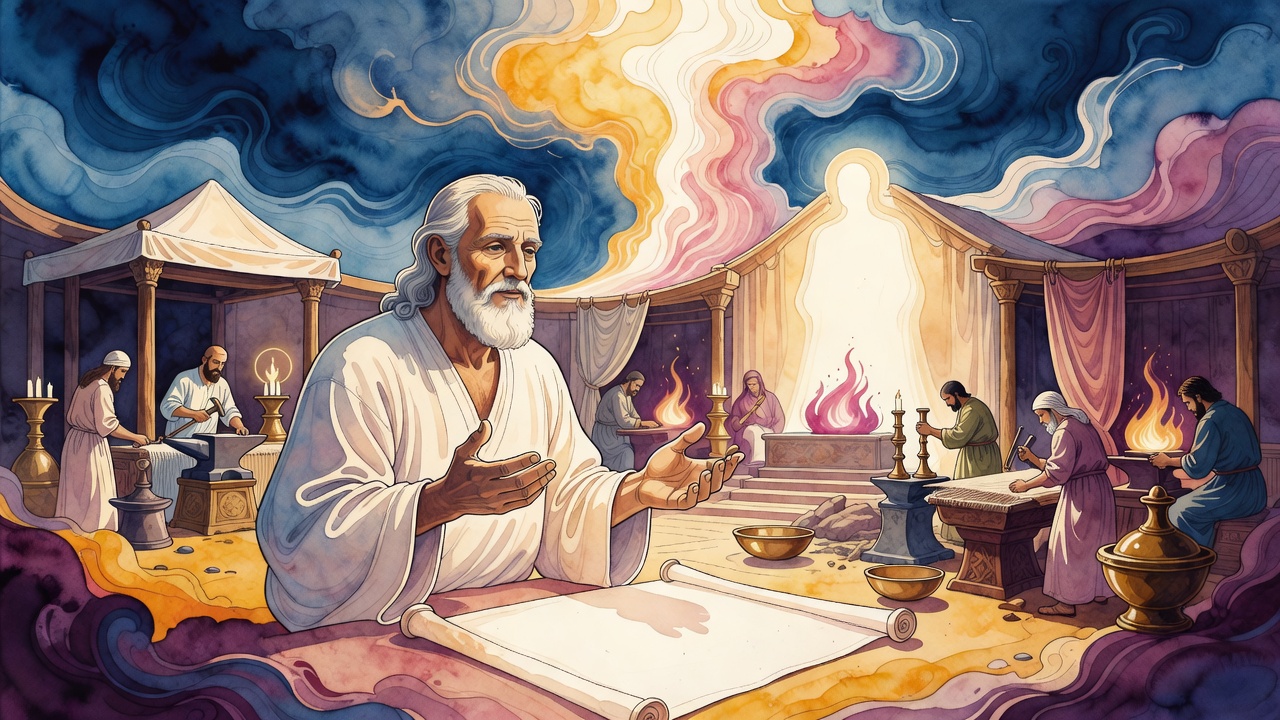
Betzalel set the last goat-hair panel on the frame and stepped back until the whole tent looked like a living animal. Other hands had spun the yarn. Other backs had hauled the beams. The Torah still wrote his name beside every piece as if he alone had built a sanctuary in the wilderness.
Betzalel Got Credit for Every Vessel He Loved Click for full size

He did not correct the record. He wiped sweat from his brow, checked the seam once more, and waited for the cloud to settle.

The Name That Swallowed the Work Crew

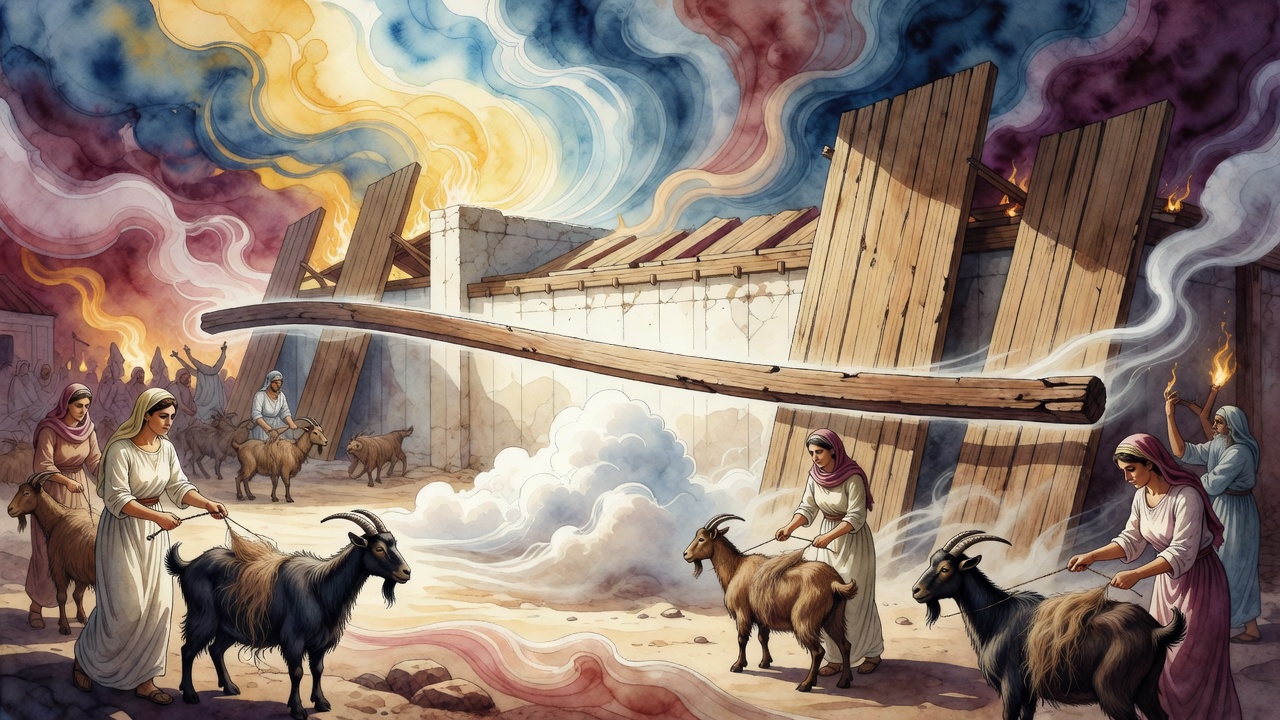
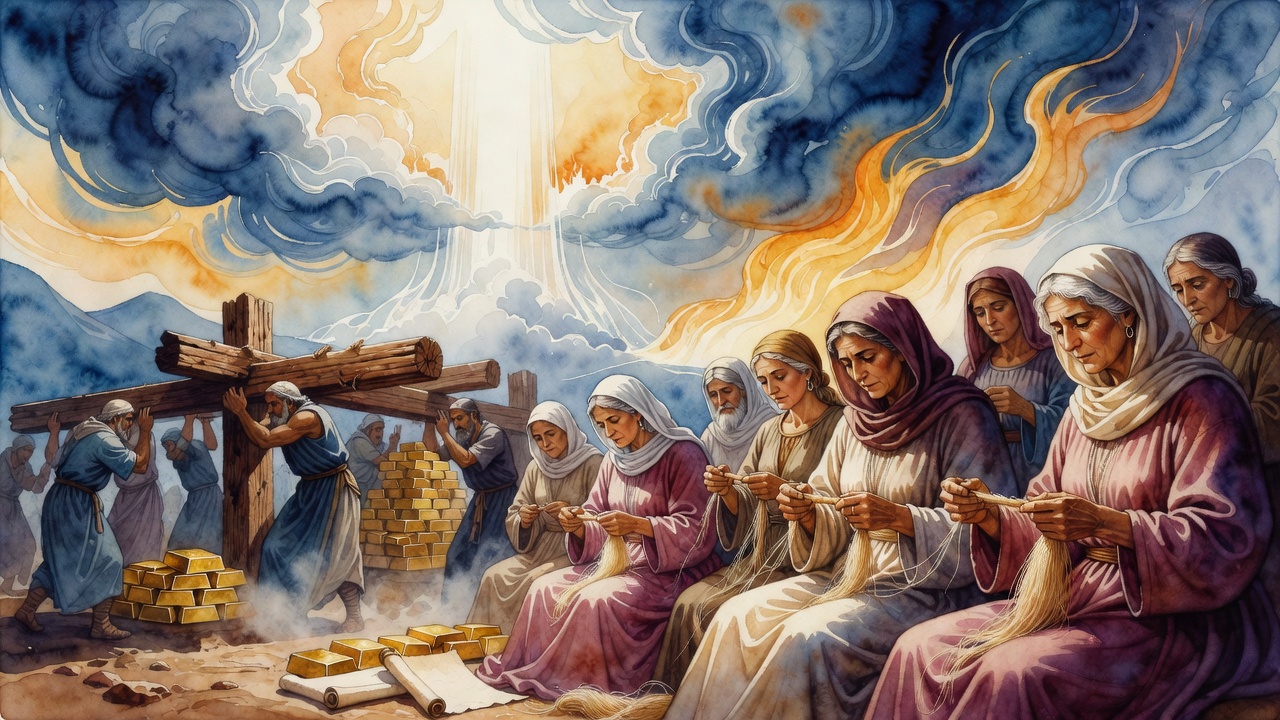
The wilderness camp already knew the truth. Oholiab stood at the next bench. Apprentices cut gold leaf so thin the wind tried to steal it. Women brought spun goats' hair that scratched the palms. The Tabernacle rose from a village of craft, not from one man's private miracle.

Still the scroll insisted: Betzalel crafted the ark, the cover, the table, the menorah, the altar, the curtains. The midrash that grew around those lines refused to call it a clerical error. Heaven was not counting labor hours. Heaven was counting kavanah, the intention that refused to leave the work until the work held holiness.

A later age would remember Yonatan son of Asael the same way. Others helped. He drove. Scripture still named the spark first.

The Rough Covering and the Cloud

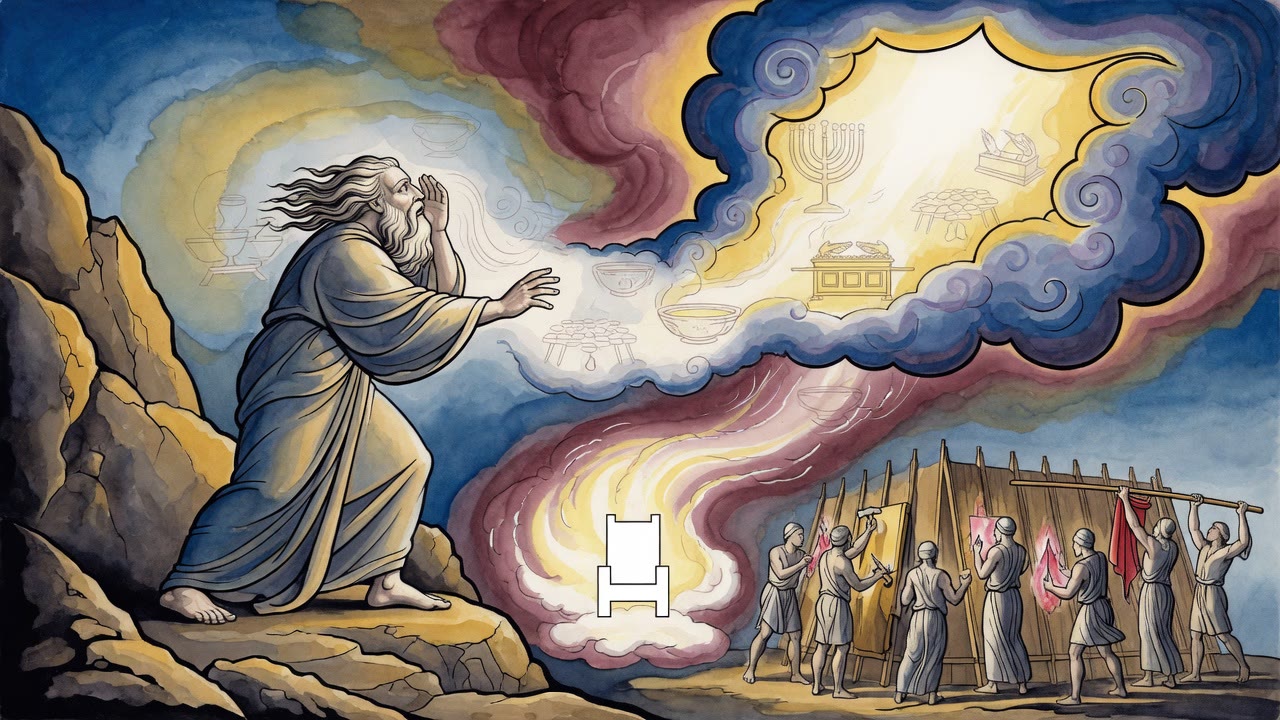
God spoke to the builders as if each object were a bargain already sealed. "You crafted weaves of goats' hair," the voice said, "and I will protect you in the World to Come with a cloud." Those panels were ugly on purpose. They sat on top of finer skins to take the sand and the sun so the inner glory would not wear out.

Because they shielded what was precious, the promise answered in kind. A cloud by day would answer their rough cloth. Protection for protection. The midrash did not soften the trade.

"You crafted a kaporet," God continued, "and I will grant atonement for your iniquities." Cover for cover. "You set a table before Me, and I will set a table before you." "You lit a menorah, and I will illuminate for you sevenfold." "You built an ark for Torah, and the reward has no end."

Each tool returned as a future. The craftsmen who had once smelled of pitch and metal were being paid in light.

Curls Black as a Raven

Not far from that workshop language, another midrash looked at Torah scholars and saw the same hidden surface. "His locks are curls, black as a raven," says the Song (Song of Songs 5:11). In this world they can look severe, withdrawn, almost unlovely. In the world to come they flash like torches and dash like lightning.

Rabbi Yehuda read the blackness as the present tense of devotion. Rabbi Shmuel bar Yitzhak pushed further. Even the portions of Torah that feel too raw to speak in polite company, the discharges and the impurities, are pleasant before the Holy One. The scroll refuses to hide what bodies do. Beauty is not only gold leaf. Beauty is also the courage to keep the hard paragraphs.

Betzalel's goat-hair panels belonged to that same logic. The outer layer looked plain. The inner work stayed radiant because someone accepted the plain work first.

What the Credit Was Really For

So the name on every verse was not theft from the crew. It was a verdict about who refused to leave early. Devotion pulls credit the way a magnet pulls iron filings. The ones who merely finish a task leave a clean bench. The ones who love the task leave a name that Scripture will not drop.

Betzalel walked the finished courtyard at dusk. The menorah 's (the lampstand) stems still held the day's heat. The ark waited under its cover like a heart under a ribcage. He knew he had not soldered every joint alone. He also knew why heaven wrote him into every line. The intention had been complete, and complete intention is what the story keeps.

Dust from the Sinai floor stuck to the wet edges of the goats' hair. Somewhere a hammer still rang on a copper ring. Betzalel listened until the ring found its true note, then raised a hand. The hammer stopped. In that silence the unfinished courtyard felt like a held breath. He had learned to hear the difference between work that was done and work that only looked finished.

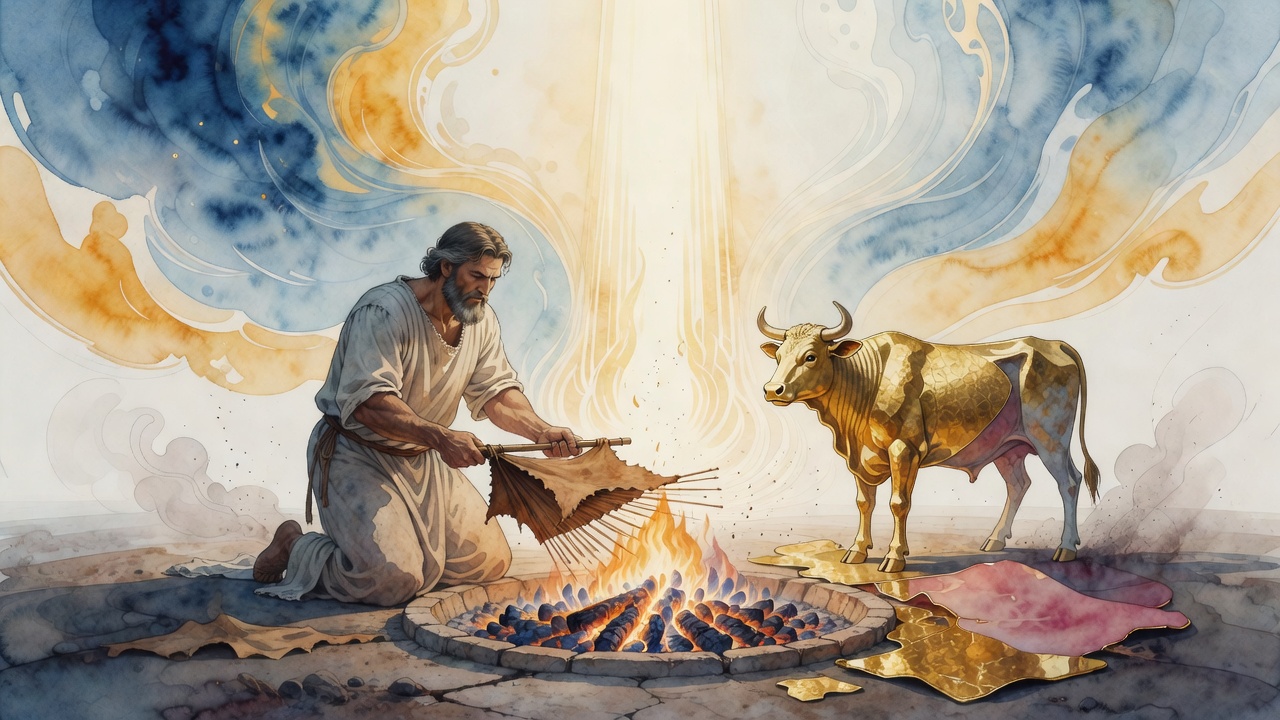
Oholiab laughed at a joke near the gate. An apprentice fell asleep against a beam with a chisel still in his fist. Children ran errands with bronze clasps clicking in clay bowls. Betzalel chose the coarsest useful hair for the outer layer and saved the softest for what only the priest would brush past. When he touched the kaporet's edge, the gold still held the fire's heat, and the promise of atonement felt heavier than the metal.

The market would laugh at scholars who cannot price a camel but can recite a tractate backward. The same market would shrug at a craftsman who stayed late for a seam no one would see. Heaven was counting both kinds of late stay. When the cloud finally settled, it did not ask who spun which thread. It rested on a house someone had loved into existence, one rough panel at a time.


← All myths
From the tradition

Sources

2 sources

The texts behind this telling. Some cards carry a translation of the source; others are our own retelling of it, and each card says which. Every card links out to the original.

Shemot Rabbah 50:5Shemot Rabbah

Retold in our words. Read the original at the link below.The Sefaria Midrash Rabbah, 2022 · CC-BY

The Torah tells us, "Betzalel crafted..." regarding every single item in the Tabernacle. But, wait a minute! Did he really do it all himself? That's the question posed in Shemot Rabbah 50.

The answer? No, probably not. But because Betzalel was so incredibly devoted, so utterly invested in the project, God blessed him. God made sure his dedication was recognized. The verse mentions him regarding each and every item, not because he physically made it all alone, but because his kavanah, his intention, his focus, was so complete.

It's like the story in (Ezra 10:15). "Only Yonatan son of Asael, and Yahzeya son of Tikva, insisted on this, and Meshulam and Shabetai the Levite assisted them." Yonatan was the driving force, the one who pushed the hardest. And even though others helped, Yonatan gets the main credit because his devotion was so strong. He was the spark.

God sees that devotion. And according to Shemot Rabbah, God rewards it.

The text continues with a powerful message, a divine promise, tied to the specific contributions to the Tabernacle. It’s almost like a cosmic thank you note.

"You crafted weaves of goats' hair," God says, "I will protect you in the World to Come with a cloud." Think about those weaves. They were tough, rough, placed atop the Tabernacle to protect the more delicate coverings underneath. Because you protected what was precious, God says, I will protect you. As it says in (Isaiah 4:5), "The Lord will create a cloud by day."

"You crafted an Ark cover [kaporet]," God continues, "I will grant atonement [mekhaper] for your iniquities." The kaporet, the cover of the Ark, was central to the Day of Atonement, Yom Kippur (the Day of Atonement). By creating this object of atonement, you earn atonement.

"You crafted a table," referring to the table holding the showbread, "I will save you from the arrangement, and I will set a table before you in the future." The "arrangement" here is a reference to future punishment, as we find in (Isaiah 30:33): "For an inferno is arranged from yesterday." God promises to save them from divine punishment and to welcome them to a feast in the world to come.

"You crafted a candelabrum before Me," God declares, "I will illuminate for you sevenfold in the World to Come." The candelabrum, the menorah, brought light into the sacred space. And in return, God promises a light beyond imagining, a light seven times brighter than the sun, as (Isaiah 30:26) tells us: "The light of the moon will be like the light of the sun, and the light of the sun will be sevenfold."

And finally, "You crafted an Ark before Me in which the Torah is placed. I will give you endless reward." The Ark, holding the Torah, is the heart of the Tabernacle, the most sacred object. And for that ultimate act of devotion, God promises a reward without end, an infinite blessing, as (Psalm 31:20) proclaims: "How great is the goodness You have stored for those who fear You."

So, what does all this mean for us? It’s a reminder that even when our contributions seem small, when we feel overshadowed or unappreciated, God sees our dedication. God sees our kavanah. And that devotion, that sincere intention, has a power and a reward that extends far beyond what we can imagine. Our acts of creation, no matter how humble, can illuminate the world and secure us a place in the world to come.

Full source
Shir HaShirim Rabbah 5:11Shir HaShirim Rabbah

Retold in our words. Read the original at the link below.The Sefaria Midrash Rabbah, 2022 · CC-BY

Jewish tradition teaches us that true beauty often lies hidden, waiting to be discovered. this idea through a fascinating interpretation of a verse from the Song of Songs.

We turn to Shir HaShirim Rabbah, a classical collection of rabbinic interpretations of the Song of Songs (also known as Song of Solomon). This collection, drawing on earlier Midrashic (rabbinic interpretive commentary) traditions, offers a wealth of allegorical readings. In one particular passage, Rabbi Yehuda interprets the verse "Curls, black as a raven" (Song of Songs 5:11) as referring to Torah scholars.

Why would Torah scholars be likened to something "black as a raven?" Rabbi Yehuda suggests that it's because, in this world, they might appear unattractive or even unappealing to some. Perhaps their dedication to study makes them seem withdrawn, or their rigorous observance makes them appear severe. But, he assures us, this is just a superficial view. In the future, their true essence will be revealed, and "their appearance is like torches, they dash like lightning!" (Nahum 2:5). Their wisdom and righteousness will shine brightly for all to see.

Rabbi Shmuel bar Yitzḥak offers a different, yet equally insightful, interpretation of the same verse. He connects "Curls, black as a raven" to the portions of the Torah itself. He argues that there are texts within the Torah that might seem "too ugly and black" to state publicly. What could he mean by this? Think about the portions dealing with bodily functions, disease, or even the more challenging aspects of human nature. These are topics we might prefer to avoid.

But here's the crucial point: the Holy One, blessed be He, finds these very portions "pleasant." As it says in (Malachi 3:4), "The offering of Judah [and Jerusalem] will be pleasant." Rabbi Shmuel bar Yitzḥak is suggesting that even the seemingly unpleasant or uncomfortable parts of Torah have inherent value. They are part of the complete picture, and we can't shy away from them.

To illustrate this point, the text brings up the example of the portions dealing with the zav and the zava (Leviticus 15:2, 25). The zav is a man with an abnormal bodily discharge, and the zava is a woman with an abnormal bloody discharge. These conditions are described in detail in the Torah, but they are not presented together in a single passage. Instead, each case is discussed separately: "Speak to the children of Israel, and say to them: Any man, when he has a discharge from his flesh" (Leviticus 15:2), and separately, "And a woman, if her bloody discharge shall flow" (Leviticus 15:25).

Why this separation? Perhaps to emphasize the individual nature of suffering and impurity. Or perhaps to avoid overwhelming the reader with too much potentially disturbing information at once. Regardless, the fact that these seemingly "ugly" topics are included in the Torah at all demonstrates their importance. They are not glossed over or ignored.

Perhaps it’s that we shouldn’t judge things by their outward appearance. What seems ugly or unpleasant might actually hold hidden beauty and profound meaning. The Torah, like life itself, is full of complexities and challenges. By embracing all aspects of it, even the uncomfortable ones, we can gain a deeper understanding of ourselves and the world around us.

Perhaps the real challenge is learning to see them that way ourselves.

Full source