5 min read

Wise-Hearted Women Spun the Tabernacle Walls

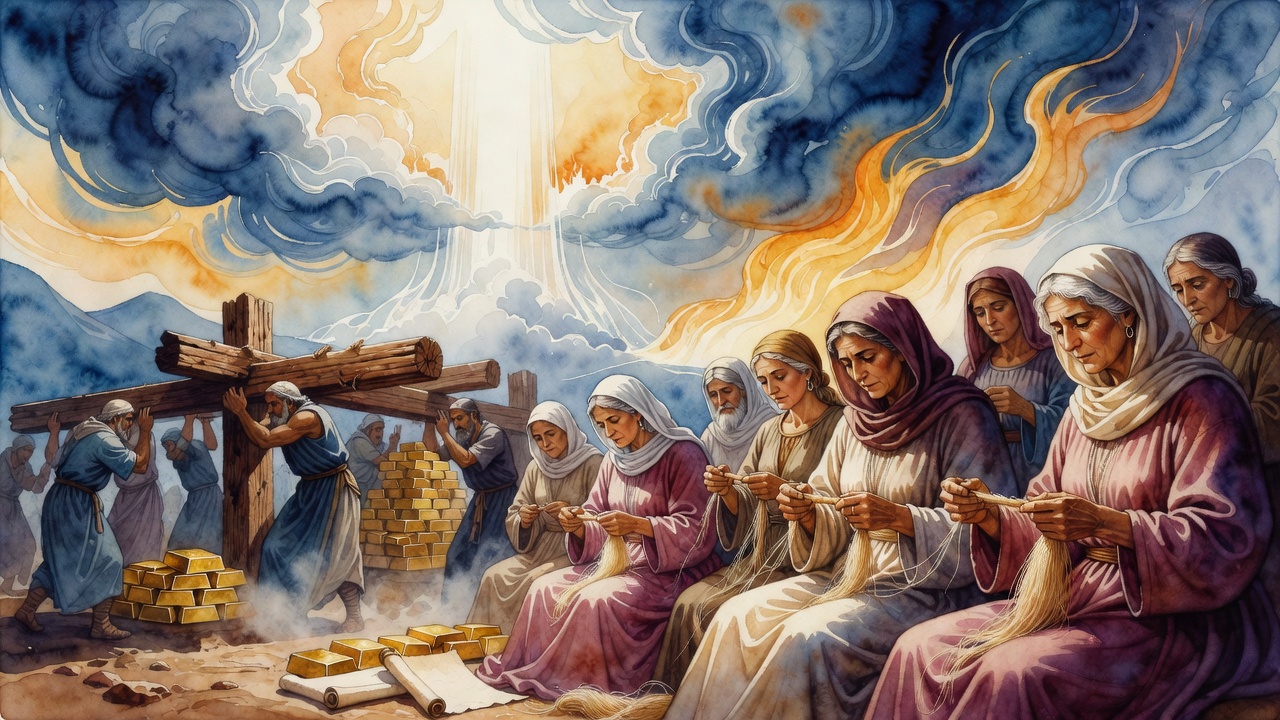
While men hauled gold and acacia, women spun goats hair and linen with hands the Torah calls wise. Skill itself became an offering fit for the dwelling of God.

Curated by Arthur · Told by Maggid ·
Table of Contents
  1. Hands That Think
  2. Aaron Among His Brothers
  3. Hands on the Bullocks Head
  4. One House, Many Kinds of Strength

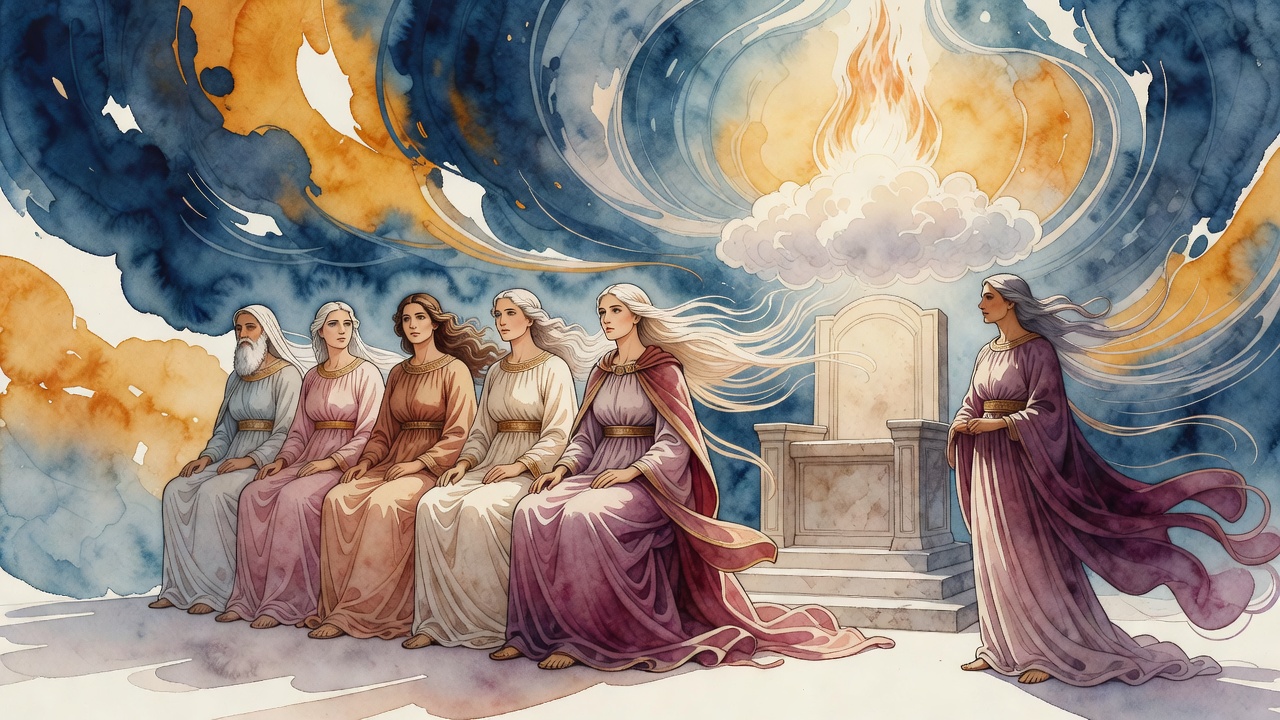
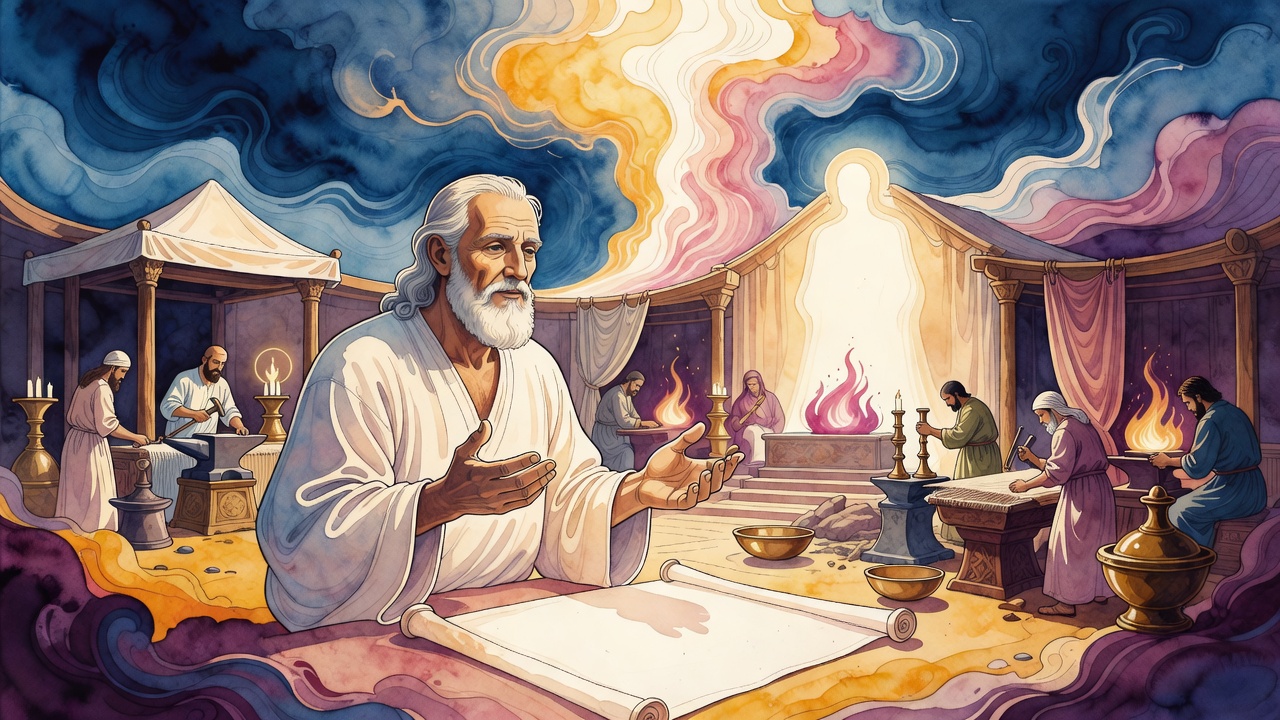
Fiber rough as desert wind lay across their knees. Spindles turned. Thread lengthened. The camp around them rang with hammer and shout, gold for the ark, boards for the walls, but the Torah stopped its listing to name another labor. Every woman wise of heart spun with her hands (Exodus 35:25).
Wise-Hearted Women Spun the Tabernacle Walls Click for full size

Wisdom usually sits behind the eyes. Here it lived in the fingers. The skill that drew even thread from stubborn hair was not a lesser gift set beside jewels. It was counted as chochmat lev, wisdom of the heart, the same heart that would soon stand near a finished sanctuary and know it had helped build a house for the Presence.

Hands That Think

Yalkut Shimoni gathers the verse without padding. The womens craft at the spinning was itself wisdom. Curtains and coverings would rise from those threads, ten panels and goats-hair tents, the soft architecture without which gold hardware would stand naked under sun.

No overseer could substitute pure intention for even yarn. Devotion had to become technique. The Tabernacle needed beauty that could be touched, measured, joined. The women supplied that beauty one twist at a time, patient as the desert is patient, until raw offering became usable holiness.

Children watched and learned that holiness is not only speech at a mountain. Holiness is also the long afternoon of making something strong enough to hang and soft enough to honor. Hands blistered. Thread held. The camp gained walls that could travel.

Aaron Among His Brothers

When the dwelling stood and service began, another kind of greatness stepped forward. Midrash Tanchuma asks why the high priest is called highest among his brothers. Because he was greatest in five things. Beauty. Strength. Wealth. Wisdom. Age.

Strength is not abstract. Come and consider Aaron. When he waved the Levites, he waved twenty-two thousand in one day, back and forth, up and down, as if an entire tribe could be lifted like a single offering. Wealth, if missing, was filled by brother priests, as when Phineas the Stonecutter was appointed and they poured gold dinars into the quarry before him so the high priest would not serve poor among his kin.

The five greatnesses do not cancel the spinners. They complete a picture of a people whose sanctuary required every kind of excellence. A high priest who can lift a tribe still needs curtains someone else spun. Gold in a quarry still needs a house those threads made possible.

Hands on the Bullocks Head

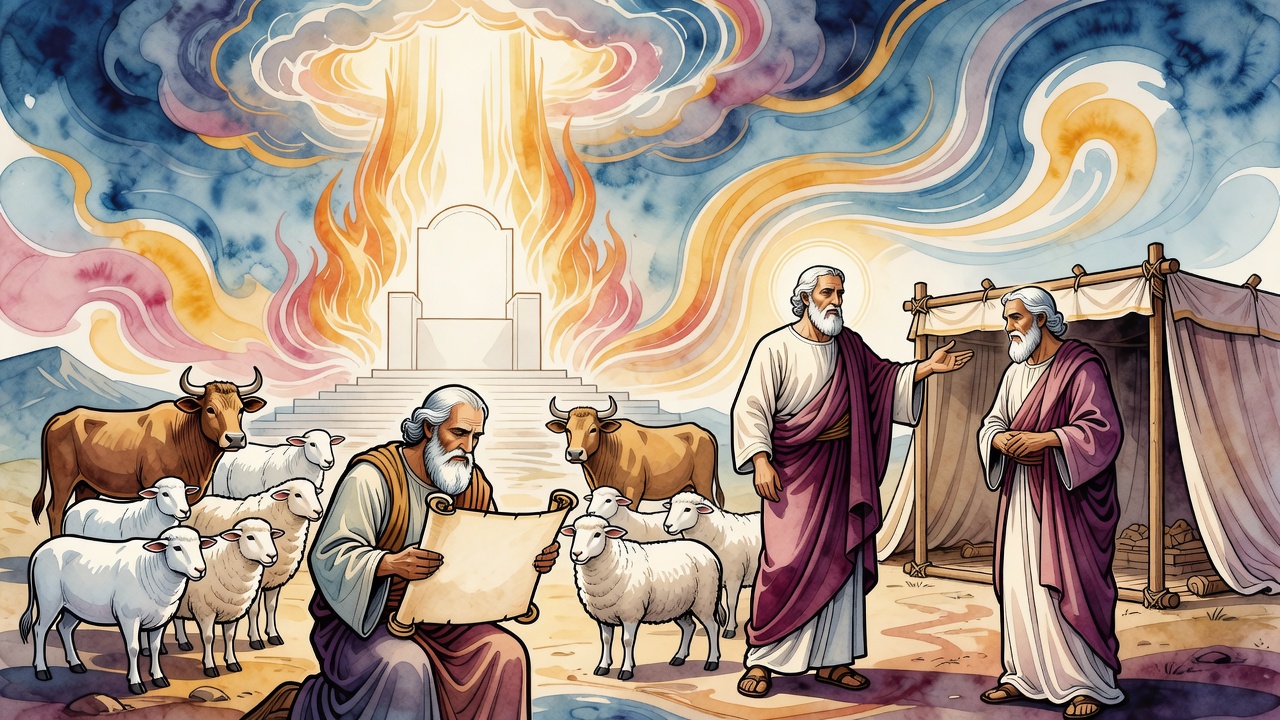
On the day of consecration Aaron and his sons leaned their hands on the bullock of the sin-offering. The Sifra asks why hands here. Not every offering receives that touch. They did it because this bullock was theirs. Ownership demands contact. Atonement will not stay abstract.

From that private scene the midrash draws a public rule. Communal offerings also require the laying on of hands. The priest who touches his own animal learns how to stand with the people. Scripture says of the ordinary Israelite, he shall lay his hand upon the head of his offering (Leviticus 3:2). No one may turn repair into a distant gesture.

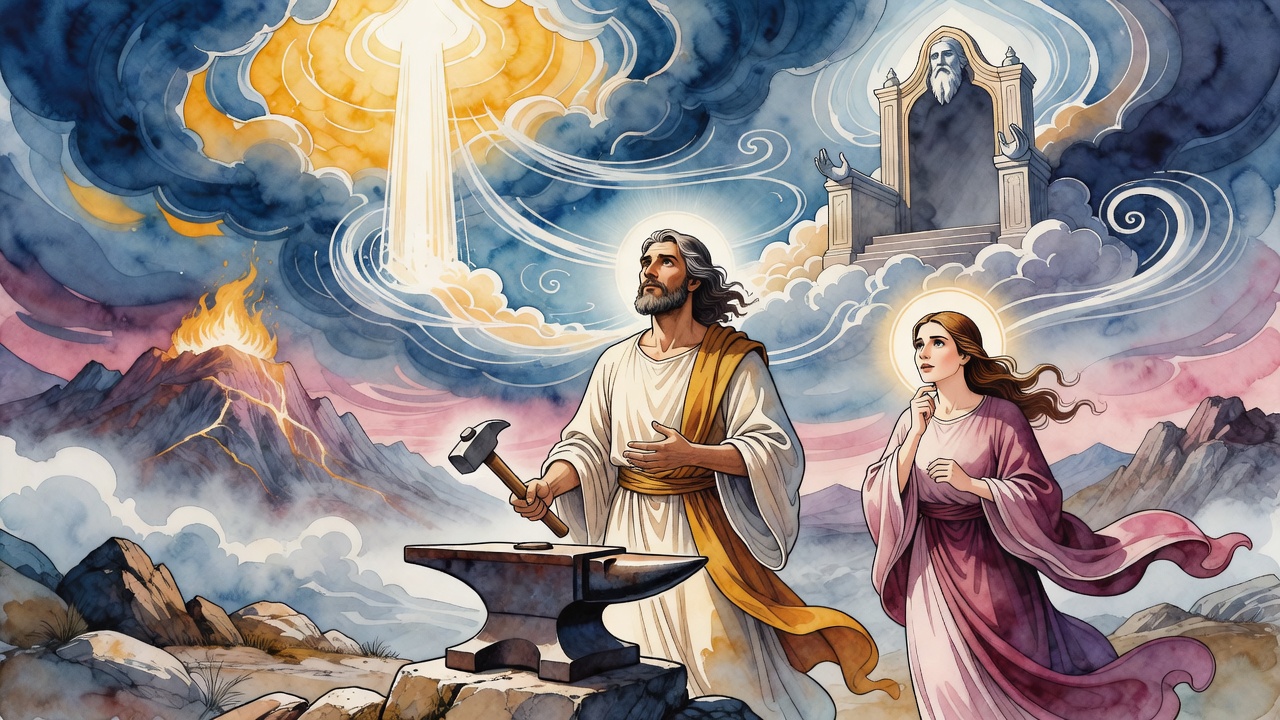
Palms press hide. Weight transfers. The animal becomes a carrier of a persons need for repair. Spinning women had already pressed fiber into thread. Now priests press intention into flesh. Different materials, same seriousness about contact.

One House, Many Kinds of Strength

Spinning women and waving priests do not compete. The sanctuary needs thread before it needs ceremony, and ceremony needs bodies willing to touch blood and gold without flinching. Wisdom of the heart can mean a spindle that does not snag. It can also mean a high priest who can lift a tribe and still bend to place both palms on a beasts skull.

When the cloud later filled the finished work, every kind of labor was already sealed inside the walls. Soft curtains remembered womens hands. The courtyard remembered priestly strength. The sin-bullock remembered the weight of palms. Holiness arrived as a people who had used their whole skill, not only their speeches.

Years afterward, when the camp moved and the curtains were folded again, someone still felt the old twist of yarn in the palm. Skill becomes memory. Memory becomes a people that knows how a house for God is made.

When the last curtain rose into place, a woman wiped fiber dust from her wrists and looked at a wall that could move with the camp. Aaron would lift and lean and serve. Her thread would travel with every journey of the cloud. The house of God was never only metal and speech. It was also the long patience of hands that refused to call skill a small gift.


← All myths

From the tradition

Sources

3 sources

The texts behind this telling. Some cards carry a translation of the source; others are our own retelling of it, and each card says which. Every card links out to the original.

Yalkut Shimoni on Torah 410:2Yalkut Shimoni on Torah

Translation of the source text.Torat Emet (Yalkut Shimoni) · CC-BY-NC

"And every woman wise of heart spun with her hands" (Exodus 35:25). (This is written in the portion "And they shall take for Me an offering," at the verse "And you shall make the Tabernacle of ten curtains," and in remez section 353.)

Full source
Midrash Tanchuma, Emor 4Midrash Tanchuma

Retold in our words. Read the original at the link below.Townsend 1989 translation of Midrash Tanhuma, S. Buber Recension · CC-BY

What is written after this passage (in Lev. 21:10)? “And the priest that is highest among his brothers” Why is he called by the name, “high priest?” Because he was highest (literally: greatest) in five things: in beauty, in strength, in wealth, in wisdom, and in age. In regard to beauty, because he was more handsome than his brothers. In regard to strength, because he was powerful in strength. Come and consider Aaron. When he waved the Levites (as in a wave offering), he waved twenty-two thousand in one day. How did he wave them? Back and forth, up and down. Ergo, he was highest in strength. With regard to wealth, where would it come from? If he was not wealthy, his brother high priests would magnify (rt. gdl) him. There is a story about Phineas the Stonecutter. When they appointed him high priest, his brother priests went out and saw him cutting stone. So they filled the quarry before him with gold dinars. And where is it shown that if he had nothing, his brother high priests would magnify (rt. gdl) him? Where it is stated (in an alternate translation of Lev. 21:10), “And the priest that is highest (rt. gdl) because of his brothers.” And [this rule applies] not to the high priest alone, but to the king as well. And so you find in the case of David, when he went to fight with Goliath the Philistine, Saul said to him (in I Sam. 17:33), “You cannot go unto this Philistine […].” David said to him (in vs. 34-36), “Your servant tended his father's sheep; and when a lion or a bear came and carried off a lamb from the flock, I would go out after it, smite it, and deliver it out of its mouth…. Your servant smote both the lion and the bear; and this uncircumcised Philistine shall be as one of them.” Saul said to him, “And who told you that you could slay him?” Immediately David replied, (vs. 37), “The Lord who delivered me from the paw of the lion will deliver me from the hand of this Philistine.” Immediately (we read in vs. 38), “Saul clothed David with his military garments.” Now it is written (in I Sam. 9:2), “he was a head taller than any of the people.” When he had clothed him in his garments and seen that they were fit for him, he immediately cast a jaundiced eye at him. When David saw that he had offended Saul, he said to him (in I Sam. 17:39), “I cannot go in these, for I am not used to them.” Here you learn that even though a person may be short, when he is appointed king, he becomes tall. Why? Because as soon as he is anointed with the anointing oil, he becomes superior to his brothers. David said, “I rejoiced over the anointing oil with which I was anointed.” It is so stated (in Ps. 16:9), “So my heart rejoices, and my glory exalts; my flesh also dwells in safety.”

Full source
Sifra, Mekhilta deMiluim I 13Sifra, Mekhilta deMiluim

Translation of the source text.Sifra by Rabbi Shraga Silverstein · CC-BY

13) "And Aaron and his sons laid their hands upon the head of the bullock of the sin-offering" (Leviticus 8:14): Do Aaron and his sons lay hands on all offerings? Rather, because these were their offerings, they laid hands upon it. Scripture compares public offerings to their offerings: just as their offerings require laying on of hands, so public offerings require laying on of hands. Just as he lays hands on his own offerings, so he lays hands on public offerings. But with an individual, each one lays hands on his own offering, as it is said, "And he shall lay his hand upon the head of his offering" (Leviticus 3:2).

Full source