Parshat Vayakhel5 min read

The Middle Bar That Turned Corners Alone

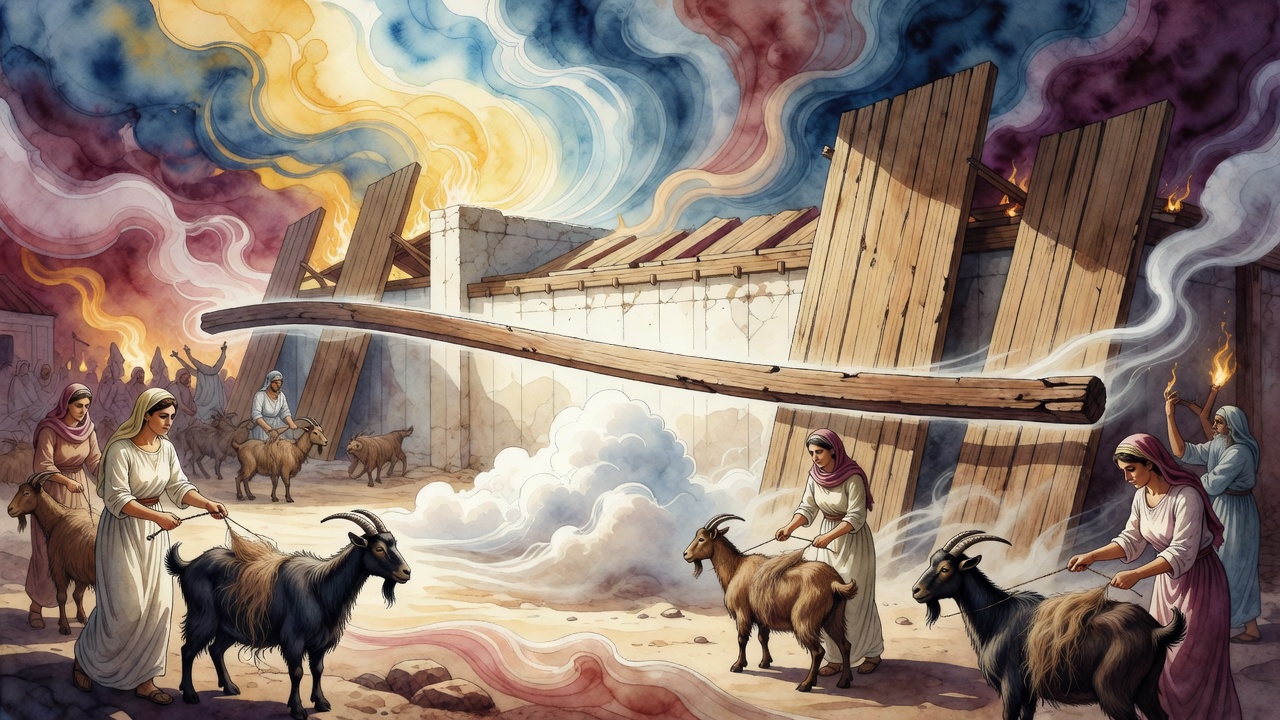
One bar ran the whole length of the Tabernacle wall, turning corners without a joint. Women spun goat hair on living goats while the boards rose.

Curated by Arthur · Told by Maggid ·
Table of Contents
  1. A Rod Through Every Board
  2. Hands That Spun on Living Goats
  3. Moses at the Altar's Logic
  4. Shekels Counted a Month Early
  5. What Holds When the Wind Hits
The Middle Bar That Turned Corners Alone Click for full size

A Rod Through Every Board

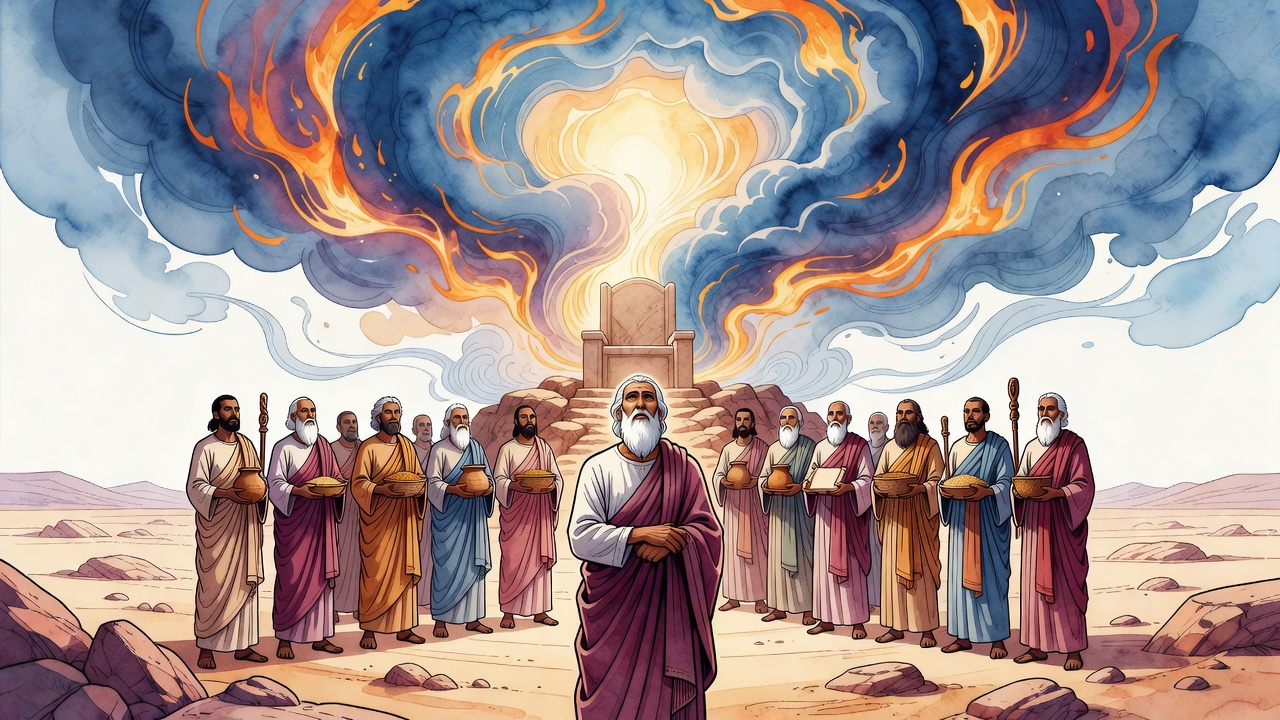
In the desert the boards of the Tabernacle stood in silver sockets like a spine waiting for a nerve. Workers slid bars through rings to lock the walls. Most bars behaved like carpentry. One did not.

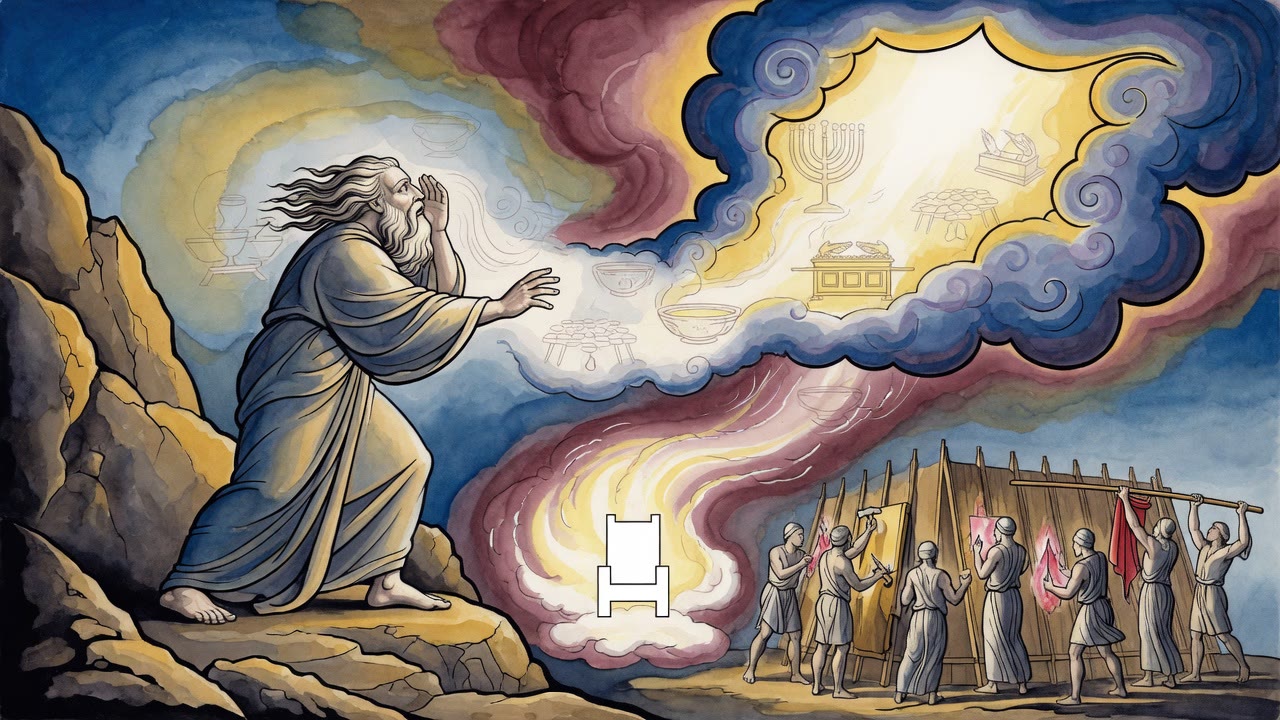
The middle bar ran the entire length of the wall, threaded through the thickness of the boards, and turned the corner from north to west and west to south as a single continuous rod. No joint where the angle should have forced a break. The sages said it plainly. The middle bar stood by a miracle, running unbroken through every board from end to end.

Men who had cut the boards still measured twice. They could not explain how a single length took the turn without a splice. They only felt the wall stiffen as the bar found its path. Around that wonder the sages later counted curtains with a clerk's patience. How much hangs down each side. Where the silver sockets peek out. The outer goat-hair covering trails longer than the inner cloth, and the image they leave is tender. The Tabernacle walks through the market of the world like a woman whose dress-train flows behind her.

Hands That Spun on Living Goats

Of the colored inner curtains the Torah praises wise-hearted women who spun with their hands. Of the rougher goat-hair coverings it praises a stranger skill. Rabbi Hiyya taught that they washed and spun the hair while it was still on the living goats. The animals stood. The women worked. The desert filled with the sound of fiber drawn straight from a breathing back.

No one called it romance. The goats stamped. The women kept their rhythm. The hair had to be clean and strong enough for a roof that would face wind and sand. Grooved boards, hollow sockets, golden clasps catching light like stars. A tent built plank by plank to mirror the heavens, held by a middle bar that refused ordinary geometry. Craft and miracle shared the same wall, and neither apologized for the other.

Moses at the Altar's Logic

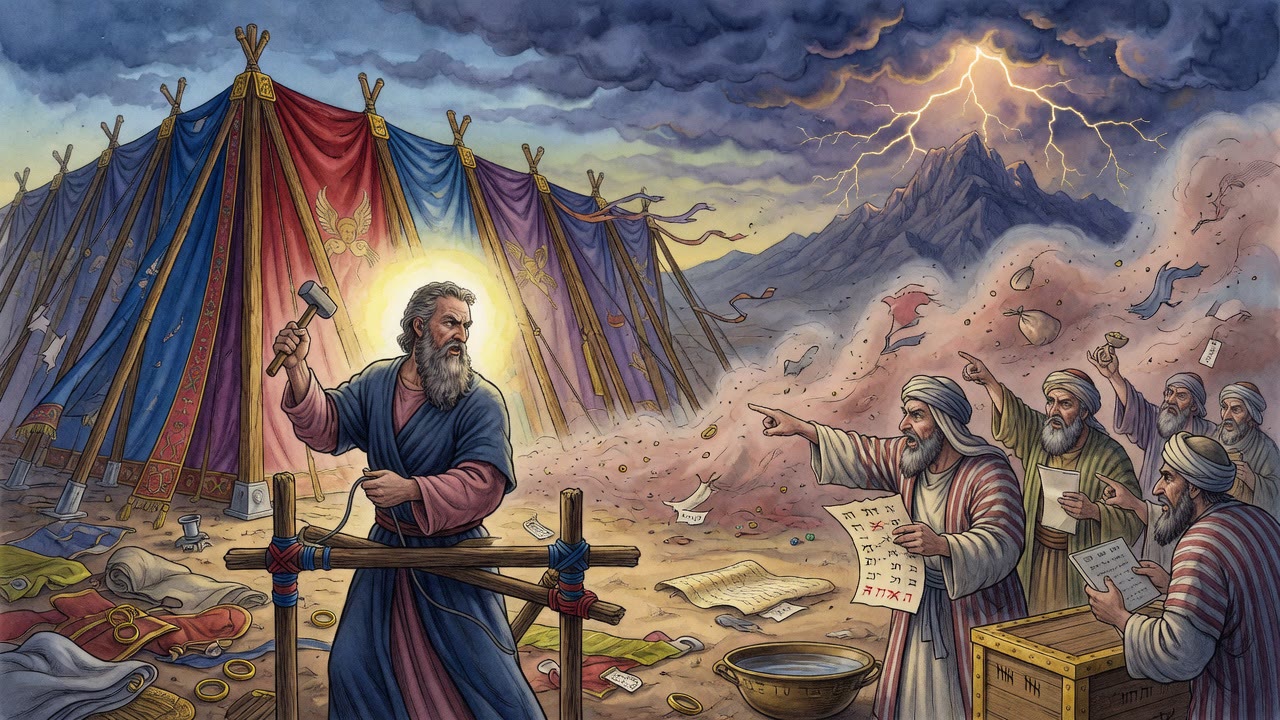
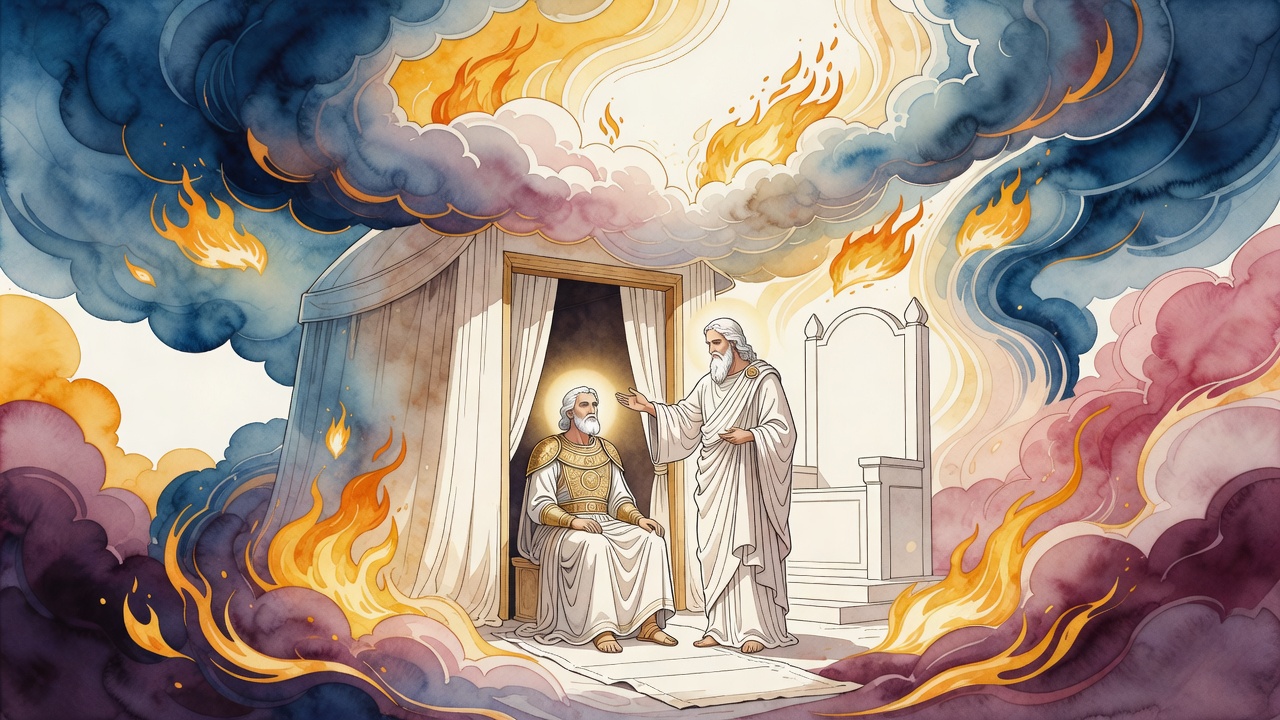
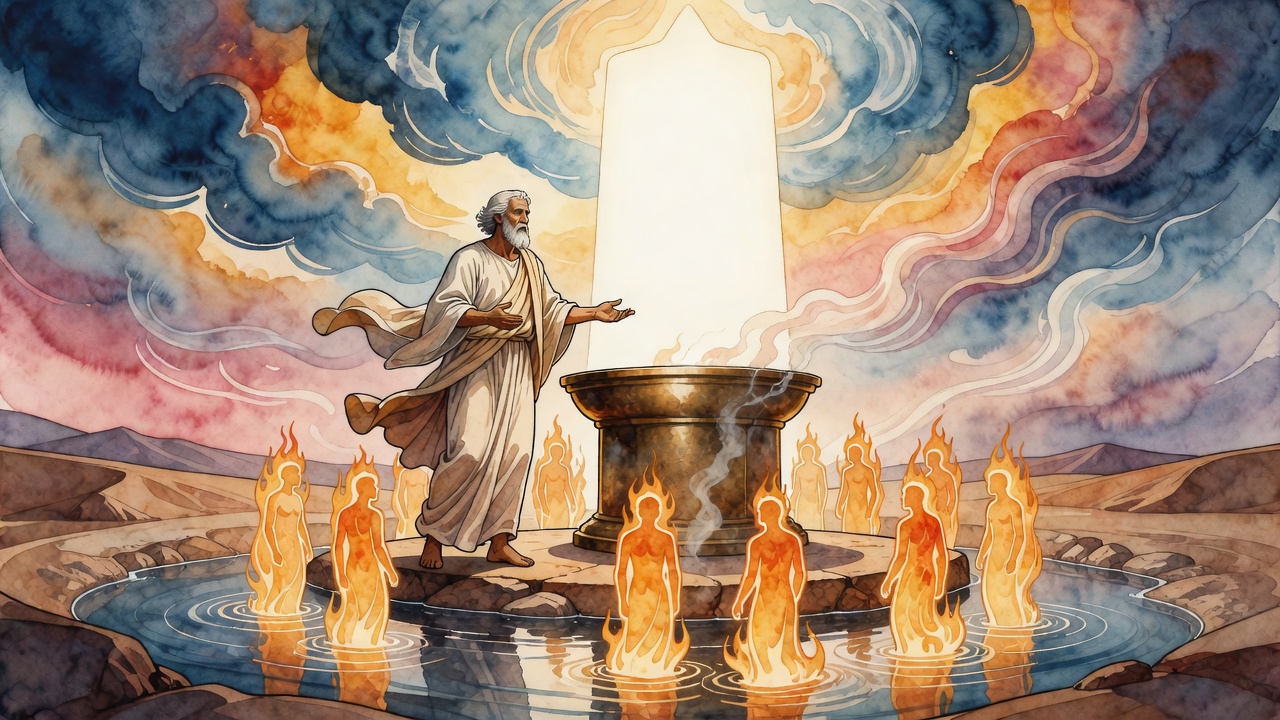
Moses learned that the altar was not only a place for fire. Shemot Rabbah walks the life of Moses through the altar's demands, the way a leader's body is trained by the same precision that trains a sanctuary. Measurements are not cold. They are how a people learns that holiness has edges, heights, ramps, and blood that must fall in the right place. The south-side ramp of later tradition, the careful approach, the refusal of stairs that would uncover nakedness, all of it trains the eye to treat approach as part of the offering.

The middle bar and the altar share a grammar. Heaven cares how things join. A wall that turns a corner without a seam, a ramp that rises without shame, a leader who accepts that the house of God will not be improvised from leftover wood. Moses had argued with God at a bush. He still had to learn to argue with a blueprint until his will matched the plan.

Shekels Counted a Month Early

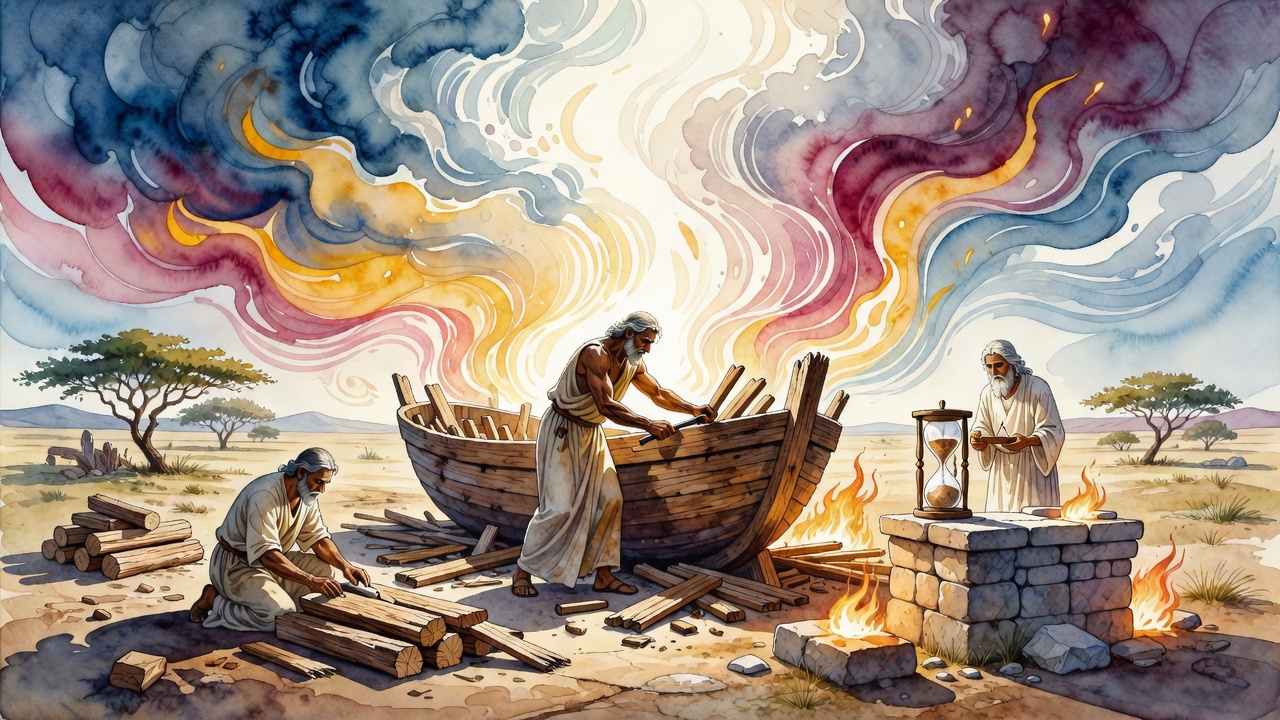
Later, when the people had a Temple and a calendar of chambers, the sages fixed the call for shekels on the first of Adar, a full month before Nisan needed them. Communal offerings of the new year had to be bought from a fresh contribution set aside on the first of Nisan. For that money to be ready and counted, the collectors had to start early. Timing itself became a kind of craft. The miracle bar held space. The shekel schedule held time. Both refused last-minute faith.

A people that watches a middle bar turn a corner without breaking can also learn to open the collection box before the festival panic begins. Sanctuary is not only vision. It is logistics baptized by commandment. Coins stacked in Adar become animals on the altar in Nisan. The chain is boring until the need arrives, and then it is holy.

What Holds When the Wind Hits

Desert wind tests every joint. The middle bar answers by being one thing through many boards. The women's spinning answers by taking fiber from life still standing. Moses at the altar answers by letting the structure teach the man. The Adar collectors answer by starting before the need is loud. None of these is a metaphor first. Each is a body or a board or a coin doing work under pressure.

When the Tabernacle finally rose, the people saw gold and goats' hair and a wall that should have needed three rods and somehow needed one. The miracle did not cancel the craft. It completed it. Children could walk the length of the wall and never see the place where ordinary wood would have demanded a joint. Adults who had spun and hammered knew better. They had felt the bar take the corner like a living thing that already knew the plan.


← All myths

From the tradition

Sources

3 sources

The texts behind this telling. Some cards carry a translation of the source; others are our own retelling of it, and each card says which. Every card links out to the original.

Yalkut Shimoni on Torah 369:10Yalkut Shimoni on Torah

Translation of the source text.Torat Emet (Yalkut Shimoni) · CC-BY-NC

"And the middle bar in the midst of the boards" (Exodus 26:28). It stood by a miracle. "And the Tabernacle you shall make of ten curtains, the length of the one curtain twenty-eight" and so on. Cast their length across the width of the Tabernacle: how much were they? Twenty-eight. Subtract ten for the roof; nine remain on this side and nine on that. According to Rabbi Yehudah a cubit of the sockets is left uncovered; according to Rabbi Nehemiah a cubit of the boards is also left uncovered. Cast their width along the length of the Tabernacle: how much? Forty. Subtract thirty for the roof; ten remain. According to Rabbi Yehudah a cubit of the sockets is covered; according to Rabbi Nehemiah a cubit of the boards is covered.

"And you shall make curtains of goats' hair, the length of the one curtain thirty cubits" (Exodus 26:7-9). Cast their length across the width: thirty. Subtract ten for the roof; ten remain on this side and ten on that. And it was likewise taught: "and the cubit on the one side and the cubit on the other of the surplus" (Exodus 26:13), to cover the cubit of the sockets, the words of Rabbi Yehudah; Rabbi Nehemiah says, to cover the cubit of the boards. Cast their width along the length: forty-four. Subtract thirty for the roof; fourteen remain. Subtract two for the doubling, as it is written, "and you shall double the sixth curtain" (Exodus 26:9); twelve remain. The school of Rabbi Yishmael taught: to what is the Tabernacle compared? To a woman walking in the market with her train trailing behind her.

Our Rabbis taught: the lower curtains were of blue, purple, and scarlet, and the upper six of goats' hair work, and greater wisdom is spoken of the upper than of the lower; for of the lower it is written, "and every wise-hearted woman spun with her hands" (Exodus 35:25), while of the upper it is written, "and all the women whose heart stirred them up in wisdom spun the goats' hair," and it was taught in the name of Rabbi Hiyya: it was washed on the goats and spun on the goats.

Our Rabbis taught: the boards were grooved and the sockets were hollow, and the clasps in the loops looked like stars in the firmament. The Tabernacle was thirty cubits long, ten wide, and ten high; Rabbi Yose says thirty-one cubits long. How did he set up the boards? He placed twenty boards on the north, twenty on the south, and eight on the west; but on the east there were no boards, only four pillars of acacia on which they hung the screen, as it is said, "and you shall set it on four pillars of acacia" (Exodus 26:32). He made the sockets hollow and grooved the board at the bottom, a quarter here and a quarter there, with the groove half in the middle, and made in it two tenons like two rungs and inserted them into two sockets, as it is said, "two sockets under one board" (Exodus 26:19), and grooved the board at the top a fingerbreadth here and a fingerbreadth there and set it into one golden ring so they should not separate from one another, as it is said, "and they shall be coupled below."

How did he set up the Tabernacle? He placed the forty silver sockets on the north and forty on the south and sixteen on the west and four on the east, thus "a hundred sockets for the hundred talents, a talent for a socket" (Exodus 38:27). Each board had two golden rings, one above and one below, in which they set the bars. The bars were each thirty cubits long opposite the twenty boards, and the middle one was twelve cubits long opposite the eight boards, sunk through the middle of the boards to east and west, as it is said, "and the middle bar in the midst of the boards" (Exodus 26:29). As he did for the boards of the north, so for those of the south; but in the west each bar was nine cubits long opposite six boards. And the boards, bars, pillars, and sockets, the thickness of the boards' surface, were overlaid with gold, as it is said, "and you shall overlay the boards with gold" (Exodus 26:29).

Full source
Shemot Rabbah 30:2Shemot Rabbah

Retold in our words. Read the original at the link below.The Sefaria Midrash Rabbah, 2022 · CC-BY

Take a look at Exodus. Right after (Exodus 21:1). What gives? What’s the connection? It’s like starting a story about building a house and then immediately launching into a discussion about ethical business practices.

That's the question Shemot Rabbah, a classical collection of Midrashic (rabbinic interpretive commentary) interpretations on the Book of Exodus, grapples with. What does the prohibition against using steps that might expose the priests have to do with laws about justice? Was there even a concern about the priests' nakedness being exposed? After all, as it says in (Exodus 28:42), "Make for them linen trousers to cover the flesh of their nakedness.”

Rabbi Avina offers a beautiful insight. He says that just as HaKadosh Baruch Hu, The Holy One, Blessed be He, cautioned the priests against taking large, hurried steps on the altar – the text literally says "heel next to toe" – so too, God cautions the judges not to take large, hurried steps in judgment. A priest on the altar is performing a sacred act, a service demanding reverence and careful consideration. Every movement matters. Similarly, judges must approach their task with measured deliberation. They can’t skip steps, make unfounded assumptions, or rush to conclusions. Their decisions impact lives, and they must proceed with the utmost care and integrity.

The physical act of ascending the altar becomes a metaphor for the weighty responsibility of administering justice.

The altar, a place of sacrifice and connection with the divine, requires a slow, respectful ascent. Justice, too, requires a slow, respectful process of careful consideration and deliberation. One misstep on the altar could be seen as disrespectful. One misstep in judgment could ruin a life.

Sometimes, the juxtaposition itself is the message. Sometimes, God speaks in whispers between the lines, urging us to approach both the sacred and the secular with reverence, caution, and a commitment to doing what is right.

Full source
Yalkut Shimoni on Torah 386:10Yalkut Shimoni on Torah

Translation of the source text.Torat Emet (Yalkut Shimoni) · CC-BY-NC

And why on the first of Adar? So that Israel may bring their shekels in their proper season, and the contribution of the chamber may be set aside from the new [shekels] at its appointed time, on the first of Nisan. Rabbi Yitzchak said: At the outset, "And it came to pass in the first month" (Exodus 40:17), and it is taught concerning it: on the day that the Tabernacle was erected, on that very day the contribution was set aside.

Full source