5 min read

The Body in the Field and the Broken-Necked Heifer

A corpse lay between towns with no killer named, so the nearest elders measured the land, broke a heifer's neck, and washed their hands in the wadi.

Curated by Arthur · Told by Maggid ·
Table of Contents
  1. The Measure That Names Guilt's Neighbor
  2. The Heifer That Never Worked
  3. Hands Over the Broken Neck
  4. What the Town Could Not Measure Away

Crows found the man first. By the time a shepherd boy reached the barley edge, the body was already stiff in the heat, face turned toward a town whose walls looked close enough to shame and far enough to claim ignorance.
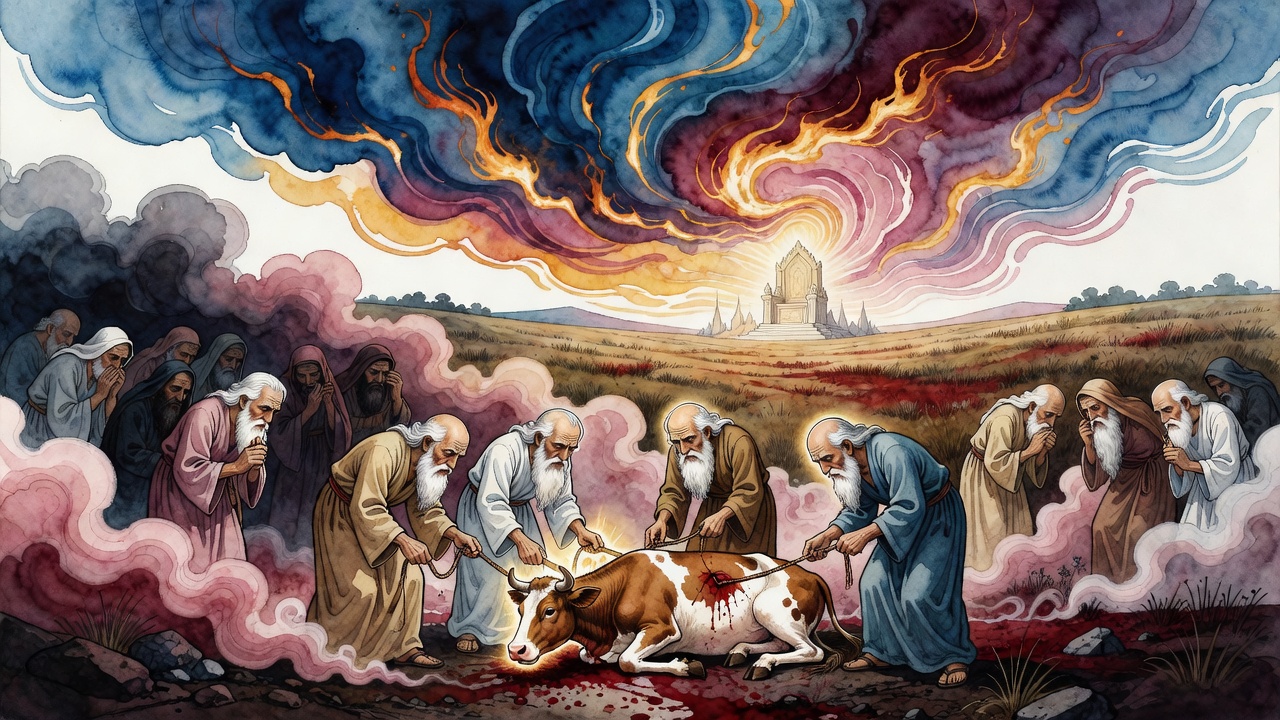
The Body in the Field and the Broken-Necked Heifer Click for full size

The Measure That Names Guilt's Neighbor

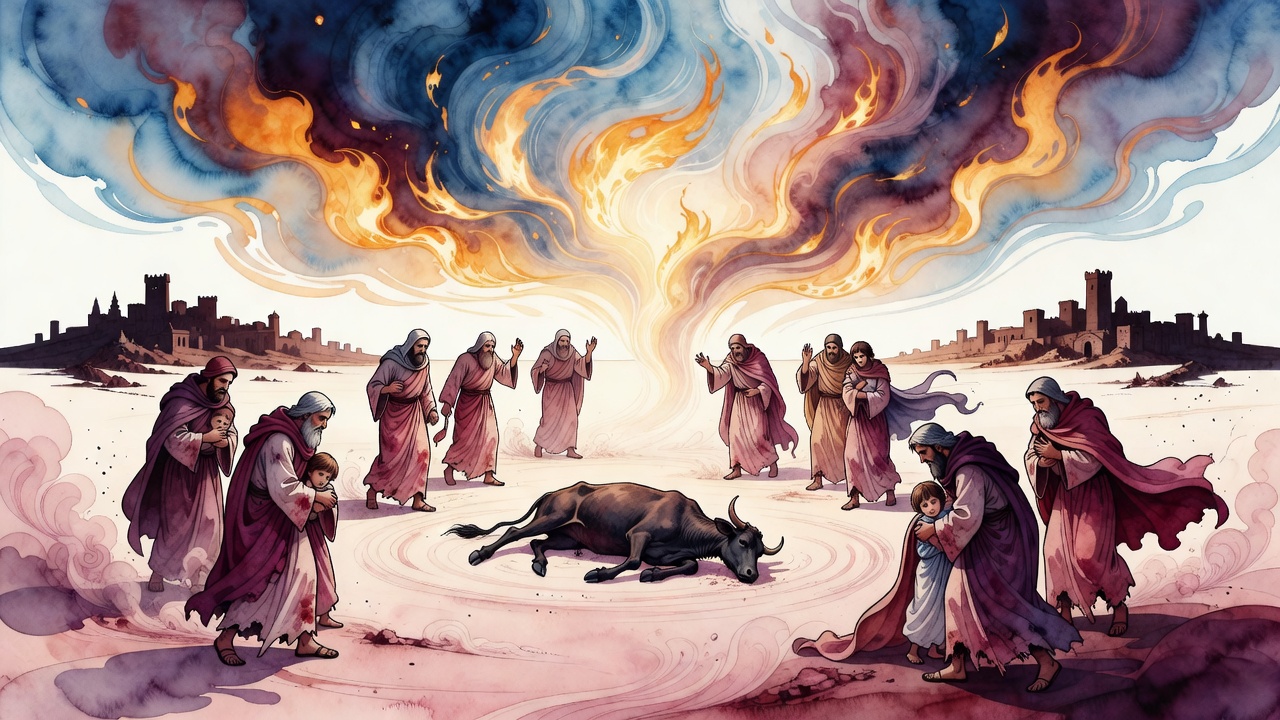
No knife lay nearby. No witness waited with a name and a pointing finger. The Torah's answer was not silence and not a shrug toward heaven alone. Elders came out with measuring cords and walked the ground between the corpse and the gates of every city that could claim him as their nearness (Deuteronomy 21:1-3).

The nearest town would own the ritual. Distance became accusation without a face. The boy who found the body kept his hands in his sleeves and watched the cords pull taut, as if the land itself were being forced to speak a verdict about hospitality and roads.

One elder muttered the road names under his breath, counting turns where a traveler might have expected company. Another refused to look at the dead man's open mouth. Flies did the looking for everyone, patient and precise.

When the measure settled, a murmur moved through the men from the closer gate. Nearness is not glory. Nearness is a debt the law collects in public.

The Heifer That Never Worked

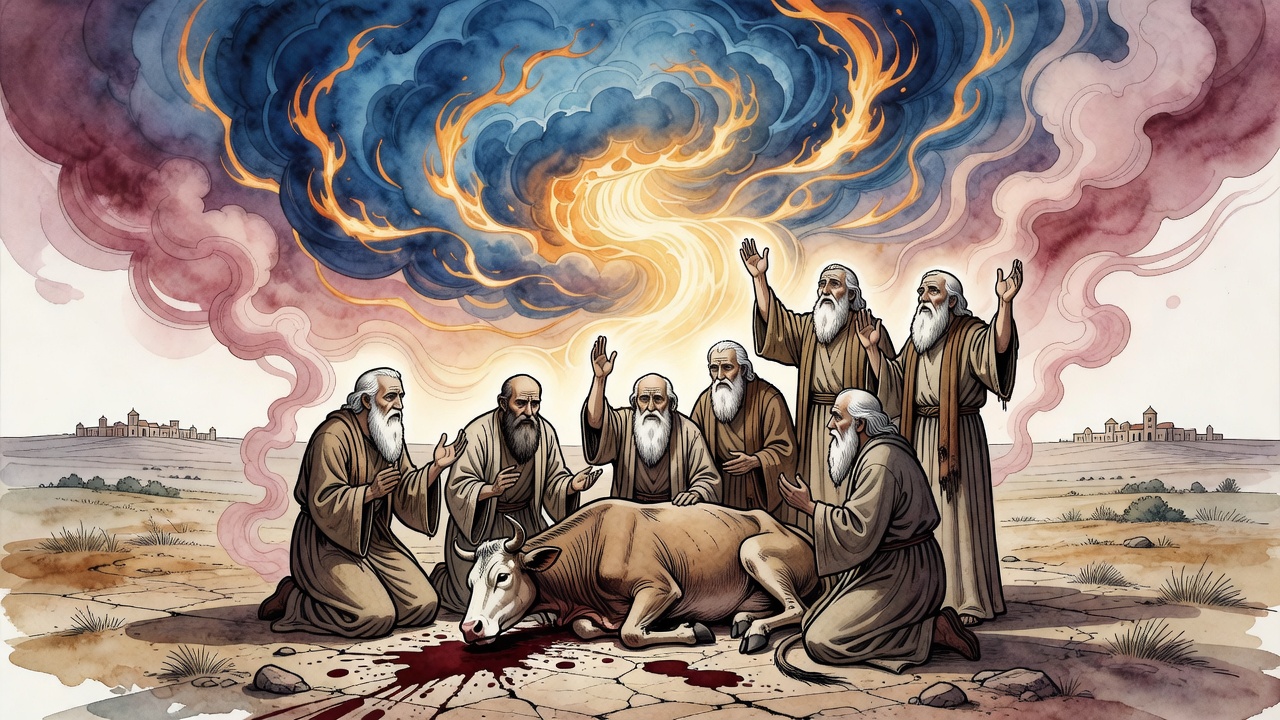
They brought a young heifer that had never pulled a yoke, never learned the rhythm of a plow. The animal walked with the calm of creatures that do not know law, only heat and the tug of a rope. The elders led her down to a nachal eitan, a hard riverbed that had never been sown, a place where water remembered rock better than crops (Deuteronomy 21:4).

If the bed was not hard, the ritual still needed a riverbed. The midrash teased the phrase until men stopped hiding in adjectives. If they argued about combing flax there or chiseling stone on the bank, the teaching drove them back to the core ban: this ground would not be worked as a field again. The death of the stranger would not be farmed into usefulness, plowed under as if blood were fertilizer.

The neck-break was quick and ugly. Blood darkened dust that had never held a plowshare. The sound made the boy flinch hard enough to drop a stick. An elder closed his eyes for half a breath and opened them onto a duty that had not finished.

Priests stood near because unknown murder was not left to local pride alone. Judgment and atonement had to share the same hard ground, with hands that serve the altar present when a city washed itself of a road's failure.

Hands Over the Broken Neck

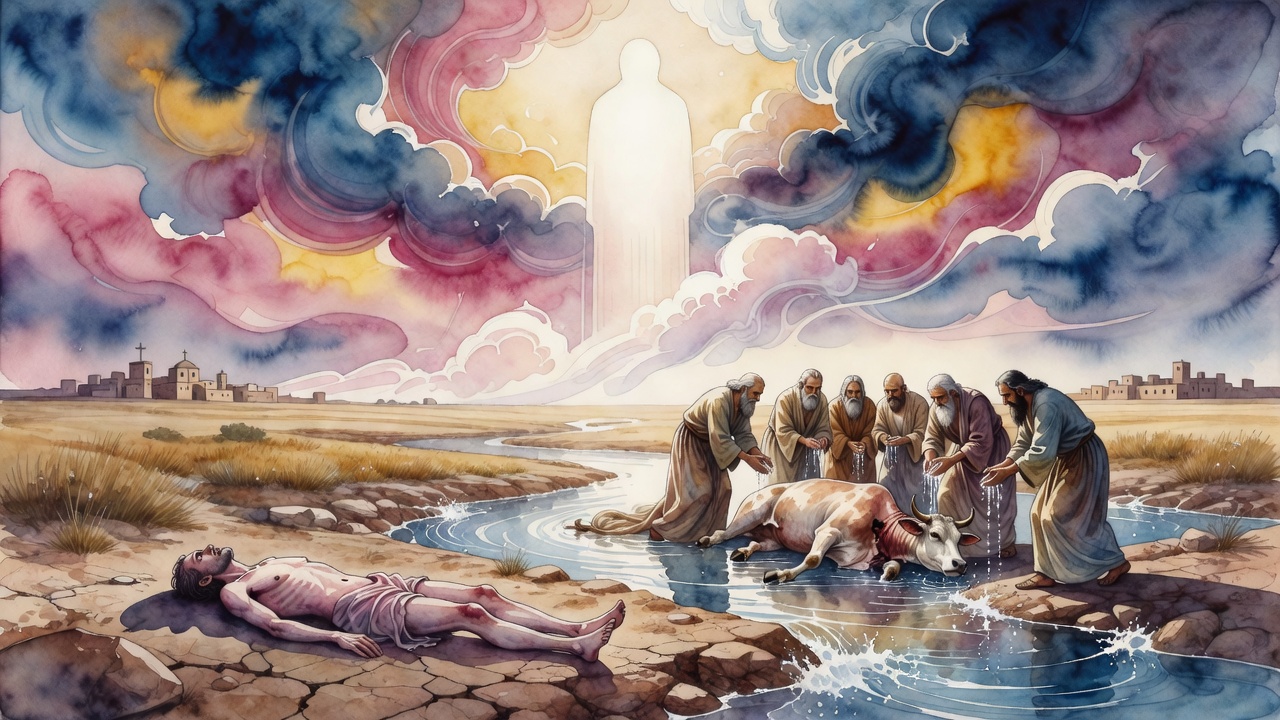
The elders washed their hands over the heifer in the riverbed and spoke the sentence that is almost a prayer and almost a legal oath: "Our hands did not shed this blood, nor did our eyes see" (Deuteronomy 21:6-7).

The words were not cheap. The midrash hears in them a city confessing what it failed to do for a traveler: no escort on a dangerous stretch, no food at a gate, no open door that might have kept a man off a lonely road at dusk. Innocence of the knife is not innocence of the road. A town can be clean of murder and still dirty with neglect.

Water ran from their fingers into the blood-darkened dust and made a thin, ugly paste. One elder's voice cracked on "our eyes." Another said the line flat, as if flatness could keep feeling from becoming theater. The heifer's body did not answer. Bodies used as signs rarely do.

The shepherd boy mouthed the words without sound, testing whether a child who only found the dead could claim the same sentence. He decided he could not. Finding is not the same as failing to protect.

What the Town Could Not Measure Away

After the washing, no one laughed and no one rushed back to market talk. The body would be buried with whatever dignity the heat still allowed. The heifer would not rise. The town would carry a new memory: a man died within their measure, and heaven required a public answer even when no human face could be dragged to court with blood on his sleeve.

That night the shepherd boy dreamed of cords stretching from the corpse to every gate in the valley. In the dream the cords sang like bowstrings drawn too tight. He woke and checked his own hands as if washing could be private and complete.

It could not. The law had already decided that unknown blood is a communal crisis, not a private tragedy for the crows and the barley. In the morning the riverbed looked ordinary again to a stranger's eye. To the elders it looked like a scar that would not grow grain, and that barrenness was the point.

Years later, when another traveler asked for escort at dusk, fewer men shrugged. Memory of a broken neck and washed hands is a poor teacher, but it is better than silence after crows.


← All myths
From the tradition

Sources

5 sources

The texts behind this telling. Some cards carry a translation of the source; others are our own retelling of it, and each card says which. Every card links out to the original.

Sifrei Devarim 207:1Sifrei Devarim

Retold in our words. Read the original at the link below.Sifrei by Rabbi Shraga Silverstein · CC-BY

An unsolved murder in the field becomes a public crisis, and Sifrei Devarim makes the nearest city answer for it.

Specifically, It grapples with the strange ritual of the eglah arufah, the "broken-necked heifer," described in (Deuteronomy 21:1-9). This ritual comes into play when a body is found in a field, and the murderer is unknown.

A person is found dead between cities. The Torah commands the elders of the nearest city to perform this ritual. They bring a young cow, one that hasn't been used for work, down to a rough, uncultivated valley. There, they break its neck.

Gruesome. But it's not just about the act itself. The elders then make a declaration, essentially saying, “Our hands did not shed this blood, nor did our eyes see it happen." (Deuteronomy 21:7). They’re proclaiming their innocence, and asking for atonement for the unsolved crime.

Why this elaborate, seemingly bizarre ritual? Many commentators suggest it's about taking responsibility. Even if the city's elders weren't directly involved, the Torah implies a communal responsibility for the safety and well-being of travelers. Maybe they failed to provide adequate protection or support for those passing through their area.

Now, here’s where Sifrei Devarim (Devarim 21:4) steps in. It focuses on the phrase "And the elders of that city shall bring the heifer down." The text highlights a repetition: the Torah mentions "the elders of that city" twice, once in verse 3 and again in verse 4. Why the repeat?

The Sifrei argues that this repetition isn't accidental. It's there to emphasize that this ritual isn't just a good idea, or a mitzvah (a good deed or commandment) that you could do. It’s a categorical requirement. It must be done. The community is obligated to address this unsolved crime and seek atonement.

But, as with all things in Jewish law, there are nuances. The text continues, "From here they ruled: If the body were found near the border or near a city inhabited mostly by gentiles or near a city lacking a beth-din, they would not measure.”

A beth-din is a Jewish court. So, what's going on here?

The Sifrei is telling us that the ritual of the eglah arufah isn't applicable in every situation where a body is found. If the body is discovered near a border, in an area populated mainly by non-Jews, or close to a town without a functioning Jewish court, the ritual is waived.

Why? The commentaries offer several explanations. Maybe it's because the responsibility of the Jewish community is less clear in these areas. Perhaps the lack of a beth-din suggests a breakdown in communal responsibility already. Or maybe, in areas heavily populated by gentiles, there’s a greater likelihood that the perpetrator isn't part of the Jewish community.

This passage from Sifrei Devarim offers a glimpse into the complex and nuanced world of Jewish law. It's not just about following rules, but about understanding the underlying principles of responsibility, justice, and atonement. The ritual of the eglah arufah, though strange to our modern sensibilities, serves as a powerful reminder that we are all connected and responsible for one another, and that even in the face of the unknown, we must strive to seek justice and repair the world. It begs us to consider: What does it truly mean to be responsible for our community?

Full source
Sifrei Devarim 207:3Sifrei Devarim

Retold in our words. Read the original at the link below.Sifrei by Rabbi Shraga Silverstein · CC-BY

There's one in particular, the ritual of the eglah arufah, the "broken-necked heifer," that always gets me. It deals with a murder where the perpetrator is unknown and how the elders of the nearest city must atone for the unsolved crime.

One of the most striking parts of the ritual, found in Deuteronomy 21, involves taking a heifer to a very specific location: a nachal eitan. This is often translated as "a hard riverbed" or "a constantly flowing wadi." But what does that even mean, and why is it so important?

Our source today, Sifrei Devarim, a halakhic midrash on the Book of Deuteronomy, dives into this very question. The verse says, "And they shall bring the heifer down to a hard river-bed." (Deuteronomy 21:4). But what if the riverbed isn't hard? Does that invalidate the whole ritual?

The Sifrei teases out a fascinating nuance here. It points out that the verse continues, "in the river bed." The implication? Even if it isn't hard! So, the basic requirement is being in a riverbed. The "hard" part seems less crucial.

But then the Sifrei asks another question. The verse goes on to say that the riverbed "shall not be worked." Does that mean absolutely no work can ever be done there?

The text answers by pointing to the specific prohibition of "sowing" in that riverbed. "Sowing was included in all (labor)," the Sifrei tells us. So why single it out?

Here's where it gets interesting. The Sifrei uses the act of sowing as a paradigmatic example. A paradigm, in this case, is a model or pattern. It explains: Just as sowing is distinctly work in the soil, all forbidden labors must also be labors of the soil. This excludes activities like combing flax or chiseling stones, which aren't directly related to working the land.

So, what are we left with? The ritual of the eglah arufah, with its strange details about a hard, unworked riverbed, isn't just some arbitrary set of rules. It reflects a deeper concern with the connection between the land, our actions, and atonement.

The key takeaway? The Torah, and the rabbinic interpretations of it, often use very specific details to teach us broader principles. It's not just about the "what," but the "why" behind the commandments. By examining these seemingly minor points, we gain a richer understanding of the underlying values and concerns of Jewish tradition. Next time you encounter a seemingly strange detail in the Torah, remember the eglah arufah and the hard riverbed. Ask yourself: what deeper meaning might be hidden within?

Full source
Sifrei Devarim 210:1Sifrei Devarim

Retold in our words. Read the original at the link below.Sifrei by Rabbi Shraga Silverstein · CC-BY

This ritual is performed when a murder occurs and the perpetrator is unknown. It’s a heavy, somber moment, designed to atone for the bloodshed and absolve the community of guilt.

The passage It's all about location, location, location!

"“They shall wash their hands over the heifer of the broken neck in the river-bed” (Deuteronomy 21:6)." The text emphasizes in the river-bed. Why? Well, the Sifrei Devarim points out the obvious: the washing must take place right there, where the heifer’s neck was broken. It's not enough to just be near the river; you have to be in it.

Then comes the kicker: "I might think that they may go up from the river-bed; it is, therefore, written 'in the river-bed.'" So, just in case you thought you could pop out of the river for a moment, the Torah is crystal clear: stay put!

Why all the fuss about being in the river-bed? Perhaps it emphasizes the severity of the situation. The elders are literally immersing themselves in the consequences of the unsolved crime, symbolically cleansing themselves in the place of tragedy. They can't distance themselves, even for a moment, from the weight of what has happened.

It doesn't stop there, though. The text continues: "And they shall answer and they shall say": Their washing and their saying must be in the river-bed." Not only the washing, but the saying too! The elders must declare their innocence and disavow any knowledge of the murderer, right there in the river-bed.

And what language should they use? According to Sifrei Devarim, verse 7 of Deuteronomy 21 tells us that "they shall answer and say": in the holy tongue (Hebrew). The statement of innocence had to be articulated in Hebrew, the language of the covenant, adding another layer of solemnity and commitment to their declaration. They're standing in the river-bed, a place of uncertainty and potential danger. They are speaking in Hebrew, the language of their deepest connection to God. They are performing an ancient rite, hoping to bring closure and atonement.

What does this teach us? Maybe it's about the importance of being fully present in moments of crisis. Maybe it's about the power of language to connect us to something greater than ourselves. Or maybe it's simply a reminder that even the smallest details can carry profound meaning.

The next time you encounter a seemingly minor detail in a ritual or tradition, remember the eglah arufah. Ask yourself: what deeper truth might be hidden within the specifics? You might be surprised by what you discover, standing right there in the river-bed of understanding.

Full source
Sifrei Devarim 206:3Sifrei Devarim

Retold in our words. Read the original at the link below.Sifrei by Rabbi Shraga Silverstein · CC-BY

Ever stumble upon a mystery so ancient, so… rural, that it makes you scratch your head and wonder, "How did they even figure this out?"

It all revolves around an unsolved murder. Imagine this: a body is found between two towns. A real tragedy. But ancient Israelite law, as detailed in (Deuteronomy 21:1-9), didn't just shrug its shoulders. It demanded action. Specifically, the elders of the nearest town had to perform a ritual with a heifer, the eglah arufah, the heifer of the broken neck, to atone for the unintentional shedding of innocent blood.

Which town? And what kind of heifer are we talking about? Our source today, Sifrei Devarim 206, really digs into these details.

“The elders of that city shall take a heifer that has not been worked.” Okay, makes sense. But Sifrei Devarim immediately clarifies: not just any elders, and certainly not the elders of Jerusalem. And, perhaps unsurprisingly, Jerusalem doesn’t bring an eglah arufah. Why Jerusalem? Well, it was considered a holy city, a place of purity and justice. The ritual seems specifically designed for communities further removed from that concentrated holiness, places where perhaps unintentional sins were more likely to occur.

Then comes the age of the heifer. The text says, "they shall take a heifer" (eglath bakar). Now, eglath bakar literally means a heifer from cattle. Simple enough. Not so fast.

Rabbi Eliezer, a prominent sage from the late 1st and early 2nd centuries CE, offers his opinion. He says that eglath means up to one year old. But a parah, a cow specifically for the parah adumah ritual (the red heifer described in (Numbers 19:1-2)2), should be two years old.

The other sages, however, had a slightly different view. They argued that an eglah could be even two years old. A parah? Three or even four years old! Their reasoning? It’s written “eglath bakar.” The word bakar, cattle, allows for a little more wiggle room, it seems.

So how do we reconcile these opinions? How do we put this into practice? Sifrei Devarim provides a brilliant, practical solution: a two-year-old heifer satisfies both definitions. It’s old enough to be considered bakar, and still young enough to be considered an eglah. Problem solved!

What I find so compelling is how these ancient texts confront real-world problems. It's not just abstract theology; it's about justice, responsibility, and the messy reality of human life. This passage, in particular, reveals the meticulous, almost forensic, approach the rabbis took to interpreting the law. They weren't just looking for loopholes; they were trying to understand the underlying principles and apply them in a way that was both fair and meaningful.

This deep dive into the eglah arufah shows us that even in the most seemingly obscure corners of Jewish law, there are profound lessons about responsibility, community, and the enduring search for justice. What does it mean for a community to take responsibility for the unknown? What does it mean to atone, even when no one is directly at fault? These are questions that resonate just as powerfully today as they did thousands of years ago.

Full source
Sifrei Devarim 206:1Sifrei Devarim

Retold in our words. Read the original at the link below.Sifrei by Rabbi Shraga Silverstein · CC-BY

Ever stumble upon a mystery so perplexing, so deeply rooted in ancient law, that it makes you scratch your head and wonder, "How did they even figure this out?"

Well, pull up a chair, because It revolves around an unsolved murder and a ritual designed to atone for bloodshed. This isn't your average "whodunit." This is a case steeped in ancient Jewish law from Sifrei Devarim, a legal commentary on the Book of Deuteronomy.

A body is found in a field, and the killer is nowhere to be seen. The Torah, in Deuteronomy 21, lays out a procedure. The elders and judges of the nearest city must perform a ritual to declare their innocence and seek atonement for the unintentional negligence that might have led to the death.

That's where things get interesting.

Sifrei Devarim 206 explores the specifics of this measurement. It states, "and they shall measure to the cities that are around the slain one." The key is direction. According to this text, we measure from the body to the cities, not the other way around. Why this distinction? It emphasizes the responsibility of the community closest to the tragedy. The focus is on where the blood cries out from.

And what if the body is… fragmented?

Let's say the head is found in one place, and the rest of the body in another. A gruesome thought, I know, but legal minds had to consider every possibility. Rabbi Eliezer says the head should be brought to the body. His reasoning likely stems from the idea that the body represents the whole person, the primary site of life. Rabbi Akiva, however, argues the opposite: the body should be brought to the head. Perhaps he prioritizes the head as the seat of intellect and consciousness. These differing opinions highlight the nuanced interpretations within Jewish law.

But the debate doesn't end there.

(Deuteronomy 21:3) states, "And it shall be, the city closest to the slain one." The text emphasizes "the nearest" (singular) and not "the near ones" (plural). This leads to another legal conundrum: What happens if the body is found equidistant between two cities?

Sifrei Devarim tells us that Rabbi Eliezer ruled that both cities should bring two separate heifers for the ritual. Each city bears the responsibility independently. However, "the sages" – a collective term for other rabbinic authorities – disagree. They argue that only one city should bring the heifer, asserting that two cities cannot simultaneously be considered the "nearest." This disagreement emphasizes a fundamental principle in Jewish law: the striving for a single, clear, and actionable ruling.

What's the takeaway from all this? It's more than just ancient legal wrangling. It's a reflection on communal responsibility, the value of human life, and the complexities of justice. This passage from Sifrei Devarim, and the debates surrounding it, reveal the depth and rigor of Jewish legal thought. It forces us to consider not only the letter of the law but also its underlying principles and moral implications.

Remember the rabbis confronting the details, striving to find justice and meaning in the face of tragedy. And remember that even in the most difficult of circumstances, the pursuit of understanding is always worthwhile.

Full source