5 min read

Clouds That Rose From Earth and From Heaven

Rabbi Yochanan and Resh Lakish argue where clouds begin, while the wind circles and the stars keep the moon's night watch.

Curated by Arthur · Told by Maggid ·
Table of Contents
  1. The Cask and the Basket
  2. The Wind That God Weakens
  3. Stars That Serve the Moon
  4. What the Earth Must Bring

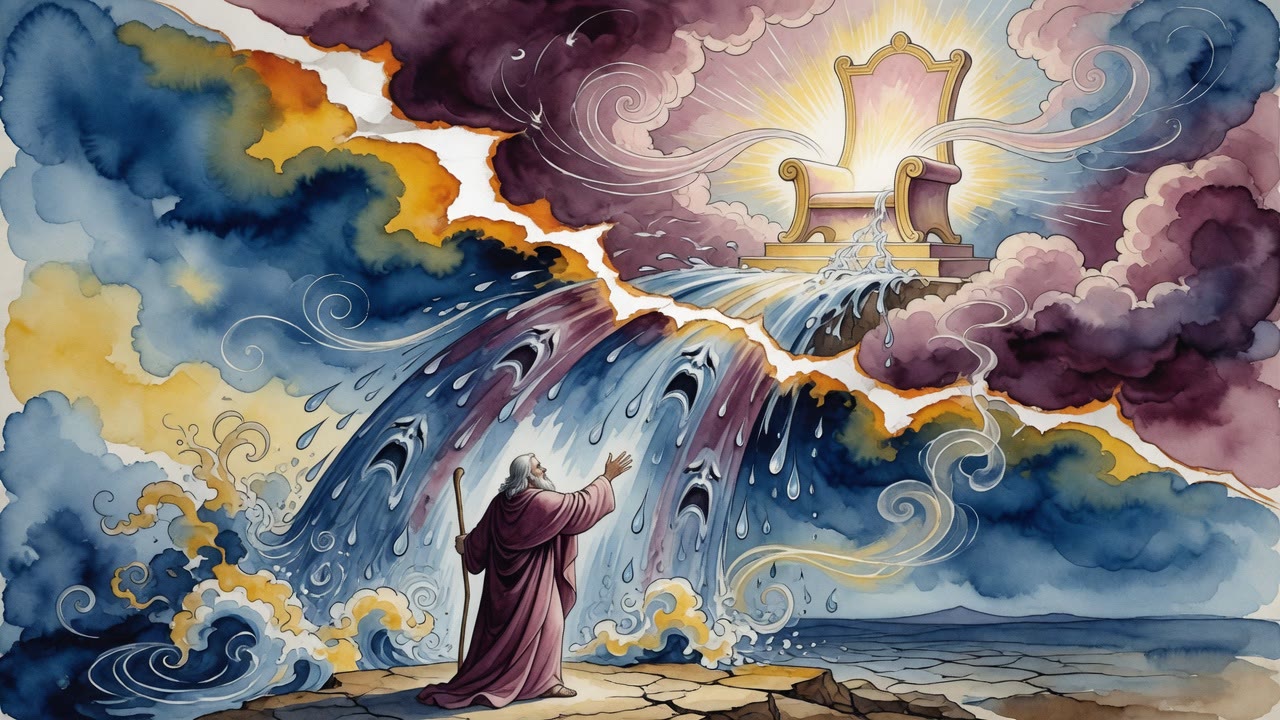
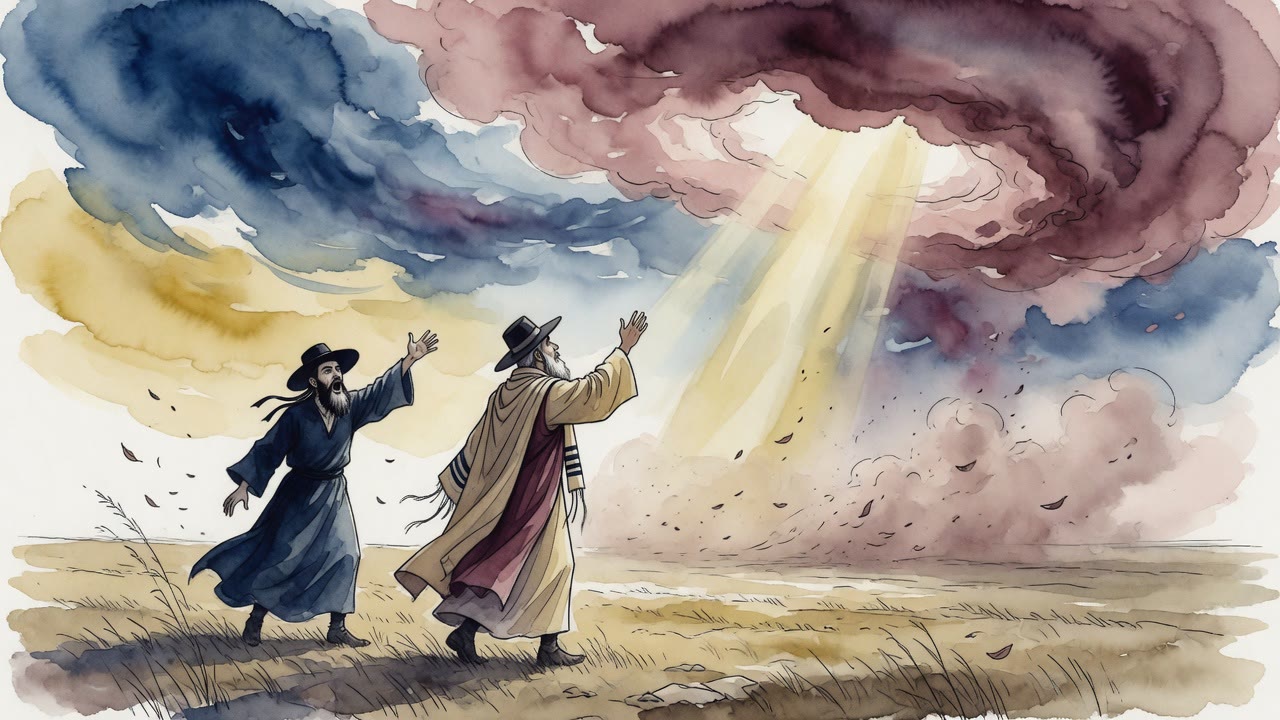
Rabbi Yochanan lifted his hand toward a gray bank over the Galilee and refused to look down. "They come from above," he said. The clouds of heaven in Daniel stood with him. Rain was a gift lowered, not a vapor bargained up from dust.
Clouds That Rose From Earth and From Heaven Click for full size

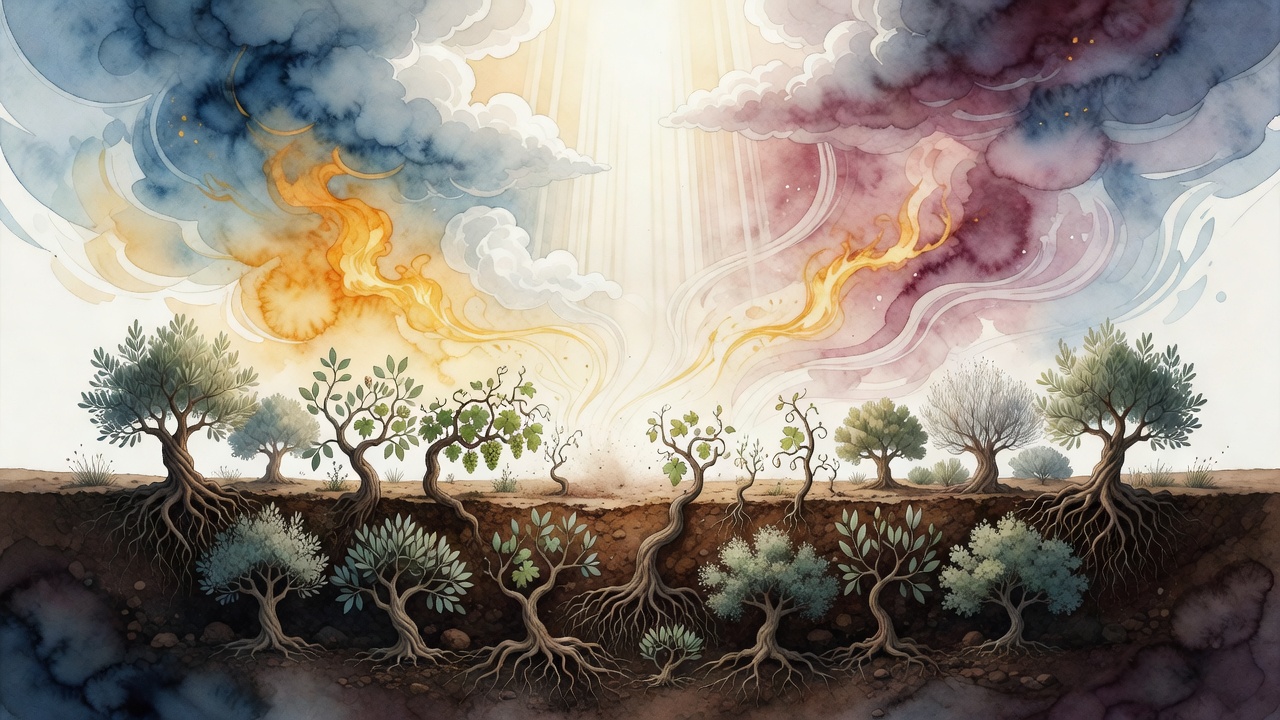
Rabbi Shimon ben Lakish crouched, scooped a fist of dry earth, and let it fall. "He makes clouds ascend from the ends of the earth," he answered, quoting the psalm. The sky, in his reading, waits for the ground to rise and meet it.

The Cask and the Basket

Yochanan pictured a giver who hands over a cask of wine with its pitcher already included. Heaven does not need the earth to invent moisture. Blessing arrives complete. Resh Lakish answered with a lender of grain who says, "Bring your basket and come measure." The Holy One tells the earth to bring its own clouds and receive rain into them. Participation is not optional. The ground must show up with a vessel.

Neither man was joking. Farmers waited on their dispute the way they waited on the season. If clouds are pure gift, prayer is thanksgiving. If clouds require earth's basket, prayer is also labor: open the ground, turn the soil, refuse despair when the horizon stays hard.

The Wind That God Weakens

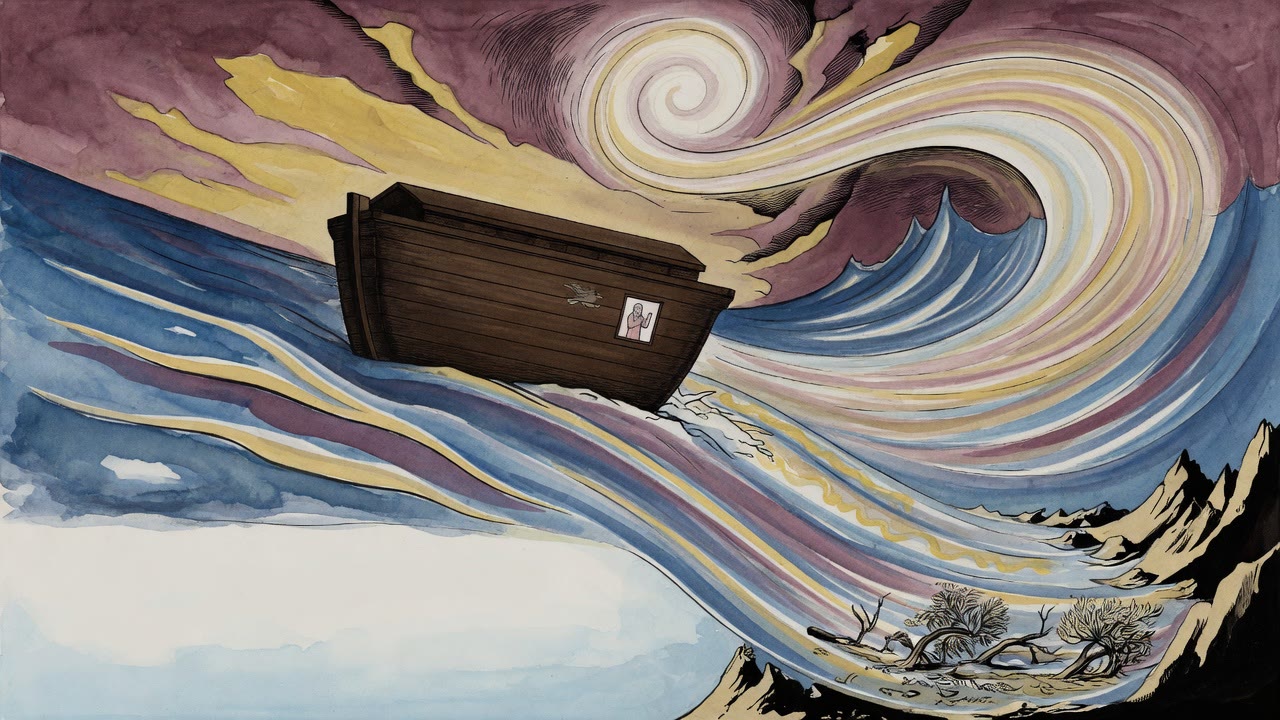
While they argued about height, the wind kept its rounds. It goes south by day and north by night, east and west in turn, and returns on its circuit. Rabbi Yehoshua ben Hananya taught that when the wind first enters the world, the Holy One weakens it against mountains and hills. "Be careful that you do not harm My creations," God warns the gale.

Isaiah's line about the faint wind becomes, in the midrash, a mercy toward souls. God made the spirits that inhabit bodies. An unchecked wind would tear them. So the same Power that hangs clouds also softens the force that drives them. Rain is not a blunt instrument. It arrives under restraint.

Stars That Serve the Moon

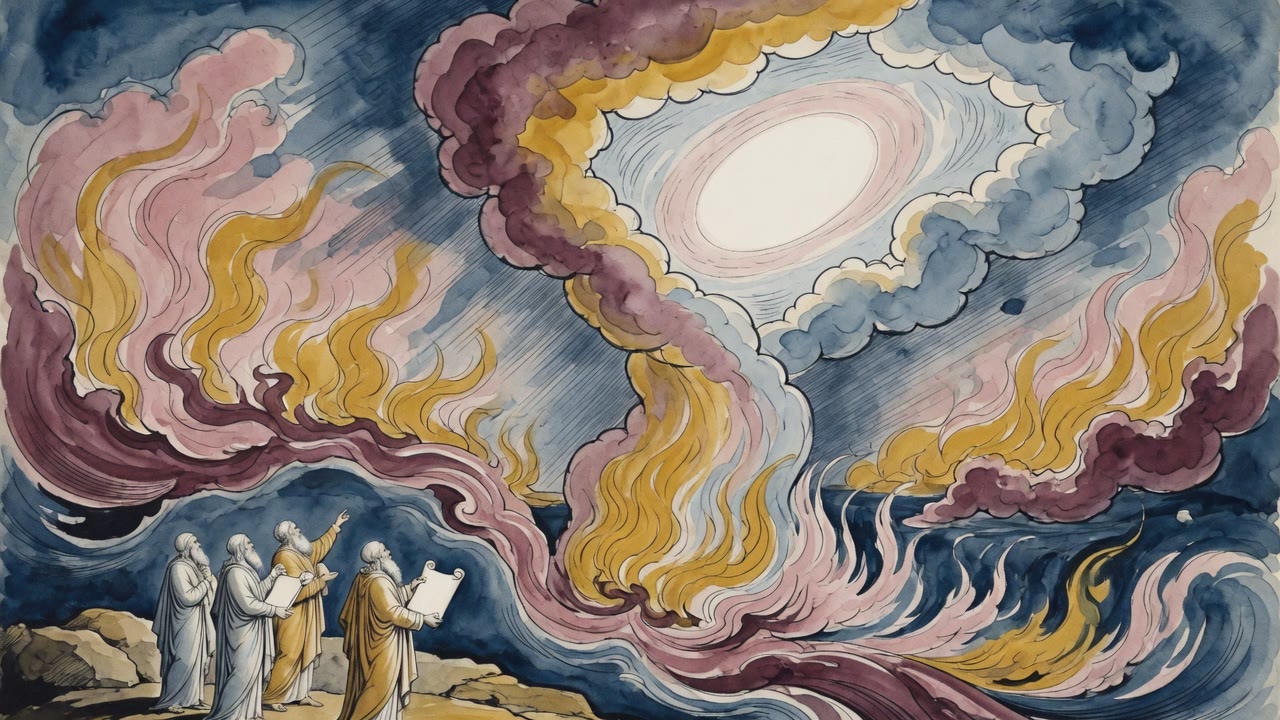
At night the argument changes color. Pirkei DeRabbi Eliezer sets constellations in four companies, three to a quarter of the sky, attending the moon through the hours. Two hours keep watch in each direction. The southern luminaries hold most of the great lights; the Great Bear alone holds the north like a stubborn sentry.

Clouds that hide those stars do not erase their service. The midrash imagines a night court still in session above the weather. Rain may rise or fall in dispute, but the lunar watch continues. Creation is not a single machine with one switch. It is stacked watches: wind tempered, stars on rotation, clouds argued into blessing.

What the Earth Must Bring

A woman who has prayed for rain knows both rabbis without their names. She looks up and begs. She also digs a channel so the first drop has somewhere to run. Yochanan's gift and Resh Lakish's basket live in the same field. Heaven gives. Earth answers with readiness.

On a morning when the ridge stayed hard, a farmer walked his boundary stones and felt Resh Lakish in his knees. He cleared a ditch. He checked the cistern mouth for debris. He did not stop praying. Yochanan's gift still needed a place to land. When a thin cloud finally dragged its shadow across the barley, his children ran out with pots as if they could catch the sky in clay.

At night the same family watched the moon and did not know the midrash of the star companies, yet they felt the order. Wind that might have torn the roof only rattled it. Someone, the story says, had already spoken to that wind about souls. The debate of the two rabbis was never meant to end in a vote. It was meant to keep both hands honest: the hand that opens upward and the hand that holds a basket ready.

Travelers crossing the valley saw the same clouds and told different stories. One said Heaven had remembered. One said the earth had finally exhaled. Both were describing the same gray mercy. The midrash keeps their argument alive so later mouths will not reduce rain to accident or to pure entitlement.

When the first cloud finally darkens the ridge, no one stops to declare a winner. They open the cisterns. They cover the grain. They watch the wind for the moment it turns from scourge to carrier. The dispute remains on the page so later generations can keep both hands open: one lifted, one holding a basket.

Before dawn a watchman on the town wall felt mist on his face and could not say whether it had climbed from the valley floor or been lowered like a curtain. He only knew the stones under his palms had gone damp. By noon the same mist would be argument in the study house and water in the cistern. The rabbis' debate was never far from a working man's skin.


← All myths
From the tradition

Sources

3 sources

The texts behind this telling. Some cards carry a translation of the source; others are our own retelling of it, and each card says which. Every card links out to the original.

Bereshit Rabbah 13:11Bereshit Rabbah

Retold in our words. Read the original at the link below.The Sefaria Midrash Rabbah, 2022 · CC-BY

Even the great rabbis of old disagreed about the answer!

In fact, Rabbi Yoḥanan and Rabbi Shimon ben Lakish – two towering figures of Jewish tradition – had a fascinating debate about it, recorded in Bereshit Rabbah, a classic collection of rabbinic interpretations of the Book of Genesis.

Rabbi Yoḥanan believed that clouds come exclusively from above. He pointed to the Book of Daniel (7:13), which says, "And behold, among the clouds of the heavens." For him, the clouds are a gift from on high, a divine blessing bestowed upon us.

Rabbi Shimon ben Lakish, however, argued that clouds originate solely from below. He cited (Psalm 135:7): "He makes clouds ascend from the ends of the earth." According to Rabbi Shimon, the earth itself is responsible for producing the clouds.

So, how did they reconcile these seemingly contradictory verses? Well, they used analogies, parables to explain their reasoning.

Rabbi Yoḥanan likened it to someone gifting a cask of wine along with its pitcher. The wine, the blessing of rain, comes from above, complete and ready.

But Rabbi Shimon offered a different image. He compared it to someone asking to borrow a se’ah of wheat, a dry measure. The lender says, "Bring your basket and come measure [the wheat] into it.” In other words, the earth has to provide something, to participate in the process. So, the Holy One, blessed be He, says to the earth: “Bring your clouds and receive rain.”

Isn’t that beautiful? Two different perspectives, both rooted in scripture, both using everyday examples to explain something profound.

What does it all mean? Perhaps it’s not about choosing one answer over the other. Maybe it’s about recognizing that both are true. The rain, the blessing, ultimately comes from above. But the earth, our world, has a role to play. It provides the foundation, the raw materials, the very substance from which the clouds are formed.

It’s a partnership, a cosmic collaboration between the divine and the earthly. Something to think about the next time you look up at the sky.

Full source
Kohelet Rabbah 6:1Kohelet Rabbah

Retold in our words. Read the original at the link below.The Sefaria Midrash Rabbah, 2022 · CC-BY

The book of Ecclesiastes, or Kohelet in Hebrew, wrestles with this too. "The wind goes to the south, and turns to the north; around and around the wind turns, and on its rounds the wind returns" (Ecclesiastes 1:6). A constant, cyclical force.

The rabbis in Kohelet Rabbah, a collection of rabbinic commentary on Ecclesiastes, take that verse and run with it, digging deeper into the nature of this ever-present force. They see more than just a weather pattern. They see divine power, divine restraint, and even a hint of messianic promise.

The Midrash (rabbinic interpretive commentary) tells us that the wind goes south during the day and north at night, circling east and west. Simple enough. But then Rabbi Yehoshua ben Ḥananya adds a fascinating layer. He says that when the wind is first unleashed into the world, the Holy One, blessed be He, actually weakens it, breaks its force against the mountains and hills. God cautions it: "Be careful that you do not harm My creations."

Why this divine intervention? Because, as (Isaiah 57:16) says, "the wind, from before Me ya’atof" – meaning, God makes it faint. The Midrash connects this to (Jonah 2:8), "When my soul was faint [nitatef] within me." But why weaken the wind to such an extent? The answer, is profound: "Because and souls I have made" (Isaiah 57:16). God tempers the wind out of concern for the souls, the very beings He created. It's a powerful image of divine compassion and responsibility.

Rabbi Huna takes this idea further, recounting three instances where the wind emerged with disproportionate force, threatening to destroy the world. The first was in the time of Job: "And behold a great wind came from across the wilderness [and smote the four corners of the house]" (Job 1:19). The second was in the days of Elijah: "Behold, the Lord passed, and a great and strong wind, smashing mountains and breaking rocks" (I (Kings 19:1)1). And the third, of course, was during the story of Jonah: "The Lord cast a great wind upon the sea" (Jonah 1:4).

Now, Rabbi Yehuda bar Shalom clarifies that only the wind during Elijah’s time was truly worldwide. The wind that struck Job was limited to the house, and Jonah's wind was confined to the ship. Only Elijah's wind was everywhere, as the verse says, "Go out and stand on the mountain before the Lord" (I (Kings 19:1)1). This implies that the wind was everywhere, because the entire world is "before the Lord" (Midrash HaMevoar).

And finally, adding yet another layer to this already rich tradition, Rabbi Ḥiyya bar Tanḥum (or Rabbi Yoḥanan, depending on the tradition) brings in a messianic element. He says that the messianic king will not come until all the souls destined to be created have lived their lives. These souls, he says, are written in the book of Adam, the first man: "This is the book of the descendants of Adam" (Genesis 5:1).

So, what does it all mean? It's a reminder that even something as seemingly simple as the wind is imbued with layers of meaning, divine intention, and even messianic hope. It speaks to God's constant care for creation, His willingness to restrain His own power out of love for the souls He has made.

And perhaps, it's a reminder to us as well. To be mindful of the forces we unleash in the world, to temper our own actions with compassion, and to remember that every soul is precious and interconnected. The wind, in its constant turning, reminds us of the cyclical nature of life, the balance between power and restraint, and the enduring promise of redemption. What do you think?

Full source
Pirkei DeRabbi Eliezer 7:6Pirkei DeRabbi Eliezer

Retold in our words. Read the original at the link below.Pirke de Rabbi Eliezer, trans. Rabbi Gerald Friedlander, London (1916) · CC-BY

This fascinating work, often abbreviated as PDR El., is a collection of stories, legends, and interpretations of the Torah, all attributed to Rabbi Eliezer ben Hyrcanus, a prominent sage of the first century CE. It paints a vivid picture of a world teeming with spiritual significance.

In Chapter 7, PDR El. unveils a celestial hierarchy. It speaks of the constellations, those familiar patterns of stars, as attending to the moon throughout the night. Imagine them as diligent courtiers, each group stationed at a different corner of the world – three in the north, three in the south, three in the east, and three in the west – all dedicated to serving the lunar orb. And the hours themselves? They too are servants of the moon, with two stationed in each direction. It's a beautiful image of cosmic order and interconnectedness. The text even notes that the constellations serving in the south end their shift in the west, and so on, as the night progresses.

What does it mean for the stars to "serve" the moon? Is it about influence, illumination, guidance? The text doesn't spell it out, but it invites us to contemplate the relationships between celestial bodies and their roles in the grand scheme of things.

Not all stars are created equal, it seems. PDR El. tells us that most of the great luminaries are situated in the south, with one notable exception: Ursa Major, the Great Bear, which resides in the north. Why? The text doesn't say, leaving us to ponder its significance. Perhaps it's a reminder that even within a structured system, there are always exceptions, unique entities that defy easy categorization.

But the cosmos isn't just populated by stars and constellations. PDR El. also mentions the Mazziḳin – mischievous spirits or demons – and angels who fell from their holy place. According to this text, these beings move within the firmament, and try to eavesdrop on the Divine Word behind the veil. But whenever they ascend, they are pursued by a "rod of fire" and forced back to their place. It's a dramatic image of cosmic policing, ensuring that only those who are meant to receive divine knowledge can access it.

This idea of Watchers attempting to ascend to hear the Divine Word is a recurring theme in Jewish mystical literature. We see it echoed in other texts like the Zohar, where the struggle between good and evil is often played out on a cosmic scale. Ginzberg, in his monumental Legends of the Jews, also recounts variations of this story, drawing from multiple sources to paint a comprehensive picture of Jewish folklore and legend. As we find in Midrash Rabbah, these stories are not just about celestial events; they're about the eternal struggle between order and chaos, holiness and impurity.

So, what are we to make of all this? Is it literal cosmology? A metaphor for spiritual striving? Perhaps it's both. Pirkei DeRabbi Eliezer invites us to see the universe as a living, breathing entity, filled with forces both visible and invisible, all playing their part in a divine drama. Next time you look up at the night sky, remember the constellations serving the moon, the Mazziḳin trying to steal secrets, and the constant interplay between light and darkness. The universe, according to these ancient texts, is far more complex and fascinating than we might imagine.

Full source