5 min read

David Counted His People and Seventy Thousand Died

David counted Israel without the required ransom offering. Seventy thousand died in three days. Where the plague stopped became the Temple Mount.

Curated by Arthur · Told by Maggid ·
Table of Contents
  1. The Order Joab Could Not Stop
  2. Three Choices, All of Them Terrible
  3. David Sees the Angel
  4. The Hill Where Everything Converged

The Order Joab Could Not Stop

Joab protested. He told the king there was no need, that God would multiply Israel a hundredfold before any census would be necessary, that the numbers themselves added nothing to David's actual power. David overruled him. The king wanted to know the size of his kingdom, and what the king wanted, the commander executed.

It took nine months and twenty days. Joab moved through all the tribes, counting fighting men from Dan to Beersheba: nine hundred thousand from Israel, four hundred thousand from Judah. The numbers were enormous, the kind of numbers that could make a king proud. Joab stopped short of counting Benjamin and Levi because David, struck at some point during the census by guilt he could not name, halted the count before it was complete.

He was right to feel it. The Torah had been explicit since Sinai: if you number Israel, every person counted must pay a half-shekel as ransom for his life. David had not collected the ransom. He had counted a million and three hundred thousand people without asking any of them to pay what the count cost.

Three Choices, All of Them Terrible

Gad the prophet arrived the next morning with God's message and three options. Seven years of famine in the land. Three months of flight before David's enemies. Three days of plague carried by the angel of death moving through Israel.

David chose plague. He said he would rather fall into the hand of God than into the hand of men, because God's mercy was great and men's mercy was not. He was right about both. God's mercy was great enough to stop the plague before it had finished. Men's mercy would not have stopped at all.

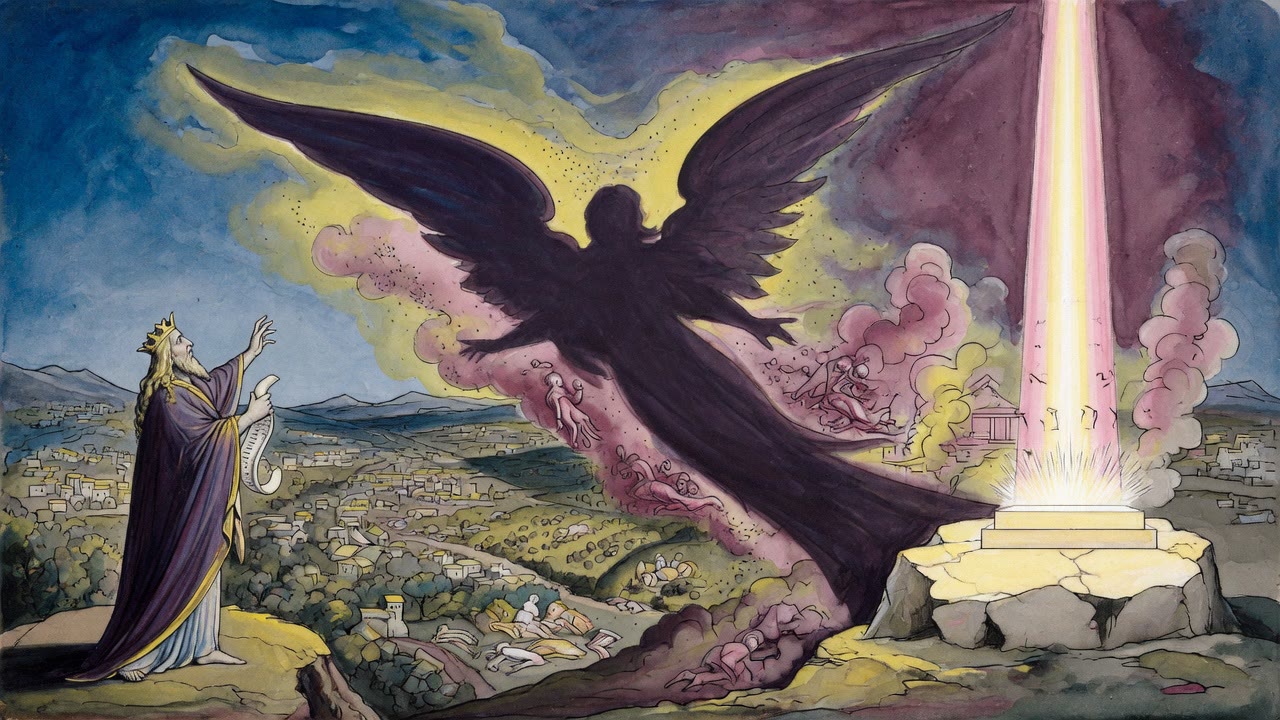
The plague lasted three days and killed seventy thousand. The angel moved through the land, visible, sword raised. When it reached Jerusalem, when it stood at the threshing floor of Araunah the Jebusite with its weapon still in its hand, God said enough and pulled it back.

David Sees the Angel

David saw it. The tradition is clear that he saw the destroying angel standing between heaven and earth above the threshing floor, sword drawn over Jerusalem, stopped at the last possible moment. He fell on his face and said what needed to be said: he was the one who had sinned, he had issued the order, the people had done nothing, whatever punishment remained should fall on his household and not on them.

This is the prayer that the Midrash on Psalms preserves in expanded form. David did not pray for himself. He told God that the eyes of all Israel were on him and his eyes were on God, and that his prayer was not his own but carried all of them with it. When a king stands in prayer, the people stand through him. When God hears the king, God has heard the people. David understood his position the way a conduit understands its position: what passes through it is not its own.

God directed him to buy the threshing floor and build an altar there. Araunah offered it as a gift. David refused. He would not offer God something that cost him nothing. He paid the full price, built the altar, offered burnt offerings and peace offerings, and the plague stopped.

The Hill Where Everything Converged

What David did not know at that moment, though the rabbis worked it out carefully, was that this was the hill. Abraham had bound Isaac here. The place had already been named: Adonai Yireh, the Lord will be seen. David, standing on the threshing floor of a Jebusite farmer, buying land under the extended sword of an angel, was standing on the same ground where Abraham had raised a knife over his son's throat and heard a voice tell him to stop.

The plague that started with a census ended at the site of the future Temple. The mistake that killed seventy thousand was resolved at the place where the whole nation would one day stand to bring their offerings and their prayers. The tradition draws this line deliberately. The Temple Mount did not become sacred because the Temple was built there. It was sacred already, and the Temple was built there because it was sacred. David's plague, and his refusal to offer God what cost him nothing, was how he found it.


← All myths

From the tradition

Sources

6 sources

The texts this telling draws on, in full. Open a card to read inline, or expand it for a wider, quieter read.

Antiquities VII.14Antiquities of the Jews (Josephus)

David made one mistake that cost seventy thousand lives. He counted his people.

The Torah had been explicit: if you number Israel, every person counted must pay a half-shekel to God (Exodus 30:12). David forgot. Or ignored, this command and ordered Joab to conduct a full census. Joab protested that there was no need. David insisted. It took nine months and twenty days to complete, and the results were staggering: nine hundred thousand fighting men from the tribes of Israel, plus four hundred thousand from Judah alone. Benjamin and Levi went uncounted because David, struck by guilt, halted the census before it was finished.

God's response was immediate. The prophet Gad appeared with three choices, each one devastating. Seven years of famine. Three months of defeat by enemies. Or three days of plague. David's reasoning, as Josephus records it, was painfully logical. Famine? He had grain stored, he'd survive while others starved. That would look self-serving. Military defeat? His fortified cities and elite soldiers gave him an advantage his people lacked. Also self-serving. So he chose the plague, the one punishment that would fall equally on king and commoner alike. "It is much better," he said, "to fall into the hands of God than into those of his enemies."

The pestilence began at dawn. By dinner, seventy thousand were dead. Josephus describes the horror in vivid detail: people dying so suddenly they collapsed on top of one another, some struck blind before the end, some disintegrating so completely there was nothing left to bury, mourners dropping dead in the middle of funeral rites for others.

Then David looked up. He saw the destroying angel suspended in the air above Jerusalem, sword drawn, ready to strike the city itself. David threw himself to the ground in sackcloth and cried out: "I am the shepherd who sinned, punish me and my house, but spare the sheep who did nothing wrong!"

God relented. The prophet Gad told David to go immediately to the threshing floor of Araunah the Jebusite and build an altar. Araunah offered the site, his oxen, and his ploughs as a gift. David refused. "I will not offer to God a sacrifice that costs me nothing." He paid fifty shekels of silver for the threshing floor, built the altar, and offered burnt offerings and peace offerings. The plague stopped.

Josephus then drops a breathtaking detail: this was the same spot where Abraham had once bound Isaac for sacrifice (Genesis 22:2). The place where a father nearly killed his son, and where a king's sin nearly killed a nation, would become the site of Solomon's Temple, the holiest ground in the world.

From that moment, David dedicated his remaining energy to preparing for a building he would never live to see. He gathered ten thousand talents of gold. A hundred thousand talents of silver. Brass and iron beyond counting. He organized the Levites, thirty-eight thousand of them, into divisions for construction, judiciary, gatekeeping, and music. He divided the priesthood into twenty-four courses, a rotation system Josephus says still functioned in his own day, nearly a thousand years later.

Standing before the assembled rulers, David laid out the temple plans that God had given him, every foundation, every chamber, every vessel weighed to specification. Then he gave from his own treasury: two hundred talents of gold, three hundred talents of pure gold for the Holy of Holies and the cherubim. The leaders and tribes responded with five thousand talents of gold, ten thousand talents of silver, and precious stones beyond measure. David blessed God aloud, calling him "the Father and Parent of the universe." The next day, they sacrificed a thousand bulls, a thousand lambs, and anointed Solomon king a second time.

Full source
Midrash Tehillim 25:5Midrash Tehillim

King David knew that feeling intimately.

Him, standing before God, pouring out his heart in prayer. It wasn't just his prayer, though. According to Midrash Tehillim, a collection of interpretations on the Book of Psalms, David understood his role as a leader, as a conduit. He says, "When I stand in prayer before You, may my prayer not be despised before You, because the eyes of Israel are dependent on me and my eyes are dependent on You. If You hear my prayer, it is as if You have heard their prayer."

Rabbi Pinchas, commenting on this, really drives home the point: David, "our Master of the world," felt this incredible responsibility. He knew the people looked to him, and he, in turn, looked to God.

You know what? This idea isn't unique to King David. We see it echoed in other Jewish practices.

Think about a public fast day. The whole community comes together, abstaining from food, focusing on repentance and prayer. During the service, the chazzan, the cantor, steps forward to lead the prayers. The Midrash (rabbinic interpretive commentary) points out that "the eyes of the congregation are dependent on him, while his eyes are dependent on the Holy One, blessed be He, and He hears their prayer."

The cantor becomes a focal point, a representative of the entire community before God. Their heartfelt plea, their sincere intention, rises through the cantor's voice. The cantor isn't just singing words; they're carrying the hopes and fears of everyone present.

There's a beautiful symmetry here, isn't there? The people look to their leader, the leader looks to God, and God, in turn, listens to the collective yearning of the people.

The Midrash concludes with a powerful promise: "None of your petitioners shall be desolate." In other words, those who sincerely seek God will not be left empty-handed. Their prayers, offered with humility and trust, will be heard.

So, what does this mean for us today? We might not be kings or cantors, but we all have moments where we stand in for others, where our actions carry weight beyond ourselves. Maybe it's advocating for a friend, or volunteering in our community, or simply offering a listening ear.

Perhaps the lesson of King David and the communal fast is that our connection to something greater – to God, to community, to shared purpose – amplifies our actions and our prayers. When we stand with and for others, we, too, can become conduits for blessing and healing in the world.

Full source
Legends of the Jews 2:139Legends of the Jews

The act of counting, it seems, isn't always a simple matter of logistics. Sometimes it's infused with deeper meaning, both positive and, occasionally, fraught with danger.

Let’s take a little tour through the ages

The Legends of the Jews, that incredible collection of stories compiled by Ginzberg, offers a fascinating overview of these countings. It seems the Israelites have been tallied on several key occasions.

Think back to Jacob, making his way down to Egypt. Even then, upon entering a new land, he found it important to count his household. Then comes Moses. Not just once, but several times! We’re told he counted the Israelites upon their triumphant exodus from Egypt. And again, after that terrible sin of the Golden Calf – a moment when stock needed to be taken, perhaps, of who remained faithful. Later, as they organized themselves into camp divisions in the wilderness, another count. And finally, when it came time to divide the Promised Land, yet another. These weren't arbitrary acts; they marked pivotal moments in the nation's journey.

Then we have Saul, the first king of Israel. The text notes a significant shift in the people's prosperity between his first and second censuses. The first time, when preparing to face Nahash the Ammonite, each man contributed a pebble for the counting. Simple, humble. But the second time, when going to war against Amalek? Every man brought a lamb! A lamb! That’s a powerful symbol of abundance, wouldn't you say? What a evidence of the changing fortunes during Saul's reign.

And then… there's David. Ah, David. His census is a cautionary tale. Unlike the others, this one wasn't ordered by God. And as a result, it brought misfortune upon both the king and his people. Why? The texts don't explicitly say, but we might infer that it was an act of pride, a reliance on numbers rather than faith. The rabbis often saw David's act as a sign of hubris, a dangerous over-confidence in his own power. Sometimes, it seems, knowing our numbers isn't what truly matters.

Finally, Ezra instituted a census when the people returned from Babylon to the Holy Land. Another fresh start, another moment to take stock and rebuild.

But here's the kicker: All these counts, as significant as they were, pale in comparison to the future. Because the texts hint at a time when God Himself will count His people. A time when their numbers will be so vast, so immeasurable, that no mortal could possibly accomplish the task. It's a breathtaking vision, isn't it? A promise of boundless growth and blessing.

So, what does it all mean? Perhaps that counting has its place, a way to mark moments of transition, to take stock, to acknowledge growth. But ultimately, the true measure of a people isn't in their numbers, but in their faith, their resilience, and their relationship with the Divine. And maybe, just maybe, that’s something that can’t be counted at all.

Full source
Chronicles 21:15-16; Midrash on ChroniclesMidrash Aggadah

Midrash Aggadah turns to The Angel Of The Lord.

Jerusalem, poised on the brink of annihilation. God, in his wrath, sends an angel to destroy it. Can you picture it? A city about to crumble, its inhabitants facing utter despair. But just as the angel is about to unleash his devastating power, a voice rings out: "Enough! Stay your hand!"

This dramatic scene comes to us from the Myths of King David, as retold in Howard Schwartz's Tree of Souls. It's a powerful image, and it makes you wonder: what stopped the destruction?

The story continues: The angel of the Lord, obedient to the divine command, halts his mission. He stands by the threshing floor of Oman the Jebusite. And then David, King David himself, looks up. What he sees is enough to make him and the elders fall to their faces in supplication.

Picture this: An angel, colossal and awe-inspiring, suspended between heaven and earth. In his hand, a drawn sword, its point aimed directly at Jerusalem. It's an image that sears itself into your mind. A stark reminder of divine power and the precariousness of human existence.

Think about the implications. Jerusalem, the heart of the kingdom, spared from utter ruin. We see echoes of other stories here, don't we? It calls to mind the story of Abraham and Isaac. Remember that pivotal moment? God calls on Abraham to sacrifice his beloved son, and at the very last second, stays his hand. The Akedah, the binding of Isaac, is a foundational story for us. It is a test of faith, and a demonstration of God's ultimate mercy.

This myth of the angel and Jerusalem mirrors that moment. It speaks of divine intervention, of a last-minute reprieve. Jerusalem was on the verge of total destruction when God intervened, preventing it at the last possible moment.

What does it all mean? Perhaps it’s a reminder that even in the face of divine judgment, there is always the possibility of mercy. Perhaps it's a evidence of the enduring power of faith and repentance. Or maybe it's simply a way of understanding that sometimes, just sometimes, we are given a second chance. A chance to rebuild, to redeem, to start again. It makes you wonder what "threshing floor of Oman the Jebusite" represents. Perhaps the place where the wheat is separated from the chaff, a place of judgement and renewal.

What do you think? Are there times in your own life when you've felt like that city, on the verge of collapse, only to be saved by a moment of grace?

Full source
Midrash Shmuel 31:1Midrash Shmuel

"And Gad came to David [and told him] and said to him: Shall seven years of famine come upon you in your land? Or three months that you flee before your foe while he pursues you? Or shall there be three days of pestilence in your land? Now know and consider what answer I shall return to Him who sent me" (II Samuel 24:13). David reasoned within himself and said: If I choose the sword, now all Israel will say, "What does it matter to the son of Jesse? He is secure in his warriors." If I choose famine, now all Israel will say, "What does it matter to the son of Jesse? He is secure in his storehouses." Let us choose a thing in which all are equal. Another interpretation: If I choose the sword, there is no sword without famine; if I choose famine, there is no famine without sword. Another interpretation: If I choose the sword, now all Israel will be seized by the sword on the roads; if I choose famine, now all Israel will be swollen with famine on the roads. Let us choose a thing in which all are equal. And some say: Gad hinted to him, "And now know and consider what answer (davar) I shall return to Him who sent me", pestilence (dever).

Full source
Midrash Shmuel 31:4Midrash Shmuel

"And the angel stretched out his hand toward Jerusalem to destroy it, and the Lord said to the angel that destroyed among the people: It is enough" (2 Samuel 24:16). They said: on that day Abishai son of Zeruiah died. "And He said to the angel that destroyed among the people", "Great (rav) is the pledge that is in your hand."

"And Gad came to David [on that day] and said to him: Go up, raise up [to the Lord] an altar," and so forth. To what was David comparable at that hour? To one who was striking his son, and the son did not know on account of what he was striking him. At the last he said to him: Know that I struck you on account of the wrong done to so-and-so. So too, all those multitudes who fell, they fell only because they did not demand the building of the Temple. And behold, these are matters of light and heavy (a fortiori): if these, who did [not] see the building of the Temple, were thus, we, all the more so. Therefore the early prophets ordained that Israel should pray three times each day, and say: Return Your Presence to Zion, and order Your service in Jerusalem Your city.

Full source