5 min read

Eliezer Raised the Camels Above Laban's Spring

Laban ran for gold and murder. At the spring Eliezer spoke a Name, the camels rose, and a cursed servant crossed into blessing.

Curated by Arthur · Told by Maggid ·
Table of Contents
  1. The Spring and the Name
  2. A Servant Crosses Categories
  3. Plain Talk Worth More Than Fine Law
  4. Even the Animals Keep Faith
  5. The Blessing That Could Not Be Taken Back

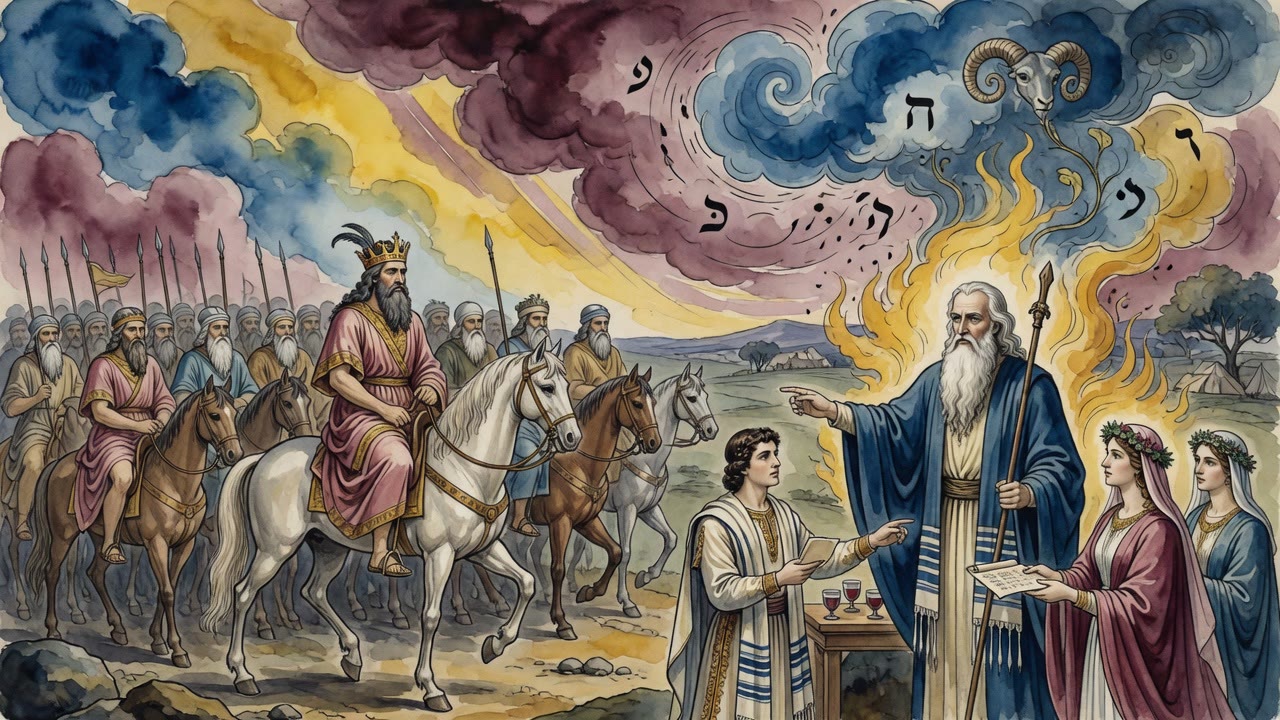
Laban saw the gold first and his legs decided the rest. He did not run to welcome a guest. He ran to kill a traveler whose camels glittered with the wealth of Abraham's house, and the spring at the edge of the town became a place where hospitality and murder wore the same smile.
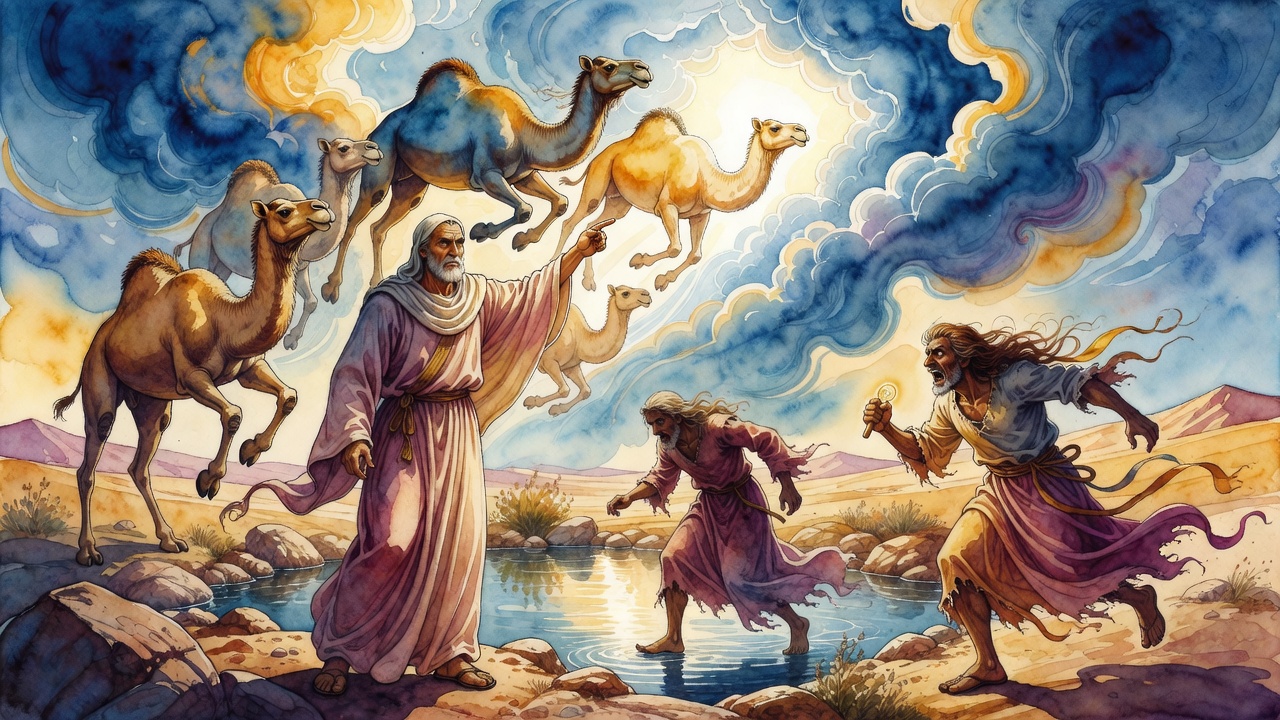
Eliezer Raised the Camels Above Laban's Spring Click for full size

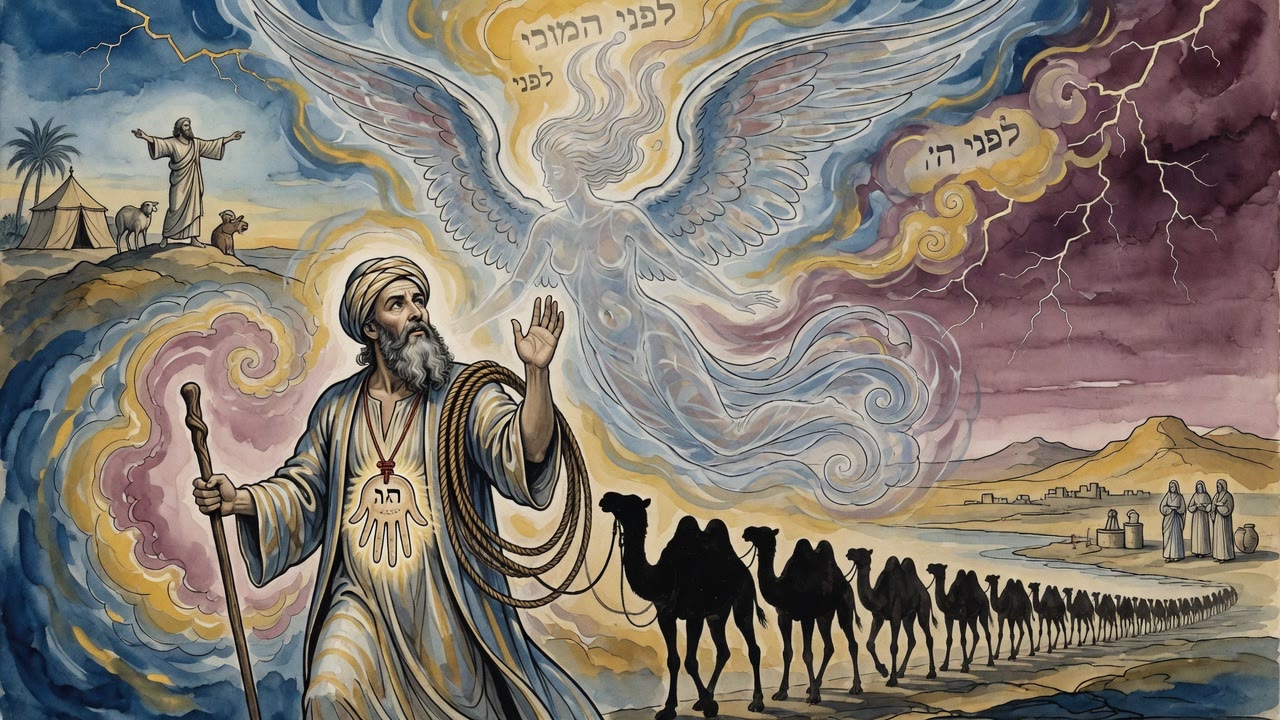
Eliezer read the haste in the man's face the way a servant reads weather. He did not draw a blade. He spoke a holy Name, and the camels rose from the water into the air as if the ground had let them go. Eliezer stood balanced on their backs above the spring, gold and dust and silence hanging between the two men.

The Spring and the Name

Laban stopped hard enough that gravel bit his heels. The wonder unmade the plan. A man who can stand on floating beasts is not a soft target for a knife behind a greeting. The gold still shone. The appetite stayed. Only the method changed. "Come, blessed of the Lord," Laban said, and the words that should have been a welcome arrived as a surrender.

Eliezer climbed down. The camels returned to earth as if the Name itself had set them gently back into the world of troughs and bridles. He entered the house of Bethuel not as a victim and not as a conqueror, but as a man whose errand had outlived the ambush prepared for it. The errand was a bride for Isaac. The ambush was greed dressed as kinship.

A Servant Crosses Categories

Eliezer was a Canaanite by birth, a man born under a curse the old stories still named. The rabbis would later linger on Laban's sudden blessing, because the words did more than flatter a guest. They moved a man from one ledger to another. A servant who kept faith with a righteous master crossed from the category of the cursed into the category of the blessed.

Abraham had walked from the east as a bird of prey called into counsel, a man who would report to God on the state of the field the way a hired worker reports to the owner what is growing and what is dying. Eliezer carried that same field-labor into Haran. He did not invent the covenant. He served it with his feet, his oath, and the Name he dared to speak when a knife waited at the spring.

The gold on the camels was bait. The loyalty under the gold was the real cargo.

Plain Talk Worth More Than Fine Law

Scripture spends long pages on this servant's journey, the oath at Abraham's thigh, the prayer at the well, the test with the pitcher, the gifts, the night under a roof that nearly became a tomb. Later generations would squeeze a sharp law about a creeping thing from a single extra letter and call it learning. Beside Eliezer's story those subtleties look thin.

The plain speech of the patriarchs' servants, the midrash insists, is more precious than the legal cleverness of later ages. A man who stands on camels in the air to protect a mission is not a footnote. He is the mission walking. Abraham needed a counselor in the field of the world; Eliezer was the counsel made flesh and travel-stained.

Even the Animals Keep Faith

Folded into the memory of that night is a later wry proof. Rabbi Pinchas ben Yair's donkey once refused barley that had not been tithed, and the animal's refusal shamed sages who had eaten untithed figs without a second thought. Even the beasts of the righteous keep commandments the humans around them forget.

At Laban's spring the camels did not preach. They rose. Their obedience to a spoken Name made Laban's murder-plan look small. A household that serves Abraham trains more than its people. It trains the air around the journey until even the animals know when the ground is not the last word.

The Blessing That Could Not Be Taken Back

Laban wanted the gold. He named Eliezer blessed because fear and calculation forced the word out of him. The midrash keeps the word anyway. Once spoken, the title sticks to the servant who earned it by loyalty rather than by bloodline. Israel, laboring in kindness with their own hands and feet, is told to hear how far a single faithful errand can move a man.

Eliezer left Haran with Rebecca and with the knowledge that a spring can be a trap and a threshold at once. Above the water the camels had hung like a verdict. Below them, Laban learned that Abraham's house does not travel unprotected. The gold stayed in the open. The Name stayed closer.


← All myths
From the tradition

Sources

2 sources

The texts behind this telling. Some cards carry a translation of the source; others are our own retelling of it, and each card says which. Every card links out to the original.

Yalkut Shimoni on Torah 109:3Yalkut Shimoni on Torah

Translation of the source text.Torat Emet (Yalkut Shimoni) · CC-BY-NC

"And it came to pass, when he saw the nose-ring" (Genesis 24:30) - at once he went out to kill him. When he recognized that his haste was for evil, [Eliezer] uttered a Name and set the camels upon the spring in the air, and he himself stood upon the camels in the air. When [Laban] saw this, he recognized that he was righteous and said, "Come, blessed of the LORD" - for he supposed he was Abraham, since his features resembled his. "Canaan" - this is Eliezer; and because he served the righteous one faithfully, he passed out of the category of cursed into the category of blessed. "And he said: Come, blessed of the LORD" (Genesis 24:31). Rabbi Yaakov in the name of Rabbi Yochanan of Bet Guvrin made of it a lesson: if Eliezer, because he served the righteous one faithfully, passed from cursed to blessed, then Israel, who do kindness with their great ones with their hands and their feet, how much more so. "Why do you stand outside?" - it is not your honor to stand outside. "And I have cleared the house" - from the filth of idolatry.

"And the man came into the house, and he ungirded the camels" (Genesis 24:32) - he untied their muzzles. Rabbi Yirmiyah asked Rabbi Chiyya bar Abba: were not the camels of Abraham like the donkey of Rabbi Pinchas? The donkey of Rabbi Pinchas - robbers took her, and she was with them three days and tasted nothing at all. They said: in the end she will die and her stench will be upon us; let us return her to her owner. They sent her off, and she entered the house of her master. As she entered she brayed, and he recognized her voice. He said: open for that poor creature and give her to eat, for she has gone three days tasting nothing. They gave her barley and she would not taste it. He said to them: have you fixed [tithed] it? They said to him: yes. He said: have you removed the demai [doubtfully tithed produce]? They said to him: but did you not teach us, master, that one who buys for seed, for cattle, flour for hides, oil for a lamp, or oil to anoint vessels is exempt from demai? He said to them: what shall we do for her, for she is strict with herself? Rabbi Yirmiyah sent Rabbi Ze'ira a basket of figs. Rabbi Ze'ira said: is it possible Rabbi Yirmiyah sends them untithed? Rabbi Yirmiyah said: is it possible Rabbi Ze'ira eats them untithed? Between this one and that one the figs were eaten untithed. The next day Rabbi Yirmiyah met Rabbi Ze'ira and said: did you tithe those figs? He said: no. Rabbi Ze'ira said: if the earlier ones were angels, we are men; and if they were men, we are donkeys. Rabbi Mana said: we are not even donkeys, for the donkey of Rabbi Pinchas ben Yair - they gave her untithed barley and she would not taste it, while we eat untithed figs.

"And he gave straw and fodder to the camels" (Genesis 24:32-35). The ordinary talk of the servants of the fathers is finer than the Torah of the sons, for behold the chapter of Eliezer is told over two and three pages, while the creeping thing is among the essentials of Torah and yet its blood does not defile like its flesh except from a redundancy in Scripture. Rabbi Shimon ben Yochai says: from "the unclean, the unclean"; Rabbi Elazar bar Yose says: from "this and this." "And food was set before him to eat" (Genesis 24:33) - Rabbi Acha said: the washing of the feet of the servants of the fathers is finer than the Torah of the sons, for if their foot-washing had to be written, while the creeping thing is among the essentials of Torah, and so forth.

Full source
Aggadat Bereshit 81Aggadat Bereshit

Retold in our words. Read the original at the link below.Sefaria Community Translation · CC0

"I will make my opinions widely known" (Job 36:3). God called Abraham from the east, "calling a bird of prey from the east, a man of my counsel from a distant land" (Isaiah 46:11). Abraham was the one who would inform God about His world, the midrash says, in the same way a worker in the field informs the master about what is growing. The labor of the trials is the labor of someone who cares deeply about the outcome.

God is known in Judah (Psalm 76:2). And the knowledge spreads from Judah outward because of Abraham. Before Abraham, the nations knew God only as a cosmic abstraction, if at all. After Abraham walked from Ur to Canaan, argued with kings, welcomed strangers, and interceded for Sodom, the name of God became attached to a specific covenant with a specific people. The nations could point to something. The abstraction had a history.

The midrash uses the image of the craftsman: a skilled worker does not need to be told what the master wants, he knows the master's taste and works accordingly. Abraham had internalized the divine will so completely that he needed no explicit instruction for most of the covenant's demands. He had extrapolated them from his relationship with God. This is why the verse says he kept God's voice, charge, commandments, statutes, and laws (Genesis 26:5), he heard the harmony beneath the individual notes and played the whole score.

Full source