Parshat Chayei Sarah6 min read

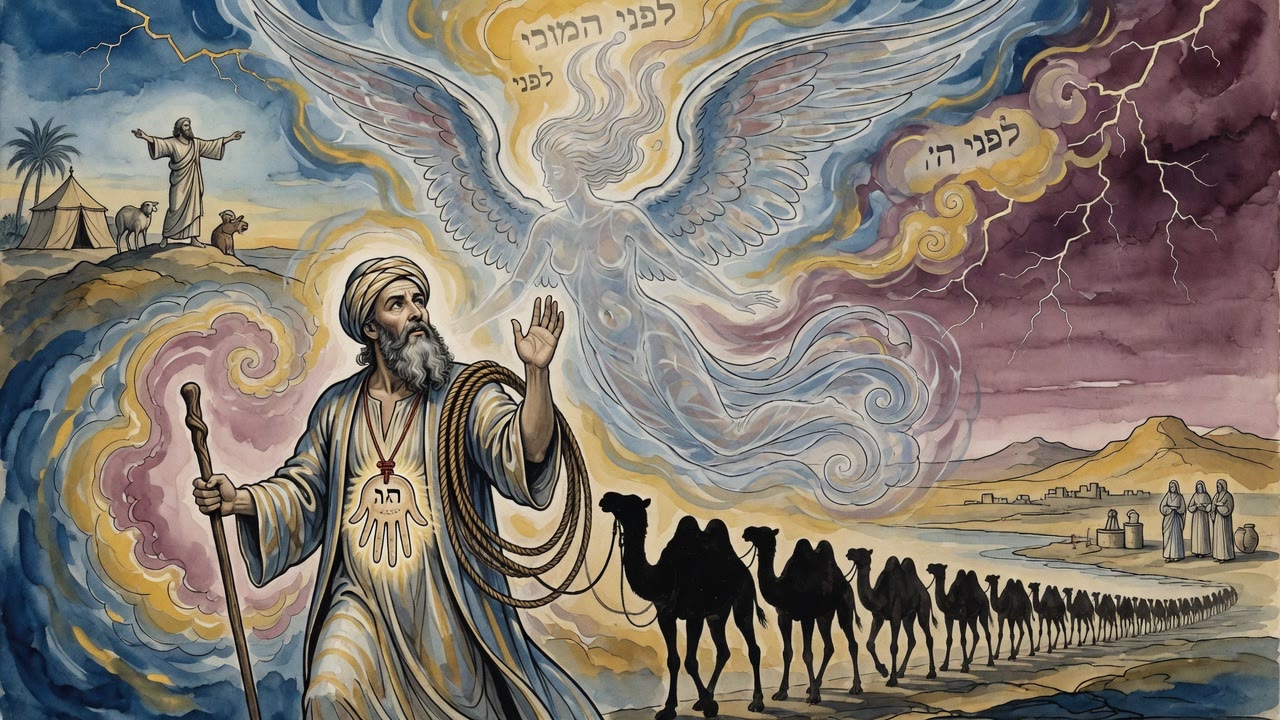
Eliezer Walked With an Angel He Could Not See

Abraham sends his servant for a wife for Isaac with one promise, not success but company, and Eliezer carries that oath all the way to Aram.

Curated by Arthur · Told by Maggid ·
Table of Contents
  1. The Hand Under the Thigh
  2. Ten Camels and No Sign
  3. The Prayer He Could Not Take Back
  4. What He Said in Bethuel's House
  5. The Road Back
Eliezer Walked With an Angel He Could Not See Click for full size

The Hand Under the Thigh

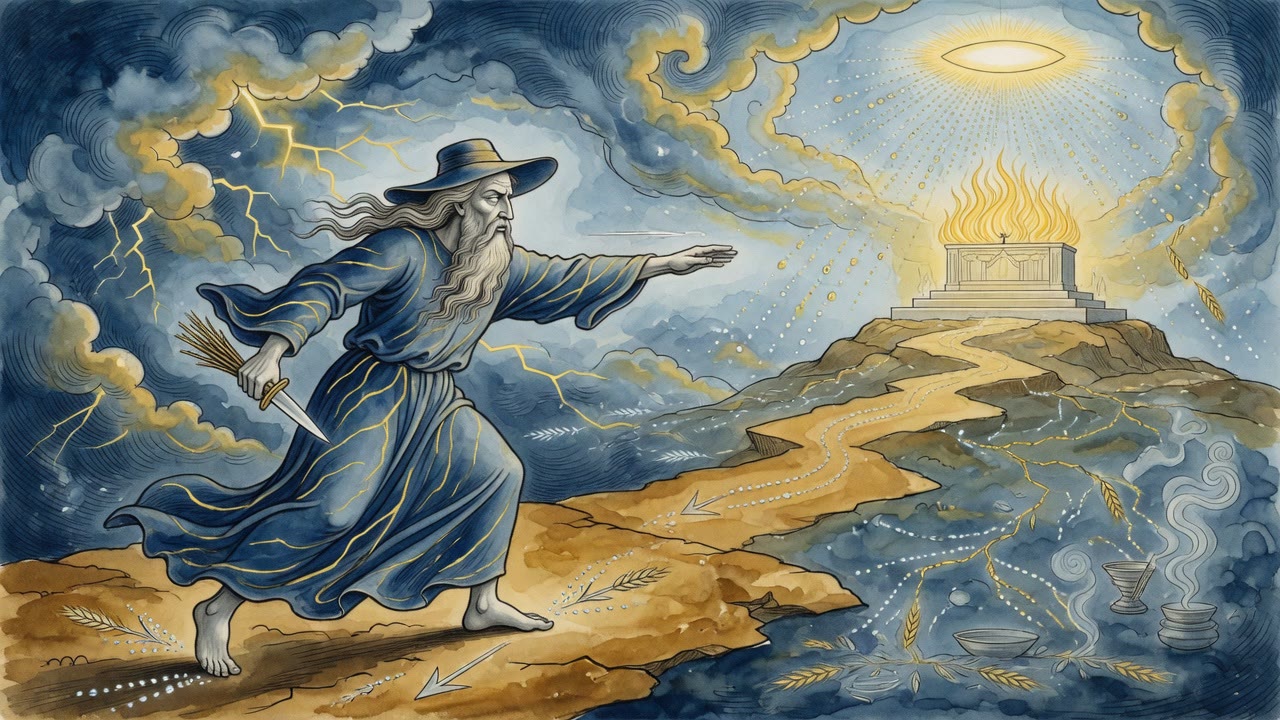
Abraham made his servant put a hand under his thigh before he would say what the errand was. Then he said it. Go to my land and to my birthplace and take a wife there for my son, and do not take one for him from the daughters of the Canaanites among whom I am living.

Eliezer waited for the rest, meaning the part where the old man explained how this was supposed to work. What he got was this: "The God whose throne is in the heavens on high, who took me out of my father's house and out of the land of my birth, and who swore this land to my seed, will send His angel before you, and you shall take a wife for my son from there."

Eliezer counted what was not in that sentence. No promise the girl would come. No promise her people would agree. No word about what the angel looked like, or how a man would know he had arrived. Abraham had not promised him success at all. He had promised him company, which is a different thing to carry into a country where nobody owed him an answer.

The condition was the hard part. The wife had to come from Abraham's own household, from the family of his father, so if the road bent and Eliezer bent with it, the angel was under no obligation to follow the bend. He could be accompanied and still fail. He simply could not improvise.

Ten Camels and No Sign

He loaded ten camels and went north, and the road behaved like a road. No wings crossed the sun, and no name came down out of the sky at a well or at a fire, though he watched for both. There was dust, and the animals, and the goods of his master strapped down under cloth, and long stretches where the only voice was the one in his own head running the failure in advance.

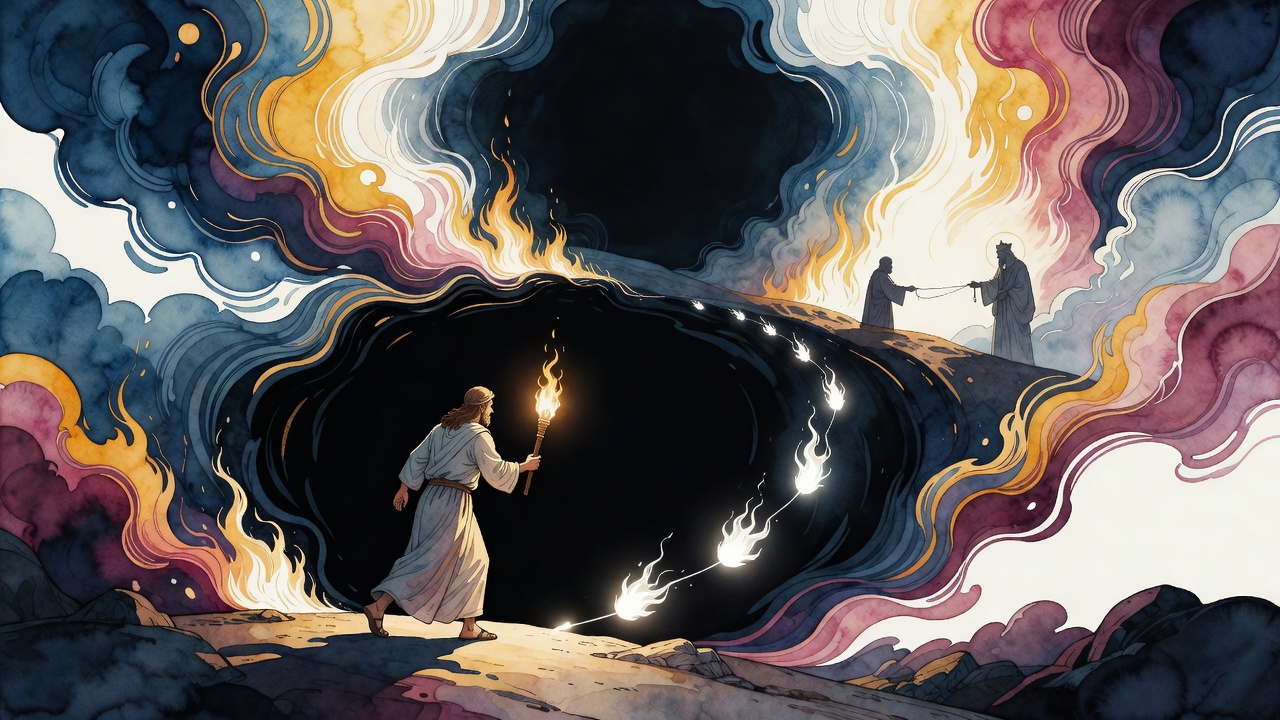
He knew what the old man had been through before this, which is why the old man could talk about angels so calmly. Abraham had stood in a dark between split carcasses and watched a furnace and four kingdoms come at his children, and out of that night he had been given a covenant: his sons would not be judged in that fire, they would be pulled out of whatever kingdom happened to be holding them, and there was a land waiting at the far end of it, from the river of Egypt to the Euphrates. A man who has been shown the far end of the fire is not easily frightened by an unmarked road.

Eliezer had not been shown anything. He had ten camels and a sentence.

The Prayer He Could Not Take Back

He stopped outside the city of Nahor at evening, at the well, at the hour the women come out to draw water. Then he did the one thing that could not be undone: he said aloud what the sign would be. Let the girl to whom he said "lower your jar so I may drink," and who answered "drink, and I will water your camels too," be the one appointed for his master's son.

The words left him and the errand went with them.

He stood there with the camels shifting behind him and understood what he had just done. Ten camels off a long road will drink until a girl's arms give out, and no stranger offers that, and now he had staked the whole house of Abraham on a stranger offering it. He could not take it back and pick an easier sign, because he had already handed the choosing away.

She came out with the jar on her shoulder before he had finished speaking, so he ran to meet her and asked for a mouthful. She lowered the jar to his hand, and then she said she would draw for the camels as well, and she kept walking down and up to the trough until the last animal lifted its head on its own.

What He Said in Bethuel's House

They set food in front of him at her father's house, and he would not eat until he had said what he came to say. He could have opened with the gold, since the gold was on the table and worked on the room by itself. He opened with the old man's words instead, quoted whole, the way he had carried them: "The Lord before whom I walk will send His angel with you and prosper your way, and you shall take a wife for my son from my family and from my father's house."

It was a strange opening in a room where the relatives were already counting jewelry, but he had carried that sentence too far to trade it now for a better one. He was telling them he had not come by his own judgment, that he had been sent on a road with a companion he could not produce, and that his master defined his God by the direction he was facing at that moment and not by anything that had happened long ago.

Laban and Bethuel answered that the thing had come from the Lord and they could say nothing to him, good or bad. Rebecca was called in and asked whether she would go with the man, and she said she would go.

The Road Back

He walked home the way he had come, on foot beside the animals, and he did not see the angel on the return road either. Nothing on that road ever announced itself. There was a girl on a camel who had said she would go, and a house behind her that had let her, and a servant who had asked for one specific thing out loud and been given it before he stopped speaking.

Toward evening Isaac came out into the field, and lifted his eyes, and there were the camels. Rebecca saw him and got down. Eliezer stopped the lead animal, and told Isaac everything he had done, and let go of the halter.


← All myths
From the tradition

Sources

3 sources

The texts behind this telling. Some cards carry a translation of the source; others are our own retelling of it, and each card says which. Every card links out to the original.

Targum Pseudo-Jonathan on Genesis 24:7Targum Pseudo-Jonathan on Genesis

Retold in our words. Read the original at the link below.The Targum of Jonathan ben Uzziel, trans. J. W. Etheridge, London, 1862 · Public Domain

When Abraham sent his servant to find a wife for Isaac, he did not send him alone. He sent him with a promise sealed by an oath. Targum Pseudo-Jonathan sharpens the moment: the God whose throne is in the heavens on high, the God who took Abraham from his father's house and from the land of his birth, the God who swore the land to Isaac's seed, that God, Abraham says, "will send His angel in season, and thou shalt take a wife for my son from thence" (Genesis 24:7).

Read the words slowly. Abraham does not promise success. He promises company. The angel is not a guarantee of outcome; the angel is a guarantee of presence. The servant is going to a strange country with a strange mission, and Abraham tells him: you will not walk this road alone.

Notice the verbs Abraham stacks together. God took him. God spoke to him. God swore to him. Each verb is a memory Abraham is handing his servant like a torch. Whatever you feel on the road, the servant is told, remember that the God who began this journey finishes journeys. The same One who uprooted me from Ur will plant a wife for my son in Aram.

The Aramaic phrase "in season" (b'idana) matters. The angel does not arrive early. The angel does not arrive late. The angel arrives at the hour the servant needs him, which, as the chapter will show, is the hour he stops at a well and lifts a prayer.

Abraham's lesson, packed into one verse: when you send someone on a holy errand, send them with a story of how God has acted before. That memory is the first angel.

Full source
Targum Pseudo-Jonathan on Genesis 24:40Targum Pseudo-Jonathan on Genesis

Retold in our words. Read the original at the link below.The Targum of Jonathan ben Uzziel, trans. J. W. Etheridge, London, 1862 · Public Domain

When Eliezer retells the story to Laban and Bethuel, he quotes Abraham directly. Targum Pseudo-Jonathan on (Genesis 24:40) preserves the quote exactly as Abraham had spoken it: "The Lord before whom I worship will appoint His angel to be with thee, and will prosper thy way."

Listen to that phrase, before whom I worship. It is not "the Lord I believe in" or "the Lord who once spoke to me." It is present tense, active, ongoing. Abraham defines his God by the direction his face is always pointed. Worship, for Abraham, is posture before it is petition.

Then the promise: an angel will be with you. The Targum uses the same language Abraham used back in verse seven, but now it is in the servant's mouth. The comforting word that was given privately at departure is now being testified publicly at arrival. Eliezer is saying, in effect: I did not come here by guess. I came here sent.

Notice the condition Abraham places on the promise. The servant must take a wife from Abraham's household, from the race of his father's house. The angel is not a taxi service; it is a guide on a specific road. If the servant had wandered from the mission, the angel would not have followed the wandering.

This is the shape of divine accompaniment in the Jewish tradition. It is not unconditional location. It is faithful presence along a faithful path. Walk the road you were sent to walk, and the messenger is beside you.

Full source
Targum Pseudo-Jonathan on Genesis 15:18Targum Pseudo-Jonathan on Genesis

Retold in our words. Read the original at the link below.The Targum of Jonathan ben Uzziel, trans. J. W. Etheridge, London, 1862 · Public Domain

Right after the terrifying vision of Gehinnom and the four kingdoms, the Lord sets a covenant. And Targum Pseudo-Jonathan on (Genesis 15:18) spells out the promise with an emphasis the Hebrew leaves implicit.

On that day the Lord ordained a covenant with Abraham, that He would not judge therein his sons, but would deliver them from the kingdom.

Notice the order. First: I will not judge your children the way the wicked are judged in that furnace you just saw. Second: I will rescue them out of whichever kingdom of the four happens to be holding them at the time. Third: and by the way, here is the land, from the Nile of Egypt to the great river, the Pherath, the Euphrates.

The Targum reads the land-promise as the end of a rescue plan, not the start of a real-estate contract. The boundaries matter because they mark the safe country at the far end of the fire. Abraham is told in one verse that his children will be spared the worst punishment, delivered from the empire that enslaves them, and given a wide homeland to breathe in.

The Maggid hears the Lord's whole promise as one motion: no condemnation, no captivity, your own land (Genesis 15:18). After a vision that long and that dark, the covenant is exactly what Abraham needs, not an explanation of the furnace, but a word about where his children end up once the furnace is behind them.

Full source