Parshat Vayera5 min read

The Angel Swears After Abraham Binds Isaac

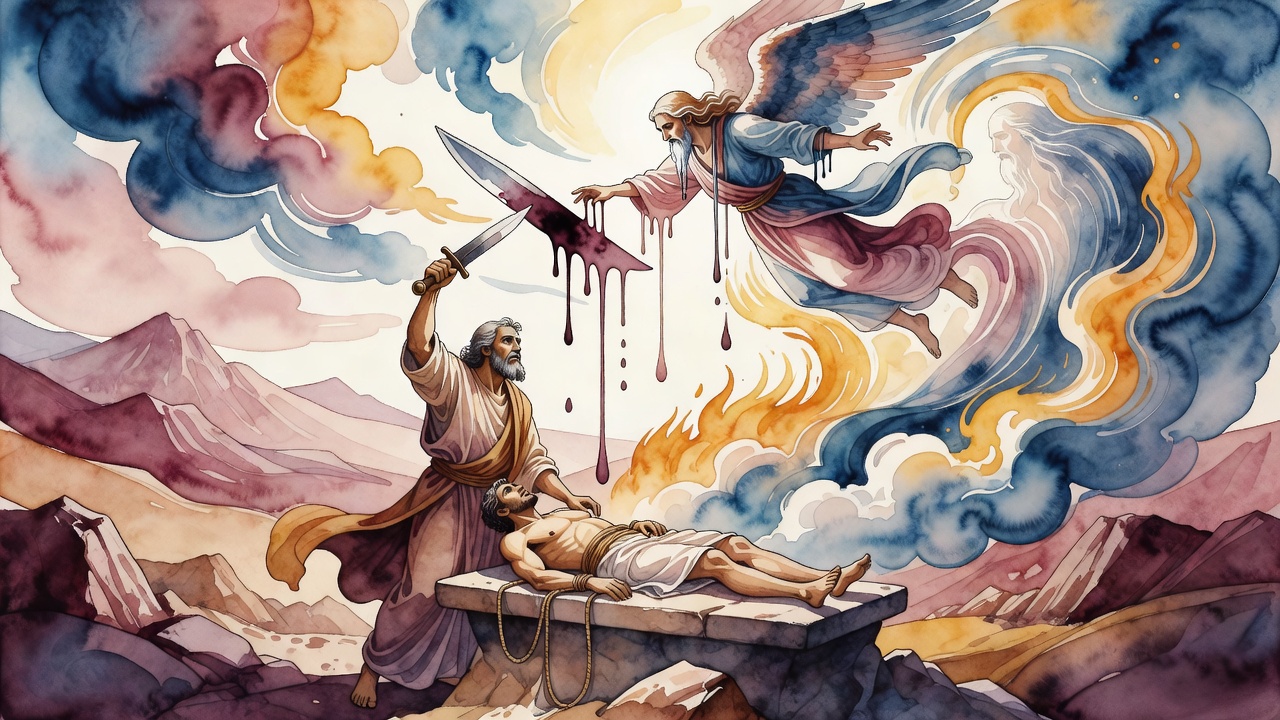
Angel tears fell on the blade and dulled the edge. Abraham would not lower it. A voice telling him to spare the boy might be the Accuser in borrowed pity.

Curated by Arthur · Told by Maggid ·
Table of Contents
  1. The Knife and the Tears
  2. Teacher and Disciple
  3. By Myself I Have Sworn
  4. Why Afflict the One You Already Knew
  5. Double Blessing on the Path Down
The Angel Swears After Abraham Binds Isaac Click for full size

The Knife and the Tears

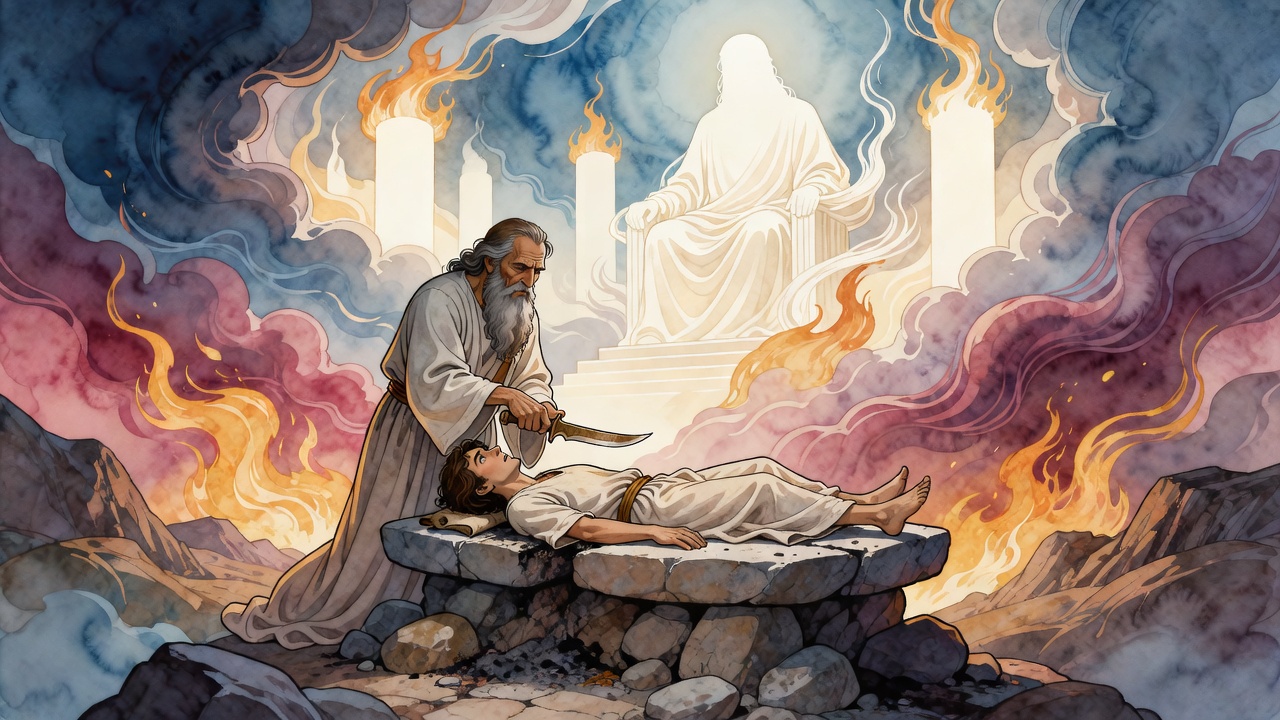
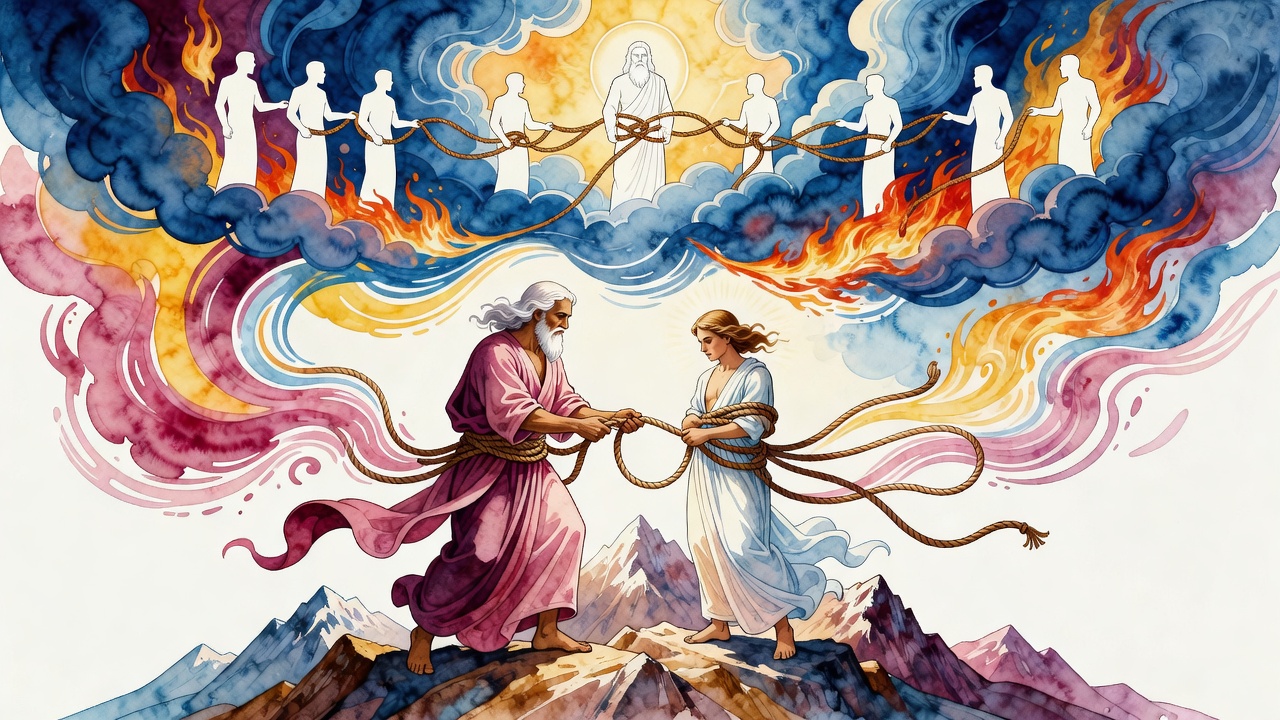
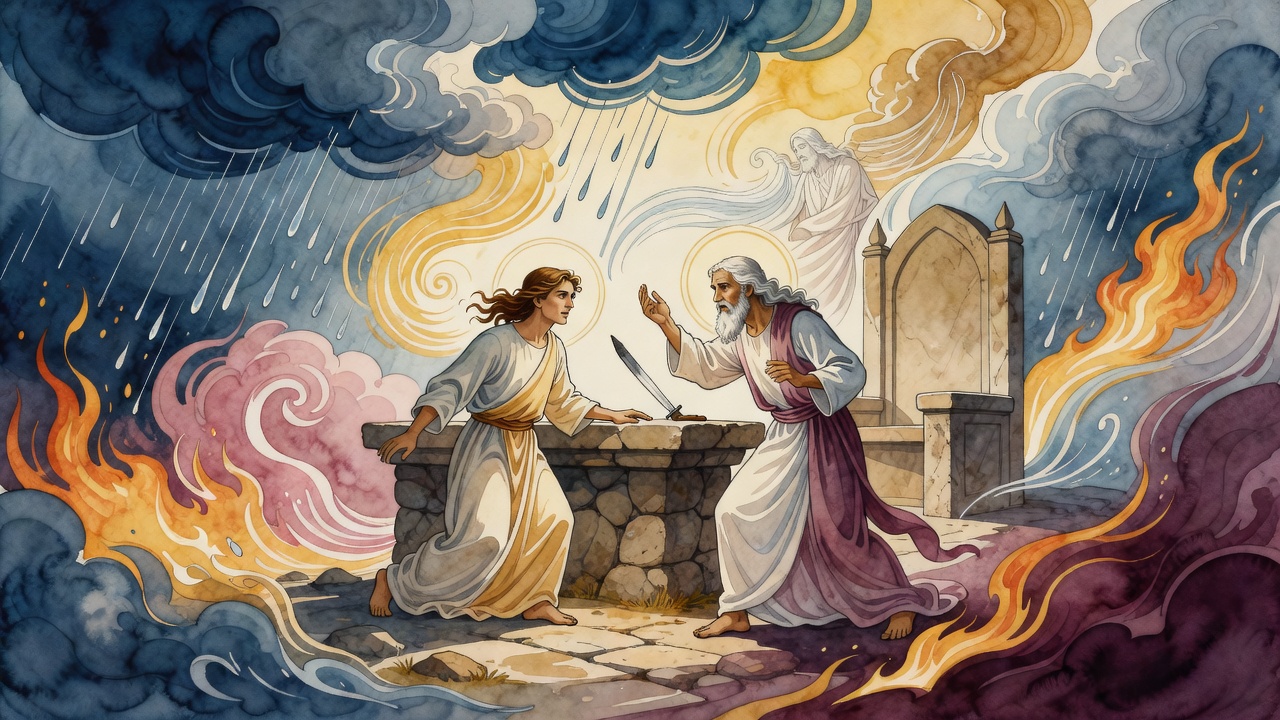
Abraham's hand rose over Isaac on the mountain after three days of walking that had stripped conversation down to footsteps and load-bearing wood. The altar was arranged. The boy who had carried the wood lay bound. In the legends, angel tears fell on the knife and made the edge useless before the stroke could finish what the command had seemed to require. Isaac's soul left him in terror and returned when the world refused the final cut.

Michael cried the double name that stops a man mid-motion: "Abraham! Abraham!" The father who had walked toward this obedience did not drop the blade on the first soft word. Soft words can be traps. He had learned that on other roads.

Teacher and Disciple

"God commanded me to slaughter Isaac," Abraham answered the messenger, "and you command me not to. The words of the Teacher and the words of the disciple, whose words does one hear?" He had not come this far to be cheated by a voice that might be Ha-Satan wearing pity like a borrowed cloak.

The Accuser slid close with a whisper that sounded like truth overheard behind the heavenly curtain: a lamb for the offering, never the son. The sentence was almost right and therefore more dangerous. Abraham knew that trade. "A liar's craft," he said. Even when the deceiver speaks a true fragment, no one is bound to trust the mouth that specializes in fragments.

Isaac's wrists kept the memory of rope even while the argument over his life continued above him. The mountain wind smelled of sweat and fear and the faint iron of a blade that heaven itself was dulling with grief.

By Myself I Have Sworn

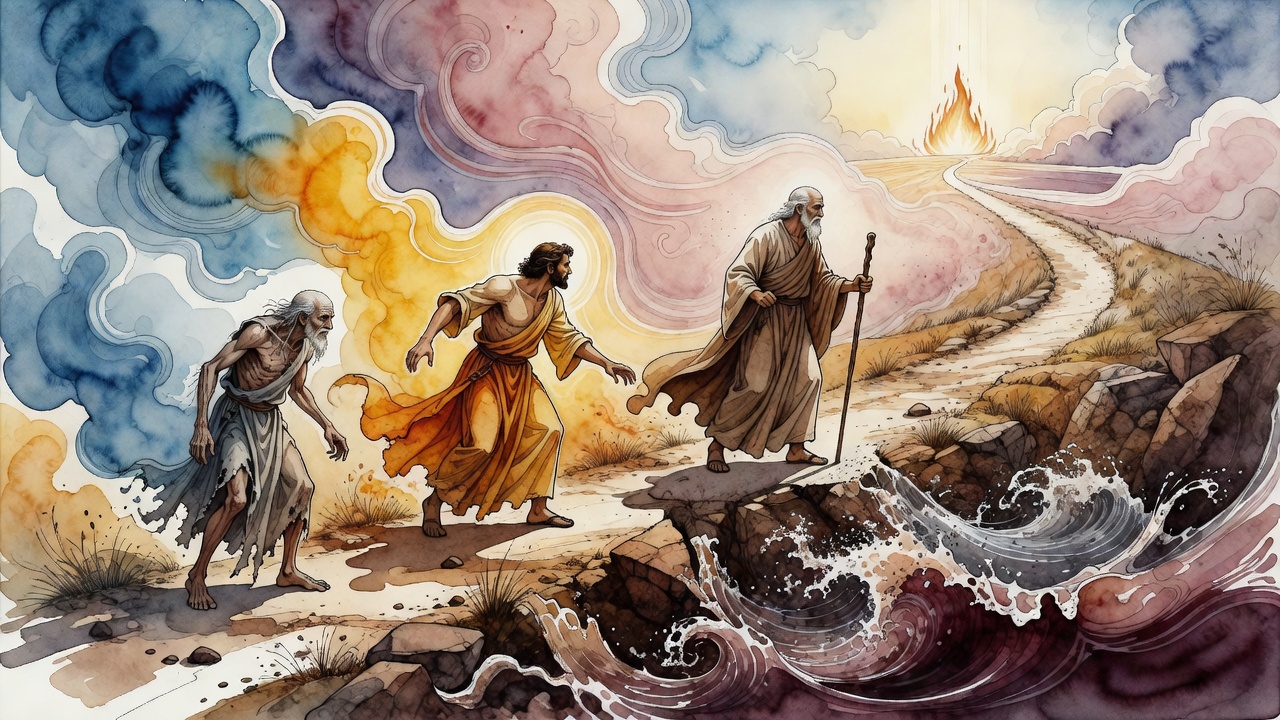
Then the Holy One broke through and confirmed the reprieve in a voice that needed no introduction. "By Myself I have sworn." The angel called a second time from the heavens (Genesis 22:15). Abraham still pressed the moment. He had crossed a river of trial with his son on his back for three days. A man who leaps such a current asks for a promise before he is sent to the bank again with the same load.

After ten tests, the Binding equaled the rest combined. Fail here and every prior obedience collapses into a story of almost. Abraham asked that he not be tried this way again, nor Isaac after him. The oath answered the request the way a king's seal answers a petition written after near blood, with finality that even an angel's tears could not supply alone.

Why Afflict the One You Already Knew

"Thou surely didst know that I was ready to sacrifice my son," Abraham said when the knife was down and the breath returned. Humans test one another because hearts are hidden behind bone and speech. Why afflict a man whose heart was already open on the table of heaven? The answer did not apologize. It pointed outward toward a world that needed evidence.

The nations needed to see why this man had been chosen from among them. Fear of God, awe that does not withhold, had to become public knowledge, not only private readiness known to the One who already knows. The most intimate trial became a demonstration. Isaac lived. The ram waited in the thicket with horns caught as if the mountain itself had prepared a substitute. Moriah kept both names: the place of seeing and the place of being seen.

Double Blessing on the Path Down

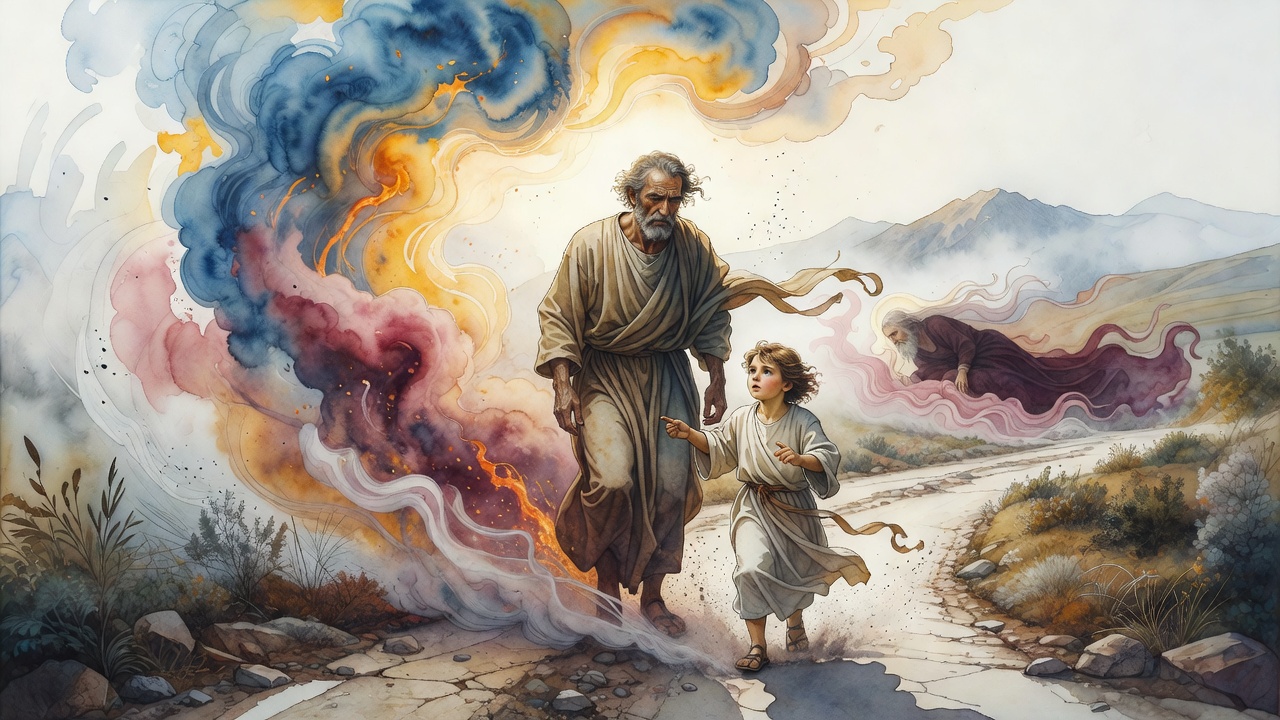
The verbs of blessing doubled in the speech that followed, one portion for the father, one for the son, seed as stars and as sand, gates of enemies held in promise. Abraham came down the path with Isaac walking, not carried as wood for a fire that would not take him. The knife that angel tears had wet stayed in the story as a blade heaven refused to let finish its work.

Behind them the altar cooled into a memory that would feed later prayer. Ahead of them the oath traveled farther than either pair of feet: a promise spoken by God about a father who would not withhold, and a son who rose from the binding into a future the knife was not allowed to edit. Father and son spoke fewer words on the way down than the climb had held. Some silences are the only honest language left after a almost-ending.

The servants waiting lower on the slope saw father and son return together and did not know what almost happened above the tree line. They saw only that the wood was not burned with the boy and that Abraham's face looked older than the climb could explain. Isaac walked carefully, as if the ground might still open into a command. The ram's blood dried dark on stone. Somewhere between the oath and the first step home, the tenth trial closed its mouth and left a blessing that doubled itself in the air.


← All myths
From the tradition

Sources

4 sources

The texts behind this telling. Some cards carry a translation of the source; others are our own retelling of it, and each card says which. Every card links out to the original.

Bereshit Rabbah 56:11Bereshit Rabbah

Retold in our words. Read the original at the link below.The Sefaria Midrash Rabbah, 2022 · CC-BY

Bereshit Rabbah turns to Why the Angel Swore an Oath After the Binding.

(Genesis 22:15) tells us, "The angel of the Lord called to Abraham a second time from the heavens." And then the angel swears an oath: "I swear by Myself… because you have done this matter, and did not withhold your son, your only one." But why the oath? Why was it necessary?

The Midrash (rabbinic interpretive commentary), specifically Bereshit Rabbah 56, explores this very question. Abraham, according to one interpretation, basically says to God, "Hold on a minute! You almost had me sacrifice my son. I need a guarantee this won't happen again. Swear to me that you will not test me again, nor Isaac my son."

It's like a harrowing analogy offered: a man leaps across a raging river, dragging his son along. He makes it, but you can bet he'll be asking for assurances before attempting that feat again!

Rabbi Ḥama ben Rabbi Ḥanina offers another compelling analogy: a king who repeatedly marries and divorces a noblewoman after she bears him a son. After the tenth son, the children band together and plead, "Father, swear you won't divorce our mother again!" Similarly, Abraham, after enduring ten trials – the Binding of Isaac being the last and most challenging – asks for a divine promise.

Rabbi Ḥanin adds a powerful perspective. He points out the verse says, "Because you have done this matter," even though it was the tenth test. His explanation is that this final ordeal, the Akeidah – the Binding – was so significant, it equaled all the others combined. Had Abraham failed, he would have lost everything.

And what about the blessings that follow? "For that I will bless you [varekh avarekhekha] and multiply your descendants [veharba arbeh] as the stars of the heavens.." The doubling of the verbs, varekh avarekhekha and veharba arbeh, isn’t accidental. The Midrash explains this is a double blessing, one for the father, Abraham, and one for the son, Isaac. A blessing for their individual merits and their shared legacy.

The verse continues, "and your descendants will inherit the gate of their enemies." This, the Midrash tells us, refers to Tarmod, a city infamous for its hostility towards the Jewish people. Rabbi Yudan and Rabbi Ḥanina recount that Tarmod contributed significantly to the destruction of both the First and Second Temples in Jerusalem. What a powerful promise – that even after such devastating events, Abraham's descendants will ultimately prevail over their adversaries.

But where was Isaac after the ordeal? (Genesis 22:18) states, "Abraham returned to his young men," but Isaac isn't mentioned. Rabbi Berekhya, citing Babylonian sources, suggests that Abraham sent Isaac to Shem (Noah's son!) to study Torah. It’s like a woman who became wealthy through her spindle, cherishing it always. Abraham understood that his blessings stemmed from Torah and mitzvot (commandments), and he wanted that legacy to continue through his children.

Rabbi Ḥanina adds that Isaac was sent away at night, a fascinating detail. Why at night? To avoid the ayin hara, the evil eye. After such a miraculous event, Abraham feared that envy or negative energy could harm his son. This concept of the ayin hara is a recurring theme in Jewish tradition, a reminder of the power of perception and the need to protect ourselves and our loved ones from negativity.

The Midrash draws a parallel to Hananya, Mishael, and Azarya, who emerged unscathed from the fiery furnace in the Book of Daniel. After their miraculous survival, their names disappear from the narrative. Why? Various explanations are offered: some say they died due to divine intervention (to prevent further mockery of Israel), others that they died from the evil eye, and still others that they went to study Torah with Yehoshua ben Yehotzadak.

Rabbi Ḥanina concludes that Hananya, Mishael, and Azarya entered the furnace with the understanding that their fate would serve as a sign – either a sign of God’s power if they were saved, or a sign of unwavering loyalty even in the face of death if they were not.

So, what do we take away from this exploration of Bereshit Rabbah 56? There's a very human need for reassurance, for guarantees, for understanding the implications of our choices. And it’s also a powerful affirmation that blessings, both material and spiritual, are often intertwined with learning, tradition, and a conscious effort to protect and nurture what we hold dear. Perhaps, the story isn't just about the test, but what comes after the test – how we rebuild, how we learn, and how we ensure a brighter future for generations to come.

Full source
Legends of the Jews 5:243Legends of the Jews

Retold in our words. Read the original at the link below.The Legends of the Jews by Louis Ginzberg (1909) · Public Domain

The familiar story centers on the binding of Isaac, the Akeidah, a narrative that echoes through millennia. But what happened after the angel stayed Abraham's hand? What was said in the hushed moments that followed?

The story, as we find it in Ginzberg's masterful retelling in Legends of the Jews, offers a glimpse into a truly human exchange.

The scene: the knife is lowered, Isaac is safe, and the relief must have been overwhelming. But then, Abraham, ever the man of conviction, turns to God and essentially says: "Wait a minute. What was that all about?"

In legend, Abraham doesn't hold back. He points out the obvious: humans test each other because we can't see into each other's hearts. But God? God knows everything! "Thou surely didst know that I was ready to sacrifice my son!" Abraham declares.

It's a bold statement, tinged with understandable frustration. You can almost hear the echo of his earlier willingness, his unwavering faith, now laced with a bit of: "Really, God? Was that necessary?"

And God's reply? It's not a simple apology. Instead, it's a profound statement about the nature of faith and example. God acknowledges that He knew Abraham's devotion. "It was manifest to Me, and I foreknew it, that thou wouldst withhold not even thy soul from Me."

But then comes the kicker. Abraham, still wrestling with the experience, asks, "And why, then, didst Thou afflict me thus?"

God's answer reveals a deeper purpose to the whole ordeal: "It was My wish that the world should become acquainted with thee, and should know that it is not without good reason that I have chosen thee from all the nations. Now it hath been witnessed unto men that thou fearest God."

In other words, the Akeidah wasn't just about testing Abraham; it was about revealing him to the world. It was about showing humanity what true devotion, true yirat Hashem (fear of God, or awe of God), looks like. The most intimate test of faith becomes a public demonstration. Abraham's personal struggle becomes a lesson for all time.

How often are our own trials, our own moments of questioning, not just about us, but about something larger? How often are we, unknowingly, being witnessed? And what message are we sending to the world?

Full source
Legends of the Jews 5:236Legends of the Jews

Retold in our words. Read the original at the link below.The Legends of the Jews by Louis Ginzberg (1909) · Public Domain

The familiar story centers on Abraham and Isaac, the binding, the near sacrifice. But the details, as the legends tell it, are astonishing.

The scene: Abraham, hand raised, knife poised. But something…intervenes. Not just the famous angel, but something almost supernatural. The legends say the tears of the angels themselves fell upon the knife, rendering it useless.

According to Ginzberg's retelling in Legends of the Jews, the terror of the moment caused Isaac's soul to actually leave him.! A soul, momentarily separated from its body, caught in the agonizing space between life and death.

Then, the voice of God rings out, directing the archangel Michael: "Why standest thou here? Let him not be slaughtered."

Michael, his voice filled with anguish, cries out the words we all know: "Abraham! Abraham! Lay not thine hand upon the lad, neither do thou any thing unto him!"

But Abraham, in his unwavering devotion, challenges the intervention. "God did command me to slaughter Isaac, and thou dost command me not to slaughter him! The words of the Teacher and the words of the disciple – unto whose words doth one hearken? The agonizing conflict between obedience and divine mercy. Who do you listen to when you think both are God?

Then, the ultimate answer, the voice from on high: "By Myself have I sworn, saith the Lord, because thou hast done this thing, and hast not withheld thy son, thine only son, that in blessing I will bless thee, and in multiplying I will multiply thy seed as the stars of the heaven, and as the sand which is upon the sea-shore; and thy seed shall possess the gate of his enemies, and in thy seed shall all the nations of the earth be blessed, because thou hast obeyed My voice." The promise, the covenant, secured in that moment of ultimate faith and ultimate reprieve.

What does it all mean? The Akedah, the Binding of Isaac, is more than just a story of obedience. It is a story of the power of faith, the boundless mercy of God, and perhaps most profoundly, the recognition that even the most sacred commands can be superseded by a higher call to compassion. It's a story that continues to resonate, challenge, and inspire us, thousands of years later.

Full source
Midrash Aggadah, Genesis 22:12Midrash Aggadah

Translation of the source text.Midrash Aggadah (Buber), Public Domain, on Sefaria · CC-BY-SA

"And he said: Do not stretch out your hand." Abraham said to him: Perhaps you are Ha-Satan, and you seek to deceive me. He said to him: No, rather I am an emissary of the Holy One, blessed be He, who does not desire a human sacrifice. And so Ha-Satan said to Abraham: Thus I heard from behind the curtain, "a lamb for the burnt offering," and not Isaac for the burnt offering. Abraham said to him: All the dealings of a liar are such that even when he speaks the truth, he is not heeded. Therefore the Holy One, blessed be He, revealed Himself to him and said, "By Myself I have sworn," and so forth.

"And do not do anything to him." Abraham said: Let me bring forth from him a drop of blood, and it will be reckoned as though I had slaughtered him. The angel said to him: But does the Holy One, blessed be He, not know that Abraham feared the Lord? Rather, "now I know", I have made known to all the world that you have done My will, until they will say: It is just that He cut a covenant with Abraham and with his seed; and all will know that everything I do well for Abraham, I do in justice.

Full source