5 min read

Elijah Ascended to Heaven and Became the Angel Sandalphon

The fiery chariot took Elijah to heaven and that was not the end. He became Sandalphon, the angel who weaves Israel's prayers into garlands for God.

Curated by Arthur · Told by Maggid ·
Table of Contents
  1. The Whirlwind Was a Beginning
  2. Sandalphon
  3. The Temple That Still Stands
  4. The Song That Waits
  5. From Phinehas to the End of Days

The Whirlwind Was a Beginning

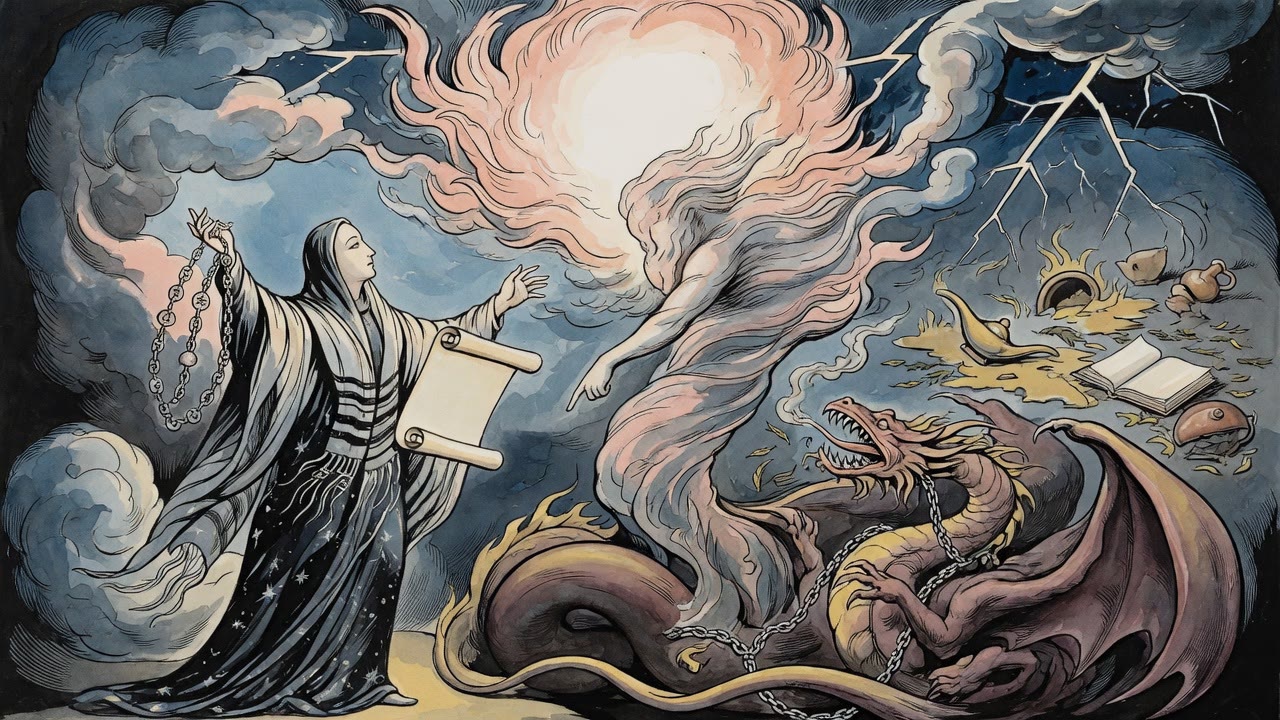
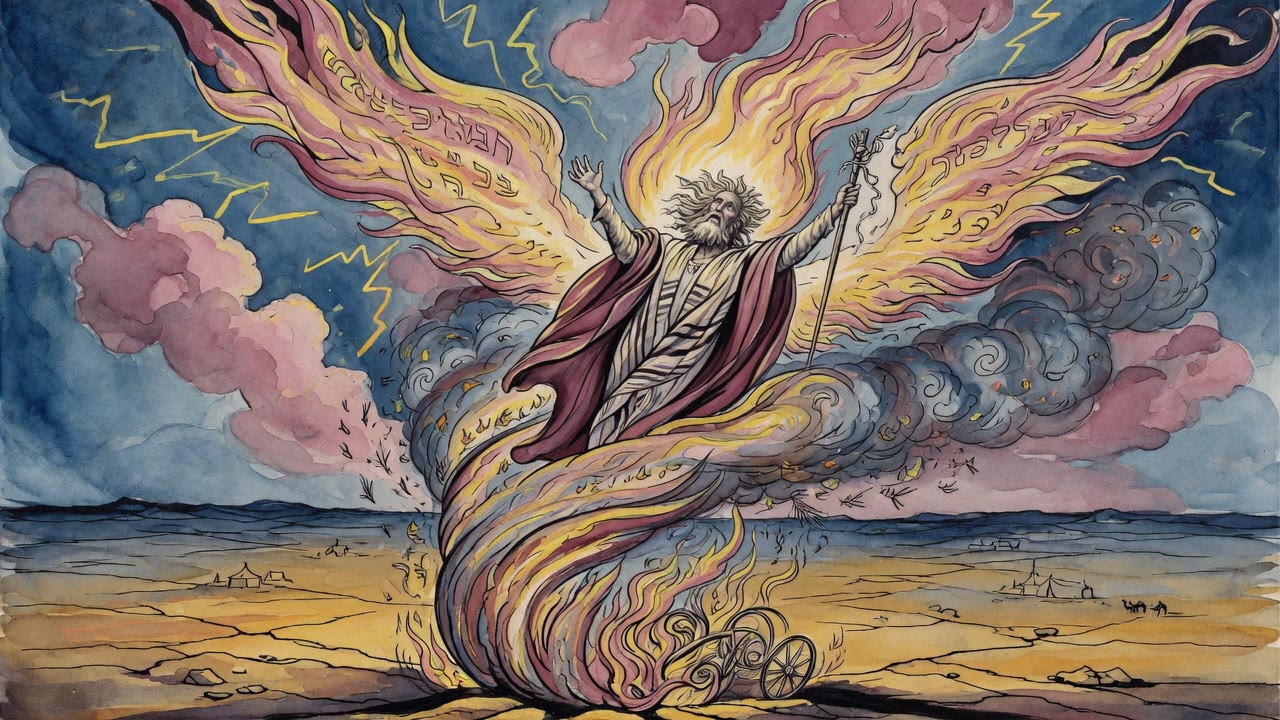
Elisha watched the chariot come. Horses of fire, a chariot of fire, the whirlwind that took Elijah upward, and then nothing. His master was gone. Elisha tore his clothes and picked up the cloak that had fallen. The Bible records this moment as an ending: Elijah went up to heaven in a whirlwind (2 Kings 2:11).

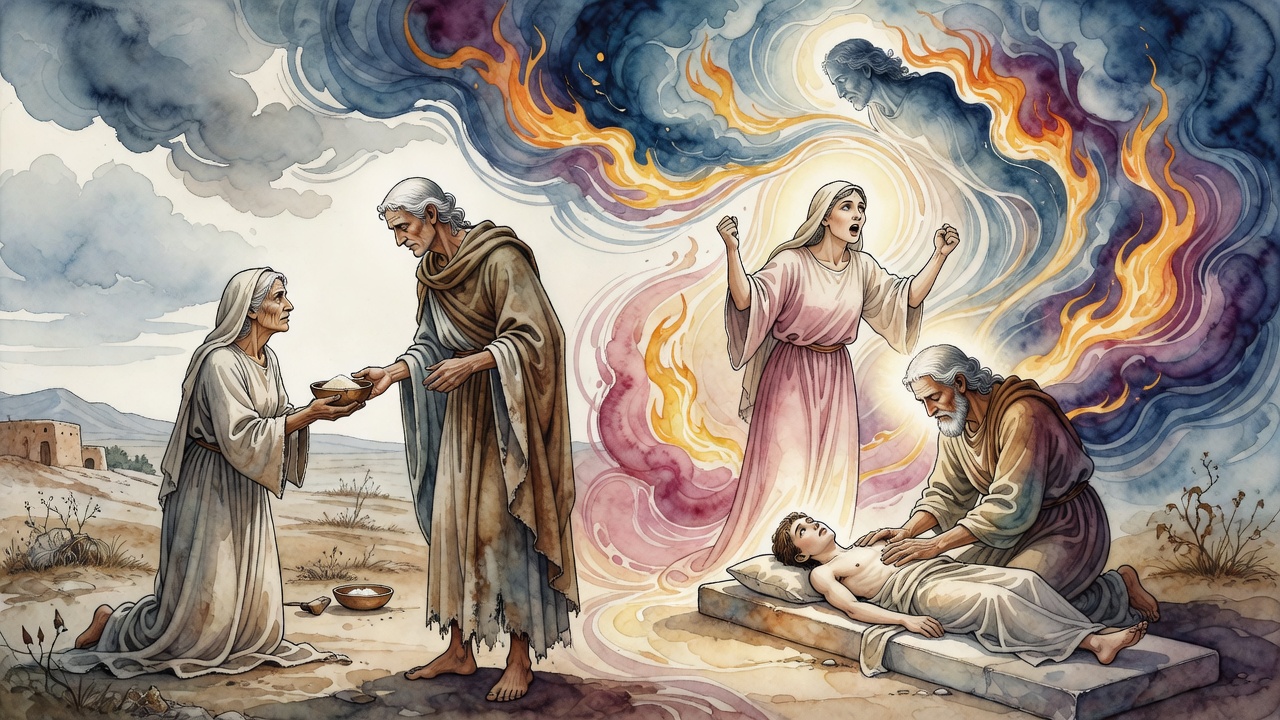
The tradition that followed refused to read it as an ending. Elijah did not die. He did not dissolve into the divine. He was transformed. The man from Tishbe who had stood before Ahab and called fire from heaven and outrun a chariot on foot became something else, something larger, in the place where the whirlwind took him.

Sandalphon

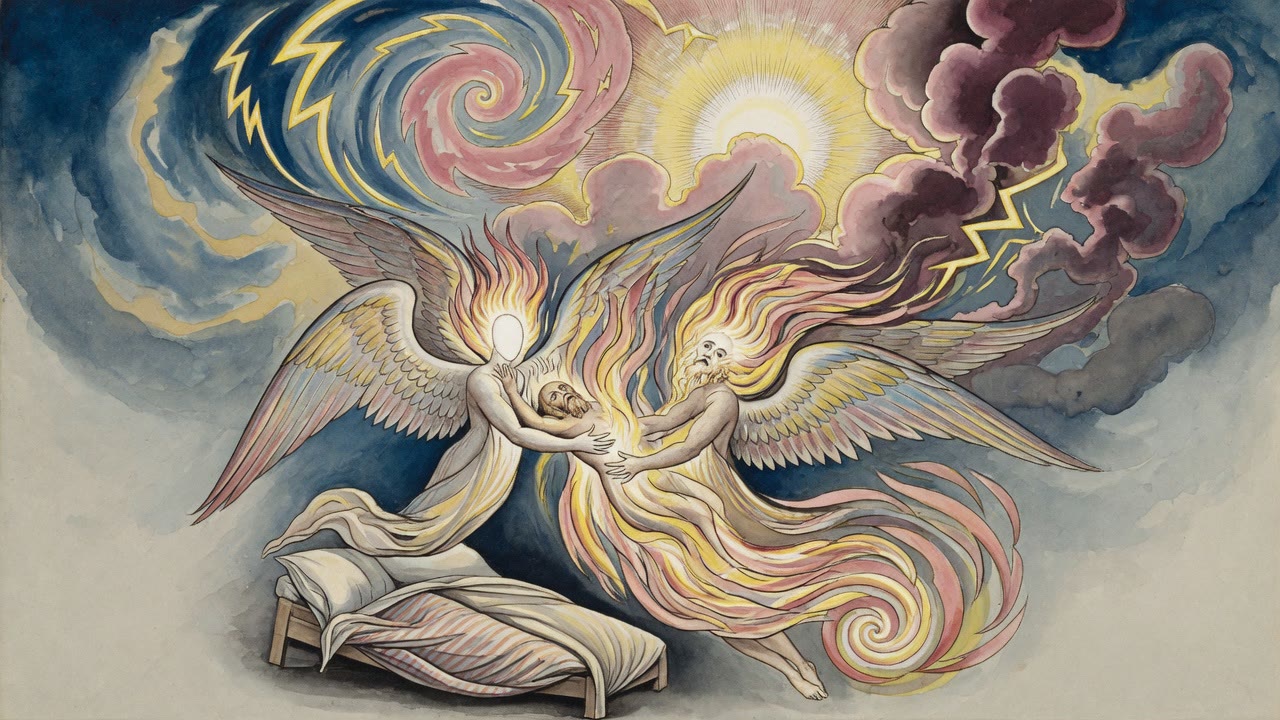
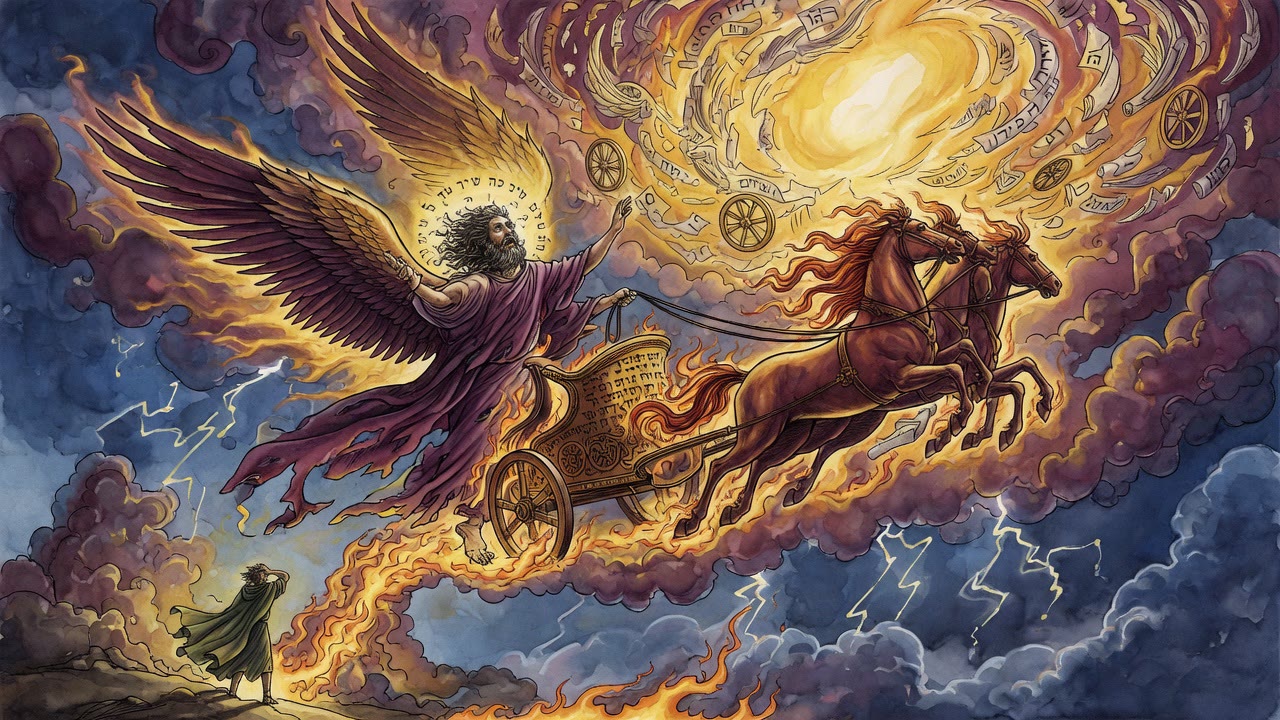
His name in heaven is Sandalphon. He is described as one of the greatest and mightiest of the heavenly host, a fiery being whose stature fills the space between the earth and the firmament. He stands above the windows of the firmament, positioned to receive what rises from below.

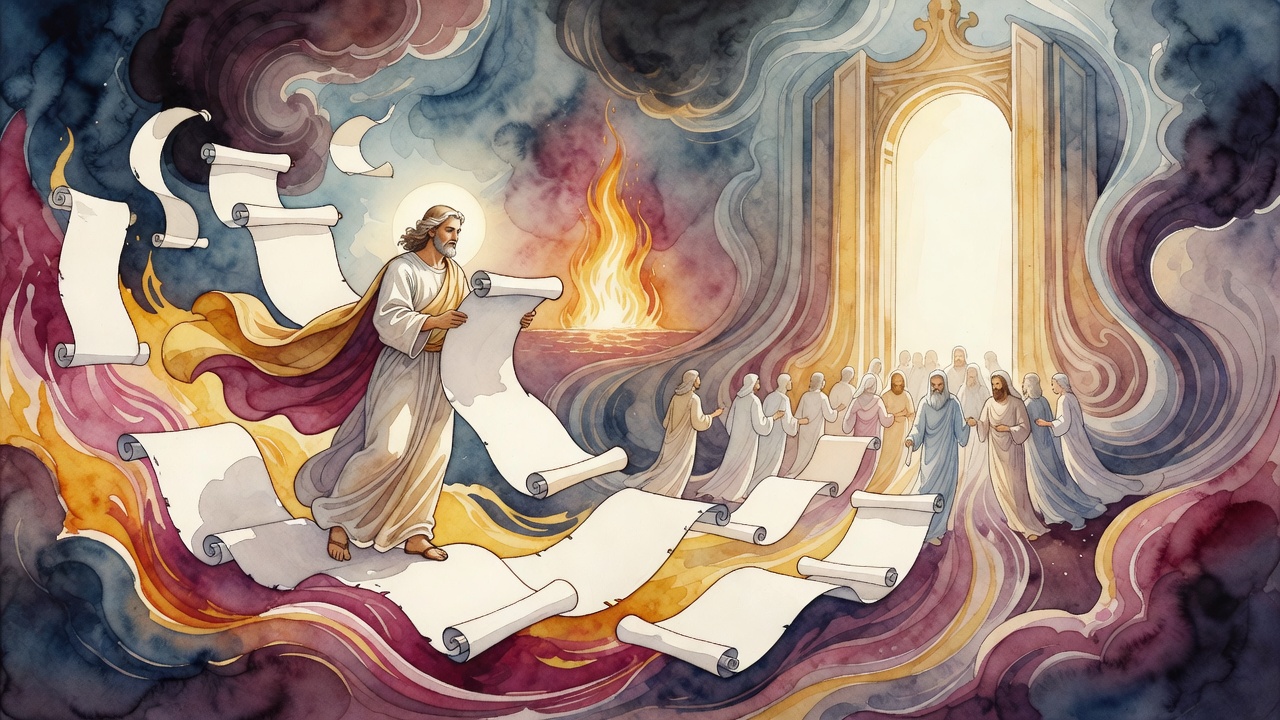
What rises from below is the prayers of Israel. Every word said in synagogue, every heartfelt petition, every blessing murmured before sleep, all of it ascends. Sandalphon waits for it. As the prayers arrive they cleave through the levels of atmosphere and the layers of heaven until they reach him. He collects them and weaves them into garlands for God.

This was his assignment after the transformation. He had been a prophet who delivered messages from heaven to earth. Now he was an angel who delivered messages from earth to heaven. The direction reversed, the role continued.

The Temple That Still Stands

When Jerusalem fell and the Temple burned, Sandalphon did not stop his work. Some traditions say the physical Temple was destroyed only in its visible form. In a dimension hidden from ordinary sight, it continues to exist. And in that invisible sanctuary, Sandalphon continues to offer the sacrifices that human priests can no longer bring.

The prayers that the priests once expressed through animal sacrifice and incense and grain offerings now come to Sandalphon as words. He transforms them into something God can receive the way God once received the rising smoke of the altar. The Temple's function was not extinguished. It was relocated and continued by an angel who knows what it is to be human.

The Song That Waits

There is a reciprocity in this arrangement that the Talmud noticed. In tractate Hagigah 13a, the angels do not sing in heaven until Israel has first sung on earth. The heavenly choir cannot open until the earthly one does. Israel's prayers and praises are not secondary to the angelic liturgy. They are its precondition. The angels wait for the signal from below.

Sandalphon stands where the prayers arrive. He receives them and makes the handoff. When Israel sings, the prayers ascend to him, and he weaves them into the form that enables the angels to join. The garlands he makes are not decorative. They are the mechanism by which human worship becomes part of the celestial chorus.

From Phinehas to the End of Days

Elijah's story, in Jewish tradition, does not begin with Ahab and does not end with the Messianic Age. He is identified with Phinehas, the priest who showed such passionate zeal for God in the wilderness that God granted him a covenant of eternal priesthood (Numbers 25:13). That priest became the prophet became the angel. One continuous identity operating across time in different forms.

In his earthly form he comes back, known and unnamed, showing up at every brit milah in every generation, attending every Passover seder, carrying an unfinished mission through the centuries until the final moment when he will announce the Messiah. He wears his terrestrial body for those visits. Above, waiting, weaving, standing above the windows where the prayers arrive, he wears his other form.


← All myths

From the tradition

Sources

5 sources

The texts this telling draws on, in full. Open a card to read inline, or expand it for a wider, quieter read.

Eruvin 45aTalmud Bavli, Eruvin

Didn’t we learn in a mishna that Rabbi Eliezer says: If a person left his Shabbat limit by walking two cubits beyond it, he may reenter his original limit; but if he left his Shabbat limit by walking three cubits beyond it, he may not reenter. What, is it not that Rabbi Eliezer follows his standard line of reasoning, in that he said with regard to the four cubits a person is allotted wherever he is, he is set in the middle of them, i.e., he may walk two cubits in each direction?

The Gemara explains that the four cubits that the Sages gave a person are regarded here as being subsumed within his original limit, and it is for this reason that he said: He may reenter his original limit. Apparently he is of the opinion that the subsuming of one Shabbat limit within another is something significant.

Rabba bar bar Ḥana said to Abaye: Do you raise an objection against our Master, Rabba, from the statement of Rabbi Eliezer? But isn’t the halakha in accordance with the opinion of Rabbi Eliezer? Abaye said to him: Yes, as I heard from our Master himself that the Rabbis disagree with Rabbi Eliezer only with regard to one who went beyond his limit for a voluntary matter, but with regard to one who went out for a mitzva matter, they agree with him about the subsuming of limits, i.e., that if one limit is subsumed in another, it is permitted to pass between them. This demonstrates that the halakha recognizes the principle of the subsuming of limits.

The mishna teaches: All who go out to save lives may return to their original locations on Shabbat. The Gemara asks: Does this mean that he may return to his original place even if he went out more than two thousand cubits beyond his limit? Didn’t the first clause say that a person who was permitted to travel beyond his Shabbat limit is allotted two thousand cubits, and no more?

Rav Yehuda said that Rav said: What this means is that they may return with their weapons to their original locations, provided they are within two thousand cubits. The Gemara asks: What is the difficulty with returning home in this situation? Perhaps in the case where people went out to fight and save lives the law is different, and they are allowed to go home even if they went more than two thousand cubits beyond the limit.

Rather, if there is a difficulty, this is the difficulty: As we learned in a mishna in tractate Rosh HaShana, at first they would take the witnesses who had come to Jerusalem from a distant place on Shabbat to testify that they had seen the new moon, and bring them into a special courtyard, and they would not move from there the entire day. This was in accordance with the law governing one who was permitted to go out beyond his limit, as once he fulfilled his mission, he was no longer permitted to move beyond four cubits.

However, Rabban Gamliel the Elder instituted that they should have two thousand cubits in each direction, so that witnesses not refrain from coming to testify. And it is not only these whom the Sages said are given two thousand cubits in the place that they have reached, but even a midwife who comes to deliver a child, and one who comes to rescue Jews from an invasion of gentile troops or from a river or a collapsed building or a fire; they are like the inhabitants of the town at which they arrive, and they have two thousand cubits in each direction.

The question may be raised: Are they given no more than two thousand cubits? Didn’t it say in the mishna: All who go out to save lives may return to their original locations on Shabbat, which indicates that they may walk even more than two thousand cubits?

In response, Rav Yehuda said that Rav said: We must not infer from the mishna that they may go home even if they went out more than two thousand cubits from their limit, but rather that they may return with their weapons to their original locations, provided that they are within two thousand cubits. As it was taught in the Tosefta: At first those returning from a rescue mission would place their weapons in the first house that they encountered upon their return, i.e., the house nearest the wall, to avoid carrying on Shabbat any more than necessary.

Once, their enemies noticed that they were no longer carrying their weapons, and they chased after them; and the defenders entered the house to take up their weapons and fight, and their enemies entered after them, causing great confusion. In the chaos, the defenders began to push one another, and they killed more of each other than their enemies killed of them. At that time the Sages instituted that they should return to their locations, i.e., their destinations, with their weapons.

The Gemara cites an alternate resolution that Rav Naḥman bar Yitzḥak said: This is not difficult. Here, in the mishna in Rosh HaShana where they only permitted two thousand cubits, it is referring to a situation where the Jews defeated the nations of the world, i.e., the gentiles, in battle; in such a case there is no concern and they need not return to their original locations. Whereas here, in the mishna which indicates that the Sages permitted even more than two thousand cubits, it is referring to a situation where the nations of the world defeated themselves, i.e., the Jews, whom the Gemara refers to euphemistically as themselves; in such a case the Sages allowed the defeated soldiers to return to their original locations.

Since the Gemara discussed war on Shabbat, the Gemara cites Rav Yehuda, who said that Rav said: With regard to gentiles who besieged Jewish towns, they may not go out to fight against them with their weapons, nor may they desecrate Shabbat in any other way due to them, but rather they must wait until after Shabbat.

That was also taught in a baraita, with a caveat: With regard to gentiles who besieged, etc. In what case is this said? It is said in a case where the gentiles came and besieged the town with regard to monetary matters, i.e., banditry. However, if they came with regard to lives, i.e., there is concern that the gentiles will attack, they may go out against them with their weapons, and they may desecrate Shabbat due to them.

And with regard to a town that is located near the border, even if the gentiles did not come with regard to lives, but rather with regard to matters of hay and straw, i.e., to raid and spoil the town, they may go out against them with their weapons, and they may desecrate Shabbat due to them, as the border must be carefully guarded, in order to prevent enemies from gaining a foothold there.

Rav Yosef bar Manyumi said that Rav Naḥman said: And Babylonia is considered like a town located near the border, and war may be waged there on Shabbat even if the gentiles came for financial gain. And this means the city of Neharde’a, which was located near the border.

Rabbi Dostai of the town of Biri expounded: What is the meaning of that which is written: “And they told David, saying: Behold, the Philistines are fighting against Ke’ila, and they rob the threshing floors” (i Samuel 23:1), after which David asked God how he should respond.

It was taught in a baraita: Ke’ila was a town located near the border, and the Philistines came only with regard to matters of hay and straw, as it is written: “And they rob the threshing floors.” And in the next verse it is written: “Therefore David inquired of the Lord, saying: Shall I go and smite these Philistines? And the Lord said to David: Go and smite the Philistines, and save Ke’ila” (i Samuel 23:2), which indicates that war may be waged in a border town on Shabbat, even with regard to monetary matters.

The Gemara refutes this proof by asking: What is David’s dilemma? If you say that he had a halakhic question and was in doubt whether it was permitted or prohibited to fight the Philistines on Shabbat, it is possible to respond: But the court of Samuel from Rama was then in existence, and rather than inquire by way of the Urim VeTummim he should have inquired of the Great Sanhedrin.

Rather, he asked: Will he succeed or will he not succeed in his war? The Gemara comments: This is also precise in the language of the verse, as it is written in the response to David’s query: “Go and smite the Philistines, and save Ke’ila.” Learn from this, from the assurance that God gave David of his victory, that this was the subject of his inquiry.

MISHNA: With regard to a person who was sitting along the road on Shabbat eve toward nightfall, unaware that he was within the city’s Shabbat limit, and when he stood up after Shabbat had already commenced, he saw that he was near the town, i.e., within its limit, since he had not intended to acquire his place of residence in the town, he may not enter it, but rather he measures two thousand cubits from his place; this is the statement of Rabbi Meir.

Rabbi Yehuda says: He may enter the town. Rabbi Yehuda said: It once happened that Rabbi Tarfon entered a town on Shabbat without intention from the beginning of Shabbat to establish residence in the city.

GEMARA: It was taught in a baraita that Rabbi Yehuda said: It once happened that Rabbi Tarfon was walking along the way on Shabbat eve, and night fell upon him, and he spent the night outside the town. In the morning, cowherds who came to graze their cattle outside the town found him and said to him: Master, the town is before you; enter. He entered and sat in the study hall and taught the entire day. This indicates that one is permitted to enter.

The other Rabbis said to Rabbi Yehuda: Do you bring proof from there? Perhaps he had it in mind the day before to acquire residence in the city, or perhaps the study hall was subsumed within his Shabbat limit. If the study hall was within two thousand cubits of the spot where he established residence, all agree that he may enter there.

MISHNA: With regard to one who was sleeping along the road on Shabbat eve and did not know that night had fallen, he has two thousand cubits in each direction; this is the statement of Rabbi Yoḥanan ben Nuri, who maintains that knowledge and awareness are not necessary for one to acquire residence, but rather, a person’s presence in a given location establishes residence there.

But the Rabbis say: He has only four cubits, as since he did not knowingly acquire residence, he did not establish a Shabbat limit. Rabbi Eliezer says: He has only four cubits total and he is in the middle of them, i.e., he has two cubits in each direction.

Rabbi Yehuda says: He may walk four cubits in any direction he wishes. But Rabbi Yehuda agrees that if he selected for himself the direction in which he wants to walk those four cubits, he cannot retract and walk four cubits in a different direction.

With regard to a case where there were two people in this situation, positioned in such a way that part of the four cubits of one were subsumed within the four cubits of the other, they may each bring food and eat together in the shared area in the middle,

Full source
Hagigah 13aTalmud Bavli, Hagigah

"And I saw the living creatures, and behold one wheel upon the earth beside the living creatures" (Ezekiel 1:15). Rabbi Elazar said: This is one angel who stands upon the earth, and his head reaches up beside the living creatures.

It was taught in a baraita: His name is Sandalphon, who is taller than his fellow by a journey of five hundred years. And he stands behind the chariot and binds crowns for his Maker.

Is that so? But is it not written: "Blessed be the glory of the LORD from His place" (Ezekiel 3:12), from which it follows that no one knows His place? Rather, he pronounces a name over the crown, and it goes and rests upon His head.

Full source
Legends of the Jews 7:21Legends of the Jews

They get collected, woven into something beautiful, something divine. And that's where Sandalphon comes in.

Sandalphon. It's a name that resonates with power. He's described as one of the greatest, mightiest angels – a truly fiery being! And his job? To weave garlands for God out of the prayers of Israel.

That's not all Sandalphon does. The destruction of the Temple in Jerusalem, the Beit Hamikdash (the Holy Temple in Jerusalem)… it was devastating. But some traditions suggest that its destruction was only apparent. That in reality, it continues to exist, hidden from our everyday sight. And in this invisible sanctuary, Sandalphon offers up sacrifices. A powerful image, isn’t it? A reminder that even in times of loss, something sacred endures.

Let's The familiar story is this: Elijah taken up to heaven in a whirlwind. But did that mark the end of his involvement with us? Quite the opposite, actually! It was almost the beginning of his real work, his true calling as a helper, a teacher, a guide.

Initially, his interventions were rare. The Zohar, that foundational text of Jewish mysticism, hints at the immense power and responsibility he now carried. One of the earliest recorded instances is a letter he wrote to the wicked King Jehoram of Judah seven years after his ascent. Think about the weight of that message, delivered from a prophet who now walked in the heavenly realms!

But perhaps one of the most dramatic examples of Elijah's continued involvement comes during the story of Purim. Remember Haman, the villainous advisor to King Ahasuerus who plotted to destroy the Jews? According to tradition, Elijah played a crucial, albeit disguised, role in foiling Haman’s plans. He assumed the guise of Harbonah, a courtier, and at just the right moment, he turned the king against Haman. As Ginzberg retells it in Legends of the Jews, this seemingly chance event was actually a carefully orchestrated intervention by Elijah himself.

So, what does all this mean? What are we supposed to take away from these stories of angels and prophets intervening in human affairs? Maybe it's this: that even when we feel most alone, most vulnerable, we are not forgotten. Our prayers are heard. Help is always possible, sometimes from the most unexpected sources. And perhaps, just perhaps, the line between heaven and earth is thinner than we think.

Full source
Legends of the Jews 7:4Legends of the Jews

The biblical account in the Books of Kings gives us glimpses of his fiery personality, his confrontations with kings, and his miraculous deeds. But those are just snapshots. They barely hint at the epic scope of his story.

Because according to Jewish tradition, Elijah’s story didn't begin with Ahab and Joram. It began way back in Egypt, during the Israelite's enslavement. And, get this, it won't end until the Messianic Age! Elijah is not just a prophet from a specific era. He’s a timeless figure, intimately connected with the entire history of the Jewish people.

The Bible tells us he was from Tishbe, but it leaves out a crucial detail: He was a priest. In fact, tradition identifies him with Phinehas – remember him? Pinhas was the priest who showed extraordinary zeal for God way back in the desert, when the Israelites were wandering after the Exodus. He stepped up to stop a plague, remember? And he reappears later, during the time of the Judges, continuing to play a significant role. (Ginzberg, Legends of the Jews)

So, is Elijah just a prophet from the Northern Kingdom? Or is he something...more? Someone who transcends time, connecting our past, present, and future? The tradition suggests the latter. And as we delve deeper into the legends surrounding him, we'll see just how powerful and enduring his presence truly is.

Full source
1 Enoch 14:8-25, 40:1-101 Enoch

Enoch, as we learn from 1 Enoch, wasn't just any man. He was righteous, a figure of immense importance in Jewish tradition. And he was granted something extraordinary: a journey to the heavens. Picture this: a thick mist descends, drawing him in. The stars themselves, along with flashes of lightning, seem to beckon him forward. Then, the winds sweep him up, carrying him higher and higher, beyond the familiar world and into the celestial realms.

What does he see? First, he approaches a crystal wall, shimmering and alive with tongues of fire. He passes through this fiery barrier and finds himself before a crystal house, its very foundations built of these luminous stones. Fire dances around its walls, and the entrances blaze with an intense heat. The ceiling shimmers like the night sky, a pathway of stars and lightning, guarded by fiery cherubim – powerful angelic beings.

Enoch, in this vision, enters the house. Can you imagine the sensation? It's both intensely hot and shockingly cold, a paradox that defies earthly understanding. Overwhelmed, trembling, he falls to his face. But the visions continue.

He sees a second house, even grander than the first. This one is built entirely of flames, its splendor beyond description. The floor and ceiling are fire, and a fiery portal stands open, inviting him in. And there, in the heart of it all, is a throne, lofty and radiant as crystal. Beneath it flow streams of flaming fire, and the wheels of the throne – yes, wheels – shine with the brilliance of the sun.

This is a key element. The vision of God's throne as a chariot, with wheels, places this squarely within the tradition of Merkavah (chariot) mysticism, an early form of Jewish mystical thought. The Merkavah tradition, as explored in texts like the Zohar, focuses on ecstatic visions of God's throne-chariot.

But the most awe-inspiring sight is yet to come. Seated on the throne is the very glory of God. His garment is described as whiter than any snow, and His light is brighter than the sun, the moon, and the stars combined. A flaming fire surrounds Him, and a great fire stands before Him. The intensity is so overwhelming that none can draw near. It's a vision of unimaginable power and majesty, a glimpse into the heart of the Divine. As 1 Enoch 14:8-25 and 40:1-10 recount, it’s an experience that leaves Enoch utterly humbled and transformed.

What does this vision mean for us? It’s a reminder of the sheer, overwhelming power and mystery of the Divine. It's an invitation to contemplate the unseen realms, to seek a connection with something far greater than ourselves. It's a evidence of the enduring power of visionary experience, and the profound impact it can have on those who are chosen to witness it. And perhaps, in our own way, we can all strive to glimpse a bit of that divine light.

Full source