5 min read

Elijah Pointed to a Jailer in the Marketplace

In a roaring market Elijah refuses the scholars and points first to a prison warder, then to two jesters who buy Paradise with laughter.

Curated by Arthur · Told by Maggid ·
Table of Contents
  1. The Man in Dark Clothes
  2. Two More Hands Rise
  3. What the Market Could Not Sell
  4. The Finger That Would Not Flatter

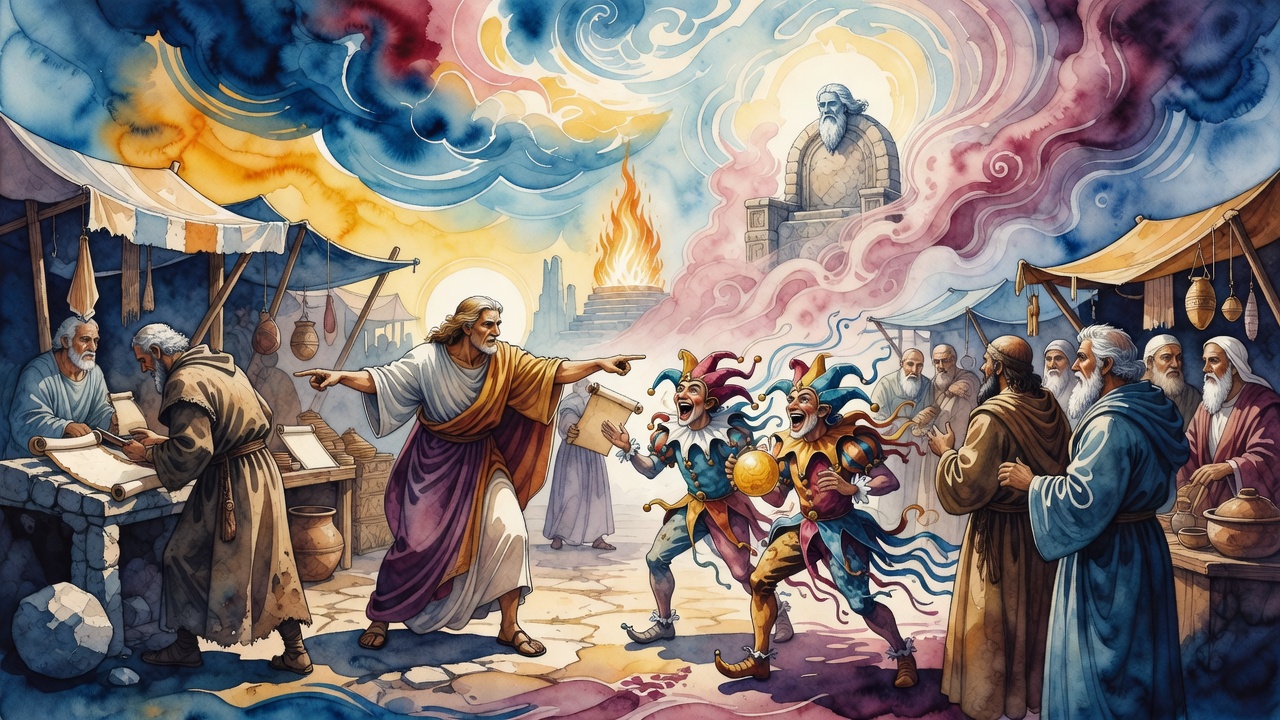
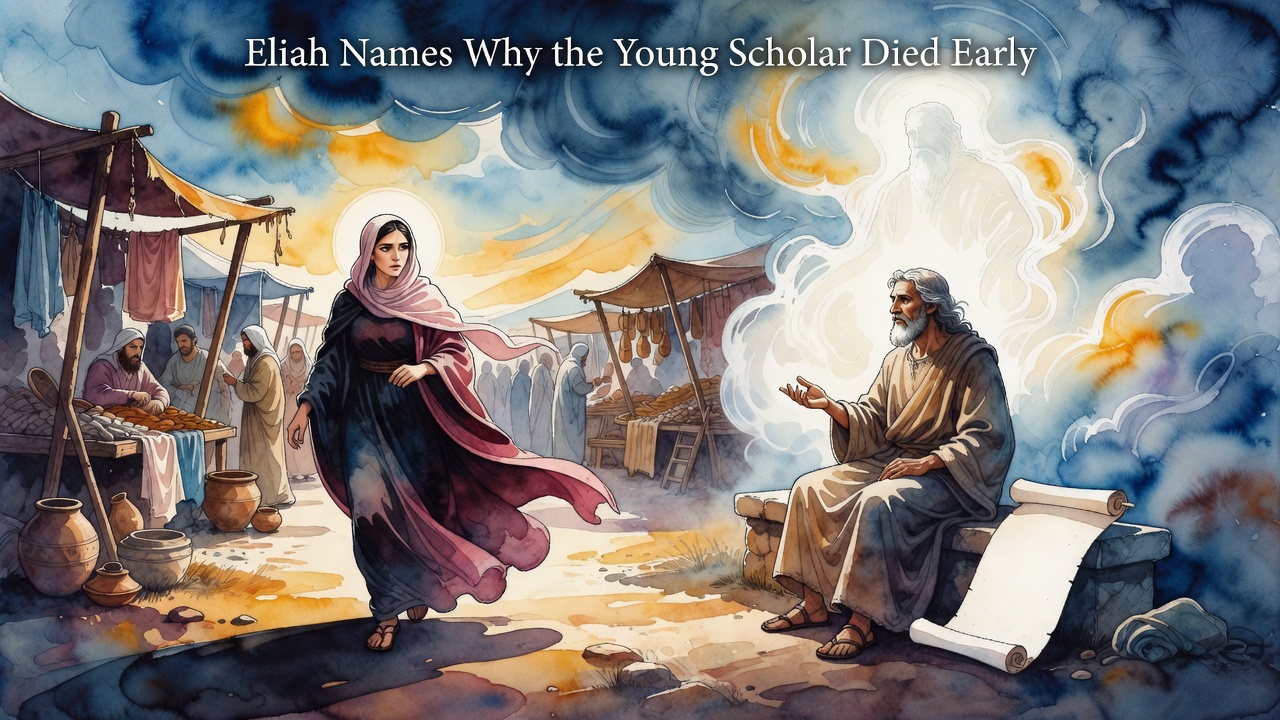
The market at Be Lapat did not pause for holiness. Donkeys balked. Copper rang. Fish scales stuck to a merchant's wrist. Through that noise walked Rabbi Beroka of Be Chozae with a man no stall-keeper greeted, because no stall-keeper knew who stood beside the rabbi.

Elijah Pointed to a Jailer in the Marketplace Click for full size

It was the prophet Elijah, dressed like a traveler, ordinary as dust on a boot.

Beroka looked at the press of bodies and asked the question that lived under every scholar's pride. "Is anyone here destined for the World to Come?"

Elijah scanned the crowd. For a long breath he found no one. Then his hand rose.

The Man in Dark Clothes

"That one," Elijah said.

Beroka followed the point and saw a man in Roman cut, dark cloth, no fringes, no scholar's face. Nothing on him said Torah. Everything on him said the empire's payroll.

"This man is worthy of the World to Come?" Beroka asked, because the answer already offended him.

He crossed the market and stopped the stranger. "What is your work?"

"I keep the prison," the man said.

Beroka waited for more. The warder did not dress the answer up. When prisoners came, he separated men from women and put his own bed between the sections so that his body was the wall no one could cross in the night. When a Jewish woman was in special danger, he spent himself to keep her out of the hands that wanted her. No one in the market saw that work. The market sold grain and gossip. The prison held the part of the world where credit never arrives.

Beroka went back to Elijah with the facts still strange in his mouth. Elijah did not soften them. The warder's worth was his anonymity. He did right where no lecture could be given and no student could clap.

Two More Hands Rise

They kept walking. The market shoved and shouted. Beroka's eyes kept hunting for fringes and staffs and the look of men who had sat too long over a page. Elijah's hand rose again.

Two men this time. Ordinary. No wealth on them. No open scroll. They moved like people who lived on their feet.

Beroka intercepted them. "What do you do?"

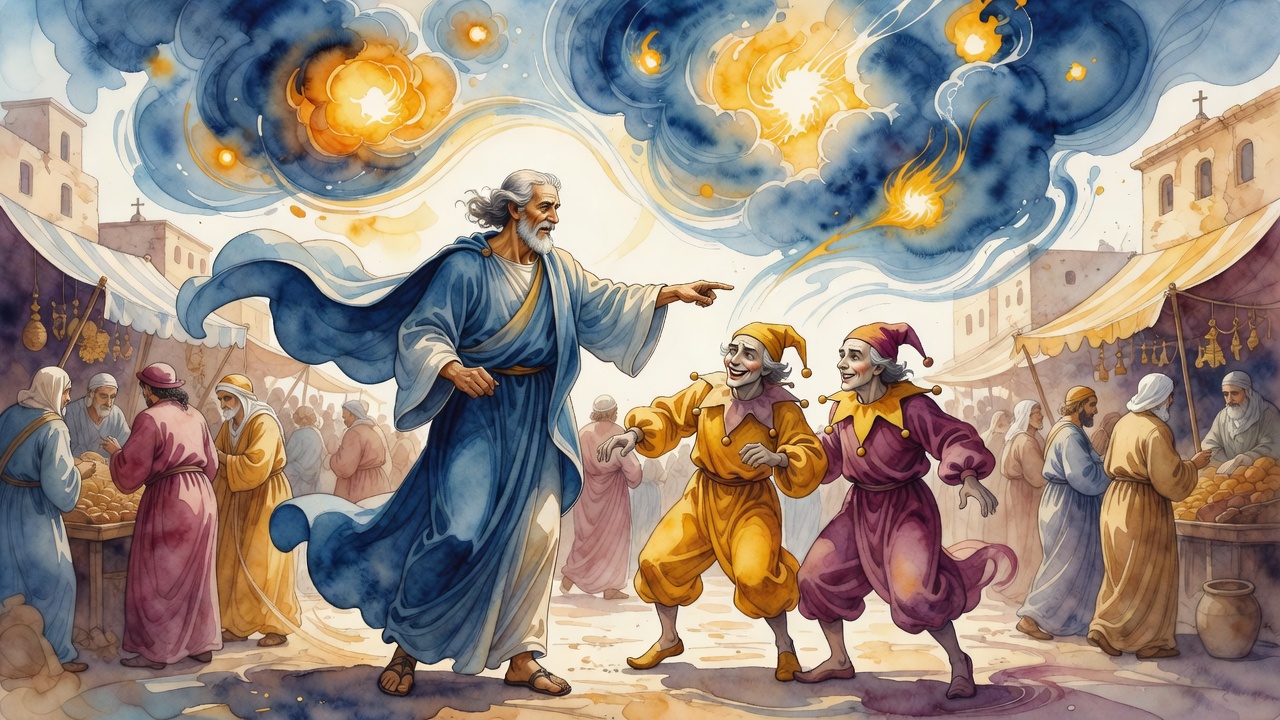
"We are jesters," one said. "We make people laugh."

Beroka pressed. That could not be the whole of it. Elijah did not point at empty noise.

"When we see someone sunk in grief," the other said, "we go to him. We pull a face. We tell a foolish story. We stay until the sadness loosens. When we see two people quarreling, we put humor between them until the fight cools and they can stand in the same street again. That is our work."

No fast. No public donation. No class in the study house. Two men hunting sorrow the way other men hunt coin, and replacing it before it hardens.

What the Market Could Not Sell

Beroka stood between the prison story and the jesters' story and felt his map of the World to Come tear. He had expected the obvious candidates: the loud pious, the known teachers, the men whose righteousness made a sound. Elijah had given him a bed dragged between cells and a joke timed to a mourner's face.

The warder never entered the market as a hero. The jesters never entered the study hall as sages. Paradise, in Elijah's pointing finger, did not wait for costume. It waited for the act that leaves no plaque: a body used as a wall at night, a laugh aimed at a wound before the wound becomes a feud.

Around them the market kept roaring. Barley changed hands. A beggar's palm stayed empty. Beroka and Elijah moved through it like a second current, and every face the rabbi had trusted as "likely" stayed unchosen.

The Finger That Would Not Flatter

Beroka did not argue with the prophet. He carried the two answers home inside his ribs. One smelled of iron keys and night watches. The other smelled of street dust and forced smiles that somehow became real. Between them sat a hard sentence: the World to Come is not a prize for looking righteous. It is earned in rooms no marketplace watches, and sometimes in the middle of the marketplace by men the market will never name.

Elijah vanished the way he always vanished, into ordinary air. The warder went back to his doors. The jesters went back to looking for a face that needed light. Beroka went back to his learning with a new weight on every page: if heaven's shortlist can hold a jailer and two clowns, then the list was never the one he had been reciting.


← All myths
From the tradition

Sources

4 sources

The texts behind this telling. Some cards carry a translation of the source; others are our own retelling of it, and each card says which. Every card links out to the original.

Exempla of the Rabbis, No. 405Exempla of the Rabbis (Gaster, 1924)

Retold in our words. Read the original at the link below.The Exempla of the Rabbis, Moses Gaster (1924) · Public Domain

The Talmud (Taanit 22a) tells of Elijah the prophet revealing to Rabbi Beroka which people in the marketplace were destined for the World to Come. Rabbi Beroka expected Elijah to point to the obvious candidates, the scholars, the pious, the visibly righteous.

Instead, Elijah pointed to a prison warder, a guard in the local jail. Rabbi Beroka was astonished. "This man is worthy of the World to Come?"

Elijah explained: the warder was scrupulous in his treatment of prisoners. He ensured that male and female prisoners were kept separate, protecting the women from abuse. He placed his own bed between the men's and women's sections, using his body as a barrier to prevent any impropriety. When he learned that a Jewish woman was in particular danger, he went to extraordinary lengths to protect her.

No one in the marketplace knew about the warder's righteousness. He did not wear the garments of a scholar. He did not pray with conspicuous piety. He did not give public lectures on Torah. But behind the walls of his prison, in the place where no one was watching, he practiced a quiet, invisible form of holiness that was worth more than all the public displays of the marketplace.

The lesson hit Rabbi Beroka with the force of revelation: the World to Come is not reserved for those who look righteous. It is earned by those who are righteous, especially in the dark corners where no one is watching, where no one will give you credit, where the only witness is God Himself. The warder's worthiness was his anonymity. He did the right thing because it was right, and for no other reason.

Full source
Exempla of the Rabbis, No. 406Exempla of the Rabbis (Gaster, 1924)

Retold in our words. Read the original at the link below.The Exempla of the Rabbis, Moses Gaster (1924) · Public Domain

Rabbi Beroka was walking through the marketplace with the prophet Elijah, who appeared to him in disguise, as he often did to the great sages, when Beroka asked a question that burned in every rabbi's mind: "Is there anyone in this marketplace who is destined for the World to Come?"

Elijah scanned the crowded market, merchants, scholars, beggars, soldiers. And pointed to two men who looked completely ordinary. They were not rabbis. They were not wealthy philanthropists. They did not spend their days studying Torah or performing elaborate acts of charity.

Rabbi Beroka hurried over to them and asked: "What do you do?"

"We are jesters," they said. "We make people laugh."

Beroka pressed further. Was that really all they did?

"When we see someone who is sad," they explained, "we go to them and cheer them up. When we see two people quarreling, we use humor to make peace between them. That is our work. We make people who are suffering feel happy, and we turn enemies into friends."

That was it. No Torah scholarship. No fasting. No grand donations to the poor. Two men who walked through the world looking for sadness and replacing it with laughter. And Elijah the prophet, speaking with divine authority, declared them worthy of Paradise.

The Talmud in Taanit (22a) preserves this encounter as one of the most surprising teachings about the afterlife in all of rabbinic literature. The World to Come does not belong exclusively to the pious, the learned, or the ascetic. It belongs to anyone who takes another person's pain and transforms it into joy. Even a joke, told at the right moment to the right person, can earn eternity.

Full source
Gaster, Exempla of the Rabbis, no. 405 (R. Nissim, Hibbur Yafeh); cf. Taanit 22aThe Exempla of the Rabbis (1924)

Retold in our words. Read the original at the link below.The Exempla of the Rabbis, Moses Gaster (1924) · PD-US-pre-1929

Rabbi Beroka of Be Chozae had a gift. The prophet Elijah, the undying messenger, would sometimes appear to him in ordinary places, in a marketplace, among vendors and travelers. And speak with him.

One day they were standing together in the crowded market. Rabbi Beroka looked at the hundreds of people passing and asked, "Is any of these destined for the world to come?"

Elijah looked with him. Then he said: "No." A silence. Then: "Wait. That man, over there, yes. He alone, of all this multitude, will enter Gan Eden."

Beroka looked where Elijah pointed. He saw a man dressed in Roman fashion, dark clothes, no ritual fringes, nothing about him that marked him as a pious Jew. Beroka was stunned. He ran to the man and asked him what he did for a living.

The man answered plainly. "I am the keeper of the prison. When Jewish prisoners are brought in, I separate the men from the women so that no dishonor touches them. When the authorities plan some evil decree against the Jews, I find out, and I send word to your leaders in time for them to prepare, to petition, to save what can be saved."

"Why do you dress like a Roman?" Beroka asked.

"So that my colleagues will trust me. So that I will hear what is coming."

This quiet infiltrator, invisible to every pious Jew in the market, was the one soul Elijah said would enter the Garden. Gaster's Exempla (no. 405, 1924, drawn from Rabbi Nissim's Hibbur Yafeh me-ha-Yeshuah) preserves the story because it destabilizes our notion of who belongs in heaven. The man with no visible mitzvot was carrying, in his plain clothing, the most essential mitzvah of his generation: he was saving Jewish lives without ever being thanked.

Full source
Gaster, Exempla no. 406; cf. Ta'anit 22aThe Exempla of the Rabbis (1924)

Retold in our words. Read the original at the link below.The Exempla of the Rabbis, Moses Gaster (1924) · PD-US-pre-1929

Rabbi Beroka of Be Hozai used to go walking through the crowds of the marketplace in the company of the prophet Elijah, who would point out to him those among the ordinary people who were destined for the World to Come.

One day Elijah pointed to two men.

They did not look unusual. They did not wear the fringed garments of the great scholars. They did not carry the staff of a sage. They looked, in fact, like wandering entertainers, two ordinary men moving from place to place.

Rabbi Beroka went up to them and asked what they did with their lives. They answered him plainly. "We are jesters. When we see people who are sorrowing, a mourner at a funeral, a family collapsed by trouble, a couple quarreling, we go to them. We make them laugh. We tell them a foolish story, or pull a face, or sing a silly song, until the sadness loosens and they smile. That is what we do."

Rabbi Beroka understood then why Elijah had marked them. The two men had not studied Torah to the level of the masters. They had not composed commentaries. But they had taken one commandment, V'ahavta l're'acha kamocha, "love your neighbor as yourself" (Leviticus 19:18). And turned it into a full-time trade. A sad person became, for them, an appointment from heaven. They brought the lightness of Gan Eden down into the dusty street.

The Exempla preserves this teaching as a small explosion against scholarly snobbery. The World to Come is not reserved for the scholar alone. It is open also to the joke-teller who makes a widow laugh for the first time in a year. He, too, is doing the work of the Torah.

(From The Exempla of the Rabbis, Moses Gaster, 1924, no. 406, from Rabbi Nissim's Hibbur Yafeh meha-Yeshu'ah, based on Ta'anit 22a.)

Full source