6 min read

Elijah Told the Widow Why Her Husband Died Young

Not one of her husband's colleagues would answer her. Then a man sat down in her courtyard and asked two questions about her marriage bed.

Curated by Arthur · Told by Maggid ·
Table of Contents
  1. She Went From Door to Door With One Question
  2. A Man Sat Down in Her Courtyard
  3. The Question About the Days of White
  4. Blessed Is the One Who Killed Him
  5. As Beloved as on the Day of the Canopy
Elijah Told the Widow Why Her Husband Died Young Click for full size

She Went From Door to Door With One Question

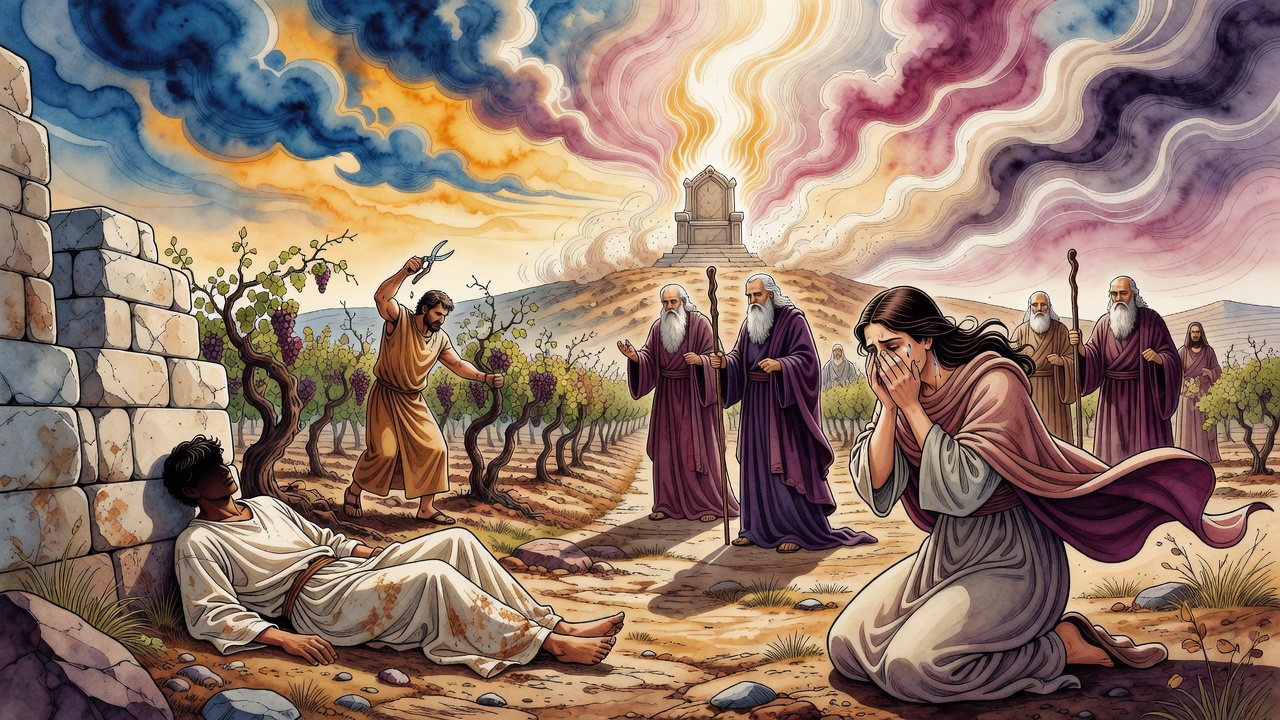
Her husband had read a great deal and studied a great deal and had spent years waiting on the sages, and he died in the middle of his days.

Afterward she went out of her mind. She went along the street where his colleagues lived and knocked, and when a man opened his door she asked him the same thing she had asked the last one.

"My masters. My husband read much and studied much and served the sages much. Why did he die in the middle of his days?"

Not one of them said anything back. Not a verse, not a guess, not a bad answer offered kindly. They stood in their doorways and let her finish and let her move on to the next house.

A Man Sat Down in Her Courtyard

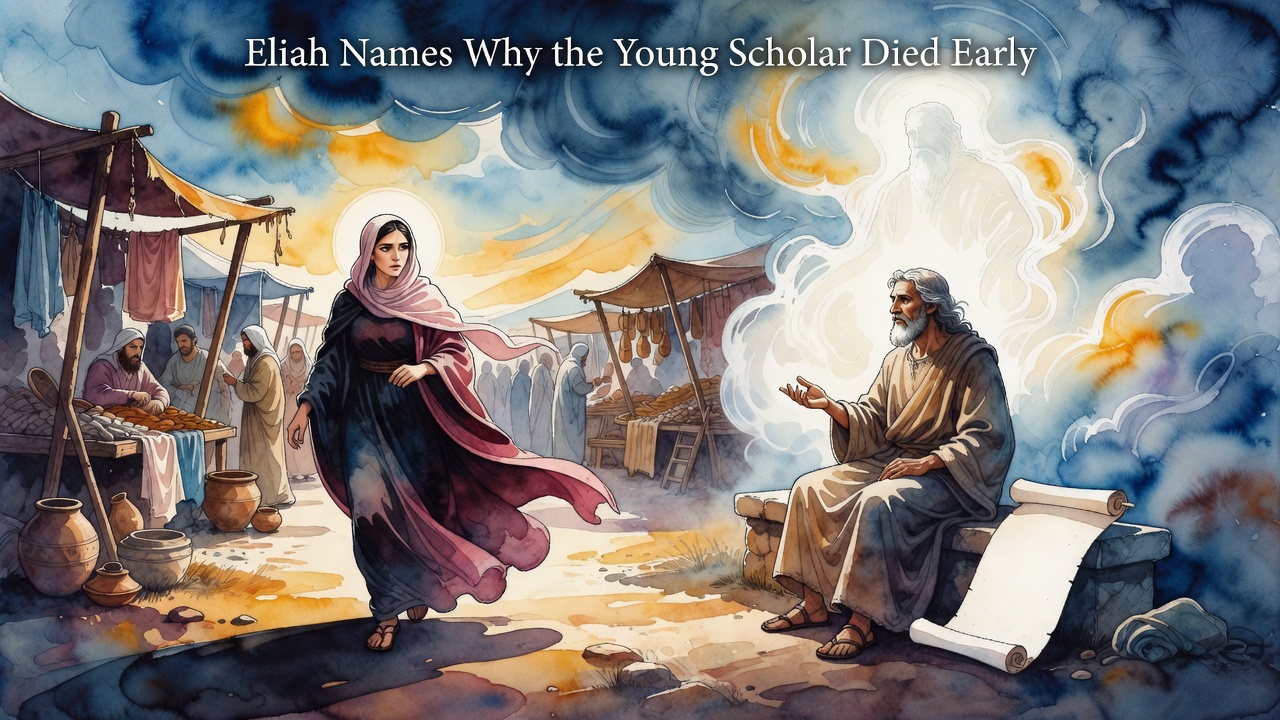
An old man was walking through the market and turned in at her gate.

She came out and sat down facing him and cried. He let her. Then he asked her why she was crying, and got the sentence he had probably already heard from three streets away: read much, studied much, served the sages much, dead in the middle of his days.

Elijah did not say that heaven works in ways nobody can follow. He asked her about her house.

"My daughter. In your days of separation, what was he to you?"

Her chin came up.

"Rabbi, God forbid. He did not touch me with his little finger. And when the days of blood were over I sat seven clean days on top of them, so that there could be no doubt about any of it."

"Your husband did right by you," he said. "The sages ruled exactly so."

Then he asked the second question.

The Question About the Days of White

"And in those seven days, my daughter. The white days. What was he to you then? Did you hand him a knife, perhaps, and his little finger touched yours?"

She answered fast, because she thought she was answering well.

"By your life, Rabbi. I washed his feet. I rubbed the oil into them. I slept beside him in one bed, I in my clothes and he in his. But his mind never once turned to anything improper."

She had just described the seven days of a scrupulous house. The feet, the oil, the shared mattress, two people fully dressed, nothing done and nothing intended. In her telling it was a defense.

Elijah heard it as the answer to her question.

Blessed Is the One Who Killed Him

"Blessed is the Place, who killed him," he said. "Because there is no favoritism in front of Him."

Do not draw near, the Torah says. Not do not lie with her. Draw near. Could a man embrace her, kiss her, talk lewdly to her? Do not draw near. Could he sleep beside her in one bed with both of them clothed? Do not draw near. The prophet Ezekiel set the menstruant woman down in the same line as another man's wife, so that a man would be as careful about the one as about the other.

And there was one more turn of the screw, and it was aimed at her husband specifically. Only you have I known of all the families of the earth, God says, meaning Israel out of the seventy nations. Therefore I will call you to account for all your iniquities, meaning the Torah scholars out of the house of Israel.

He had spent his life on the pages. He could take apart a hard passage in front of men twice his age. He had not been able to keep the fence in his own bedroom, and the account was settled against him first, because he above everyone else had known where the fence stood.

Blessed is the Place, who killed him. That was the answer nobody on that street had been willing to hand her.

As Beloved as on the Day of the Canopy

Elijah did not leave her sitting in the wreckage of it. He kept talking, the way a man keeps talking to someone he has just wounded on purpose.

The reward of a commandment is another commandment, he told her, and the wages of a sin are another sin. He went through the ledger heaven keeps. Men who deal in lies and men who swear falsely and men who carry themselves with arrogance, and how each of them ends up doing it to everyone. Householders who tell a poor man at the door that there is no wheat and no barley in the house when there is, and how the plague comes out on their walls until the furniture is carried into the street and the whole town can see what was in there. Money lent at interest, grain hoarded until the price climbs, quarrels started for sport, and the ones who are buried like Korah.

Then the other column. People who are insulted and do not insult back. People who hear themselves slandered and say nothing. People who return what they find and keep what they are told in confidence. People who marry off their children early, before the empty years can find them.

And at the end of all of it, the reason for the seven days in the first place, which is not coldness and was never meant as coldness. A man keeps his distance so that on the day she comes back to him she is as beloved as she was on the day she walked under the wedding canopy.

He said that to a woman with nobody left to come back to.


← All myths

From the tradition

Sources

2 sources

The texts behind this telling. Some cards carry a translation of the source; others are our own retelling of it, and each card says which. Every card links out to the original.

Tanna Debei Eliyahu Rabbah 15:2Tanna DeBei Eliyahu Rabbah

Translation of the source text.Tanna debei Eliyahu Rabbah, Warsaw 1880 · Public Domain

There was an incident concerning a certain man who read much and learned much and served Torah scholars much, and entered his eternal home in the middle of his days, and his wife became like one demented, and she would go around to the doors of her husband's companions and say to them, "My masters, my husband, who read much and learned much and served Torah scholars much - for what reason did he die in the middle of his days?" And there was no man who answered her anything. One time I was walking in the marketplace, and I entered her courtyard. She came and sat opposite me and was weeping. I said to her, "My daughter, for what reason are you weeping?" She said to me, "My master, my husband read much and learned much and served Torah scholars much, and he died in the middle of his days." I said to her, "My daughter, in the time of your menstrual impurity, how was he with you?" She said to me, "My master, God forbid, he did not touch me even with his little finger. And after all those days in which I saw blood in them, I sat seven clean days, so that I should not come to any doubt." I said to her, "My daughter, well did your husband say to you, for thus the Sages said concerning men with a flux and women with a flux and menstruants and women after childbirth: that after seven they are pure, as it is said (Leviticus 15:28), 'And if she is cleansed of her flux, she shall count for herself seven days, and after that she shall be clean.' But in those days of the white garments, how was he with you? Perhaps you brought him the knife that was in your hand, and he touched it, even with the little finger?" She said to me, "My master, by your life, I washed his feet for him and anointed him with oil, and I slept with him in one bed, I in my garments and he in his garments, but he did not turn his mind to any other matter." I said to her, "Blessed is the Omnipresent who slew him, for there is no favoritism before Him; for so it is written in the Torah (Leviticus 18:19), 'And to a woman in the impurity of her menstruation you shall not draw near.' One might think he may embrace her and kiss her and speak with her words of levity - Scripture teaches, 'you shall not draw near.' One might think he may sleep with her in her garments on one bed - Scripture teaches, 'you shall not draw near,' so that a man should not say to himself, 'When she is in her menstruation, her flesh is forbidden but her bed is permitted.' He kept apart from the menstruant; lest you say her flesh is forbidden but her bed is permitted, therefore He returned and explained through Ezekiel (Ezekiel 18:6), 'And he has not defiled his neighbor's wife, and he has not drawn near to a menstruant woman' - He equated the menstruant woman to a married woman, that you be careful concerning her as in all the deaths stated in the Torah. And it says (Amos 3:2), 'You only have I known of all the families of the earth' - these are Israel from among the seventy tongues; 'therefore I will visit upon you all your iniquities' - these are the Torah scholars from within the house of Israel." Again I said to her, "My daughter, come and learn from what is written in the Torah, that the reward of a commandment is a commandment and the reward of a transgression is a transgression. A man uses much false speech, lying speech, with his father and with his mother, with his wife and with his children, with his master who taught him Scripture and Mishnah and wisdom; in the end he does so with every man. A man swears much false oaths with all these; in the end he does so with every man. A man conducts himself with haughtiness of spirit with all these; in the end he does so with every man. A man is brazen-faced toward his father or toward his mother or before one who is greater than he; in the end he does so with every man. The plagues are shown on his body; if he repents and does repentance, they heal him; and if not, lo, he remains in his state until the day of his death. A man loved robbery and multiplied it everywhere - the plagues are shown on his body; if he repents and does repentance, they heal him; and if not, lo, he remains in his state until the day of his death. A man loved his money and multiplied it everywhere - the plagues, warp and woof, are shown in his fine garments; if he returns in repentance they are healed; and if not, they take his fine garments and burn them before him. A poor man comes and stands at the door of the householder and says to him, 'Lend me one kav of wheat or of barley,' and the householder says to him, 'I have neither wheat nor barley,' and in truth he has - the plagues are shown in the walls of his house, until they reach the ground; and when they bring his vessels out of his house to the outside, to the street of the city, people say to one another, 'Is this not the one who said, I have neither wheat nor barley? But lo, he has!' Blessed is the Omnipresent, blessed is He, who sanctifies His great name openly to the whole world; therefore it says, 'When you joined with Ahaziah, the Lord broke your works, and the ships were wrecked,' and so on. The craftsmen and the artisans and the brazen-faced - concerning them it says (Psalms 37:17), 'For the arms of the wicked shall be broken,' and so on. Those who plot evil and pervert words and make speech deep and make the tongue smooth - concerning them it says, 'Let their way be dark and slippery,' and so on. Those who strike their fellows in secret and profane the Name openly and demean their fellows with words and cast strife - they are destined to be like Korah and his company, and concerning them it says, 'And the earth covered over them, and they perished from the midst of the assembly.' Those who hoard produce and lend at interest and make the ephah small and inflate prices - concerning them it says, 'The Lord has sworn by the pride of Jacob: I will never forget all their deeds.' All these do not bequeath to their children, and if they bequeath to their children, they do not bequeath to their children's children. Those who play with dice and lenders at interest and those who raise small cattle in the Land of Israel, and the priests and Levites who went up to their portion, and the heretics and the violent and the profaners of the name of Heaven and the flatterers - concerning them it says, 'What is crooked cannot be made straight,' and so on (Ecclesiastes 1:15). But those who are insulted and do not insult, who hear their reproach and do not reply, who do the commandments out of love and rejoice in sufferings - concerning them it says, 'And those who love Him are like the going forth of the sun in its might' (Judges 5:31). The despised and lowly in their own eyes, who lower their spirit and subdue their inclination - concerning them it says (Isaiah 49:7), 'Thus says the Lord, and so on, to him who is despised of soul, to him who is abhorred by the nation, to a servant of rulers: kings shall see and arise, princes, and they shall bow down,' and so on. Men of faithfulness, who return a deposit and restore a lost object and conceal secrets - concerning them it says (Psalms 101:6), 'My eyes are upon the faithful of the land, that they may dwell with me,' and so on. He who does the desires of his wife and leads his children properly and marries off a wife to his young sons before they reach their maturity, before they come to sin - concerning him it says, 'And you shall know that your tent is at peace, and you shall visit your habitation and not sin, and you shall know that your seed is numerous and your offspring like the grass of the earth; you shall come to the grave in ripe age, as a shock of grain comes up in its season.' He who marries his sister's daughter and loves his neighbors and draws near his kin and lends a sela to a poor man in the hour of his distress - concerning him it says (Isaiah 58:9), 'Then you shall call, and the Lord will answer,' and so on. A man saw a seminal emission - he is obligated in immersion from the Torah; if he says, 'Who saw me? There is nothing in it,' and removed it from before his face, and again saw an emission and says, 'Who sees me? There is nothing in it,' and so a third time - he transgresses what is written in the Torah (Leviticus 15:16), 'And when a man has a seminal emission go out from him, he shall bathe all his flesh in water and be unclean until evening,' and he transgresses what is written (Job 33:29), 'Behold, all these God works, twice, three times, with a man'; in the end he becomes a man with a flux out of his own ways, as it is said (Leviticus 15:2), 'Any man who has a flux from his flesh,' and so on. And what does 'any man' (ish ish) teach? Rather, one man for the flux from his flesh and one man for the nocturnal emission; and if he repents and does repentance, they heal him; and if not, lo, he is a man with a flux until the day of his death, as it is said, 'And this shall be his impurity in his flux: whether his flesh runs with his flux,' and so on. From this they said: A woman who saw a drop of blood like a mustard seed and said, 'Who saw me? There is nothing in it,' and removed it from before her face two and three times, and transgressed what is written in the Torah (Leviticus 15:19), 'And when a woman has a flux, and her flux in her flesh is blood,' and so on, and transgressed what is written, 'Behold, all these God works,' and so on - in the end she becomes a woman with a flux of many days out of her own ways, as it is said (Leviticus 15:25), 'And when a woman has a flux of her blood for many days, not at the time of her menstruation,' and so on. And what does 'in her flesh' teach? It teaches that she conveys impurity inside as outside. Rabbi Ishmael says: This passage was not said at the outset except to teach about the daughters of Israel, that they become impure by a drop of blood like a mustard seed, and she must count seven clean days; and after she has counted seven clean days, she must immerse like a full menstruant, in order to go out from the category of transgression. Rabbi Meir says: This passage was said only for the sake of the commandment to be fruitful and multiply; for even if a woman eats all kinds of food and drinks all kinds of drink, her husband does not find her loathsome; but if he were accustomed to her at all times, even in the days of her menstruation, he would find her loathsome and would nullify being fruitful and multiplying. Therefore it is said in the Torah, 'Seven days she shall be in her menstruation,' and so on, so that she may be beloved to her husband on the day of her immersion as on the day she entered the wedding canopy. If she returns and does repentance, they heal her immediately; and if not, lo, she remains in her state until the day of her death, as it is said, 'And when a woman has a flux of her blood,' and so on. Blessed is the Omnipresent, blessed is He, who gave the Torah to Israel that they may learn from it proper conduct, so that the iniquities of Israel should not multiply; for everyone who transgresses what is written in the Torah uproots himself from this world and from the World to Come, and concerning him it says, 'Who has woe? Who has sorrow?' and so on (Proverbs 23:29). Another interpretation: 'Who has woe? Who has sorrow?' From this they said: Everyone who rises early and stays late and lingers over wine - it is a bad sign for him, and it is in his hand; he uproots himself from this world and the World to Come, and concerning him it says (Habakkuk 2:5), 'And moreover, wine is treacherous; a haughty man who does not rest, who has enlarged his appetite like Sheol,' and so on. And 'haughty' (yahir) is only an expression of alacrity and swiftness, as it is said (Proverbs 22), 'Do you see a man swift (mahir) in his work?' and so on. From this they said: A worker who took on the work of a householder is obligated to do it as the householder desires; and if he does not do the will and desire of the householder, concerning him Scripture says, 'Cursed is he who does the work of the Lord deceitfully' (Jeremiah 48:10); therefore it is said, 'a haughty man who does not rest.' And what is 'who has enlarged his appetite like Sheol'? Rather, because he eats and drinks and has enlarged his appetite like Sheol, it would have been pleasant and good had he not been created in the world; therefore let a man do what is good in the eyes of the Holy One, blessed be He. And what is 'and he is like death and is not satisfied'? Rather, just as this Angel of Death, even if all the people of the whole world were given to him, his way is not to be satisfied, so everyone who rises early and stays late over wine, his way is not to be satisfied, and concerning him it says (Proverbs 3:33), 'The curse of the Lord is in the house of the wicked, but the dwelling of the righteous He blesses.' And what is 'and he gathers to himself all the nations and collects to himself all the peoples'? Rather, not all the nations literally and not all the peoples literally, but because he eats and drinks, he sets his eyes upon all the transgressions that the idolaters do, and he too does them; therefore it is said, 'and he gathers to himself all the nations,' and so on. And what is written in the matter that follows? 'Shall not all these take up a parable against him, and a taunting riddle?' and so on, 'And say, Woe to him who multiplies what is not his - how long? - and loads himself with thick pledges' (Habakkuk ibid.). What is 'and loads himself with thick pledges'? Rather, not only that, but he sits and undoes all the works of the hands of the Holy One, blessed be He, from the day the world was created until that hour; therefore it is said, 'Who has woe? Who has sorrow?' and so on. Another interpretation: 'Who has woe?' and so on - for smooth lips and a tongue that speaks great things, and for the brazen-faced and the haughty of spirit, and for householders who do not distance themselves from robbery, and for him who transgresses 'and her sickness in her menstruation.'

Full source
Tanna Debei Eliyahu Rabbah 28:1Tanna DeBei Eliyahu Rabbah

Translation of the source text.Tanna debei Eliyahu Rabbah, Warsaw 1880 · Public Domain

...out of love. How so? Just as the Holy One, blessed be He, loves Israel and loves the Torah scholars most of all, as it says (Deuteronomy 7): "Not because you were more numerous than all the peoples did the LORD desire you and choose you... but because the LORD loved you," and it says (Malachi 1): "I have loved you, says the LORD" - so let a person love Israel and love the Torah scholars most of all. Whence the love of a person for the Omnipresent? The love of a person for the Omnipresent is a weighty commandment of the Torah, for the yoke of the kingdom of Heaven is written beside love, as it says (Deuteronomy 6): "Hear, O Israel, the LORD our God, the LORD is one." From here they said: whoever recites the Shema and makes his voice heard to his own ears is praiseworthy, and whoever prays and makes his voice heard to his own ears, this one bears false witness; and some say he is lacking in faith.

Another interpretation (Deuteronomy 6): "And you shall love the LORD your God" - that you should make the name of Heaven beloved among the creatures: that you should know words of Torah and read and learn words of Torah, and that your dealings with people should be in good faith, so that people who see you will say: Happy is so-and-so who learned Torah; how pleasant are his deeds, how fine are his ways! Woe to the one who did not learn Torah. By the Temple service, we too shall learn Torah and teach our children Torah, and the name of Heaven is found sanctified through him; and of him Scripture says (Isaiah 49): "And He said to me, You are My servant, Israel, in whom I will be glorified." But when a person reads and learns words of Torah and his dealings are not gentle with people and his business is not in good faith, they say of him: See so-and-so who learned Torah; how evil are his deeds, how repulsive are his ways! By the Temple service, we will not learn Torah nor teach our children Torah; and the name of Heaven is found profaned through him; and of him Scripture says (Ezekiel 36): "And they profaned My holy name when it was said of them, These are the people of the LORD, yet they had to leave His land." The Torah was given only in order to sanctify His great name.

From here they said: let a person keep himself far from robbery, whether from a Jew or from an idolater; and moreover, because whoever steals from an idolater will in the end steal from a Jew, and if he swears falsely to an idolater he will in the end swear falsely to a Jew, and if he deceives an idolater he will in the end deceive a Jew, and if he sheds blood of an idolater he will in the end shed blood of a Jew. And the Torah was given only to sanctify His great name, as it says (Isaiah 66): "And I will set a sign among them and send from them survivors... and they shall declare My glory among the nations."

What is the difference between one who serves the Holy One out of love and one who serves out of fear? They told a parable. To what may this be compared? To a king of flesh and blood who had to go overseas and sought to entrust his son to a wicked guardian. His friends and attendants said to him: Do not entrust him to his hand. But the king disregarded the words of his friends and attendants and entrusted his son to the wicked guardian. The guardian had two servants: one of them loved the king and feared the king, and one of them feared the king but did not love the king. The one who loved the king and feared him went and planted gardens and orchards and all kinds of delicacies; but the one who feared the king and did not love him did nothing. In time a letter came to them from the king by the hand of a messenger, that the king would come within a short while to see their work and their labor. When the one who loved entered his house and saw the figs and grapes and all kinds of delicacies, his mind was at ease toward the joy of the king, that the king would rejoice with him over his good work. But the one who feared the king and did nothing, when he entered his house and saw all kinds of ruin, was shaken before the sorrow and anger of the king against him. Therefore it says (Psalms 111): "He has given food to those who fear Him" - this is the attribute of justice; but of the one who fears and does Torah and commandments out of fear it says (Psalms 111): "He remembers His covenant forever" - this is the world to come, with Torah; and what is written before it? "He has made a memorial for His wonders; gracious and merciful is the LORD" - this is this world, with Torah; this is the reward of the one who fears. But the reward of the one who loves, whence? Scripture says, "You shall have no other gods..." (Exodus 20 and Deuteronomy 5). From this you learn that the reward of the one who loves is two portions, and the reward of the one who fears is one portion. Therefore the idolaters did not merit to enjoy anything but this world alone, but Israel merited to enjoy two worlds, this world and the world to come.

But the sages taught in the Mishnah: Rabbi Elazar of Modiin says: One who profanes the holy things, and despises the festivals, and shames his fellow in public, and breaks the covenant of Abraham our father, and reveals faces of Torah not according to the law - even though he has Torah and good deeds, he has no portion in the world to come. Master of the world, I am the atonement of Israel in all their dwelling places. It is revealed and known before You that Israel circumcise their sons and read and learn and enter the covenant only because of their love for their Father in Heaven; therefore the Holy One, blessed be He, says: Even if all the idolaters stood and gave all their silver and gold and all their good treasures and said, Give us the crown of the house of Aaron and the crown of the house of David, I would not give them even one thing from the spoil of the Torah, as it says (Song of Songs 8): "Many waters cannot quench love... if a man gave all the wealth of his house for love, it would be utterly scorned."

And the sages taught in the Mishnah: every love that depends on a thing, when the thing ceases the love ceases; and one that does not depend on a thing never ceases. Which is the love that depends on a thing? This is the love of Balaam and Balak. And which is the love that does not depend on a thing? Such as the love of Abraham, Isaac, and Jacob, who love the Holy One, and the Holy One loves them and their children and their children's children until the end of all generations. When Noah and his sons came into the world, the Holy One, blessed be He, said to Shem son of Noah: Shem My beloved, had My Torah been among the first ten generations, you would say I had already destroyed My world because of them; now that all the nations have been created, I will see whether they accept My Torah upon themselves; go and prophesy to them. Then Shem son of Noah prophesied to the nations four hundred years, and the nations did not accept from him. From then on there prophesied to the nations Eliphaz the Temanite, Bildad the Shuhite, Zophar the Naamathite, Elihu son of Barachel the Buzite, Job from the land of Uz, Beor the father of Balaam, and Balaam, who was the last of them all. And the Holy One, blessed be He, left nothing in the world that He did not reveal to Balaam. And why? Because it was revealed and known before Him, may His name be blessed, that all the nations who deny the Torah would one day say before Him, may His name be blessed, on the day of judgment: Master of the world, had You given us a prophet like Moses, we would have accepted Your Torah. Therefore the Holy One, blessed be He, gave them Balaam, who was loftier in wisdom than Moses. Moses exceeded Balaam in one matter, and Balaam exceeded Moses in one matter. Moses exceeded Balaam in one matter: of Moses it says (Leviticus 1), "And He called to Moses," but of Balaam it is written (Numbers 23), "And God chanced upon Balaam"; of Moses it says (Deuteronomy 5), "And you, stand here with Me," but of Balaam it says (Numbers 24), "fallen down, with eyes uncovered." And Balaam exceeded Moses in one matter: of Moses it says (Exodus 33), "Show me now Your ways," but of Balaam it says (Numbers 24), "and knows the knowledge of the Most High"; of Moses it says (Exodus 33), "Show me now Your glory," but of Balaam it says, "who sees the vision of the Almighty."

See what is written concerning Balaam (Micah 6): "My people, remember now what Balak king of Moab counseled, and what Balaam son of Beor answered him." Balaam came to Balak only to curse Israel. Go and learn from his first words that Balaam spoke when Balak sent messengers to Balaam, as it says (Numbers 22): "And he sent messengers to Balaam... and now come, curse for me this people." Balaam should have said to Balak's messengers that he did not wish to curse Israel; but he did not do so. Rather, he rejoiced greatly to curse Israel more than Balak sought, and sleep did not come upon him all that night, as it says (Numbers 22): "And he said to them, Lodge here tonight... and God came to Balaam." And when the Holy One, blessed be He, said to Balaam that he should go with them, as it says (Numbers 22), "If the men have come to call you, rise, go with them," he should have said: Master of the world, You are not a man that You should lie, nor a son of man that You should loathe the work of Your hands; these beloved ones, the children of Your beloved, are the children of Abraham, Isaac, and Jacob, who did Your will in Your Torah. But he did not do so; rather, he rejoiced greatly and rose early to go at once, as it says (Numbers 22), "And Balaam rose in the morning." What is written afterward? "And the anger of God was kindled because he was going." The Holy One, blessed be He, said to His retinue: See this one who knows that I recognize all the thoughts in the heart of each and every one, and now he goes to curse Israel; therefore it says, "And the anger of God was kindled."

When Balaam came to Balak, Balaam should have said to Balak: Why do you concern yourself with these matters, to make war with Israel, that you may find through them great blows and perish from the world? But he did not do so; rather he said to Balak: Shem son of Noah prophesied four hundred years to all the nations and they did not accept from him; from then on prophesied Eliphaz the Temanite, Bildad the Shuhite, Zophar the Naamathite, Elihu son of Barachel the Buzite, Job from the land of Uz, my father Beor, and I, the last of them all; and I tell you what their fathers did. Each one of them arose and built an altar and offered upon it three times each year, each a bull and each a ram. But you, "build me here seven altars and prepare me here seven bulls and seven rams" (Numbers 23). At that hour the Holy One, blessed be He, sat and laughed at him; therefore it says, "My people, remember now what Balak king of Moab counseled, and what Balaam son of Beor answered him." What is written afterward? "With what shall I come before the LORD and bow myself before God on high? Shall I come before Him with burnt offerings, with calves a year old? Will the LORD be pleased with thousands of rams?... He has told you, O man, what is good, and what the LORD requires of you: only to do justice, and to love kindness, and to walk humbly with your God."

And if you should say, such is the greatness of the Holy One, blessed be He, that if He asks for food and drink none can stand before Him - is it not said (Numbers 28), "The one lamb you shall offer in the morning"? And is there hunger before Him? Is it not already said (Psalms 50): "Not for your sacrifices do I reprove you, and your burnt offerings are continually before Me; I will take no bull from your house... If I were hungry I would not tell you, for the world is Mine and its fullness. Do I eat the flesh of bulls or drink the blood of goats? Offer to God thanksgiving." If so, why did the Holy One, blessed be He, ordain two lambs, one in the morning and one toward evening? Only so that they would set a remembrance of us and a remembrance of our fathers before Him. And thus the Holy One, blessed be He, said to Israel: My beloved children, have I lacked anything that I should ask of you? And what do I ask of you? Only that you love one another and honor one another and fear one another, and that there be found in you no transgression and robbery and repulsive matter, so that you never come to disqualification. Therefore it says, "He has told you, O man, what is good, and what the LORD requires of you: only to do justice, and to love kindness, and to walk humbly with your God." Do not read "and to walk humbly with your God" but "and walk humbly, your God is with you": as long as you walk with Him in modesty, He too will be with you in modesty. Therefore it says, "and to walk humbly with your God."

Full source