The Short Life That Earned a Laborer's Full Wage
A young scholar died in his prime, his widow wept for fairness, and the sages answered with a vineyard worker paid a full day for two fierce hours.
Table of Contents
 Click for full size
The Widow in the Street
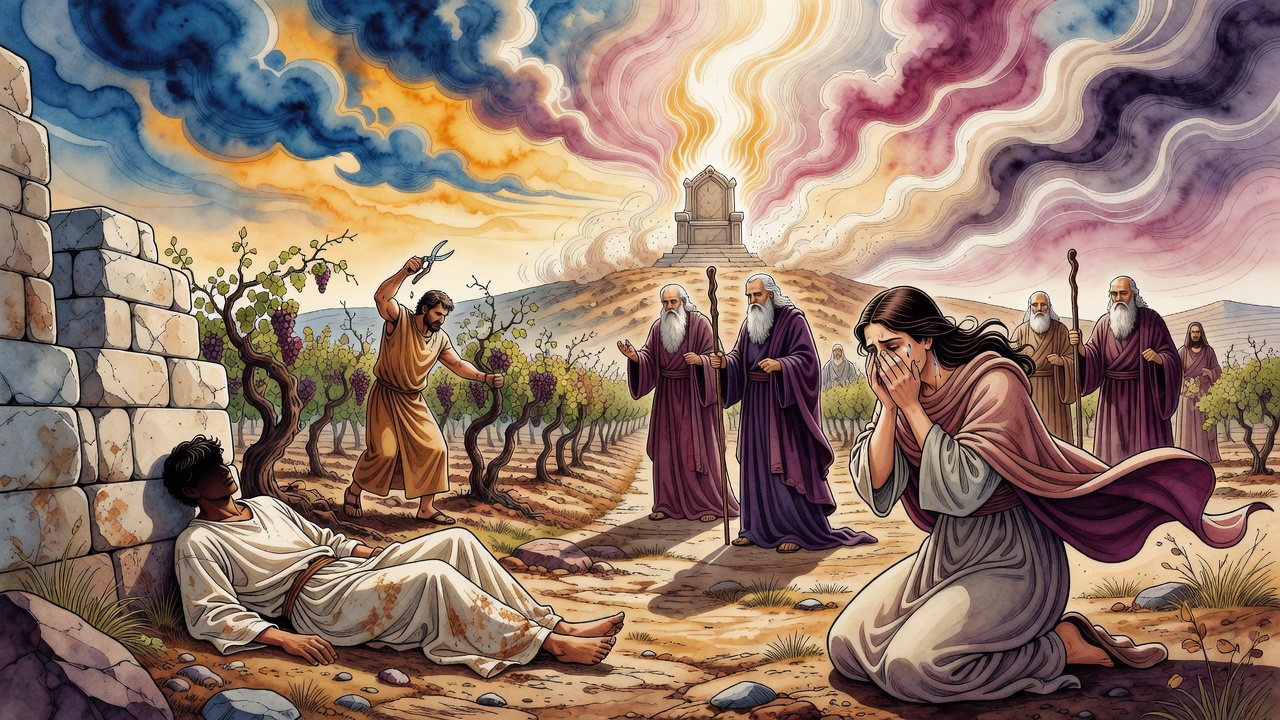
The young scholar's body was still warm in the house when his widow's grief spilled into the street. He had been careful with every commandment people could see. He rose early, studied late, and walked as if Heaven were watching the angles of his steps. Why take such a man in the prime of life? What hidden sin could justify a death that made no sense to neighbors who had trusted his piety?
She wept not only for a husband. She wept for a world that looked unfair in public. A righteous man should live long. Scripture itself promises length of days for those who cling to the right path. Her tears were a lawsuit against the sky.
Elijah at the Door
Elijah the prophet came to her without a soft lie. In the old tales he walks the earth in ordinary clothes and brings hard news when soft news would be false. "Your husband was pious," he said, "but not in every chamber of the law." There was a place where care slipped. The laws of separation between husband and wife in their times of impurity had not been held with the strictness he believed he kept.
He thought he was fulfilling the commandment. He congratulated himself on precision while a small carelessness lived in the house. The widow's grief did not vanish. It changed shape. The death was no longer a random cruelty. It was a ledger she had never been shown.
Twenty-Eight Years in a Vineyard
Another young life ends in a different story, and the comfort comes from a different angle. When Rabbi Bon son of Rabbi Hiyya died at twenty-eight, Rabbi Zeira rose to eulogize him with a verse from Ecclesiastes. "Sweet is the sleep of the laborer" (Ecclesiastes 5:11). Then he told of a king who hired workers for a vineyard. One laborer outworked them all, finishing in two hours what others could not finish in a day.
The king walked with that man, kept him close, and at sundown paid him a full day's wage. The other workers protested. They had sweated from morning light. How could the short shift earn the same coin? The king answered that the two fierce hours had equaled their whole day. Quantity of time is not the only measure Heaven uses.
Two Readings of an Early Death
Hold the widow's house beside the vineyard. In one tale an early death exposes a hidden fault. In the other, an early death crowns a compressed greatness. The tradition does not force every young death into a single moral. Sometimes the soul needed a correction no one else could see. Sometimes the labor was already complete, and sleep became sweet because the work was done.
Rabbi Bon's generation saw in him a mind that gathered Torah the way that vineyard worker gathered grapes, fast and clean. Twenty-eight years can hold more than eighty empty ones. The full wage is not a joke told to quiet mourners. It is a claim that God counts intensity, not only calendars.
How a Community Should Mourn
A street full of tears wants a simple answer. Either the dead were perfect and Heaven is cruel, or the dead were secretly wicked and grief is shame. Both shortcuts fail. The pious disciple was mostly careful and still missed a law that lives in the most private room. Rabbi Bon was brief on earth and still heavy with achievement.
Stand with the widow long enough to let Elijah finish speaking. Stand with Rabbi Zeira long enough to watch the king count wages. Then look at the living who still have years. The stories push in two directions at once. Tighten the hidden commandments no neighbor can audit. Work the hours you have as if two of them might need to equal a day.
The widow's neighbors had already written their own midrash of the death. Some whispered secret sin without evidence. Some whispered that Heaven is simply cruel. Elijah's visit cut between those two rumors. The man had been largely careful and still failed in a law that lives where no neighbor audits. That middle is harder to live with than either extreme, which is why the story insists on it.
Rabbi Zeira's vineyard king is not a denial of grief. He does not tell the mourners of Rabbi Bon that twenty-eight years were enough because pain is inconvenient. He tells them that the ledger of Heaven can count compressed brilliance as a full day. Sweet sleep belongs to the laborer who finished, not only to the laborer who was slow and long.
Hold both stories without forcing them into one formula. If you are young and strong in study, do not assume your private rooms are already perfect. If you bury someone young whose work burned bright, do not assume the wage was unpaid. The tradition is large enough for warning and for honor in the same cemetery.
A community that only knows how to accuse the dead will become cruel. A community that only knows how to flatter the dead will become blind. Elijah and Rabbi Zeira, standing on different graves, teach the two skills together. Investigate the hidden commandments. Celebrate the finished labor. Then return to your own hours, which are still uncounted.
← All myths