5 min read

Elisha Stacked Bricks Where Stones Belonged

Aher built Torah on a foundation without deeds. Rain came, the wall failed, and the king who trusted him with a bird demanded a life for a forgotten word.

Curated by Arthur · Told by Maggid ·
Table of Contents
  1. The Builder Who Liked Light Materials
  2. Twenty Years Can Die in Two
  3. The Bird and the King's Servant
  4. Rain Finds the Seam
Elisha Stacked Bricks Where Stones Belonged Click for full size

The Builder Who Liked Light Materials

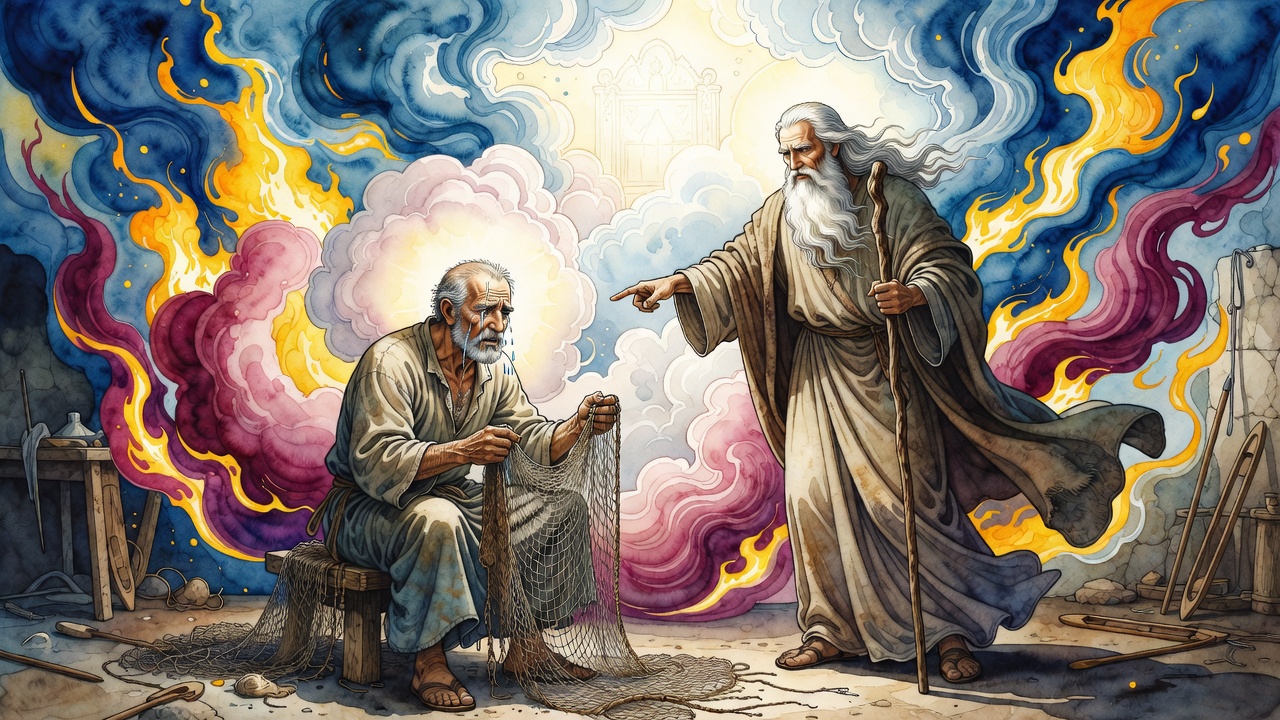
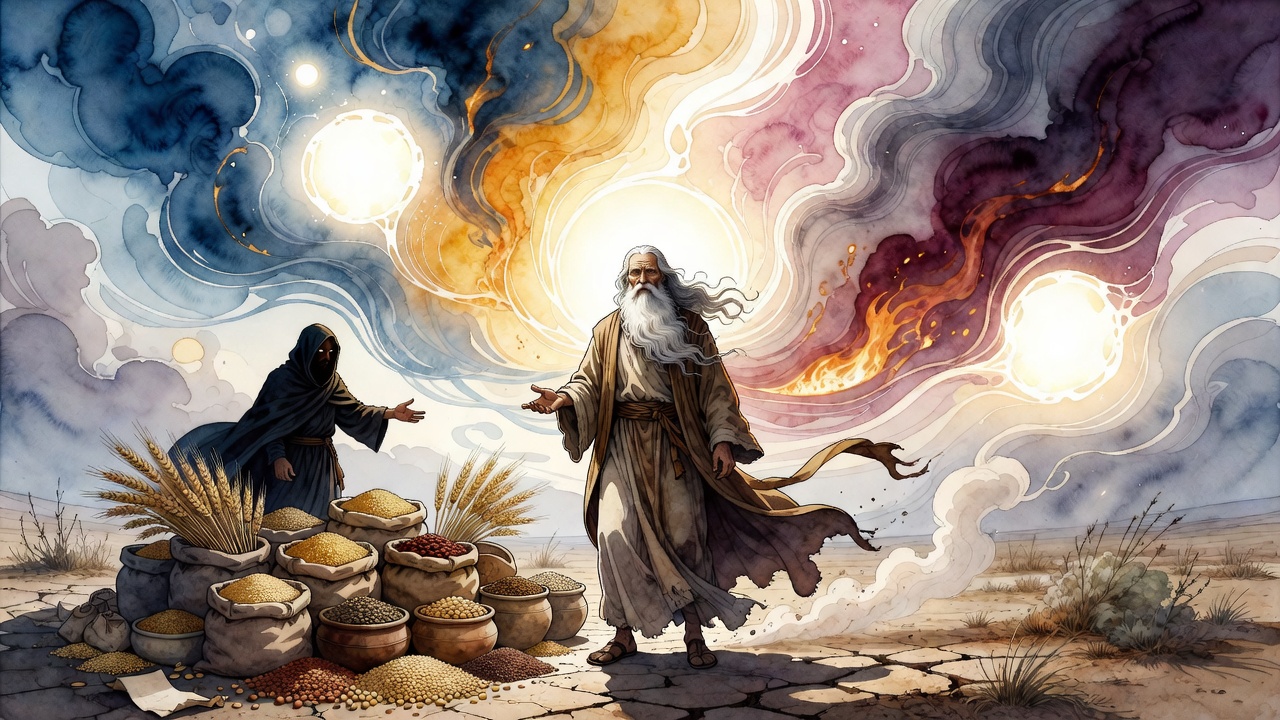
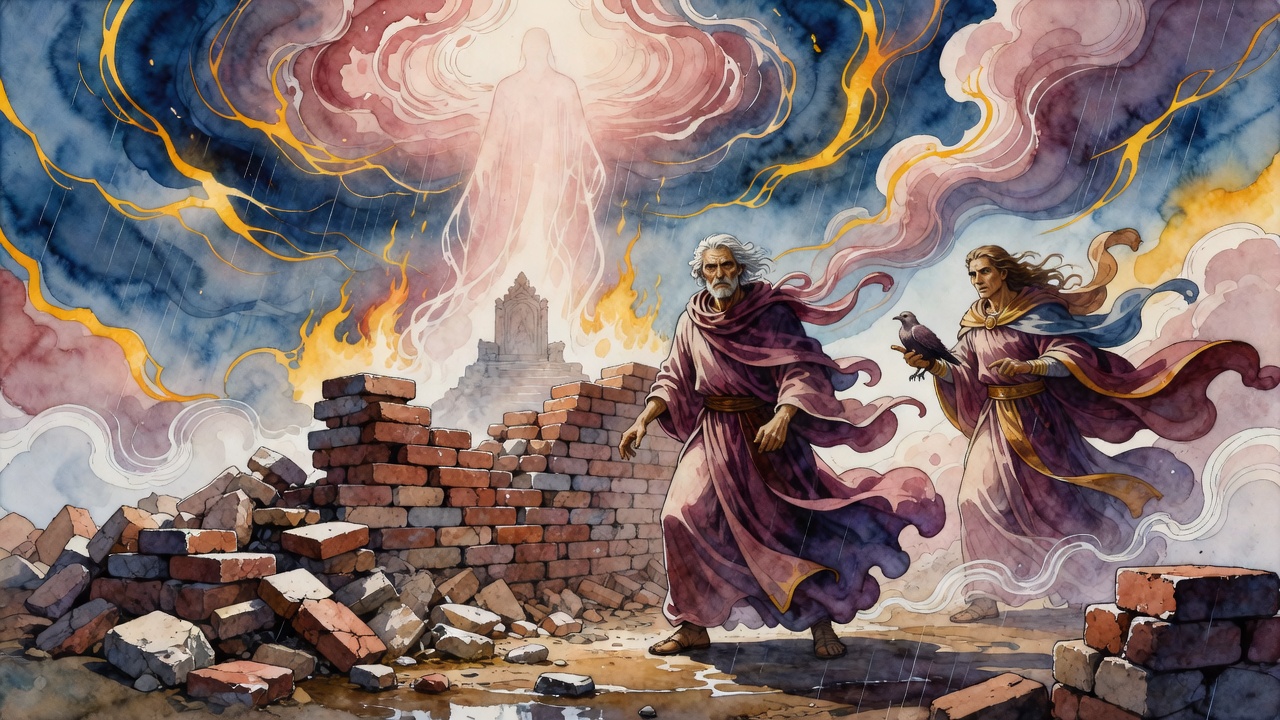
Elisha ben Abuyah knew how to stack a sentence until it shone. Students leaned in as if warmth came from the words themselves. Arguments landed. Hands rose with better questions. Then he set the shining courses on bricks instead of stone, Torah without the weight of deeds underneath, and waited for weather as if weather were optional and admiration were a roof.

He had a parable for the mistake, which means he saw it clearly enough to teach and still walked into it with his eyes open. Stones below, bricks above, and water may pool without washing the house away. Bricks below, stones above, and a little water undoes the whole boast. Lime on stone holds through rain. Lime on bricks flakes like cheap paint. A cup with a square base spills less when the table shakes. A horse without a bridle throws the rider who trusted the saddle alone and called the throw bad luck.

He said these things in the hearing of men who would later quote him with pain. Then he entered too deep into theosophical speculation and came out as Aher, "that other one," a name like a door shut from the inside while people still knocked with his old titles.

Twenty Years Can Die in Two

He mapped forgetting with a merchant's honesty, weights on the table, no romance. Sit idle six months, and clean becomes unclean in the mouth. Twelve months, and sages' names trade places like coats on the wrong hooks. Eighteen, and chapter openings blur. Twenty-four, and even tractate titles go dark. Then silence, a vineyard wall broken, thistles where rows had been (Proverbs 24:30-31). The wall does not argue with the thistles. It simply fails, and the field follows.

Torah words are hard to gain as gold and easy to ruin as glass. Gold can be repaired when bent. Glass must be melted back to sand and begun again. The face of one who toils and fulfills shines like fine gold. The face of one who toils and does not fulfill goes dull as cheap glass (Job 28:17). Youth absorbs words into blood so they leave the mouth clear. Old age learning without that early heat is a heifer broken late, stubborn at the threshing floor, resentful of the yoke it might have loved if the training had come on time.

Elisha had youth. He spent it brilliantly. The later silence was not lack of genius. It was a wall that collapsed because the foundation preferred brilliance to weight. Genius without deeds is a second story with no first floor, impressive until the rain starts a conversation with the mud.

The Bird and the King's Servant

Another parable left his mouth like a warning labeled with his own future. A human king catches a bird and gives it to a servant. Guard it, and live. Fail, and your life answers for the bird. So God entrusted Israel with the words of Torah. Guard them. They are not a vain thing. They are life (Deuteronomy 4:9; 32:47). The servant who loves the glitter of the cage more than the living bird will still be charged for the flight when the window opens.

Aher stopped guarding the bird in the way the king meant. Speculation without deeds is a hand opening over a cliff and calling the drop flight. R. Meir still learned from him later, plucking the fruit and throwing away the rind, which only proves how bright the bird had been before the hand loosened. Brightness does not cancel the charge. It increases the grief of the loss.

Humility like Moses, wealth as joy in one's portion, might as rule over one's own impulse, these measures from Ben Zoma's teaching sat in the same house of lessons. Aher had study enough to teach them and not enough foundation to live them when the rain started and the students watched to see whether the house was as wise as its lectures.

Rain Finds the Seam

When the rain came, it did not need a flood from Noah's old sky. A little water under brick foundations is enough. The structure of a mind that could out-argue a room failed the way he had said a bad house fails. Not all at once in public theater with a neat moral painted on a banner. Seam by seam. Title by title. Until the man who had spoken of square-based cups could not set his own cup down without spilling, and the spill became a story other people told carefully, with love and dread mixed.

Other sages chose stone under brick. Their walls stained and stood. The difference was not who had read more pages by age twenty. It was who let deeds take the weight first so that study could be a second story rather than a floating roof. The bird was still in the air somewhere. The king was still counting. Aher was already other, and the name stuck because the house of Israel needed a word for brilliance that refused the foundation it had itself described.

Night classes continued in other rooms. In his absence the parables worked harder, like tools left by a master who can no longer be trusted to hold them.


← All myths

From the tradition

Sources

3 sources

The texts behind this telling. Some cards carry a translation of the source; others are our own retelling of it, and each card says which. Every card links out to the original.

Avot DeRabbi Natan 24Avot DeRabbi Natan

Retold in our words. Read the original at the link below.The Minor Tractates of the Talmud, trans. A. Cohen, Soncino Press (1965) · CC-BY

Elisha b. ’Abuya said: 1This chapter is devoted entirely to the teachings of Elisha b. ’Abuyah, a great scholar of the second century C.E. and teacher of R. Meir, who entered too deeply into theosophical speculations and eventually abandoned Judaism. Thereafter he was always referred to as ’Aḥer, ‘That other one’; cf. Ḥag. 15a (Sonc. ed., pp. 93ff). For a recent and learned study of this ‘outcast’ scholar, cf. Travers Herford in Essays Presented to J. H. Hertz, 1944, pp. 215-225.A man who has good deeds to his credit and has also studied much Torah, to what is he like? To one who builds [a structure and lays] stones below [for the foundation] and bricks above, so that however much water may collect at the side it will not wash it away.

A man who has no good deeds to his credit, though he has studied Torah, to what is he like? To one who builds [a structure and lays] bricks first [for the foundation] and then stones above, so that even if only a little water collects it at once undermines it.2The study of the Torah can become a permanent blessing only if it is founded on the good life. This is the theme of all the illustrations quoted.

He used to say: A man who has good deeds to his credit and has also studied Torah, to what is he like? To a coating of lime spread on stone,3So according to the MSS. and GRA. V. reads ‘bricks’, an obvious error since the contrast is between lime spread on stone and lime spread on bricks, the former enduring whilst the latter flakes off quickly. so that however much rain falls on it, it will not wash it away. But a man who has no good deeds to his credit, though he has studied much Torah, is like a coating of lime spread on bricks, so that even if the lightest rain falls on it, it will immediately dissolve and fall away.

He used to say: A man who has good deeds to his credit and has also studied much Torah is like a cup which has a square base4The Heb. noun is the Greek for ‘a stone’, here a solid base with four polished sides (cf. below XXVIII, 9, p. 137). Since the cup has a wide four-square base, even if it be shaken and pushed, it will retain its balance and not lose its contents. to it, so that when it is set down, though it is turned on its side, all its contents will not be split. But a man who has no good deeds to his credit, though he has studied much Torah, is like a cup which has not a square base, so that when it is set down it will at once turn on its side and all its contents will be spilt.He used to say: A man who has good deeds to his credit and has also studied much Torah is like a horse with a bridle;5Reading כלינוס, as found in the MSS. and ‘Aruk. V. reads ‘fine trappings’. but he who has no good deeds to his credit, though he has studied much Torah, is like a horse without a bridle,6Here, too, reading kalinos in accordance with the authorities quoted in the preceding note. V. has ‘a bridle to curb it’. and as soon as a man attempts to mount it he is thrown headlong.He used to say: He who learns Torah in his youth, its words are absorbed in his blood and issue from his mouth with clarity; but he who learns Torah only in his old age, its words are not absorbed in his blood and do not issue from his mouth with clarity. Accordingly the proverb runs, ‘If thou hadst no delight in them in thy youth, how canst thou attain them in thy old age?’

He used to say: The words of the Torah are hard to acquire as vessels of gold, and are easily destroyed as glassware; as it is stated, Gold and glass cannot equal it.7Job 28, 17. A comparison is drawn between gold and glass: a golden vessel can be repaired when it is broken, but vessels of glass cannot be repaired when broken unless they are reduced to their original element.8i.e. melted by fire and then reshaped. And how am I to interpret, Neither shall the exchange thereof be vessels of fine gold?9ibid. It teaches that he who toils in [the words of the Torah] and fulfils them, his face shines like fine gold; but he who toils in them and does not fulfil them, his face is dark like glass.10The meaning is either opaque glass which is dull, or glass which quickly darkens.

He used to say: A man may study the Torah for twenty years and forget it in two years. How can this be? If he sits idle for six months and does not revise his studies, he will in consequence pronounce the unclean to be clean and the clean to be unclean. [If he continues idle for] twelve months without revision, he will then confuse [the names of] the Sages;11Attributing a teaching to the wrong authority. if for eighteen months without revision, he will forget the opening words of the chapters; and if twenty-four months without revision, he will forget even the titles [27a] of the Tractates.12This is the more logical order and is supported by MSS., cf. Schechter ad loc. V. reverses the order, putting ‘the titles of the Tractates’ before ‘the opening words of the chapters’. And so, having pronounced the unclean to be clean and the clean to be unclean, having also confused [the names of] the Sages, and forgotten the chapter headings and even the titles of the Tractates, he will eventually sit in silence. Of him Solomon said, I went by the field of the slothful, and by the vineyard of the man void of understanding; and, lo, it was all grown over with thistles, the face thereof was covered with nettles, and the stone wall thereof was broken down.13Prov. 24, 30f. When the wall of a vineyard collapses the entire vineyard is soon destroyed.

He used to say: He who causes another to perform a commandment is regarded by Scripture as if he had performed it himself…. 14There seems to be a lacuna here, because the parable which follows has no relation to the preceding statement. GRA inserts here the teaching of R. Dostai b. Yannai in Aboth 3:10 (Sonc. ed., III, 8, p. 32): ‘Whosoever forgets one word of his study, him Scripture regards as though he was guilty against his soul.’ This dictum is well illustrated by the parable. Cf. Men. 99b (Sonc. ed., p. 607)This may be illustrated by a parable. To what can it be compared? To a human king who caught a bird and gave it to one of his servants saying, ‘Be careful with the bird. If you guard it, well and good; but if not I will take your life for it’. So, too, did the Holy One, blessed be He, say to Israel, ‘I have entrusted the words of the Torah to you. If you guard them, well and good; but if not I will take your lives for them’. For it is stated, Only take heed to thyself, and keep thy soul diligently, lest thou forget the things which thine eyes saw.15Deut. 4, 9. In Aboth loc. cit. this verse is quoted in support of R. Dostai’s teaching mentioned in the preceding note. [And it is also stated,] For it is no vain thing for you, because it is your life.16ibid. XXXII, 47.

Full source
Avot DeRabbi Natan 23Avot DeRabbi Natan

Retold in our words. Read the original at the link below.The Minor Tractates of the Talmud, trans. A. Cohen, Soncino Press (1965) · CC-BY

BEN ZOMA SAID: WHO IS WISE? HE THAT LEARNS FROM ALL MEN, AS IT IS STATED, FROM ALL MY TEACHERS HAVE I GOT UNDERSTANDING.1Ps. 119, 99, E.V., I have more understanding than all my teachers. Who is the humblest among the humble? He who is humble like Moses our teacher, as it is stated, The man Moses was very meek.2Num. 12, 3. WHO IS THE RICHEST AMONG THE RICH? HE WHO REJOICES IN HIS PORTION, AS IT IS STATED, WHEN THOU EATEST THE LABOUR OF THY HANDS, HAPPY SHALT THOU BE, AND IT SHALL BE WELL WITH THEE.3Ps. 128, 2. In Aboth 4:1 (Sonc. ed., p. 43) the question reads, ‘Who is rich?’. WHO IS THE MIGHTIEST AMONG THE MIGHTY? HE WHO SUBDUES HIS PASSIONS, AS IT IS WRITTEN, HE THAT IS SLOW TO ANGER IS BETTER THAN THE MIGHTY; AND HE THAT RULETH HIS SPIRIT THAN HE THAT TAKETH A CITY.4Prov. 16, 32. In Aboth loc. cit. the question reads, ‘Who is mighty?’ Whosoever subdues his passions is accounted as though he conquered a city filled with mighty men, as it is stated, A wise man scaleth the city of the mighty;5ibid. XXI, 22. and6GRA inserts here ‘Another interpretation’ which is to be preferred, because what follows is an exposition substantially different from the preceding. the mighty are none other than those who are strong in [the performance of the] Torah, as it is stated, Ye mighty in strength, that fulfil His word.7Ps. 103, 20. The verse therefore means: the wise man is raised to the category of ‘the mighty’ who fulfil God’s word. Some say: They are the ministering angels, as it is stated, Bless the Lord, ye angels of His, ye mighty in strength.8ibid. The verse is thereby interpreted to mean that the wise man is raised above the level of the angels. Others say: [Who is mighty?] Who turns an enemy into his friend.

R. NEHORAI SAID: WANDER FORTH TO A PLACE OF THE TORAH,9From Aboth 4:18 (Sonc. ed., IV, 14, p. 51). etc. 10A saying of Ben ‘Azzai, ibid. 3 (Sonc. ed., pp. 44f.). [Cf. Bacher, Ag. d. Tannaiten I, p. 410, n. 1.]He used to say: Despise no man and consider nothing impossible, as it is stated, Whoso despiseth the word shal suffer thereby; but he that feareth the commandment shall be rewarded.11Prov. 13, 13.12GRA inserts here: ‘Elisha b. ’Abuyah used to say: If one learns as a child, what is it like? Like ink written on clean paper, etc. (Aboth 4 25, Sonc. ed., IV, 20, p. 55). Cf. §3 below.He used to say: He who learns Torah in his youth, to what is he like? To a heifer which has been broken in while young, as it is stated, Ephraim is a heifer well broken, that loveth to thresh.13Hos. 10, 11. Trained from its early days to thresh, the animal welcomes the task. So, too, the scholar, initiated in his youth to Torah-study, finds it a welcome duty. But he who learns Torah in his old age is like a heifer which was broken in only in its late years, as it is stated, For Israel is stubborn like a stubborn heifer.14ibid. IV, 16.He used to say: He who learns Torah in his youth is like dough which a woman kneads with warm water;15Following the emendation of GRA. but he who learns Torah in his old age is like dough which a woman kneads with cold water.

R. Eliezer b. Jacob said: He who learns Torah in his youth is like writing which is written on new paper; but he who learns Torah in his old age is like writing which is written on old paper.16i.e. paper which has once been written on and rubbed out, so that any further writing would be blurred and indistinct.

Rabban Simeon b. Gamaliel added to the former’s saying: He who learns Torah in his youth is like a young man who married a virgin: they suit one another and desire one another. But he who learns Torah in his old age is like an old man who married a virgin: she suits him but he does not suit her; she desires him but he withdraws from her, as it is stated, As arrows in the hand of a mighty man, so are the children of one’s youth,17Ps. 127, 4. and in the following verse it is written, Happy is the man that hath his quiver full of them.He who learns [Torah] and forgets it is like a woman who bears children and buries them, as it is stated, Though they bring up their children, yet I will bereave them till none is left.18Hos. 9, 12, E.V., that there be not a man left. Read not I will bereave them but ‘I will make them forget’.19The two verbs differ in only one letter, ושכלתים, ‘and I will bereave them’, and ושכחתים, ‘and I will make them forget’. The lesson is derived by drawing upon both verbs: bereavement is the result of forgetting the Torah.R. Simeon b. Eleazar said: He who learns Torah in his youth is like a surgeon who, even when confronted with a growth, possesses a knife for the operation and remedial drugs to cure; but he who learns Torah in his old age is like a surgeon who, when confronted with a growth, possesses a knife for the operation but has no drugs to cure.Therefore20This paragraph follows logically on the last but one, and suggests means whereby the words of the Torah shall not be forgotten; cf. ‘Erub. 54b (Sonc. ed., pp. 381ff). The preceding paragraph, the maxim of R. Simeon b. Eleazar, is manifestly out of place where it stands, and is transferred by GRA to the end of chap. XXII. It could very well be inserted between §§3 and 4 of this chapter. let the words of the Torah be distinguished so that one thing [may be derived] from another and one thing [may be equated] with another, as it is stated, Bind them upon thy fingers, write them upon the table of thy heart;21Prov. 7, 3. and Scripture also states, Bind them continually upon thy heart, tie them about thy neck.22ibid. VI, 21.

Full source
Avot DeRabbi Natan 9Avot DeRabbi Natan

Retold in our words. Read the original at the link below.The Minor Tractates of the Talmud, trans. A. Cohen, Soncino Press (1965) · CC-BY

NITTAI1In V. this chapter begins with the name of Joshua b. Peraḥiah followed by that of Nittai the Arbelite. This is an obvious error since the former’s aphorism was the theme of the preceding chapter. THE ARBELITE SAID: KEEP FAR FROM A BAD NEIGHBOUR, ASSOCIATE NOT WITH THE WICKED, AND ABANDON NOT BELIEF IN RETRIBUTION.KEEP FAR FROM A BAD NEIGHBOUR. It is all one whether the neighbour is within or without your house or in a [nearby] field; for leprosy affects only the house of the wicked, as it is stated, His own iniquities shall ensnare the wicked.2Prov. 5, 22. It teaches that leprosy is caused only through the iniquity of the wicked., the sins of the wicked cause the righteous man’s wall to be pulled down. For instance, where there is a party-wall between the house of the wicked and the righteous, and a plague-spot appears in the party-wall on the side of the wicked man’s house [so that the wall must be demolished], the result is that the righteous man’s wall is pulled down through the iniquity of the wicked. R. Ishmael, the son of R. Joḥanan b. Beroḳah, said: Woe to the wicked and woe to his neighbour, since the sins of the wicked cause the righteous man’s wall to be pulled down.

With ten trials did our fathers try the Holy One, blessed be He, yet they were only punished because of their evil tongue,3The reference is to the evil report spread by the spies; cf. Num. 13, 32. which was but one of them. They are as follows:4Cf. the variant list in ‘Arak. 15a (Sonc. ed., pp. 85f) and below XXXIV, 1, p. 162. once at the Red Sea,5Cf. Ps. 106, 7, But were rebellious at the sea, even at the Red Sea. once when the manna first fell6The Israelites were commanded not to leave of the manna until the morning but some disobeyed (Ex. 16, 19f). and again later on,7When they were charged not to go out and gather it on the Sabbath (ibid. 26f.). once at the [first] appearance of the quails8ibid. 12f. and again later on,9Cf. Num. 11, 31-33. once at Marah,10Cf. Ex. 15, 23. once at Rephidim,11ibid. XVII, 1ff. once at Horeb,12Another name for Sinai. The temptation at Horeb is usually taken to refer to the making of the golden calf, but as this incident follows immediately in the list, the inclusion of Horeb is redundant. GRA and other commentators substitute ‘Taberah’ (cf. Num. 11, 1-3). once at the episode of the golden calf,13Cf. Ex. 32, 1ff., and once in connection with the spies.14Num. 13, 1ff. The incident of the spies was the gravest of them all, as it is stated, Ye have put Me to proof these ten times, and have not hearkened to My voice.15ibid. XIV, 22. And it is similarly [stated], Even those men that did bring up an evil report of the land, died by the plague before the Lord.16ibid. 37. Now is there not an inference from the less to the greater? If [for making disparaging remarks about] the Land, which can neither speak, nor blush, nor feel shame, the Holy One, blessed be He, exacted punishment from the spies for its humiliation, how much more will He exact punishment for a man’s humiliation from his fellow who speaks [evil] words against him and puts him to shame!R. Simeon said: Upon those who utter slander does the plague of leprosy fall. We find it so with Aaron and Miriam who slandered Moses and were visited with punishment, as it is stated, And Miriam and Aaron spoke against Moses.17ibid. XII, 1. Why does Scripture mention Miriam’s name first before Aaron’s? It teaches that Zipporah18The wife of Moses. went and spoke of it to Miriam; Miriam went and spoke of it to Aaron, and both of them arose and spoke ill of that righteous man [Moses]. Because the two of them stood speaking ill of that righteous man, Divine punishment came upon them, as it is stated, And the anger of the Lord was kindled against them, and departed.19ibid. 9, E.V., and He departed. What is the significance of the expression and departed? It suggests that [the leprosy] departed from Aaron20Cf. Shab. 97a (Sonc. ed., p. 464). and attached itself to Miriam, because Aaron did not enter into the details of the matter whereas Miriam did; therefore she was immediately punished with greater severity. Miriam said, ‘To me came the Word yet I did not separate myself from my husband’. Aaron said, ‘To me came the Word yet I did not separate myself from my wife. The Word also came to our fathers of old and they did not separate themselves from their wives. But [Moses], in his arrogance, has separated from his wife!’ They did not criticize him to his face21To avoid shaming him to his face. but only behind his back, and their criticism was not stated as a fact but only as a surmise; since it was a matter of doubt whether he had acted so from arrogance or not. Now is there not here an inference from the less to the greater? If Miriam, who spoke only against her brother, spoke only in [22a] secret22The words ‘and spoke only in secret’ are not found in many texts and appear to be redundant. The clause is apparently a doublet of the preceding one. and spoke only behind Moses’ back, was punished, how much greater will be the punishment of an ordinary man who speaks ill to the face of his fellow and puts him to shame!At that time Aaron said to Moses, ‘Moses, my brother, do you think that this leprosy affects only Miriam? It touches also the person of our father Amram. Let me illustrate this to you. To what can the matter be compared? To a man who had taken a glowing coal in his hand; no matter how much he shifts it about from place to place his flesh is still scorched. For so it is stated, Let her not, I pray, be as one dead’.23Num. 12, 12. Thereupon Aaron began to conciliate Moses, saying, ‘ Moses, my brother, have we ever done evil to any person in the world?’ He answered, ‘You have not’. ‘Well then,’ he said, ‘if we have never hurt anyone in the world, how could we hurt you, our brother? What can I do now? It was a misunderstanding between us; we have broken24Adopting the variant as given in the margin of V. the covenant between us and you, as it is stated, And remembered not the brotherly covenant.25Amos 1, 9. Are we to lose our sister because the covenant which was made between us is broken?’ Immediately Moses drew a small circle, stood within it and prayed for mercy on her behalf, saying, ‘I shall not stir from here until my sister Miriam is healed’, as it is stated, Heal her now, O God, I beseech Thee.26Num. 12, 13. Forthwith the Holy One, blessed be He, said to Moses, ‘If a king had rebuked her, or if her father had rebuked her, would it not be proper that she hide in shame for seven days? Surely, if I, the King of kings, rebuke her, how much more should she hide in shame for fourteen days [at the least]! But for your sake I pardon her’. As it is stated, And the Lord said unto Moses: If her father had but spit in her face,27ibid. 14. etc.Now the man Moses was very meek.28ibid. 3. It is possible [to think] he was meek but not handsome and imposing;29lit. ‘worthy of praise’. therefore Scripture states, And he spread the tent over the tabernacle:30Ex. 40, 19. as the tabernacle was ten cubits in height, so Moses must have been ten cubits tall. It is possible [to think] that he was as meek as the ministering angels; therefore Scripture continues, [Moses was very meek] above all the men: above all men, it is said, but not above the ministering angels. It is possible [to think] that he was as meek as those of the former generations;31i.e. the patriarchs. therefore Scripture continues, Upon the face of the earth, implying above those of his own generation, but not above those of the former generations.Three types of leprous condition were created in the world: the moist, the dry and the polypus;32Here a type of skin disease; strictly a morbid growth in the nose. Persons so afflicted must feel very lowly. but the soul of Moses was lowlier than them all.

R. Simeon b. Eleazar said: Also upon those who utter calumny33GRA reads ‘who utter lies’. does the plague [of leprosy] fall. We find it so in the case of Gehazi; because he uttered calumny against his master leprosy clung to him until his dying day, as it is stated, The leprosy, therefore, of Naaman shall cleave unto thee…. And he went out from his presence a leper as white as snow.342 Kings 5, 27.He further said: Also upon those who are arrogant does the plague [of leprosy] fall. We find it so in the case of Uzziah, as it is stated, But when he was strong, his heart was lifted up so that he did corruptly, and he trespassed against the Lord his God; for he went unto the temple of the Lord to burn incense upon the altar of incense. And Azariah the priest went in after him, and with him fourscore priests of the Lord, that were valiant men; and they withstood Uzziah the king, and said unto him: It pertaineth not unto thee, Uzziah, to burn incense unto the Lord, but to the priests the sons of Aaron that are consecrated it pertaineth to burn incense; go out of the sanctuary; for thou hast trespassed; neither shall it be for thy honour from the Lord God. Then Uzziah was wrath, and he had a censer in his hand to burn incense; and while he was wroth with the priests, the leprosy broke forth in his forehead.352 Chron. 26, 16-19. At that moment the sanctuary was split from end to end,36By a violent earthquake, alluded to in Zech. 14, 5. and [the chasm covered an area of] twelve square miles. The priests fled in alarm. The king also made haste to go out because the Lord had smitten him. And he was a leper unto the day of his death, and dwelt in a house set apart, being a leper; for he was cut off from the house of the Lord; and Jotham his son was over the king’s house, judging the people of the land.372 Chron. 26, 20f.

ASSOCIATE NOT WITH THE WICKED. This teaches that a man should not associate himself either with an evil man or a wicked man. We find it so in the case of Jehoshaphat; because he associated with Ahab and went up with him to Ramoth Gilead, the wrath of the Lord came upon him, as it is stated, Shouldest thou help the wicked, and love them that hate the Lord? For this thing wrath is upon thee from the Lord.38ibid. XIX, 2. The Biblical text is omitted in V but is found in MS. E. and inserted by GRA. And also later when he associated with Ahaziah, and they made themselves ships in Ezion Geber, the Lord wrecked his enterprise, as it is stated, Because thou hast joined thyself with Ahaziah, the Lord hath made a breach in thy works. And the ships were broken.39ibid. XX, 37. So, too, we find with Amnon who associated with Jonadab and received from him bad advice, as it is stated, But Amnon had a friend, whose name was Jonadab, the son of Shimeah David’s brother; and Jonadab was a very subtle man;402 Sam. 13, 3. he was subtle to do evil.41This unusual connotation of ḥakam, translated subtle, is quoted from Sanh. 21a (Sonc. ed., p. 114).Another interpretation of ASSOCIATE NOT WITH THE WICKED: even to [bring him near to] the Torah.42Although the purpose is laudable, there is always the danger of oneself becoming corrupt by the association. Cf., however, Finkelstein, op. cit., pp. 19-22.

AND ABANDON NOT BELIEF IN RETRIBUTION. What does this mean? It teaches that a man’s heart should be daily in fear of retribution43The text therefore means: Do not consider yourself exempt from chastisement under the illusion of self-righteousness. and he should say, ‘Woe is me, perhaps reckoning will overtake me to-day or to-morrow’. As a consequence he is fearful every day, as it is stated of Job, For I feared a fear.44Job 3, 25. So ilt., E.V., For the thing which I did fear.

Another interpretation of AND ABANDON NOT BELIEF IN RETRIBUTION. What does this mean? When a man sees that he is successful in whatever he undertakes, let him not say, ‘Because I am meritorious the All-present has provided me with food and drink in this world, while the capital [of my reward] is laid up for me in the world to come’. Rather should he say, ‘Woe is me, perhaps I have only one meritorious deed to my credit before Him, and as a reward for that He has granted me food and drink in this world, so as to cut me off utterly in the world to come’.

Full source