Parshat Balak5 min read

Balaam's Bones Shattered at Full Study Halls

Hired to curse, Balaam found Israel packed in houses of study until his bones felt broken and every curse left his mouth as blessing.

Curated by Arthur · Told by Maggid ·
Table of Contents
  1. Greater Than the Angels
  2. Night Pouring and a King Who Bowed
  3. An Old Man on the Road
  4. What Balaam Could Not Unsee

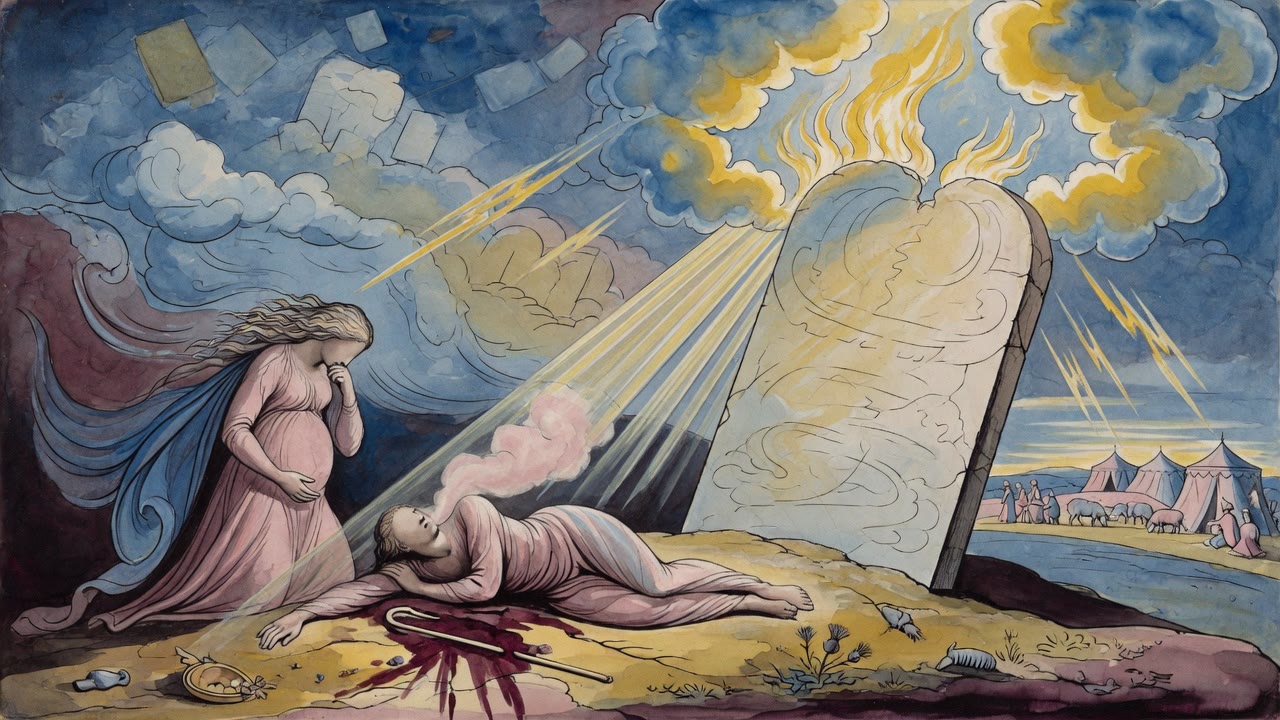
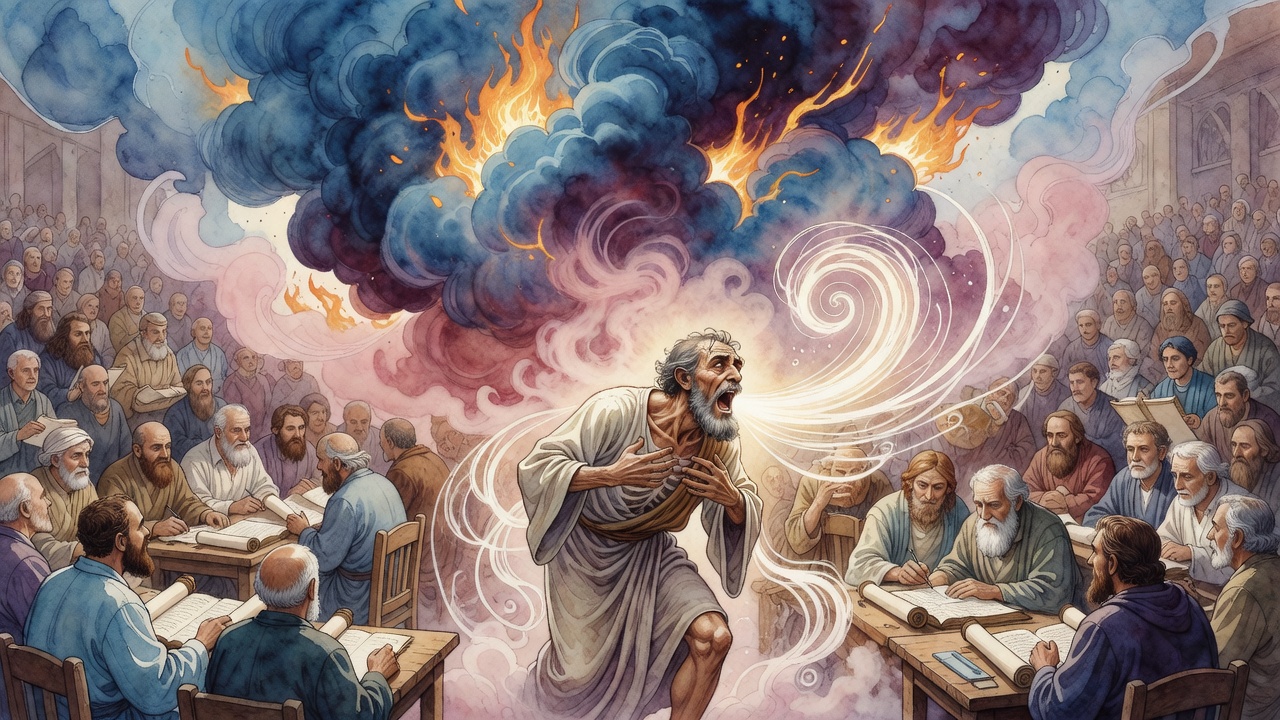
Balaam rode toward the camps ready to sell a curse, and the first thing he saw was Israel sitting assembly after assembly over open scrolls.
Balaam's Bones Shattered at Full Study Halls Click for full size

The sight broke him. He felt as if his bones were shattering and his eyes were pierced. He had come for empty streets, the kind Lamentations names when children faint in the open. Those streets, the teacher says, are really the synagogues and houses of study. When they stand empty, God Himself carries hidden grief no creature can detect. These halls were not empty. They were full. God forced the word into Balaam's mouth, and curse turned into blessing after blessing.

Greater Than the Angels

From that forced praise the sages learn that Israel occupied with Torah is greater than the ministering angels. The tents become valleys that raise a person from impurity. The gardens by the river are the teachers and scholars. The cedars by the water are the great who still bend over a page. Even the wicked who repent on their deathbed are counted among the sons of the world to come.

Balaam had been hired to see a people weak enough to damn. He saw a people studying hard enough to make a hired seer come apart.

Night Pouring and a King Who Bowed

Rise in the night, pour out your heart like water, lift your hands for starving children. Out of that grief another comfort answers: God's mercy over Israel never lapses, even when the people have ruined their own conduct. In all their distress He was distressed. Read slightly differently, and the line declares that in every single trouble Israel has, He is with them.

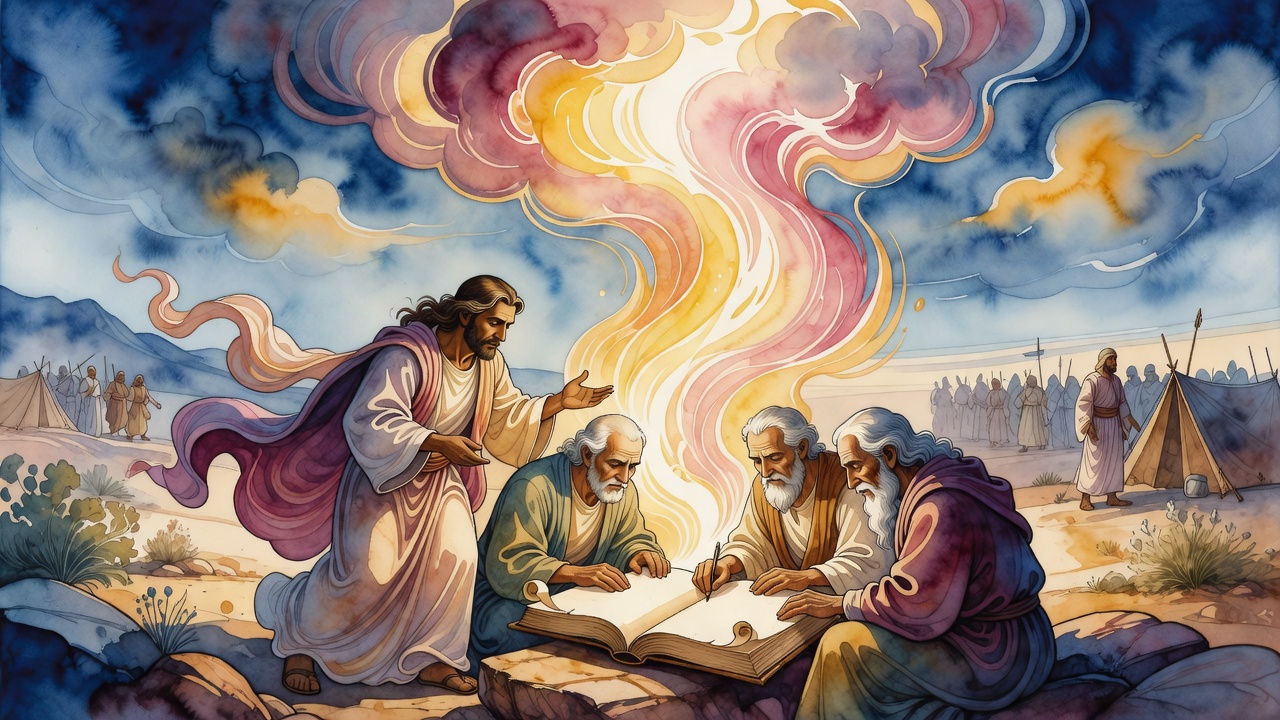
When a student sits over Torah, God sits facing him and learns alongside, two camps drawn up face to face. David proved the courtesy of that love. God sent Nathan with the promise of an everlasting throne, and David sat before the Divine Presence, bowed to the floor, and insisted that everything he ever offered, Torah and kindness alike, was only borrowed back from God in the first place. For that small gift returned he was handed this world, the messianic age, and the world to come.

An Old Man on the Road

An old man once stopped a sage with a sharp challenge. Surely our generation is greater than the one that left Egypt. We have Torah, Prophets, and Writings, while Moses' people had only the Torah itself. The sage refused the flattery. Even the generations between the two Temples possessed the whole of Scripture and the sharp give and take of study, and still they did not measure up to the people of the Exodus.

What made that generation precious was not the size of their learning but one commandment held in common. They bound themselves into a single people: kindness to one another, fidelity to circumcision from the patriarchs, loyalty to their own language, refusal of Egypt's idols. A single faithful act, shared by a whole camp, outweighed later ages thick with books.

What Balaam Could Not Unsee

He left the heights with blessings he had not meant to give. The study halls stayed full behind him. Empty streets still grieve heaven when they appear, but on the day Balaam came the streets were desks, and the desks were stronger than hired speech. A people that sits over Torah can break a curse without lifting a sword. Balaam's shattered bones were the sound of that fact arriving too late for his employers and just in time for the tents he had come to ruin.

From the ridge Balaam counted tents the way a merchant counts inventory, then lost the count when he saw the clusters of learners. Children repeated verses. Elders argued a line until it opened. The air smelled of oil lamps and dust and the stubborn joy of people who study as if study were bread. His employers wanted a people alone on the plain, easy to damn. He found a people walled by open books.

When the forced blessing left his mouth he tasted copper. He tried to aim a curse at the empty places and found none. God sat, as the teacher says, face to face with students, two camps in one room. That intimacy is what shattered Balaam. A seer for hire cannot price a God who learns beside a child. David had once bowed to the floor and returned every gift as borrowed; Balaam had come to take payment for words that were never his to sell.

The old man's boast on the road still rings hollow against that ridge. Later ages stacked Prophets and Writings and still could not outshine the Exodus camp that kept kindness, language, circumcision, and refusal of idols as one shared act. Balaam rode away richer in speech and poorer in purpose. Behind him the study halls stayed loud. Heaven's hidden grief waits for the days they empty. On his day they did not empty, and that was enough to turn every curse into praise.


← All myths
From the tradition

Sources

3 sources

The texts behind this telling. Some cards carry a translation of the source; others are our own retelling of it, and each card says which. Every card links out to the original.

Tanna Debei Eliyahu Rabbah 21:1Tanna DeBei Eliyahu Rabbah

Translation of the source text.Tanna debei Eliyahu Rabbah, Warsaw 1880 · Public Domain

Another interpretation of "Lift up your hands to Him for the life of your children, who faint with hunger at the head of every street" (Lamentations 2:19). From here the Sages said: a person should seek mercy for himself and for his wife and for his children and for his household so that not one of them goes out to an ugly matter; and a person should not see his father and his mother speaking idle words and stay silent toward them; and if he does so, he and they do not fill out their days and their years, as it is said, "Only take heed and guard your soul diligently" (Deuteronomy 4:9). What is "who faint with hunger at the head of every street"? You must say that "streets" are nothing other than synagogues and houses of study, as it is said, "Roam the streets of Jerusalem" (Jeremiah 5:1). At that time the Holy One, blessed be He, would put grief and sighing into his heart, and no creature recognized it in Him, as it is said, "In its streets they gird on sackcloth" (Isaiah 15:3).

And when Balaam son of Beor came to Balak king of Moab to curse Israel, he came and found Israel sitting in assemblies upon assemblies, occupying themselves with Torah. Of them it says, "The envy of scribes increases wisdom"; this is a good sign for Israel, as it is said, "And Balaam lifted up his eyes and saw Israel dwelling by its tribes, and the spirit of God was upon him" (Numbers 24:2). At once Balaam wept in his heart and was pained as though his bones were being broken and his eyes pierced, and Balaam set his mouth to the ground. At once the Holy One, blessed be He, put a word in the mouth of Balaam and compelled him to prophesy all those good things and consolations over Israel, as it is said, "And the LORD put a word in the mouth of Balaam... and he took up his discourse and said... Who can count the dust of Jacob... Now it shall be said of Jacob and of Israel, What has God wrought! Behold, a people that rises like a lioness and lifts itself like a lion" (Numbers 24). From here the Sages said that Israel are greater in Torah than the ministering angels, and needless to say that Israel are greater than all who come into the world and than all the works of His hands that He created in His world. Therefore the Sages taught in the Mishnah: Be bold as a leopard and light as an eagle, swift as a deer and mighty as a lion, to do the will of your Father in heaven.

What is "Who can count the dust of Jacob and number a fourth of Israel"? Rather, how much dust there is in Israel, that they occupy themselves with words of Torah, which shield Israel and resemble weapons of war, as it is said, "Flee, my beloved" (Song of Songs 8:14). How many householders there are in Israel who occupy themselves with Torah, and so it has been from the day the Holy One, blessed be He, chose Abraham our father, peace be upon him, until now; how many lads and little ones there are in Israel who are with their seal until they enter their wedding canopy; how many young virgin girls there are in Israel who are with their seal until the hour they enter their canopy. A case of a certain girl whose father was a companion to an idolater, and they ate and drank and made their hearts merry together, and that idolater said to her father: Give your daughter to my son as a wife. And her father consented to him. The girl sensed the matter and kept silent about it until the time of her wedding arrived; and when the time of her wedding arrived she went up to the roof and threw herself to the ground and died. At once a heavenly voice went out and said of her: of her Scripture said, "and number a fourth of Israel."

And when Balaam prophesied all those good things and consolations over Israel he wept in his heart and said, "Let my soul die the death of the upright, and let my end be like his" (Numbers 23:10). This teaches that the wicked Balaam longed for the death of Moses and Aaron, and said: If I die in my bed like Moses and Aaron, I am like them, and if not, I am not like Moses and Aaron. And the third time, when Balaam blessed Israel, what did he say to them? "How good are your tents, O Jacob, your dwellings, O Israel; like valleys they stretch out, like gardens by a river, like aloes the LORD has planted, like cedars beside the waters; water shall flow from his buckets, and his seed shall be in many waters; his king shall be higher than Agag... blessed be those who bless you" (Numbers 24). What is the nature of valleys beside synagogues and houses of study, that he says "like valleys they stretch out" beside "How good are your tents, O Jacob"? Rather, to tell you: just as valleys raise a person from impurity to purity, so synagogues and houses of study raise a person from impurity to purity. How so? They bring a person from liability to merit; therefore it is said, "like valleys they stretch out."

And what is "like gardens by a river"? These are the teachers of children in Israel, who bring out from their heart wisdom, understanding, knowledge, and intellect and teach the children to do the will of their Father in heaven; therefore it is said, "like gardens by a river." Another interpretation of "like gardens by a river": these are the sages in Israel and their disciples who occupy themselves with Torah every day and discipline themselves in Scripture, in Mishnah, in midrash, in laws, and in homilies; of them it says, "You who dwell in the gardens, companions are listening for your voice; let me hear it" (Song of Songs 8:13). Had the Holy One, blessed be He, said to Israel, "You who dwell in the gardens, Israel are listening for your voice, let me hear it," I would say it means specifically all Israel; rather the Holy One, blessed be He, said to Israel, "You who dwell in the gardens, companions are listening," to tell you that even three, even two, who sit and occupy themselves with Torah, of them it says, "You who dwell in the gardens." Therefore it is said, "like gardens by a river." And what is "like aloes the LORD has planted"? These are synagogues and houses of study. Another interpretation: do not read "like tents" but "like aloes"; a parable to a king who made a feast for all the great ones of the kingdom who pass before him. And what is "like cedars beside the waters"? These are the arrogant in Israel who have words of Torah in them; how much more so the lowly and the poor who lower themselves over words of Torah; therefore it says afterward, "water shall flow from his buckets." What is "and his seed shall be in many waters"? These are the householders in Israel who prosper in the work of their hands on account of the worldly conduct in them; how much more so the disciples of the wise in Israel who prosper, they and their children and their children's children. And what is "his king shall be higher than Agag"? This is Agag, who wept and sighed when he was imprisoned in the prison house and said, Woe is me, lest my offspring be lost from the world; therefore it is said, "his king shall be higher than Agag." Another interpretation of "his king shall be higher than Agag": these are the wholly wicked in Israel who bring grief and sighing into their hearts when they enter their eternal home, on account of the evil deeds they did, and they turned back and repented and died in the midst of repentance; these too are sons of the world to come.

Full source
Tanna Debei Eliyahu Rabbah 18:1Tanna DeBei Eliyahu Rabbah

Translation of the source text.Tanna debei Eliyahu Rabbah, Warsaw 1880 · Public Domain

"Arise, cry out in the night, at the beginning of the watches; pour out your heart like water before the face of the Lord; lift up your hands to Him for the life of your young children, who faint with hunger at the head of every street" (Lamentations 2:19). Blessed is the Omnipresent, blessed is He, whose mercies are abundant over Israel forever; even though they were corrupt in their deeds before the Holy One, blessed be He, and the Holy One, blessed be He, is angry at them, even so His mercies are upon them every single day, as it is said (Psalms 89), "The mercies of the Lord I will sing forever; to all generations I will make known Your faithfulness with my mouth." And so He explains it in the tradition through Isaiah the prophet (Isaiah 43:21), "This people I formed for Myself; they shall declare My praise," and so on. And it says (Isaiah 63:7), "The mercies of the Lord I will mention, the praises of the Lord, according to all that the Lord has bestowed upon us, and the great goodness to the house of Israel which He bestowed upon them according to His mercies and according to the abundance of His kindnesses," and so on, "In all their affliction He was afflicted, and the angel of His presence saved them; in His love," and so on. I have only the affliction of the community; the affliction of the individual, from where? Scripture teaches (Psalms 91:15), "He shall call upon Me and I will answer him," and so on. If so, why is it said, "In all their affliction He was afflicted"? Rather, the Holy One, blessed be He, said: In every single distress that Israel has, as it were, I am with them, as it is said, "He was afflicted"; read it not "to Him affliction" but "to Me affliction," as it is said (Isaiah 49:3), "And He said to me, You are My servant, Israel, in whom I will be glorified"; therefore it is said, "Arise, cry out in the night," and so on. What is "pour out your heart like water before the face of the Lord"? From this they said: Every Torah scholar who sits and reads and learns and engages in Torah, the Holy One, blessed be He, sits opposite him and reads and learns with him; for here it says "before the face of the Lord," and there it says, "And these encamped opposite those," and so on (1 Kings 20:29) - just as there the faces of these were opposite the faces of those, and the faces of those opposite the faces of these, so too here. After it, what is written there? "And it came to pass on the seventh day that the battle drew near, and the children of Israel struck of Aram a hundred thousand foot soldiers in one day, and the rest fled," and so on; and were the matter not written, it would be impossible to say it, and everyone who says it would be liable to death. Another interpretation: "pour out your heart like water," and so on. And what does it teach? Rather, because the mercies of the Holy One, blessed be He, are abundant over Israel forever, both over the wicked among them and over the righteous among them. And from where do you know that it is so? Go out and learn from David king of Israel, that from the love with which He loved him and from the joy with which He rejoiced in him, He sent him words by the hand of Nathan the prophet, as it is said (2 Samuel 7:4-5), "And it came to pass that night that the word of the Lord came to Nathan, saying, Go and say to My servant, to David," and so on, "Will you build Me a house for My dwelling? For I have not dwelt in a house," and so on - the whole matter, until "And your house and your kingdom shall be established forever before you; your throne shall be established forever," and so on, "and according to all this vision, so Nathan spoke to David." And from this they said: Everyone who dines with his fellow, even bread with salt, or vegetable, or dates, or dried figs, or even dips with him in brine - even though that diner has a hundred meals every day, like the meal of Solomon in his time, even so he holds him in his favor before him; therefore it is said, "For I have not dwelt in a house," and so on. When David heard this, immediately he came and sat before the Shekhinah and bowed his full height to the ground and said, "My Father in heaven, may Your great name be blessed forever and ever and ever, and may You have contentment of spirit from Israel Your servants in all the places of their dwellings, in that You have made us great and exalted us and sanctified us and praised us and bound to us a crown of words of Torah from one end of the world to the other. The Torah that I made before You, I made from what is Yours; and the acts of lovingkindness that I did before You, I did from what is Yours; and even so, as the reward of the little Torah that I made before You, You have granted me this world and the days of the son of David and the World to Come, as it is said (2 Samuel 7:18), "And King David came and sat before the Lord and said, Who am I, O Lord God, and what is my house, that You have brought me thus far?" and so on - the whole matter, until "and from Your blessing may the house of Your servant be blessed forever." They told a parable: To what may the matter be compared? To a king who had a servant, and the king loved him with a complete love, and every single day they would bring him in before him, and the king would do him honor in the presence of all his servants. And that servant would reply before the king and say to him, "My lord the king, what work did I do for you more than all your other servants, and what contentment of spirit did you find from me more than from all your other servants, that you do me all this honor before your servants?" Therefore it is said, "And King David came and sat before the Lord," and so on. It says here "thus far" (halom), and there it says (1 Samuel 10:22), "Has the man come here (halom) yet?" and it says (1 Samuel 14:38), "Draw near here (halom), all you chiefs of the people," and it says (Exodus 3:5), "Do not draw near here (halom)" - just as the "halom" said there is an expression of kingship and rulership, so the "halom" said here is an expression of kingship and rulership. You may know that it is so, for by the good deeds that the Holy One, blessed be He, found in David, He is destined to seat him at the right of the Shekhinah, as it is said (Psalms 110:1), "The utterance of the Lord to my lord: Sit at My right hand," and so on. How? A man does a little Torah before You, You set his reward at a thousand thousands for good, and no creature knows; he does charity and acts of lovingkindness a little before You, You double his reward at a thousand thousands for good, and no creature knows; a man does a little Torah before You, You set his reward at a thousand thousand thousands for good, as it is said (2 Samuel 7:19), "And this was yet a small thing in Your eyes, O Lord God, and You have spoken also of the house of Your servant for the distant future; and this is the law of man," and so on. And is this the law of man, that he does a little Torah before You, O Lord God? And he said one more thing before Him, as it is said, "And what more can David say to You? For You know Your servant, O Lord God"; and it says, "And now, O Lord God, You are God, and Your words are truth," and so on, "and from Your blessing may the house of Your servant be blessed forever" - this is the world in which there is no death, forever and ever and ever. Happy is he who knows in his heart what he is before his Father in heaven, and all his deeds he does in trust upon his Father in heaven; happy is he who fears Heaven in secret and leans and trusts as one who grasps a shield and buckler, as it is said (2 Samuel 22:1), "And David spoke to the Lord the words of this song," and so on, "And he said, the Lord is my rock and my fortress," and so on, "my shield and the horn of my salvation, my high tower and my refuge," and so on, "For by You I run against a troop," and so on, "a shield is He to all who take refuge in Him," and so on, "And You gave me the shield of Your salvation," and so on, until the end of the song.

Full source
Tanna Debei Eliyahu Rabbah 23:2Tanna DeBei Eliyahu Rabbah

Translation of the source text.Tanna debei Eliyahu Rabbah, Warsaw 1880 · Public Domain

Once I was passing from place to place, and an old man met me and said to me: Rabbi, are these generations more worthy than those who came out of Egypt? See with your eyes and hear with your ears, for the generation of Moses had with them only the Torah alone, whereas these generations have with them Torah, Prophets, and Writings. I said to him: No. For those generations that lived from the day the First Temple was destroyed until the Second Temple was built had with them Torah, Prophets, Writings, and the dialectics of Torah, and even so they were not as worthy as those who came out of Egypt.

And if you wish to learn and desire words of Torah, go and learn what is said of those who came out of Egypt (Jeremiah 2:2): "Go and cry in the ears of Jerusalem, saying, Thus says the LORD: I remember for you the devotion of your youth, the love of your bridal days, your going after Me in the wilderness, in a land not sown. Israel is holy to the LORD, the first of His produce." When those who came out of Egypt traveled in the wilderness, the Holy One, blessed be He, left nothing in His world that He did not reveal to Israel, as it says (Psalms 25:14): "The secret of the LORD is for those who fear Him, and His covenant, to make it known to them." And it says (Amos 3:7): "For the LORD God does nothing without revealing His secret to His servants the prophets."

By the Temple service! I call heaven and earth to witness concerning me, that every day and every hour, when I remember all these deeds, I fall on my face to the ground and bless and exalt and praise and sanctify the name of Him who spoke and the world came to be, blessed be He and blessed be His name, the name of the King of kings, the Holy One, blessed be He, who sits and apportions sustenance to all who come into the world, to all the work of His hands, from man to beast to creeping thing to bird of the sky, and all the souls He created.

David too praised those who came out of Egypt, for even the single commandment that was in their hand was pleasing before the Holy One, blessed be He, far more than many commandments of ours. And what was that single commandment in their hand? That they all gathered as one band and made a covenant to perform acts of lovingkindness with one another, and to keep the covenant of circumcision, which is the covenant of Abraham, Isaac, and Jacob, and not to abandon the language of Jacob our father, and not to learn the language of Egypt because of the ways of idolatry, as it says (II Samuel 7:23): "And who is like Your people Israel, one nation in the earth, whom God" - this is Moses and Aaron - "went to redeem for Himself as a people, and to make Himself a name, and to do for you great and awesome things for Your land, before Your people whom You redeemed for Yourself from Egypt, nations and their gods." Do not read it thus, but rather read: "before Your people Israel whom You redeemed for Yourself from Egypt, You cut off nations and their gods."

Full source