5 min read

Emden Refused to Swallow Kabbalah With Its Lees

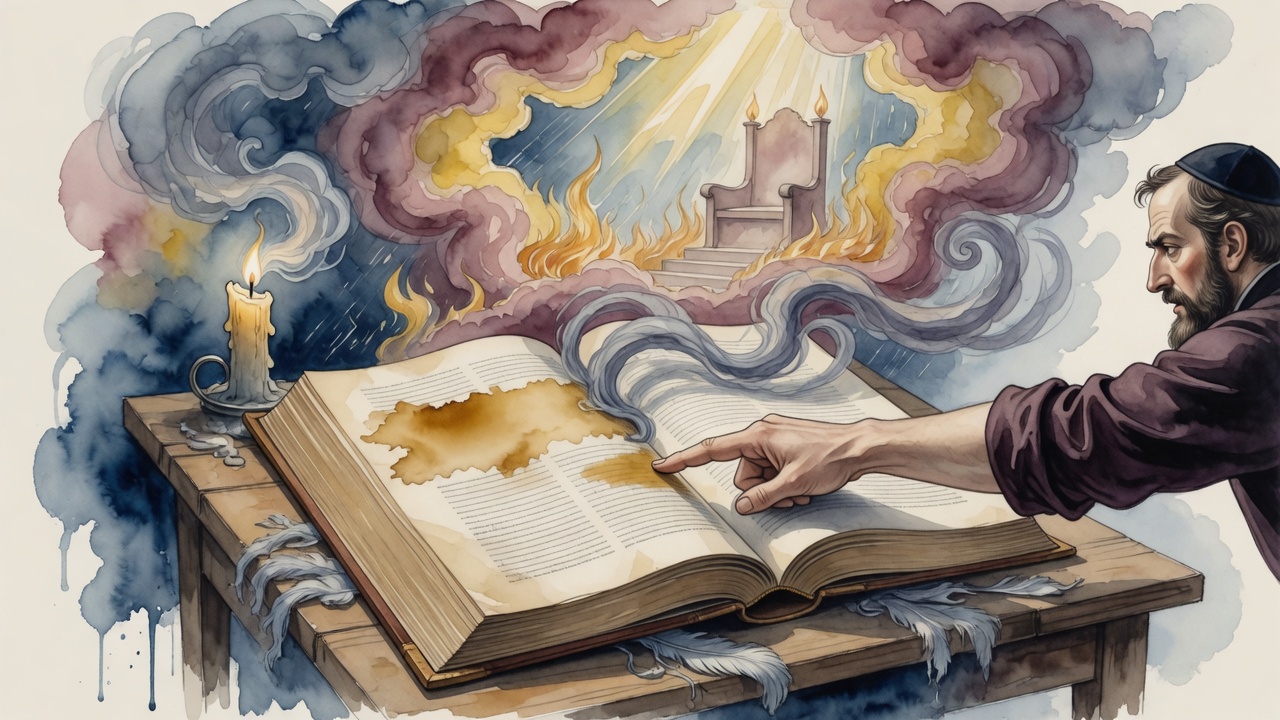
Candle smoke clung to the open Zohar while a stubborn scholar ran his finger under a Spanish word that had no business on an ancient page.

Curated by Arthur · Told by Maggid ·
Table of Contents
  1. A Finger Stops Under a Foreign Word
  2. Wine and Lees in the Same Cup
  3. The Faithful Shepherd Speaks With a Later Accent
  4. Rashbi in the Cave and de Leon at the Desk
Emden Refused to Swallow Kabbalah With Its Lees Click for full size

A Finger Stops Under a Foreign Word

Jacob Emden hunched over the folio until the candle guttered and left a black rim on the wax. The Aramaic ran like a river he had trusted for years. Then his finger snagged. Esnoga. Not Hebrew. Not Aramaic. Not a word Ravina or Rav Ashi would have whispered in Babylon. He said it aloud once, tasting the Spanish on his tongue the way Sephardim in his town named their prayer house, and the room went cold around him.
A synagogue should have been beit knesset, kenishta, something the Tannaim could have owned. This word came from the street of exiles who spoke Judeo-Spanish. Emden did not speak Ladino as a mother tongue, and still he had heard it from living mouths in his own alleys. A responsum of the AMaH had already translated a Ladino question into Hebrew and set esnoga opposite the holy house. The Zohar spoke as if the term were as old as Rabbi Shimon bar Yochai. Emden's jaw locked. Ancient sages do not borrow tomorrow's dialect. A page that claims antiquity and then slips into the speech of Spain has confessed something, whether its printers meant to or not.

He copied the word into a margin of his own notebook and underlined it twice. The second line cut the paper. Evidence should hurt a little when it arrives.

Wine and Lees in the Same Cup

He rose and paced between shelves until the floorboards answered. Kabbalah books stacked high enough to make a man drunk if he drank without looking. Emden named the danger the way a vintner names a spoiled cask. Swallow wine and lees together, he told the empty room, and you poison the pure with the sediment. People of understanding must separate. Origins. Roots. The way a book was stitched. He had vowed a wrapping for books, a mitpachat, so children would not fall into darkness dressed as light.

His hand closed on a volume attributed to the Holy Lamp, Rabbi Shimon, who hid in a cave and came out blazing. Emden loved that fire. He also refused to lie for it. Moshe de Leon of the thirteenth century had brought the Zohar into the light of Castile. Did de Leon only copy? Emden would not swear the whole corpus sprang from a single Tanna's mouth. Addition is a kind of authorship. Silence about addition is a kind of theft from the living who still need clean vessels. A teacher who hands a student a forged pedigree hands him a cracked cup and calls the leak faith.

He poured himself water, not wine, and drank it warm. The joke was private. Lees are heavier than water. Discernment is the lighter cup that still costs more effort.

The Faithful Shepherd Speaks With a Later Accent

He turned to the Raya Meheimana, the Faithful Shepherd, and to the Tikkunei Zohar, those rectifying pages that climb higher than plain narrative. Here Emden's doubt hardened into certainty without triumph. These sections, he judged, were the work of a Sephardic kabbalist who hung his teaching on a great tree so the fruit would sell as ancient. Attribution is not always reverence. Sometimes it is a cloak. Emden would not burn the cloak without reading the cloth, and he would not wear the cloak without asking who wove it.

Outside, the congregation slept. Inside, a man who had judged a hundred disputes felt smaller than a clerk. He wrote anyway. Each line was a sieve. False signs out. Spurious claims out. What remained must be pure enough to hold holiness without cracking. Salvation, he muttered from the psalm he loved, belongs to the Lord. The sieve still belonged to human hands that refused to go numb. He imagined a boy in his community swallowing every printed mystery whole and then breaking when one page failed a test of language. That boy was why the wrapping existed.

Rashbi in the Cave and de Leon at the Desk

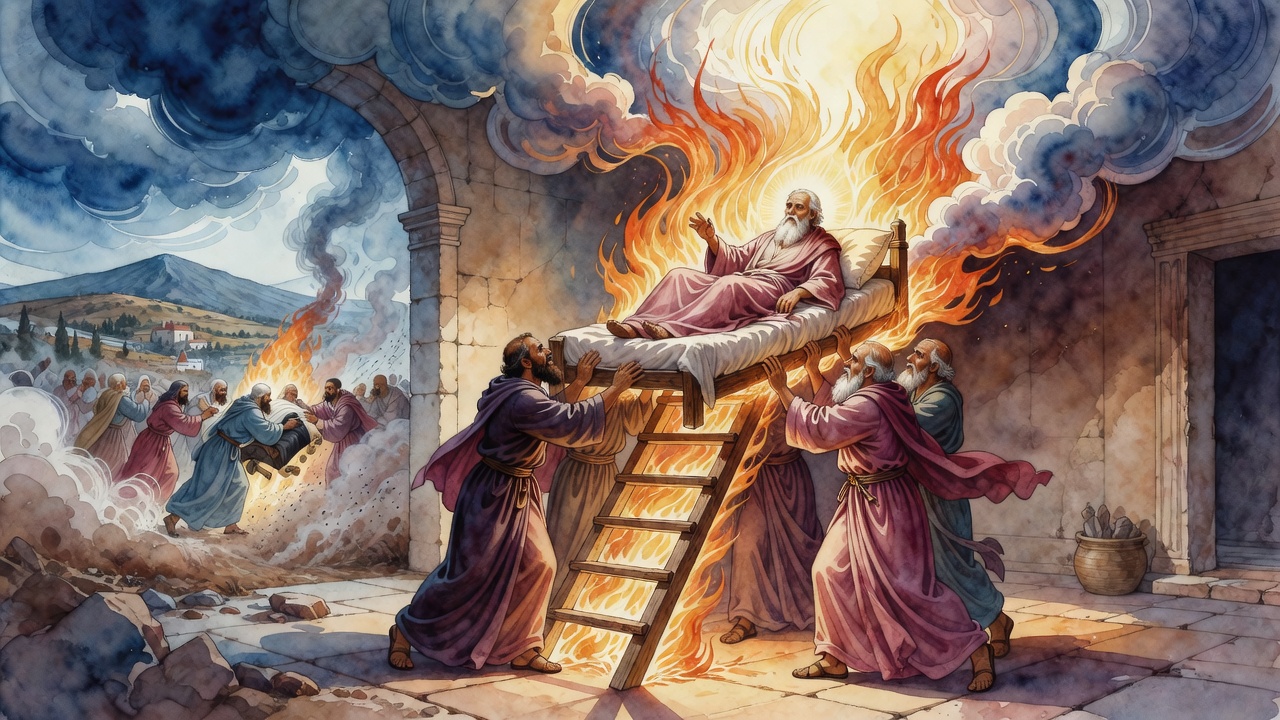
In his mind the scenes refused to merge. Rabbi Shimon and his son in the cave, sand for a bed, carob for bread, secrets arriving like rain through rock. Moshe de Leon at a Castilian desk, ink drying on Aramaic that could pass for Galilee if no one checked the Spanish seams. Emden did not need both men to be frauds. He needed one generation to stop treating every printed mystery as Sinai's own dust.

He pictured students tomorrow, eyes bright, asking for the deepest gates. He would answer with a harder gift. Fear of God first. Investigation second. Joy third, if the vessel survived the test. A pure holy vessel is not born pure. It is scraped. It is heated. It is emptied of vanity that pretends to be awe. Emden scraped his own vanity by admitting how much he still loved the Zohar even while he wrapped it in questions.

The candle finally died. He sat in the dark with the taste of Spanish still on his teeth and a vow growing teeth of its own. When dawn found the folio, the word esnoga still waited under his finger like a stone in a shoe. He did not remove the stone. He walked with it, so every step would remind him that holiness without honesty is only a prettier stumble.


← All myths

From the tradition

Sources

3 sources

The texts behind this telling. Some cards carry a translation of the source; others are our own retelling of it, and each card says which. Every card links out to the original.

Mitpachat Sefarim 1:39Mitpachat Sefarim

Retold in our words. Read the original at the link below.Sefaria Community Translation · CC-BY

He urges us – "people of understanding," he calls us – to listen closely and use our discernment. He’s worried about the uncritical acceptance of everything written in books of Kabbalah – Jewish mysticism. He cautions against swallowing everything whole, "wine and lees" – the good stuff mixed with the sediment.

Why the warning? Because, he says, we shouldn't rush to embrace Kabbalistic writings without investigating their origins, their roots, and the very way they were put together. There’s a real concern here about corruption, about potentially dreadful content lurking within these books. He wants to help us sift through, removing false signs and spurious claims, so we can create "pure holy vessels. Taking something flawed and making it sacred.

That, he tells us, is his purpose: to fulfill a vow he made, to bring his own book, this Mitpachat Sefarim, into the light. He's compiled and enlarged it to save children from the "darkness of destruction" and their souls from the abyss. It’s a dramatic mission statement, filled with urgency! "Salvation belongs to the Lord," he reminds us, grounding this ambitious project in faith.

He gets to the heart of the matter: the true reception of wisdom. He wants to be crystal clear: no one from Israel should doubt the truth of Kabbalah! He calls it "the soul of the Torah," beyond any doubt or speculation. This wisdom, he says, has been transmitted through various books, a tradition passed down from ancient sages – the Amoraim and Tannaim, the masters of the Talmud.

He even name-drops some heavy hitters. He mentions the "illustrious Rabbi Meir Einayim," a master of Halacha (Jewish law) and a philosopher well-versed in external wisdom. Then there’s the renowned Rambam (Maimonides), the great medieval Jewish philosopher, legalist, and physician. Our author describes him as a skilled physician of both body and soul, and crucially, "a faithful and divine Kabbalist, a holy and awesome man." He lived nearly six hundred years ago, and his acceptance of Kabbalah, along with his Torah commentary, are, as our author states, "well-known and renowned throughout the world."

So, what's the takeaway here? It seems to be this: embrace the wisdom of Kabbalah, explore its depths, but do so with discernment. Don't be a sponge. Question, investigate, and seek out trustworthy sources. And maybe, just maybe, we can all play a part in creating those "pure holy vessels."

Full source
Mitpachat Sefarim 3:5Mitpachat Sefarim

Retold in our words. Read the original at the link below.Sefaria Community Translation · CC-BY

Why the Zohar Calls the Synagogue an Esnoga is the question behind this passage from Mitpachat Sefarim.

Hold on. Esnoga? Where did that come from?

That’s the question that bothered the author of Mitpachat Sefarim, and it's a good one. Esnoga isn't a Hebrew or Aramaic term. You won’t find it in the Bible. It's absent from the Targums, the Talmuds (both Babylonian and Jerusalem), and the vast collections of Midrashim (rabbinic interpretive commentary) handed down by the Talmudic sages. It's simply not there.

So where does it come from?

The answer, surprisingly, is Ladino, or Judeo-Spanish. It's what Spanish-speaking Jews call a synagogue. The author of Mitpachat Sefarim points out that even though he doesn’t know Ladino himself, he’s heard Sephardim in his own community use the term. He even refers to a responsum (legal ruling) by the AMaH (may his memory be a blessing), Responsum 38, where a question written in Ladino is translated into Hebrew, and there, plain as day, is the word Esnoga corresponding to the Hebrew word for synagogue.

Now, here's the crux of the issue. The Zohar attributes this connection between "appearance of shining" and Esnoga to ancient sources. But is that really plausible?

Could the Talmudic sages, including luminaries like Ravina and Rav Ashi, or even the Geonim of Babylon, have known and used Ladino? It seems highly unlikely. And attributing it to Rabbi Shimon bar Yochai (Rashbi), the Tanna to whom the Zohar is traditionally ascribed? Well, that, the author suggests, would be utter foolishness.

So what's going on here? One could argue that the author of the Zohar used a contemporary, well-known term to explain the mystical meaning of the text, sort of like using a familiar metaphor to illuminate a complex idea. It's a possibility, but it feels… forced.

Instead, Mitpachat Sefarim concludes, the most likely explanation is that this, and similar instances within the Zohar, are later additions. Additions, specifically, made by a Sephardi Kabbalist.

This isn't about discrediting the Zohar. It's about understanding its history, its layers of authorship, and the influences that shaped its final form. It's a reminder that even the most sacred texts are often the product of a long and complex process, shaped by the hands and minds of many individuals across generations. And sometimes, a single word – an Esnoga – can open a window into that fascinating history.

Full source
Mitpachat Sefarim 3:2Mitpachat Sefarim

Retold in our words. Read the original at the link below.Sefaria Community Translation · CC-BY

Was it truly the work of Rabbi Shimon bar Yochai, the 2nd-century sage said to have received divine secrets while hiding in a cave? Or is there more to the story?

One scholar suggests a fascinating possibility: that Rabbi Moshe de Leon, the 13th-century Kabbalist who first brought the Zohar to light, may have played a more active role in its creation than we previously thought. It’s a bold claim, I know.

The author of Mitpachat Sefarim doesn't go so far as to say Rabbi Moshe de Leon wrote the entire thing from scratch. But they do raise a compelling argument: that he might have, at the very least, added to the text that came into his possession. That he may have had a hand in shaping it.

When it comes to the Raya Meheimana (“The Faithful Shepherd”) and the Tikkunei (spiritual repair) Zohar ("Rectifications of the Zohar")? Here, the author is far more certain. They argue that these sections are "certainly, without any doubt or uncertainty whatsoever," the work of a Sephardic Kabbalist. This Kabbalist, according to the author, intentionally attributed his teachings to a "great tree" – a symbolic reference, perhaps, to the tradition of esoteric knowledge being passed down through generations.

This idea of hanging "his words on a great tree" is fascinating. It evokes the image of Rabbi Akiva's advice to Rabbi Shimon Bar Yochai, a story that speaks to the power of tradition and the importance of grounding new insights in established wisdom.

The author of Mitpachat Sefarim insists there's ample evidence to back this up, "strong proofs that are 'as strong as a molten mirror'" – arguments so clear and reflective, they leave no room for doubt. While the specific details of these proofs aren't laid out here, the strength of the claim is undeniable.

What does this all mean? Does it diminish the Zohar’s power if it wasn't solely the work of Rabbi Shimon bar Yochai? Absolutely not! The Zohar’s influence on Jewish thought and spirituality is undeniable, regardless of the precise details of its authorship. Perhaps, instead, it highlights the collaborative nature of spiritual knowledge, the way wisdom can be passed down, interpreted, and enriched by generations of seekers.

The question of the Zohar’s authorship remains a mystery, one that continues to fascinate and inspire. But by considering these different perspectives, we can gain a deeper appreciation for the complexity and richness of this extraordinary text. It invites us to confront the very nature of authorship, inspiration, and the enduring power of mystical tradition.

Full source