5 min read

Two Kabbalists Lost a Debate and Fled into the Night

Chaim Malach used the Zohar itself to argue that Shabbetai Tzvi was the messiah. Two weeks later the men from Prague gave up and went home.

Curated by Arthur · Told by Maggid ·
Table of Contents
  1. Flattery That Almost Took Krakow
  2. When the Zohar Is Turned into a Trap
  3. A Mission Called a Covering of Books
  4. Clear Judgment Before the Twist Hardens

The demand arrived like a slap dressed as scholarship. The cursed Chaim Malach wanted men who knew Kabbalah. Send them, he said to the head of the yeshiva in Prague. Let them debate faith.

Two Kabbalists Lost a Debate and Fled into the Night Click for full size

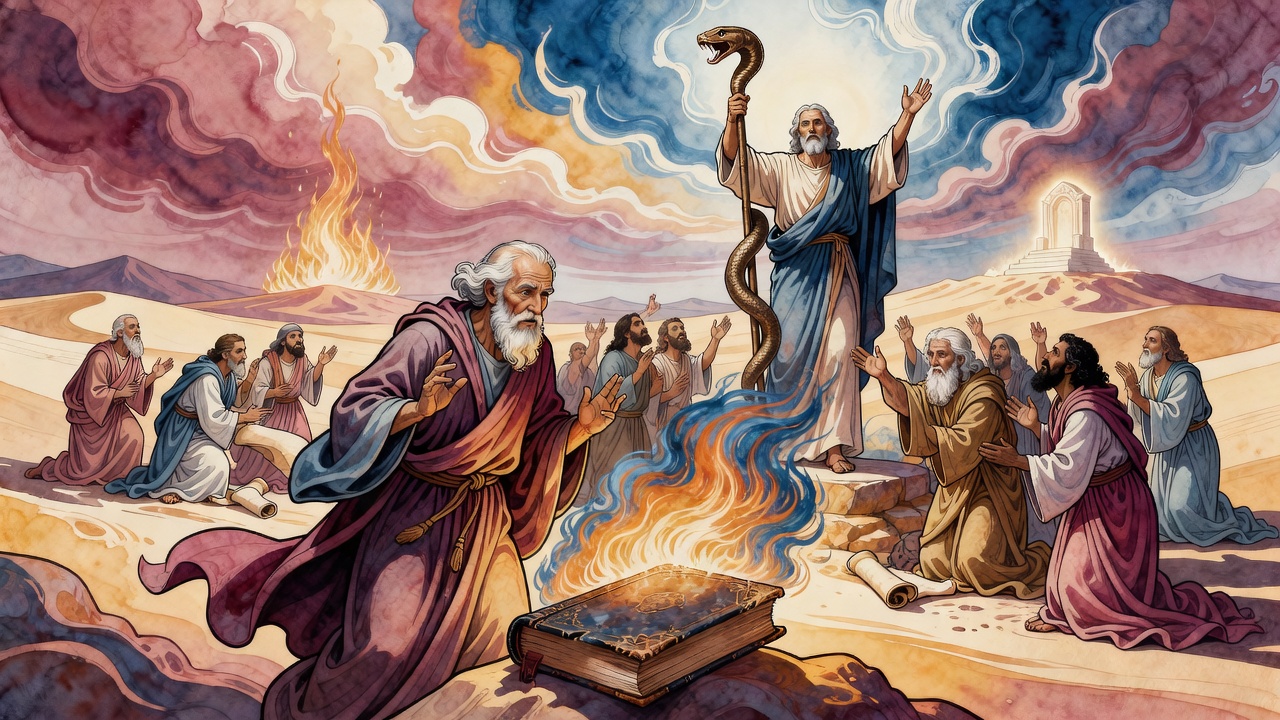
Rabbi Hillel chose two of his sharpest: Rabbi Yonah Landes Sofer and Rabbi Moshe Chasid, men steeped in the Zohar, pious enough that their names alone should have been armor. They went to meet the "aimless species," the tempter the chronicle refuses to honor with soft titles.

They sat for days. Some say two weeks. Arguments knotted. Proof texts flipped. When they rose, they did not rise as winners.

Flattery That Almost Took Krakow

Before Prague there had already been a near miss. Rabbi Pinchas Yoshev Ohel of Krakow met the heretic called Eivshitzar and heard flattering words aimed at drawing him into the accursed sect. Pinchas resisted. Not every scholar did. The chronicle keeps his refusal as a bright edge against later duller blades.

Resistance is a scene, not a slogan. A man hears praise of his learning and feels the door open toward a circle that names false redemption with sacred syllables. Pinchas shut that door. The two who later left Prague's yeshiva walked through a different door thinking they carried enough Zohar to slam it from inside.

They miscounted.

When the Zohar Is Turned into a Trap

The impostor's craft was not only charm. He made it seem as if the Zohar itself demanded belief in the false messiah Shabbetai Tzvi, may the name be erased from hope. In Berlin, a witness who knew the deceiver said the same web was being spun there: cunning arguments, persuasive speeches, sacred pages bent until they pointed at a living lie.

Complex books are flammable that way. A page that speaks in symbols can be forced to bless a disaster if the hungry want the disaster enough. The two scholars arrived with reverence and left with fallacies stuck in their teeth. "Let us go," the broken answer ran when rebuttals failed. They could not find the solid counterstroke. Seduction here meant intellectual capture, not romance. Their mastery had been used as the handle of the knife.

Night outside the debate room felt colder than doctrine.

A Mission Called a Covering of Books

Another thread in the same fabric follows Rabbi Moshe Chasid on a longer road. His master sent him to a distant land to make a mitpachat sefarim, a covering of books, a protective barrier for Torah against a threat the text refuses to miniaturize. He went. He worked. He returned to a master's pleasant countenance and great happiness, the face of a teacher who sees a mission completed under pressure.

Whether that Moshe is the same name as the debater or another bearer of the title, the chronicle's world is one world: men sent out to shield the books, men sent out to argue the books, some returning in joy, some returning emptied. The covering of books is not cloth alone. It is the labor of keeping sacred pages from being conscripted by impostors.

Prague's failed debate is what happens when the covering frays mid-argument.

Clear Judgment Before the Twist Hardens

Mitpachat Sefarim opens elsewhere with a rabbi demanding pause before a deceptive teacher can finish twisting texts. Clear-headed reflection. A stop. The wicked impostor thrives on speed and heat, on the hunger for near redemption. The remedy is not naivete about mysticism. The remedy is judgment that refuses to let a living falsehood wear the Zohar like a borrowed coat.

The two who lost in Prague learned the cost of arriving late to that pause. Pinchas of Krakow learned the cost of flattery refused in time. Between them the book draws a hard line through the eighteenth-century fight over Sabbatean residue: some doors a scholar does not enter, even to win a debate, without an exit already prepared.

Dawn found the yeshiva quieter. Somewhere a master still looked for men who could keep both learning and refusal in the same fist.

On the third day of argument Yonah felt a proof he trusted dissolve because the impostor granted every premise and then drove the conclusion into Shabbetai's arms. Agreement became the trap. Moshe Chasid tried a different page of the Zohar and heard it answered with three pages twisted faster than caution could walk. Speed favored the liar.

When they finally left, one of them vomited in an alley from pure shame. Learning had always been their refuge. Now learning felt like a rented room the enemy had also keyed. They did not return to the yeshiva as heroes. They returned as a warning with names, which is sometimes more useful than a victory.

Rabbi Hillel received them without theater. He did not ask for a transcript first. He asked whether the impostor's mouth still tempted them. Both said no, too quickly, then yes, more honestly: the temptation was shame's hunger to reverse the loss by returning to argue again. He forbade the return. Some fights a man leaves once he has learned the shape of the snare.


← All myths

From the tradition

Sources

3 sources

The texts behind this telling. Some cards carry a translation of the source; others are our own retelling of it, and each card says which. Every card links out to the original.

Mitpachat Sefarim 1:5Mitpachat Sefarim

Retold in our words. Read the original at the link below.Sefaria Community Translation · CC-BY

I want to tell you a story I heard from Mitpachat Sefarim, a collection of stories and accounts. This particular one involves Rabbi Pinchas Yoshev Ohel, a Torah scholar from Krakow, may his memory be a blessing. He himself had a run-in with a heretic, someone referred to as Eivshitzar – may his name be erased, a pretty strong condemnation. Apparently, this Eivshitzar even tried to deceive Rabbi Pinchas with flattering words, attempting to lure him into his "accursed sect."

The story really heats up when we move to Prague, specifically to the Gaon Meir of Broda Yeshiva. It was during this time that a notorious apostate – the cursed Chaim Malach – rose up. Now, this Chaim Malach had the audacity to demand that Rabbi Hillel, the head of the Yeshiva, send him some of the wisest men, scholars deeply knowledgeable in Kabbalah (Jewish mysticism), to debate him on matters of faith.

Rabbi Hillel, peace be upon his soul, agreed. He chose two of his most brilliant scholars, sharp minds well-versed in the teachings of the Zohar (the foundational text of Kabbalah) and Kabbalah itself: Rabbi Yonah Landes Sofer and Rabbi Moshe Chasid, may their souls rest in peace. These were pious and outstanding individuals, the best of the best.

So, they journeyed to meet this "aimless species" – that's how the text refers to Eivshitzar. They spent days, maybe even two weeks, locked in intense discussions and debates. But here's the heartbreaking part: they were seduced by his fallacies. They couldn’t find any substantial rebuttals.

They were stumped.

Their response? "Let us fix a date," they said, "and when we return home, we'll review everything, examine the evidence he presented from the Zohar, and then we can refute his false faith." Promising to study the texts and bring forth a solid argument later.

But when they returned to Prague, to the rabbi who had sent them, they were filled with distress and anguish. Rabbi Hillel was understandably furious. They hadn't been able to answer the heretic! They immediately blamed themselves, lamenting that they "did not place a muzzle on the mouth of the enemy of God." They hadn't been able to respond in the moment.

And Eivshitzar? He reveled in it. He boasted of his victory over the wise men of Israel, claiming that he had silenced them. A dark day,.

This story, though short, offers a glimpse into the challenges faced by those who defend their faith. How would you fare in such a situation? How prepared are we to articulate and defend what we believe, especially when confronted with challenging arguments?

Full source
Mitpachat Sefarim 1:6Mitpachat Sefarim

Retold in our words. Read the original at the link below.Sefaria Community Translation · CC-BY

Mitpachat Sefarim opens with a rabbi demanding clear judgment before a deceptive teacher can twist sacred texts.

The text before us, from Mitpachat Sefarim – literally "mantle of books," a polemic against Sabbateanism – dives right into this very phenomenon. It speaks of a rabbi who had to intervene, demanding a pause, a moment of clear-headed reflection. Why? Because a "wicked impostor" was weaving a web of deceit. This wasn’t just some harmless charlatan; this was someone skillfully manipulating people, capturing their attention with cunning arguments.

This wasn't a localized incident. A reliable source, someone who knew this deceiver firsthand in Berlin, confirmed that he was working his manipulative magic there too. Convincing people that his twisted beliefs were actually supported by the very sacred texts they revered, specifically the Zohar?

The Zohar, a foundational text of Jewish mysticism, is complex and often open to interpretation. This made it ripe for exploitation. This impostor, with "cunning arguments and persuasive speeches," made it seem as if the Zohar explicitly called for belief in the false messiah, Shabbatai (the Sabbath) Tzvi, may his name be erased.

For just a moment, imagine being one of those people. The world felt like it was on the cusp of redemption, maybe even the coming of Mashiach. You heard it not only from a charismatic person, but seemingly confirmed by the mystical tradition itself!

It’s a stark reminder of the power of persuasion, the vulnerability of faith, and the crucial importance of critical thinking. It's a warning against blind faith, urging us to always examine the source, to question the claims, and to protect ourselves from those who would manipulate our deepest beliefs. Because sometimes, the most dangerous deceptions are the ones that sound the most like hope.

Full source
Mitpachat Sefarim 1:9Mitpachat Sefarim

Retold in our words. Read the original at the link below.Sefaria Community Translation · CC-BY

The Torah, our sacred scroll, is like that. And sometimes, that protection takes on a life of its own, becoming a story in itself.

The tale I want to share with you is a tiny fragment, a whisper really, from the world of Jewish mysticism. It's about a chassid, a devoted follower, named Rabbi Moshe Chassid. Now, we don't have a full biography here, no grand pronouncements or sweeping historical context. What we have is something far more intimate: a glimpse into an act of devotion, a mission undertaken in faith.

Rabbi Moshe Chassid, as instructed by his master – and we aren't told who that master is, adding to the mystery – embarked on a difficult journey. He went to a distant land. Why? To fulfill his Rabbi’s decree, and to create a mitpachat sefarim.

mitpachat sefarim literally translates to "covering of books," but here it's understood more broadly. Think of it as a "protective barrier for the Torah." A shield, if you will, against something… ominous. We aren’t told exactly what threat Rabbi Moshe Chassid was meant to counter, but we know it was serious enough to warrant a long and arduous journey.

What kind of barrier? Was it a spiritual one, a campaign of prayer and good deeds? Was it a physical one, perhaps establishing a school or community to strengthen Torah study in a place where it was weak? The text doesn't say. All we know is that Rabbi Moshe Chassid went, he worked, and he eventually returned.

And upon his return, joy! He was received by his Rabbi with a "pleasant countenance and great happiness." Can you imagine that moment? The relief, the satisfaction of a mission accomplished, the warmth of reunion.

But here's where the story takes another turn, a subtle yet significant one. The narrator admits he doesn't know the specifics. He's in the dark about the "accusations of the accursed faction" that prompted the mission in the first place. He doesn’t know the details of Rabbi Moshe Chassid's response, its quality, or even if it was published publicly under his own name or anonymously.

Isn’t that fascinating? We have this vivid snapshot of devotion and dedication, but the why and the how remain shrouded in mystery. It’s a reminder that sometimes, the most profound acts of service are the ones that go unseen, unacknowledged, even unknown.

This little fragment, preserved in Mitpachat Sefarim, leaves us with so many questions. What was Rabbi Moshe Chassid’s secret work? What forces, "the accursed faction," threatened the Torah? Perhaps, the lack of answers is precisely the point. Maybe, the story isn't about knowing all the details, but about recognizing the unwavering commitment to protect what is precious, even when the path is unclear.

Full source