6 min read

Before the Temple Burned, God Tore His Bride From His Side

The Shekhinah, the Divine Presence, had led no revolt and carried no guilt. God reached for her anyway, and she wept the whole way down through the spheres.

Curated by Arthur · Told by Maggid ·
Table of Contents
  1. The Decree Began in Heaven, Not on Earth
  2. God Loosed His Bride From the Embrace
  3. She Fell, and the Wailing Began
  4. She Went Down With Her Children
  5. The Body That Could Be Torn but Not Cut Away
Before the Temple Burned, God Tore His Bride From His Side Click for full size

The Decree Began in Heaven, Not on Earth

Before a single stone of the Temple cracked, before the first Roman torch touched the cedar beams, the ruin had already begun. It began where no eye below could see it, in the highest heaven, where God and his Bride had dwelled together since the world was first fastened to its foundations.

Her name was Shekhinah, the Presence, and she was the nearness of God, the part of him that a living thing could actually feel. For as long as anyone could remember she had rested against him in the upper world, and from that union a river of light ran downward. It fed the Temple below. It fed the land, and every creature that lifted its face toward Jerusalem. While the two of them held together, heaven and earth held together.

Now judgment had been passed. And judgment, when it falls, does not begin in the streets of a city. It begins above. First the sentence is spoken in the world of the angels, and only afterward is it carried out in the world of men. So the fire that everyone would later remember, the smoke that rose over the mount, was not the first blow. It was the second.

God Loosed His Bride From the Embrace

The Holy One did the thing himself. He did not send an angel to do it. He reached for the Bride who had never once turned from him, who had done nothing whatever to earn what came next, and he cast her out of his side.

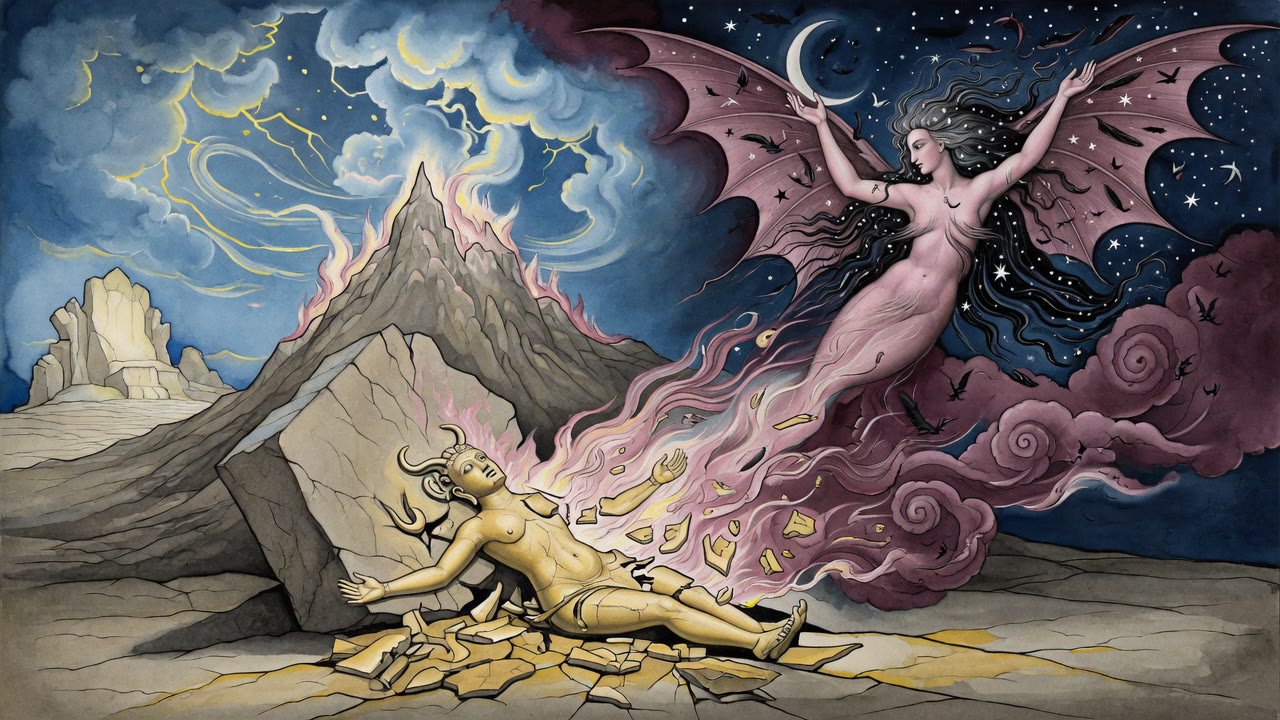
Others had been thrown from heaven before her, but they had rebelled, had raised themselves against their Maker and been hurled down for it. Not her. She carried no guilt. She had led no revolt. The same hand that had made her his companion now cast her down from on high, down from the source of all nourishment, and there was no charge against her at all except that her children below had failed.

This was the first wound, and it was God's own. Long before the people of Jerusalem lost their house of prayer, God lost his Bride. The grief that the world below would soon carry was, in the order of things, his grief first. He tore open the union that had held the worlds together, and he did it with his own hands, and he felt it.

She Fell, and the Wailing Began

So she fell.

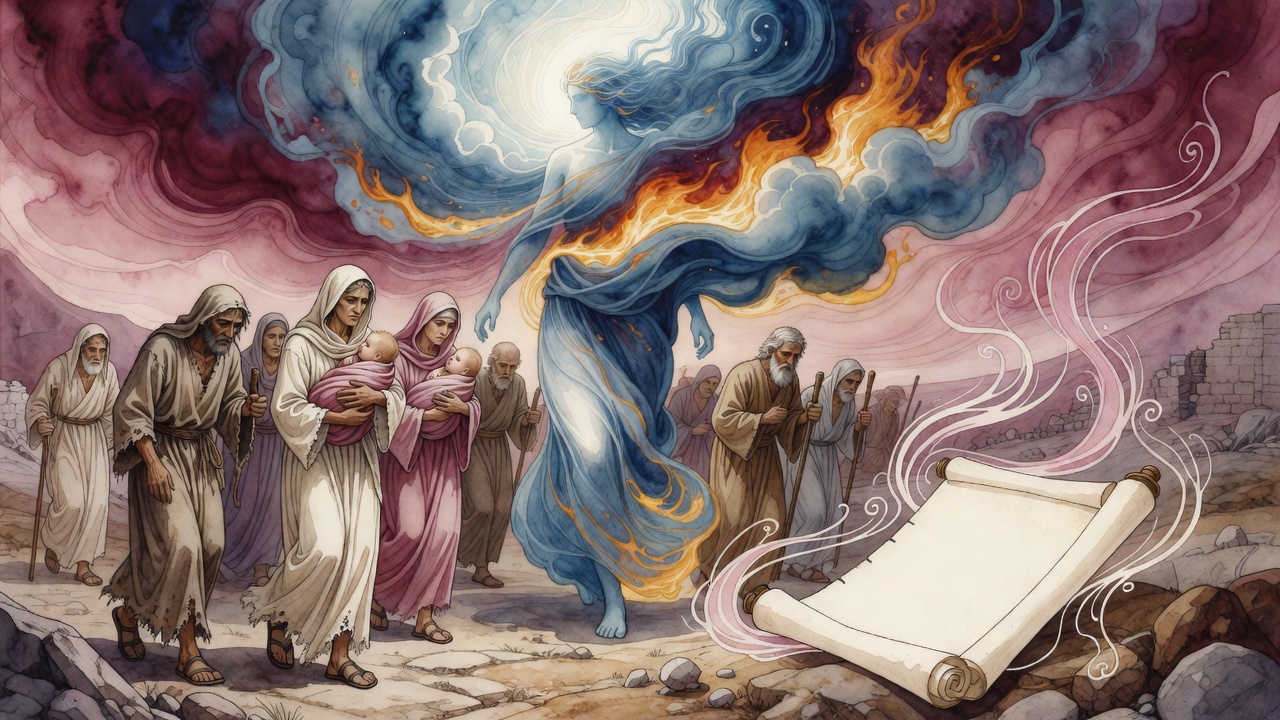
Down from the light she had been, down through the spheres, down toward the world of dust and iron and men, the Presence came loose and descended. And as she fell she wept.

It was not a soft weeping. It was the wail of something torn from the body it belonged to, and it did not stop when she reached the bottom. Every exile that would ever come after, every road out of a burning city, every family driven from its home with the ash still in its hair, would carry that same sound running underneath it. When Jerusalem finally caught fire below her, the flames were only catching up to a cry that had already crossed the heavens.

She Went Down With Her Children

She could have stayed above, apart, a queen without a country. She did not.

Where Israel went, she went. Into Babylon, into every province and back alley of the long dispersion, the Presence walked beside the scattered people as one of the exiled, sharing the road, sharing the hunger, sharing the ache of a home that was gone. She did not watch the exile from a safe height in heaven. She was inside it.

There was a hard comfort buried in that. Those who sat in the bitter exile were told that the sharpest grief they could offer was not for themselves. A man weeping only over his own losses wept small. The one who understood wept for her, for the Presence torn from her place, because his own exile was a single thread pulled out of hers.

The Body That Could Be Torn but Not Cut Away

For the people were not merely her traveling companions. They were her body. Each soul among them was a limb of the Presence, a hand, an eye, a foot, and when the nations scattered them the scattering was felt in her own flesh. Every wrench of exile was a wrench in the Shekhinah (the Divine Presence).

But a scattered limb is still a limb. As long as it stays joined to the body, however far it is dragged, there is hope that it will heal and be drawn home. What she feared was not the distance. It was the limb cut clean away, the child who turns from her entirely, because once a member is severed no repair can ever reach it. That was the wailing beneath the wailing.

The exile had done one thing more to her. It had not only moved her. It had broken her, scattered her into countless pieces the way light shatters when the vessel that carried it falls. She lay in fragments across the whole grieving world.

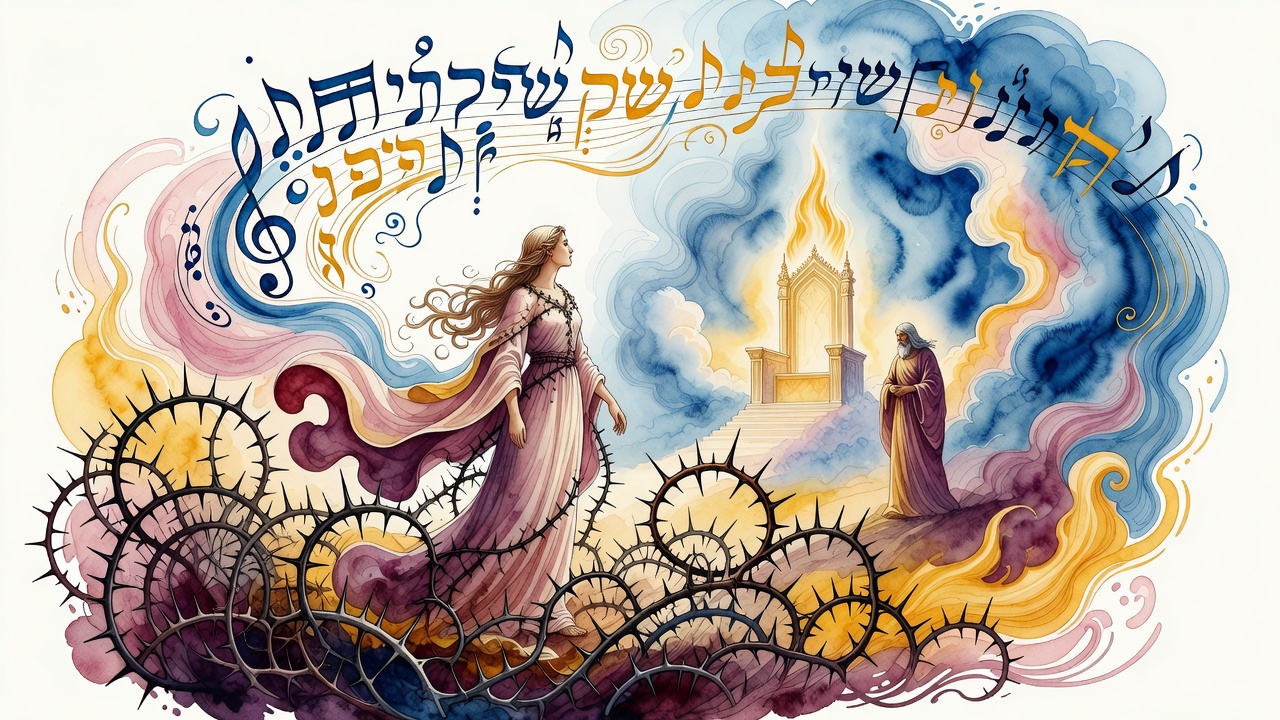
But fragments can be gathered. Wherever one of her children bent over the words of the Torah, wherever a prayer rose in the dark out of some place of exile, another shard of her was lifted and carried back toward the whole. Piece by piece, word by word, the broken Presence was being gathered, and the union that God had torn open with his own hands was, slowly, from below, being sewn back toward the day it would close again.


← All myths
From the tradition

Sources

3 sources

The texts behind this telling. Some cards carry a translation of the source; others are our own retelling of it, and each card says which. Every card links out to the original.

Zohar 2:175aZohar

Retold in our words. Read the original at the link below.Sefaria-hosted English translation · CC-BY

It wasn't just bricks and mortar that crumbled, you see. Something far more profound was shattered.

The story, as told in the Zohar (2:175a), isn't just about her departure. It's about something far more jarring. It says that before God destroyed the Temple, before the holy land below was ravaged, He first "cast His Bride from on high." He brought Her down from the heavens, from the very source of sacred nourishment. Only then, after this cosmic fall, did the earthly destruction follow. Why this order? Why this prelude of divine disruption?

Well, the tradition teaches that when God judges the world, He doesn't just start with us down here. He begins in the celestial realms. First, judgment is passed in the world above, and then His justice – or, perhaps more accurately, His reckoning – is established in the world below.

This myth, as Howard Schwartz points out in Tree of Souls, is a variant of the exile of the Shekhinah myth. It creates a direct link between the Temple's destruction and the Shekhinah’s departure from Her heavenly home. It's almost violent in its imagery: God casting out His Bride. It echoes, in a way, the exile of Adam and Eve from the Garden of Eden.

But what does it mean?

One interpretation is that it highlights the immense loss God Himself suffered at the time of the Temple's destruction. It wasn't just our loss; it was a wound to the Divine itself. And, according to this understanding, God's loss preceded ours. Only after casting out His Bride did He allow the Temple to be destroyed.

It’s a powerful, and somewhat unsettling, idea.

Now, you might be thinking, isn't that similar to the story of Satanael being cast from heaven in 2 Enoch? And yes, there's a parallel. But there’s a crucial difference. that angel led a rebellion against God. But there’s no suggestion that the Shekhinah did anything wrong. As Ginzberg’s Legends of the Jews and Midrash Rabbah suggest, her removal from heaven symbolizes the immense price paid above, as well as below. The Divine, in a sense, experiences the exile alongside us.

So, what does this myth leave us with? Perhaps a deeper understanding of the interconnectedness of all things. Perhaps a reminder that even in the darkest moments, the Divine is not absent, but rather, shares in our pain. And maybe, just maybe, a glimmer of hope that after the casting down, after the shattering, comes the possibility of rebuilding, of restoration, of bringing the Shekhinah home.

Full source
Zohar 3:74aZohar

Retold in our words. Read the original at the link below.Sefaria-hosted English translation · CC-BY

The Jewish mystics had a powerful image for that kind of pain: the Shekhinah, the Divine Presence, weeping.

God, or at least this aspect of God, experiencing sorrow. But the Kabbalists, those Jewish mystics who delved into the deepest secrets of the Torah, weren't afraid to explore the complexities of the Divine. The Shekhinah, often seen as the feminine aspect of God, is deeply connected to the world and especially to the people of Israel. She dwells among us, sharing in our joys and, yes, in our sorrows.

In Rabbi, Israel Baal Shem Tov, the founder of Hasidism, each and every Jew is a member, an integral part of the Shekhinah. Think of it like this: Each person, a hand, a foot, an eye, contributing to the whole. But what happens when one of those limbs is severed?

That's when the Shekhinah wails.

Imagine someone abandoning their faith, converting to another religion. It’s not just a personal decision; it's a tearing away from the Divine body. As the Ba'al Shem Tov taught, "As long as the member is connected, there is some hope that it will recover, but when the member is cut off, no repair is possible." (Schwartz, Tree of Souls, 55). Powerful words, aren't they?

This idea, that the people of Israel are like the very limbs of the Shekhinah, highlights the profound responsibility we have to one another and to our tradition. We see this concept echoed in other texts as well. The idea of Israel as a collective, almost an organism, is prevalent throughout Jewish thought. We're not just individuals; we're interconnected.

The text specifically mentions conversions that occurred during the time of the Ba'al Shem Tov. We can only imagine the pain and anguish felt by the community, and how that was reflected, according to this teaching, in the weeping of the Shekhinah.

Perhaps it's a reminder that our actions have consequences, not just for ourselves, but for the entire spiritual ecosystem. That when we distance ourselves from our heritage, we create a void, a wound in the Divine fabric. It’s a call to cherish our connection to Judaism, to nurture it, and to recognize the preciousness of belonging to something larger than ourselves.

But it's also a message of hope. As long as we remain connected, as long as the limb is still attached, there is always the possibility of healing, of repair, of tikkun (spiritual repair) olam – repairing the world. And maybe, just maybe, quieting the wails of the Shekhinah.

Full source
Zohar 2:9aZohar

Retold in our words. Read the original at the link below.Sefaria-hosted English translation · CC-BY

Think of the Shekhinah as the feminine aspect of God, the immanent presence that dwells among us. She’s not a separate deity, but rather the way God makes Godself known and felt in the world. And when things are tough, when injustice reigns and suffering abounds, the Shekhinah feels it deeply.

Where does this idea come from? It’s woven throughout Jewish mystical thought. As Howard Schwartz explores in Tree of Souls, the exile of the Shekhinah is inextricably linked to the exile of the Jewish people. Wherever we go, she goes with us. She shares our pain, our struggles, our longings for redemption.

Why is this important? Why should we care about the Shekhinah's suffering when we're already dealing with our own? Because, according to tradition, our actions can actually help to alleviate her pain.

The text we're exploring says that those "who are in this bitter exile should not be concerned with their personal distress, but should only lament the exile of the Shekhinah." That sounds a little harsh at first. Like we're supposed to ignore our own problems?

But consider this: it's not about ignoring our pain. It's about shifting our perspective. It's about recognizing that our individual struggles are part of a larger, cosmic struggle. And by focusing on the bigger picture, by lamenting the exile of the Shekhinah

So, how do we "lament the exile of the Shekhinah?" The text offers a powerful answer: through Torah study and prayer. These aren't just rote activities. They're acts of connection, ways of reaching out to the Divine and helping to repair what's been broken.

Think of it like this: the exile has shattered the Shekhinah, fragmented her into countless pieces. But through Torah study and prayer, we can gather those pieces and begin to put them back together. We can help to heal the Divine Presence that dwells within us and around us.

This idea, that we can actively participate in the healing of the Divine, is incredibly empowering. It means that even in the darkest of times, we have the ability to make a difference. We have the ability to bring a little more light and wholeness into the world.

So, the next time you're feeling overwhelmed by the suffering in the world, remember the Shekhinah. Remember that you're not alone in your pain. And remember that through Torah study and prayer, you have the power to help heal not only yourself, but also the Divine Presence that dwells within us all. What could be more meaningful than that?

Full source