7 min read

Esther Kept Her Silence and Her Silence Saved a Nation

Esther inherited the craft of silence from Rachel herself. In a palace full of competing claims, that silence became the most powerful thing she carried.

Curated by Arthur · Told by Maggid ·
Table of Contents
  1. Two Names, One Orphan
  2. What Mordechai Had Commanded
  3. The Craft Inherited From Rachel
  4. What She Brought When Her Turn Came
  5. The Moment Silence Became Action

Two Names, One Orphan

The Megillah introduces her with two names and explains neither. Hadassah, the myrtle: a plant with a sweet fragrance and a bitter taste, something that gives pleasure and asks something in return. Esther, the Persian name: the word for hidden, for concealed, for the thing that cannot be seen directly. Mordechai had raised her after both her parents died, and the household that formed her was a household of exile, a Jewish family maintaining its identity inside an empire that did not ask about identity and did not need to know.

The rabbis in Esther Rabbah read the myrtle comparison carefully. Hadassah was beautiful in the way myrtles are beautiful: not the dominant flower, not the one that announces itself, but the one that outlasts the display plants, that keeps its fragrance in circumstances that strip other plants of theirs. She carried both the sweetness and the bitterness without separating them. She had learned how to hold contradictory things at once from the family she had lost and from the cousin who had become her father.

What Mordechai Had Commanded

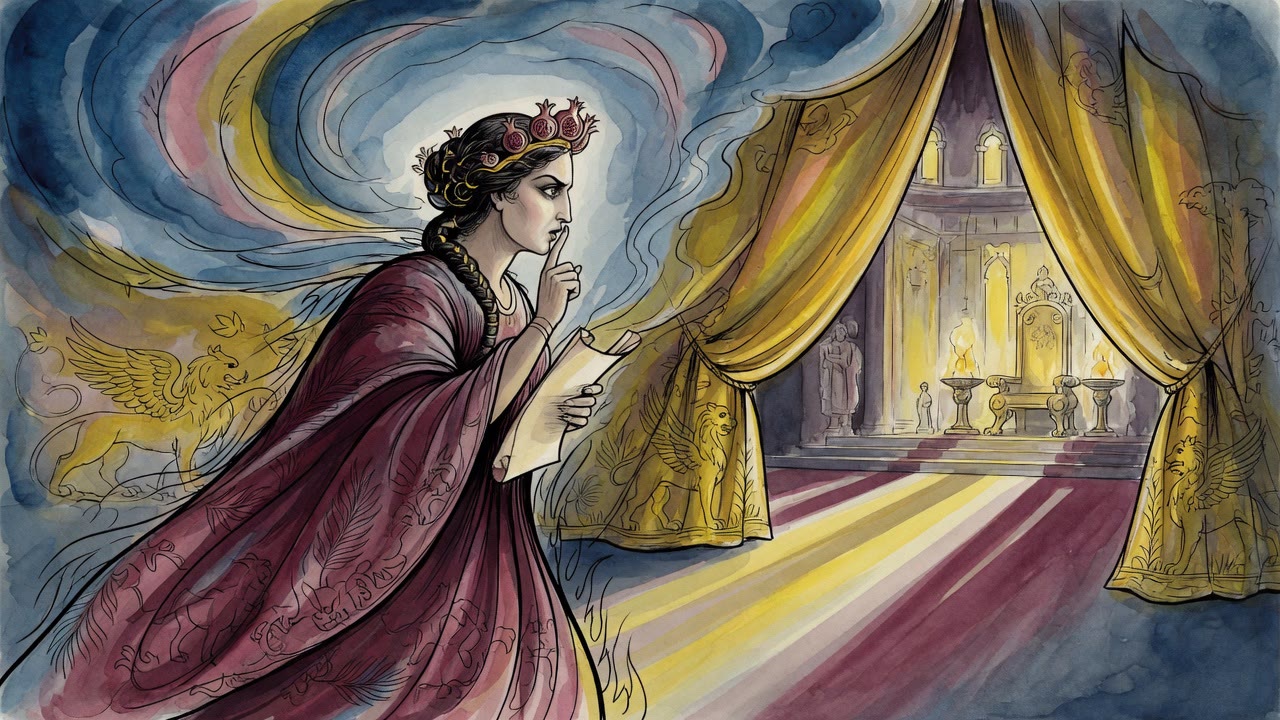
He told her to say nothing. When the royal officials were collecting young women for the king's selection, when Esther was taken into the palace and placed in the custody of Hegai the keeper of the women, Mordechai walked in front of the court of the women's house every day to learn how she was faring. And Esther followed Mordechai's instruction: she did not reveal her people or her family.

The verse in the Megillah says she kept this instruction as she had kept it while being raised by him, which the rabbis read as evidence of a deeply formed habit. This was not a strategic decision made once and maintained with effort. This was the continuation of a practice she had been building since childhood. She was accustomed to silence about the things that mattered most. She had learned how to live in a household where the most important facts were held quietly, where identity was not performed for an audience that would not understand it.

The Craft Inherited From Rachel

The Midrash makes a genealogical claim about this silence. Esther did not invent it. She inherited it from Rachel.

Rachel had seen her betrothal gifts in the possession of her sister Leah on the wedding night and said nothing. Jacob had arranged signs with Rachel so that he would know he was marrying the right woman, and Rachel, understanding that her father Laban had switched sisters, passed the signs to Leah rather than exposing the deception to Jacob. She was silent about her own injury in order to protect her sister from humiliation. She absorbed the cost herself and said nothing.

The tradition traces the inheritance: Rachel's silence passed to Benjamin, who was born from Rachel and who carried something of her quality all his life. Benjamin's silence passed down through the generations, and Esther, who was of the tribe of Benjamin, received it when it came to her. The craft of silence was not a personal quirk but a family inheritance, a transmitted capacity to hold what mattered without speaking it aloud until speaking it was both safe and necessary.

What She Brought When Her Turn Came

When Esther's turn came to go before the king, she requested nothing except what Hegai the keeper of women suggested. Every other woman asked for the items that would display her most effectively. Esther came with only what had been provided through the palace's own system, no additional perfumes, no extra jewels, no chosen presentation strategy of her own devising. Rabbi Yuda compared this to a portrait so universally beautiful that every person who looked at it found exactly what they were looking for. She was not performing a particular aesthetic for a particular judge. She was simply what she was, and what she was worked on everyone.

The king loved Esther more than all the women. More than all the virgins. The Midrash notes the doubled phrase and asks what the distinction was. Rabbi Helbo's answer: Ahasuerus was a man who had loved many women and grown bored with all of them. Esther was different because each time he saw her, she seemed new to him. She did not diminish through repetition. The quality she carried, which the Midrash connects directly to her silence about her origin, her refusal to be fully known by the palace apparatus that was trying to assess and categorize her, meant that there was always something he had not yet reached. She remained partially hidden, and what remained hidden kept renewing his interest.

The Moment Silence Became Action

When Haman's decree went out, when Mordechai tore his clothes and sat in ash and sackcloth at the king's gate, when Esther learned what had happened and understood what was being asked of her, the silence she had maintained for years became the resource she needed. She had not told the king who she was. The king did not know he had a Jewish queen. The secret that had been a survival mechanism, the thing Mordechai had commanded and Rachel had modeled and Benjamin had transmitted, was now the lever that could move an empire.

She asked Mordechai to gather all the Jews of Shushan and fast for her for three days. She and her attendants would fast as well. Then she would go before the king, which was against the law, and if she died she would die. The deliberateness of the statement, the acceptance of the risk, the three days of collective preparation: these are the actions of a woman who understood that the silence she had kept was about to be broken, and who was making sure that when she broke it, she was breaking it at the right moment, with the right preparation, into the right silence.


← All myths

From the tradition

Sources

5 sources

The texts this telling draws on, in full. Open a card to read inline, or expand it for a wider, quieter read.

Esther Rabbah 6:5Esther Rabbah

The Megillah introduces the heroine with two names: "He fostered Hadassa, that is, Esther, his uncle's daughter, for she had neither father nor mother, and the girl was fair and beautiful; and with the death of her father and her mother Mordekhai took her for his own daughter" (Esther 2:7). The sages of Esther Rabbah read every word as deliberate. Why is she called Hadassa, the myrtle? Because the myrtle has a sweet fragrance yet a bitter taste, and Esther embodied both at once. To Mordekhai and to her people she was sweet, a source of fragrance and deliverance, while to Haman she proved bitter, the very instrument of his downfall. The single plant captures her double role in the story.

The rabbis then press on the phrase "for she had neither father nor mother." Rabbi Pinchas and Rabbi Chama bar Guryon, in the name of Rav, object to the obvious reading. Was Esther some foundling of unknown parentage, that Scripture must announce she had no father and no mother? Surely her lineage is plainly given. Why state the absence so starkly? They answer that the verse marks the cruelty of her orphaning down to its exact timing. When her mother conceived her, her father died, so that he never lived to see his daughter. And when she was born, her mother died in giving her life, so that she never knew the embrace of either parent. Esther entered the world having lost both, and from her very first breath she belonged to no one but Mordekhai, who raised her as his own. The double phrase teaches that she was an orphan in the fullest, most unsparing sense.

Full source
Esther Rabbah 6:9Esther Rabbah

“With the arrival of the turn of Esther, daughter of Aviḥayil uncle of Mordekhai, who had taken her as his daughter, to go to the king, she did not request anything except that which Hegai, the king's official, guardian of the women, said; and Esther found favor in the eyes of everyone who saw her” (Esther 2:15). “With the arrival of the turn of Esther…Esther found favor in the eyes of everyone who saw her” – Rabbi Yuda says: Like that portrait that a thousand people look at and it is beautiful to them all. Rabbi Neḥemya says: They positioned Median women on one side and Persian women on the other side and Esther was more beautiful than them all. The Rabbis said: “And Esther found favor in the eyes of everyone who saw her” – in the eyes of the higher beings [angels] and of the lower [humans]; that is what is written: “And you shall find favor and good grace in the eyes of God and man” (Proverbs 3:4).

Full source
Esther Rabbah 6:10Esther Rabbah

The passage from Esther Rabbah dwells on a single word in the Purim narrative: “Esther was taken to King Ahashverosh, to his royal palace, in the tenth month, which is the month of Tevet, in the seventh year of his reign” (Esther 2:16). The Hebrew verb rendered “was taken,” vatilakaḥ, draws the midrash’s attention, for it shares a root with the word likuḥin, which carries the sense of buying or acquiring at a price.

Reading the verb through that lens, the sages picture a scene of competitive bidding around the future queen. As Esther was being brought to the king, she was, in the midrash’s striking phrase, rising in price. The courtiers and officials vied with one another for the honor of escorting her into the royal presence. One declared, I will give one hundred dinars for the privilege of escorting her to the king, and another answered, I will give two hundred to escort her. Her worth, in their eyes, kept climbing as each tried to outbid the last.

The wordplay turns a quiet verse into a portrait of Esther’s extraordinary standing even before she became queen. The very language of the text, the sages suggest, hints that she was so prized that men paid for the mere chance to accompany her. Beneath the surface narrative of a young woman swept into a foreign court, the midrash finds a sign of the favor and value that surrounded her, preparing the reader to see in this “taken” woman the deliverer who would one day stand before that same king to save her people.

Full source
Esther Rabbah 6:11Esther Rabbah

"The king loved Esther more than all the women, and she found favor and grace in his eyes more than all the virgins. He set the royal crown on her head, and made her queen in place of Vashti" (Esther 2:17). The midrash in Esther Rabbah reads the doubled phrasing closely, because the rabbis hold that no word in Scripture is wasted.

Why does the verse say both "more than all the women" and "more than all the virgins"? Rabbi Helbo teaches that this teaches something startling about Ahasuerus. They brought even married women before him, not only the unwed maidens gathered in the king's search. The word "women" covers the wives dragged to the palace, and "virgins" covers the maidens. Esther surpassed both. The detail darkens the picture of the Persian court and sharpens the sense of how dangerous and exposed Esther's position truly was among a king who took whatever pleased him.

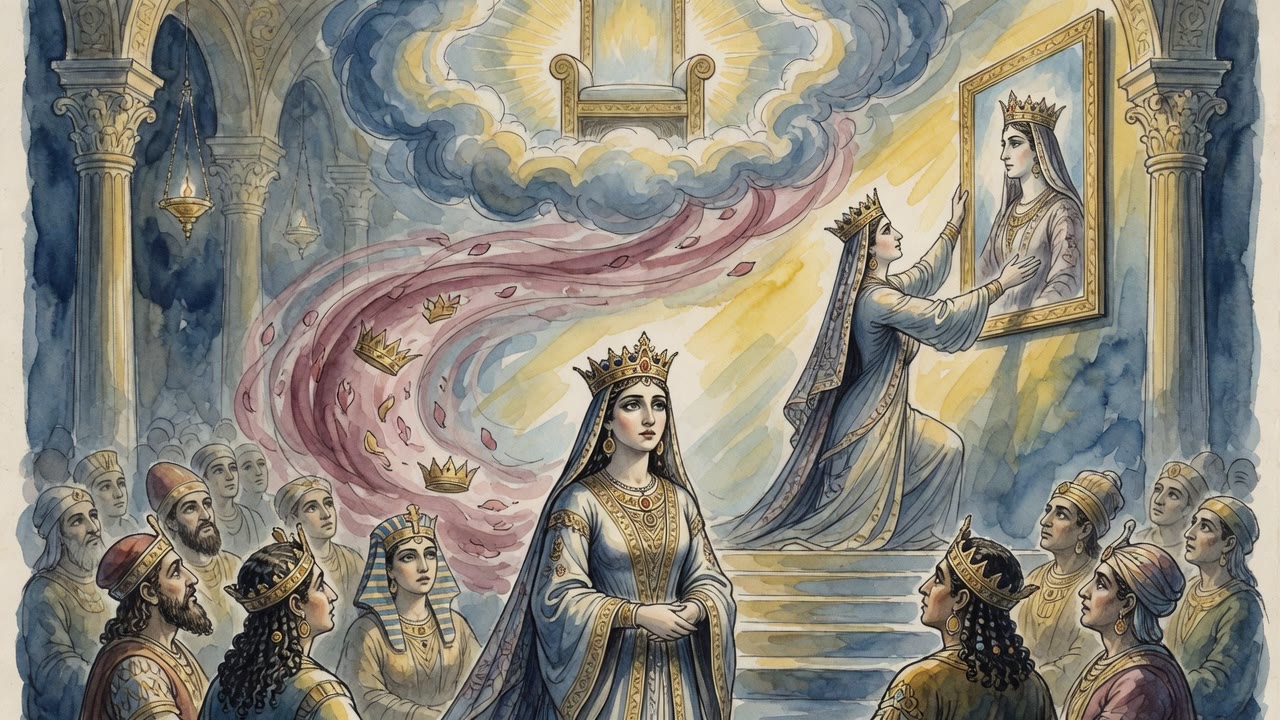
Then the verse says he set the crown on her head and made her queen "in place of Vashti." The midrash imagines the literal staging of the palace. Until they crowned Esther, the portrait of Vashti still hung in its place, for a king does not simply forget the queen he deposed. Only once Ahasuerus married Esther, a woman well born and of noble descent, did he give the order: take down Vashti and hang up Esther. That is the force of "in place of Vashti." One image comes down, another goes up, and the reversal that will eventually save the Jewish people is set quietly into motion.

Full source
Esther Rabbah 6:12Esther Rabbah

Esther did not disclose her family or her people, as Mordekhai had commanded her; Esther followed Mordekhai’s instructions, as it was when she was fostered by him” (Esther 2:20).“Esther did not disclose her family” – teaching that she practiced silence for herself, like her ancestor Rachel, who practiced the craft of silence; all her great descendants maintained silence. Rachel adopted the craft of silence – she saw her betrothal gifts in the possession of her sister and she was silent. Benjamin her son practiced silence – know, as his stone in the breast piece was a chalcedony [yashefe], [i.e.,] he had a mouth [yesh peh],16He knew that his brothers had sold Joseph. but was silent. Saul, her grandson17Not literally her grandson, but descendant. – “but the matter of the kingdom…he did not tell him” (I Samuel 10:16). Esther – “Esther did not disclose her family or her people.”

Full source