5 min read

Evil-Merodach Dragged His Father's Corpse

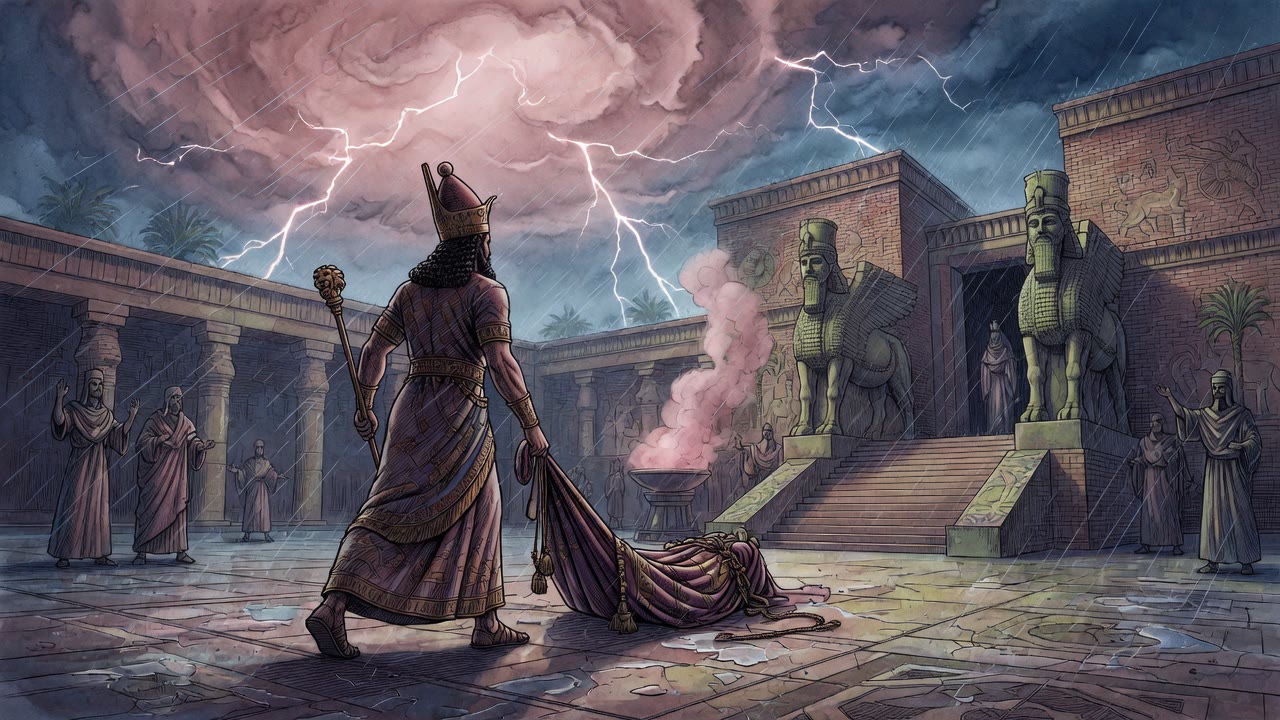
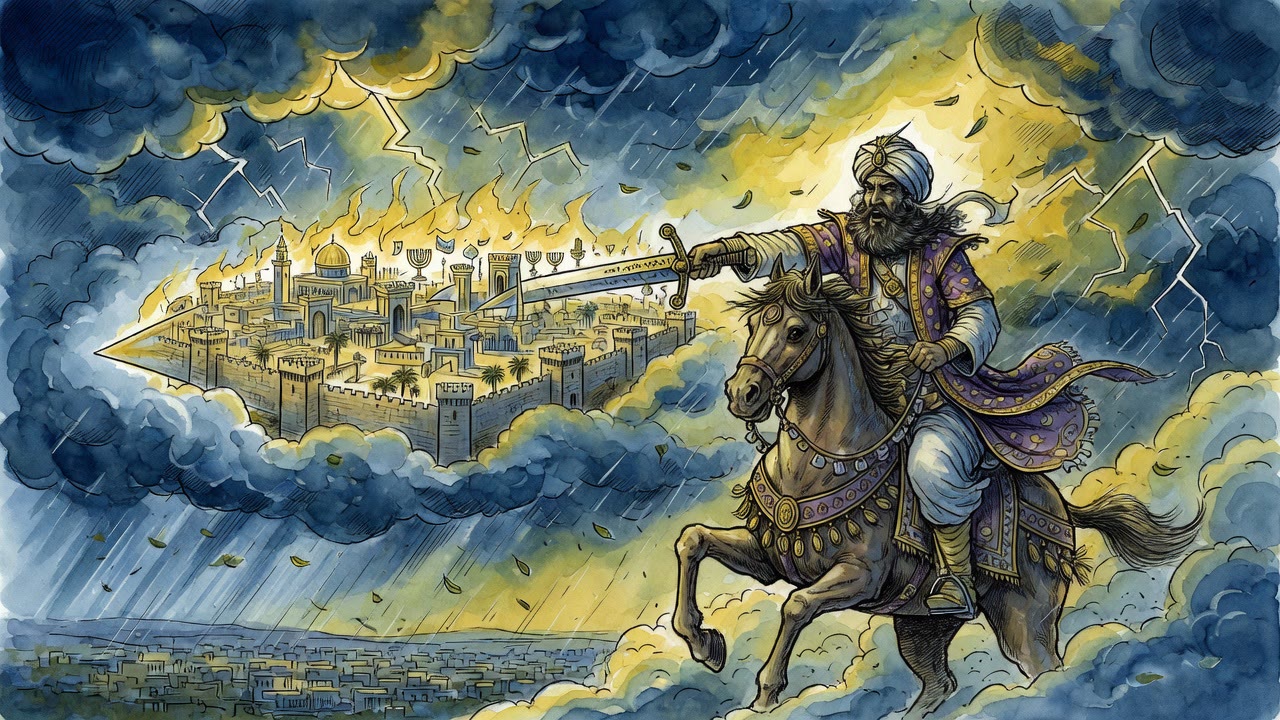
Babylon will not crown the son until he proves the mad king is dead. He hauls Nebuchadnezzar's body through the street by a chain.

Curated by Arthur · Told by Maggid ·
Table of Contents
  1. Ten Kingdoms and One Empty Throne
  2. The Chain Through the Street
  3. Why David Spared the Man Who Cursed Him
  4. Bodies That Hang Past Nightfall
Evil-Merodach Dragged His Father's Corpse Click for full size

Ten Kingdoms and One Empty Throne

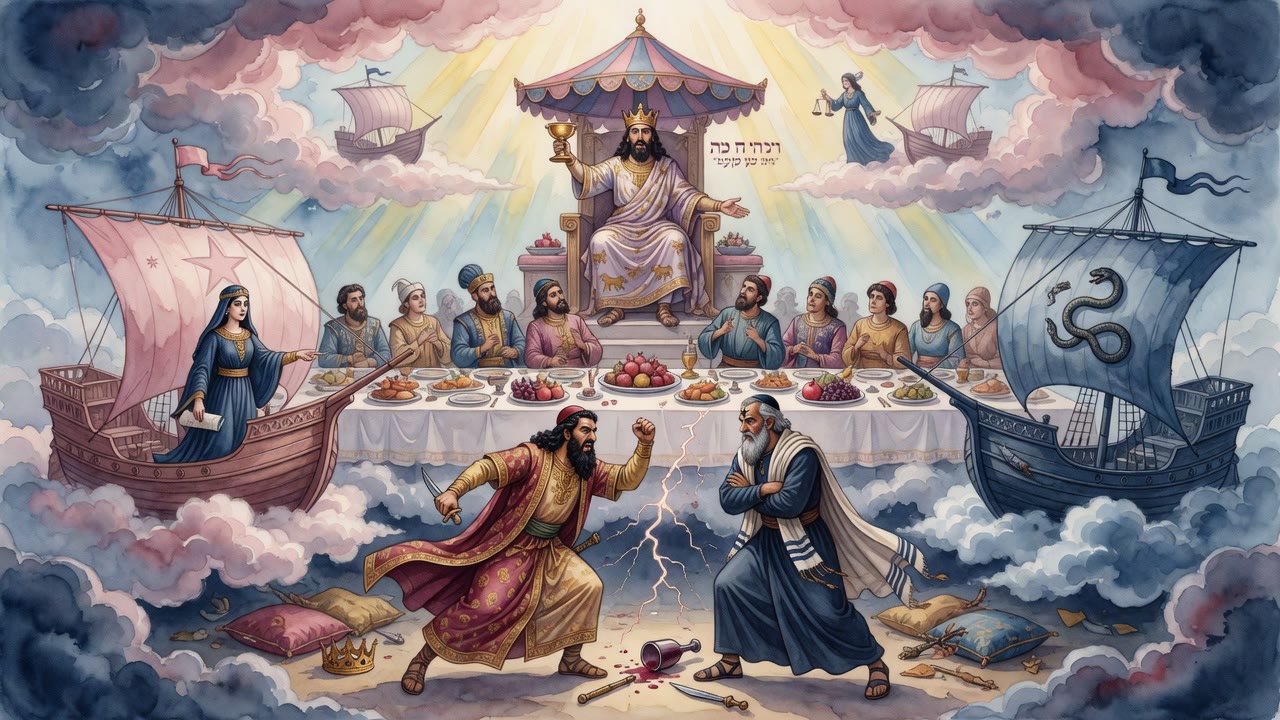
Ahasuerus sits on a throne that the old books refuse to leave alone. They count ten kingdoms that have ruled and are still to rule the world. The first belongs to the Lord of Hosts, whose reign will soon be revealed; then come Nimrod, Pharaoh, Israel, Nebuchadnezzar, Ahasuerus himself, Greece, Rome, the Messiah son of David, and at the end the King of kings again, whose dominion will be unveiled over every dweller on earth. Between those bookends sit men who thought their crowns were permanent.

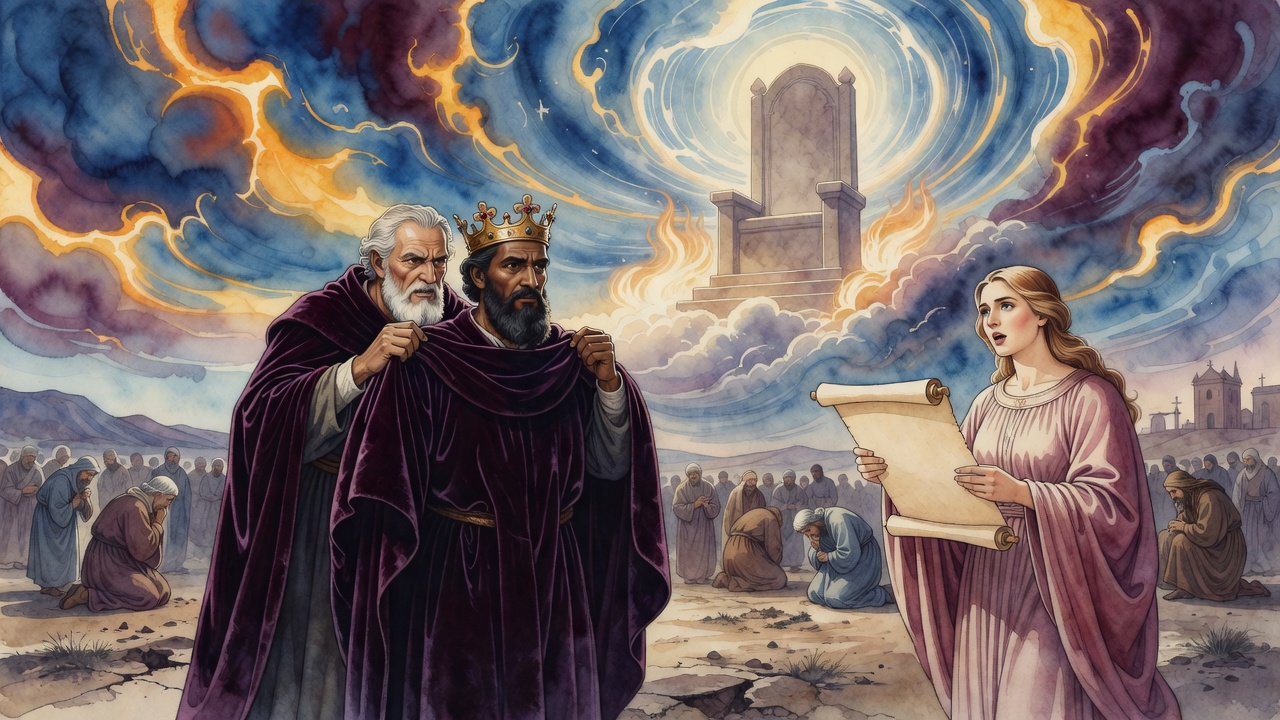
When Babylon's power was draining away and Nebuchadnezzar died, his son Evil-Merodach could not be crowned. The people refused. Their old terror had vanished into madness once, living with the beasts, and they feared he would return from death the way he had returned from the fields. Prove he is dead, they said, or keep your hands off the crown. A city that had watched a king eat grass would not trust a quiet tomb.

The Chain Through the Street

Evil-Merodach went to the vault where kings keep their dead. He dragged his father's corpse out and hauled it through the streets of Babylon so every eye could see the body that would not rise again. Chain on royal flesh. Dust on a face that had once made nations tremble. Children were made to look. Elders nodded. Only then would the city place a crown on a living head.

A kingdom that had shaken the world needed a son willing to shame his own blood to buy legitimacy. The chain on the corpse was the price of the throne. Succession, in that hour, was not a ceremony. It was a spectacle of proof, and the proof was a dead father pulled through public light.

Why David Spared the Man Who Cursed Him

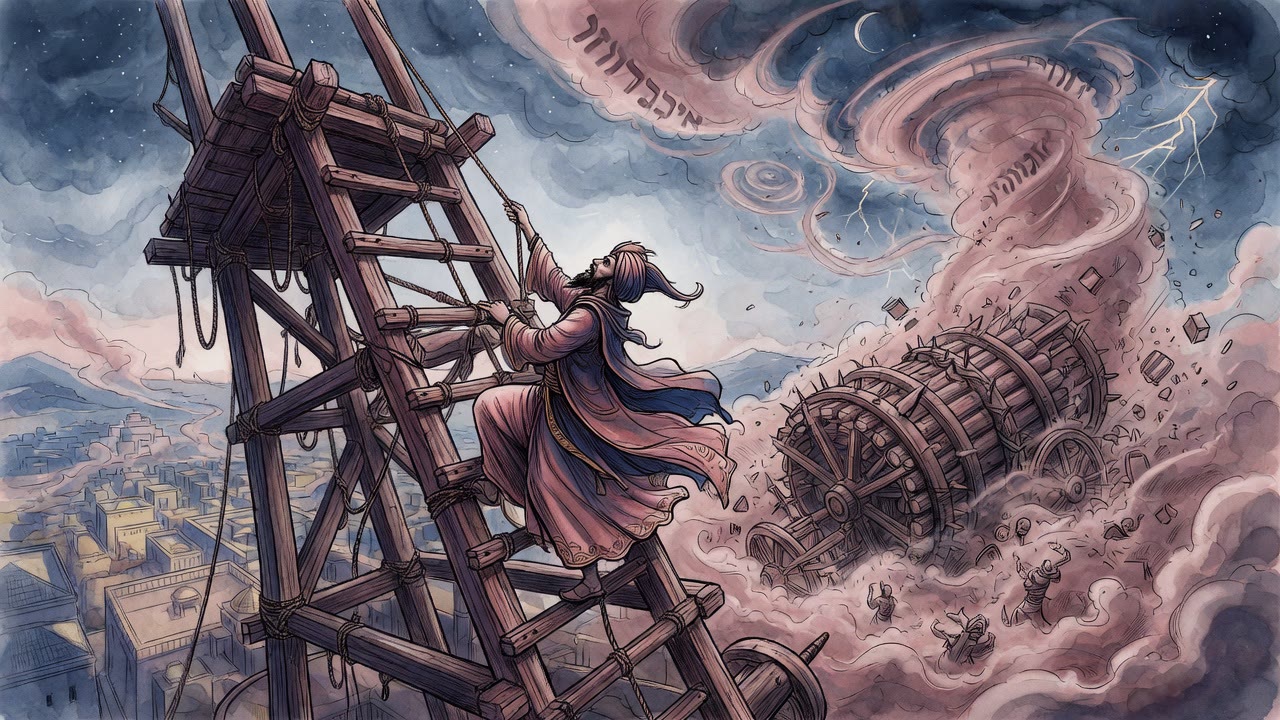
Far from Babylon, another chain of fathers runs toward Shushan. A man named Mordecai lived there, called a Jewish man because he feared sin, and the chronicle climbs his line name after name, back through Saul son of Kish, through Mephibosheth and Jonathan, all the way to Benjamin son of Jacob. One link holds a secret.

Years before, David fled his own kingdom, and a man named Shimei ran alongside the road hurling curses, calling the king a wicked man fit to be killed (2 Samuel 16:5). Abishai son of Zeruiah drew close and asked leave to strike off the curser's head. But David gazed into his own prophecy and saw what no sword could see. Out of this reviling man would rise Mordecai, the righteous one through whom God would work wonders and deliverances for Israel across their four exiles.

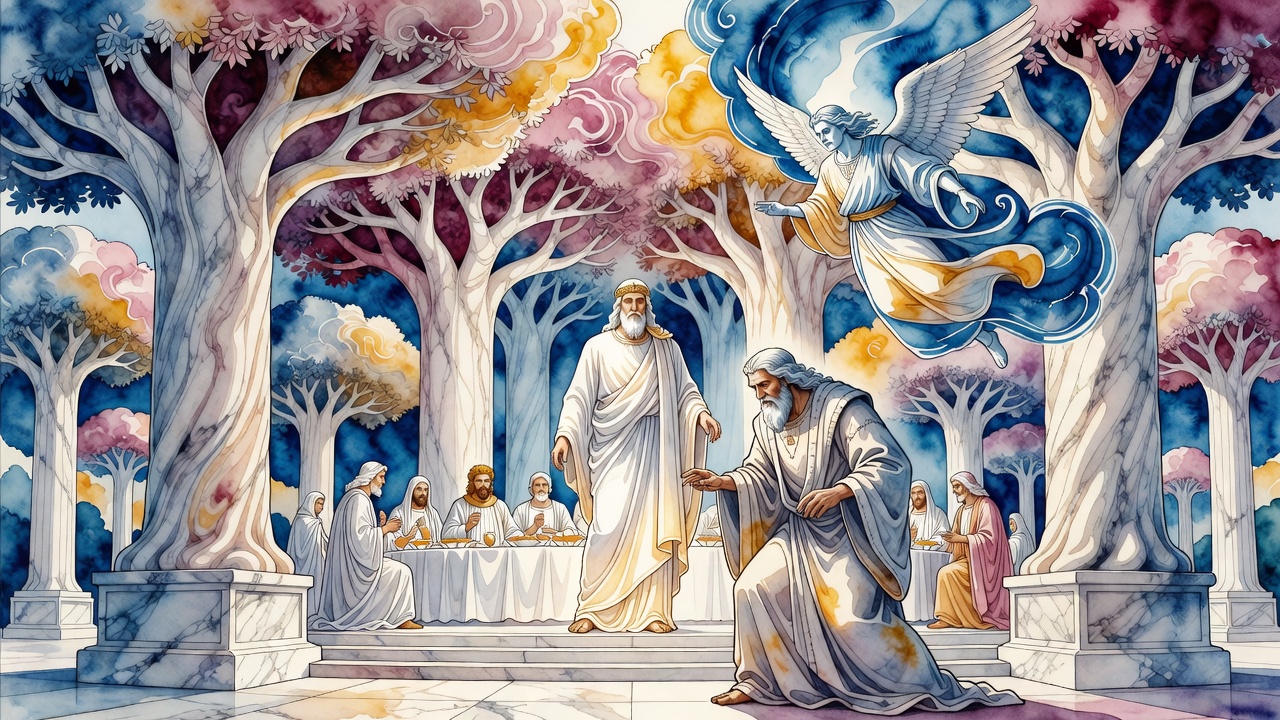
So David held back the blade. He spared the man who cursed him because the future was hiding inside him. Later he charged his son Solomon to bring the matter to its just end in its proper hour (1 Kings 2:8). Shimei deserved death under the law that forbids cursing a leader of the people (Exodus 22:27), yet David's mercy guarded the line, so that the redeemers waiting unborn within it might one day stand and save the house of Israel.

Bodies That Hang Past Nightfall

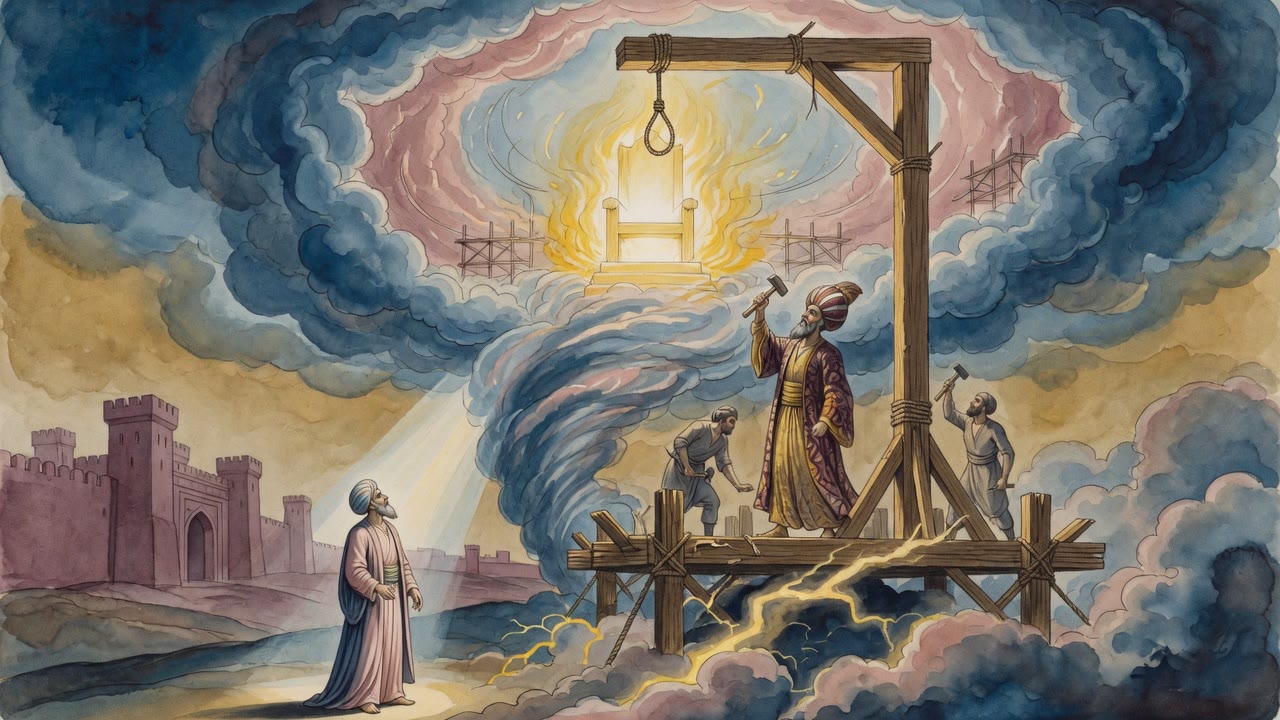
When Haman and his ten sons hung day after day, the watching nations sharpened their accusation. The Torah is plain: a hanged man's body must not stay on the gallows overnight (Deuteronomy 21:23). So why does Esther break the written law? Why does she leave the dead swinging against the sky?

Esther answered them with an older case. Long before, King Saul had struck down the converts of the Gibeonites, the strangers who had joined Israel under oath. For that broken faith his own sons were given over to hang, and they hung from the first cutting of the barley until the rains finally fell, six months later (2 Samuel 21). Heaven itself had sanctioned that long exposure, so that every passerby would ask the reason and learn it. When Israel came up to appear in the Temple, the nations pointed and asked why those bodies still hung. The people answered plainly: because their father had stretched out his hand against the Gibeonite converts and killed them.

From that precedent Esther reasoned upward. If Saul's house hung half a year to vindicate murdered converts, then Haman the wicked, who schemed by lot and by pur to wipe out all Israel, deserves far worse. He and his sons should hang upon the gallows for all the days of the world. Empires drag corpses to prove a king is gone. Israel leaves a gallows standing to prove a decree against converts and against the whole people will not be forgotten. Mordecai's spared ancestor and Haman's unburied sons sit at opposite ends of the same long memory, while Babylon's chained father still walks, in story, through a street that needed proof more than dignity.


← All myths
From the tradition

Sources

3 sources

The texts behind this telling. Some cards carry a translation of the source; others are our own retelling of it, and each card says which. Every card links out to the original.

Targum Sheni on Esther 1:1:3Targum Sheni on Esther

Translation of the source text.Berlin, 1898 · Public Domain

This is Ahasuerus, one of the ten kings who reigned and are destined to reign in the world. And these are the ten kingdoms: The first kingdom is that of the Lord of Hosts, whose kingdom shall soon be revealed over us. The second is that of Nimrod. The third is that of Pharaoh. The fourth kingdom is that of Israel. The fifth is that of Nebuchadnezzar, king of Babylon. The sixth is that of Ahasuerus. The seventh is that of Greece. The eighth is that of Rome. The ninth is that of the son of David, the Messiah. The tenth is that of the King of kings, the Lord of Hosts, whose kingdom shall soon be revealed over all the inhabitants of the earth. When the kingdom of Babylon was about to perish from the earth and dominion was to be removed from it, the children of men did not know whom they should set over themselves as king. And when Nebuchadnezzar, king of Babylon, died, and Evil-Merodach his son arose in his place, the people of his province were unwilling. They answered and said to him: "Your father Nebuchadnezzar did not dwell among the children of men, so how shall we set you up as king over us? Lest your father Nebuchadnezzar turn back and come upon us and kill us." And when Evil-Merodach heard these words that the people of his province said to him, he answered and said to them: "Nebuchadnezzar is dead and banished from the world." But still they would not believe him. They answered and said: "Your father Nebuchadnezzar shook the whole earth and all the kings, concerning whom Scripture explains: 'This is the man that made the earth tremble, that shook kingdoms' (Isaiah 14:16-17)." What did Evil-Merodach do at that time? He went to the king's treasure-house and brought out from there chains of iron and bronze and cast them upon the heels of Nebuchadnezzar his father, and dragged him out and brought him out of his grave. For thus Scripture explains concerning him: "But you are cast out of your grave like an abhorred branch" (Isaiah 14:19). And when the people of his province saw that Evil-Merodach did the will of his Father in heaven, they all rose in great joy and clothed Evil-Merodach in the fine purple of kingship and gave him great honor and exceeding greatness. Daniel, the man of delight, answered and said to him: "Evil-Merodach, behold, all the days of Nebuchadnezzar your father, no prisoner ever went out free from his house, for thus Scripture explains concerning him: 'He did not open the house of his prisoners' (Isaiah 14:17). When the enemies of the Jews became liable, your father Nebuchadnezzar prevailed and rose against them, destroyed the land of Israel, plundered the city of Jerusalem, burned the Temple with fire, exiled the people of the house of Israel and brought them to Babylon, and exiled with them Jehoiachin, king of the house of Judah, and bound him in the prison-house thirty-seven years, because he did not place upon himself the will of his Father in heaven. And Nebuchadnezzar too became proud in his heart and said, 'There is no king or ruler but me,' for thus Scripture explains concerning him: 'I will ascend above the heights of the clouds, I will be like the Most High' (Isaiah 14:14)." At that hour Evil-Merodach did the will of his Father in heaven and entered the prison-house and brought out from there Jehoiachin son of Josiah, king of the tribe of the house of Judah, and all the prisoners went out with him. What did Evil-Merodach do at that time? He went to the king's treasure-house and brought out from there all the good oils and every kind of spice, and washed him and anointed him and clothed him in garments of kingship, and he ate bread continually before him all the days of his life.
Full source
Targum Sheni on Esther 9:24:1Targum Sheni on Esther

Translation of the source text.Berlin, 1898 · Public Domain

Because Haman son of Hammedatha the Agagite, the oppressor of the Jews, plotted against the Jews to destroy them; he cast the pur, threw lots, evening and morning, for every lot, to destroy them and to annihilate them. And when they saw Haman and his sons hanging on the gallows many days, they said: Why does Esther transgress what is written, "his corpse shall not remain overnight upon the gallows" (Deuteronomy 21:23)? Esther answered and said to them: Because Saul the king slew the converts of the Gibeonites, his sons were left hanging on the gallows from the start of the barley harvest until the day the rain came down, which was six months. And when the house of Israel went up to appear in the Temple, the nations would say to them: Why are these hanging? The house of Israel answered and said to them: Because their father stretched out his hand against the converts of the Gibeonites and slew them. Haman the wicked, who sought to annihilate the house of Israel, all the more so shall he and his sons hang on the gallows for all the days of the world.
Full source
Targum Sheni on Esther 2:5:1-2Targum Sheni on Esther

Translation of the source text.Berlin, 1898 · Public Domain

A Jewish man lived in Shushan the capital, and his name was Mordecai. And why was he called "a Jewish man"? Because he feared sin. Concerning him David prophesied and said, "On this day shall a man die in Israel." And who was that man? This is Mordecai son of Yair, son of Shimei, son of Shmida, son of Baanah, son of Elah, son of Micah, son of Mephibosheth, son of Jonathan, son of Saul, son of Kish, son of Abiel, son of Zeror, son of Becorath, son of Aphiah, son of Shaharit, son of Uzziah, son of Sheshak, son of Michael, son of Eliel, son of Ammihud, son of Shephatiah, son of Pethuel, son of Pithon, son of Maloch, son of Jerubbaal, son of Jeroham, son of Hananiah, son of Zabdi, son of Eliphal, son of Shimri, son of Zebadiah, son of Merimoth, son of Hushim, son of Shahorah, son of Gazzah, son of Bela, son of Benjamin, son of Jacob the firstborn, who was called by the name Israel. And what did Mordecai see, that he was called the son of Shimei? Shimei reviled David king of Israel, and said to King David, "Get out, you wicked man, a man liable to be killed." Abishai son of Zeruiah answered and said to David, "Let me go and take off Shimei's head from him." King David looked into his prophecy and saw that Mordecai was destined to arise from him. And when King David saw this, he charged Solomon his son and said to Solomon his son, "When the time comes that Shimei ceases from sons, kill him, so that he may be acquitted and come to the world to come." And because there would arise from him a righteous son by whose hand miracles and mighty deeds would be done for Israel in their four exiles, and he is Mordecai "pure myrrh," son of Yair, son of Shimei, son of Kish, of the tribe of Benjamin. And Shimei was liable to be killed by law, as it is written in the Torah of Moses, "You shall not afflict a righteous judge, and a prince among your people you shall not curse," and he reviled David king of Israel. But David had pity on him, not to kill him, because he saw that these two righteous ones would arise from him, and that the house of Israel would be redeemed through them.
Full source