Parshat Bereshit6 min read

The Four Empires Coiled in the Chaos Before Creation

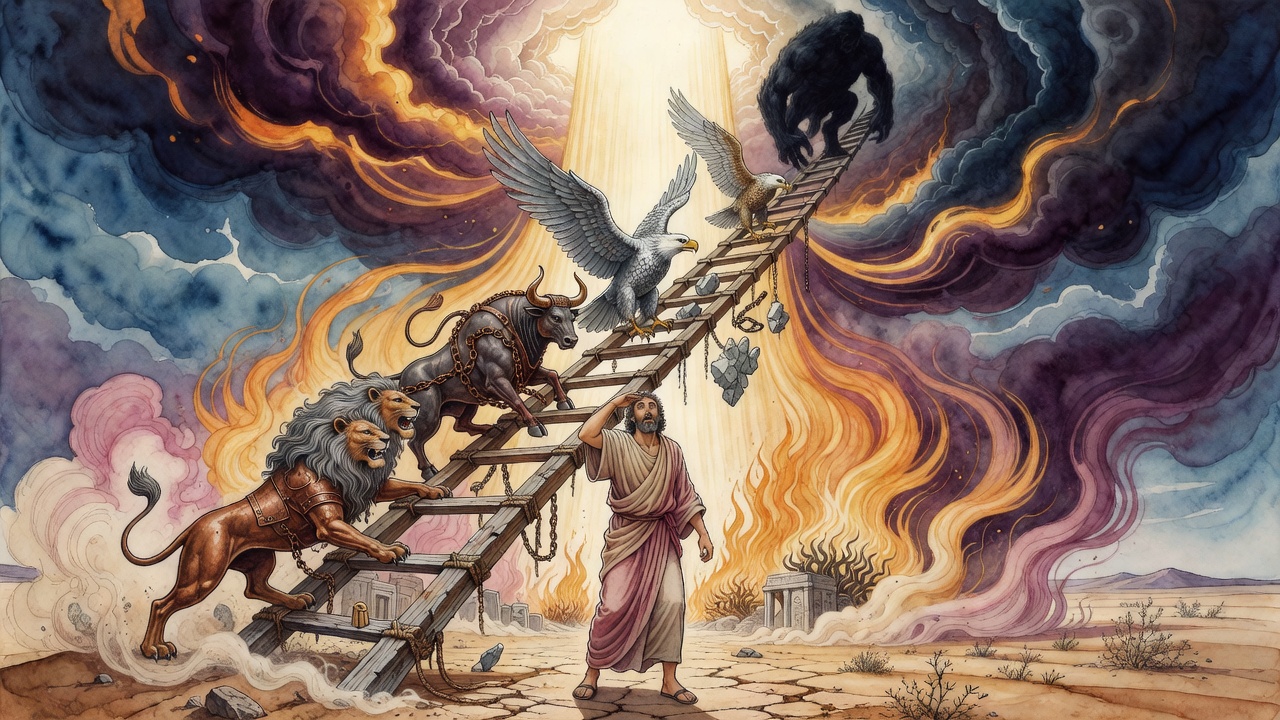
Resh Lakish looked into the dark verse before the light and saw four empires crouched in the chaos, and the redeemer's spirit hovering above the deep.

Curated by Arthur · Told by Maggid ·
Table of Contents
  1. The Verse That Held the Whole of History
  2. Four Kingdoms Coiled in the Dark
  3. The Spirit Above the Abyss
  4. The Water That Cools and Cleanses
  5. The Sage Who Looked Too Long
The Four Empires Coiled in the Chaos Before Creation Click for full size

The Verse That Held the Whole of History

Resh Lakish bent over the second verse of the Torah until the letters seemed to shift under his eyes. The earth was unformed and void, it said. Darkness lay over the face of the deep. And the spirit of God hovered above the water. Other men read weather in those words, the raw morning of the world before light. He read a warning set down before there was anyone alive to warn.

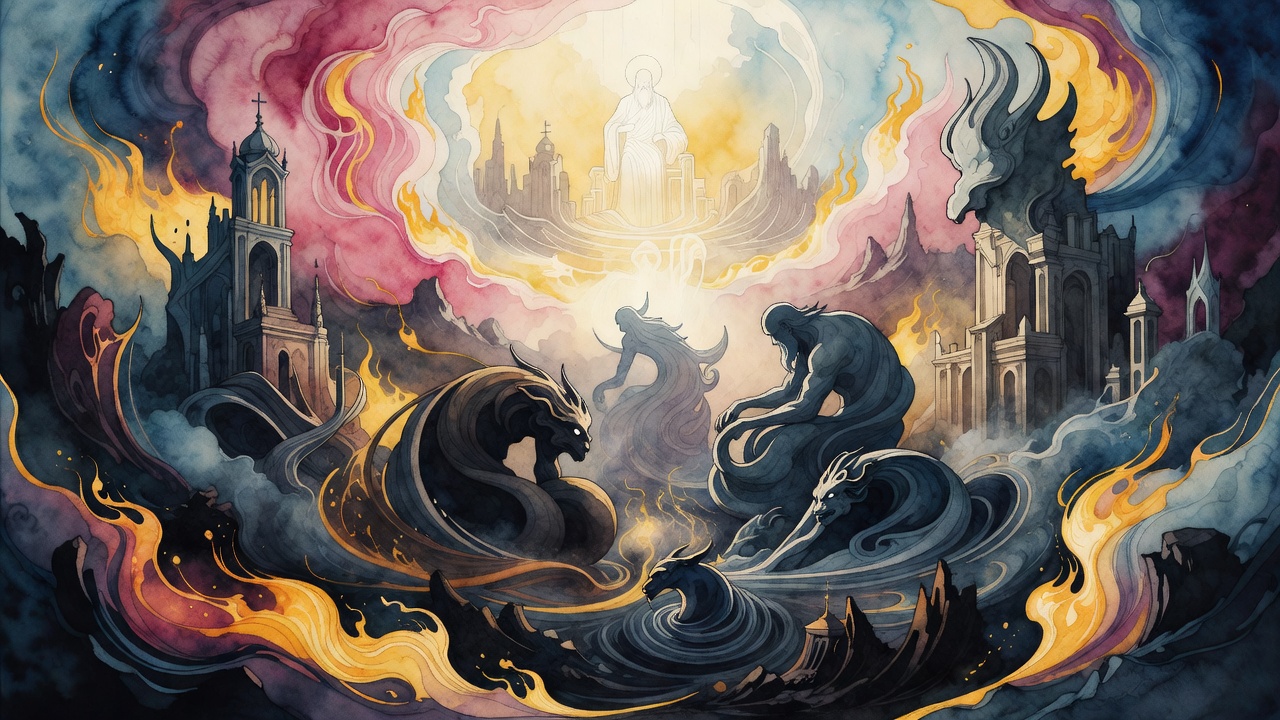
He was an Amora of the third century, a man who carried in his bones the memory of the Temple burned and the weight of Rome pressing on the land in his own day. When he looked into that first darkness, he did not see mist rising off new seas. He saw four kingdoms crouched in the chaos, each waiting its turn at Israel, all of them there before the first morning ever broke.

Rabbi Berekhya had taught that nothing begins as a blank page. "Even a boy is known by his deeds," he quoted, and reminded his students that a young plant shows its nature before it flowers, pushing out small thorns while it is still tender. The unformed world was no clean slate. It already held the shape of everything that would grow from it, the fruit and the thorn alike. Resh Lakish took that thorn and named it four times over.

Four Kingdoms Coiled in the Dark

"Unformed," he said, tohu, and that was Babylon. He reached for the prophet Jeremiah, who had stared at a ruined land and cried, "I have seen the earth, and behold, it was unformed and void." Not rubble only. A hollow where a people's life had been, the first emptiness that Israel would be marched into in chains.

"And void," vohu, and that was Media. He heard inside the word the sound of vayavhilu, they hastened, the same word the scroll of Esther uses when the king's men come running for Haman. "They hastened to bring Haman," it says, and in that rush Resh Lakish saw the whole Median kingdom, a power that moved too fast, impatient on its rise, hurrying its favorites up the ladder and then hurrying them off it.

"Darkness," and that was Greece, because Greece darkened the eyes of Israel with its decrees. He could hear the cruelest of them, the demand that a Jew take the horn of an ox and write upon it, "We have no portion in the God of Israel." They did not only want to kill. They wanted a man to sign away his own God with his own hand, in daylight, on the horn of a beast. That was the darkness, a night poured straight into the eyes.

"Upon the face of the deep," and that was the wicked kingdom, Edom, which the sages knew as Rome. Why the deep? Because the deep cannot be measured. Drop a line into it and the line never finds bottom. So it was with this kingdom, its cruelty past sounding, its reach past counting. Just as no one can calculate the deep, Resh Lakish said, no one can calculate the wicked.

The Spirit Above the Abyss

Four kingdoms, and the verse was not finished. Over that same black water, where the last and worst empire spread itself like a sea without a floor, one more thing moved. "And the spirit of God was hovering," the verse said, and Resh Lakish would not let it pass as wind. This, he declared, was the spirit of the Messianic King, hanging above the abyss before the first light was ever spoken.

He set beside it the words of Isaiah, "The spirit of the Lord shall rest upon him." Before Babylon, before Media, before the darkness of Greece and the fathomless cruelty of Rome, before any of it had a name, the redeemer's breath was already there, waiting out the whole long night above the deep. The ruin and the rescue lay folded into the one dark verse together.

The Water That Cools and Cleanses

How would that hovering spirit ever come down into the world? By the water it hovered over, the sages said, and the water was repentance. They heard it in the cry from the book of Lamentations, "Pour out your heart like water before the face of the Lord." Turning back was a thing a person poured. It soaked and it washed, and it could carry a whole people out of exile the way water carries anything set upon it.

Rabbi Hagai, in the name of Rabbi Pedat, said a covenant was cut with the water at the beginning. Even when the heat is savage, a wind is sent to move across the face of the water and cool it. That was why the verse chose the word merahefet, hovering, in the present tense and not the past. The hovering never stopped. It was happening still, over every generation's deep, a breath kept moving above the water so the water would not fail.

The Sage Who Looked Too Long

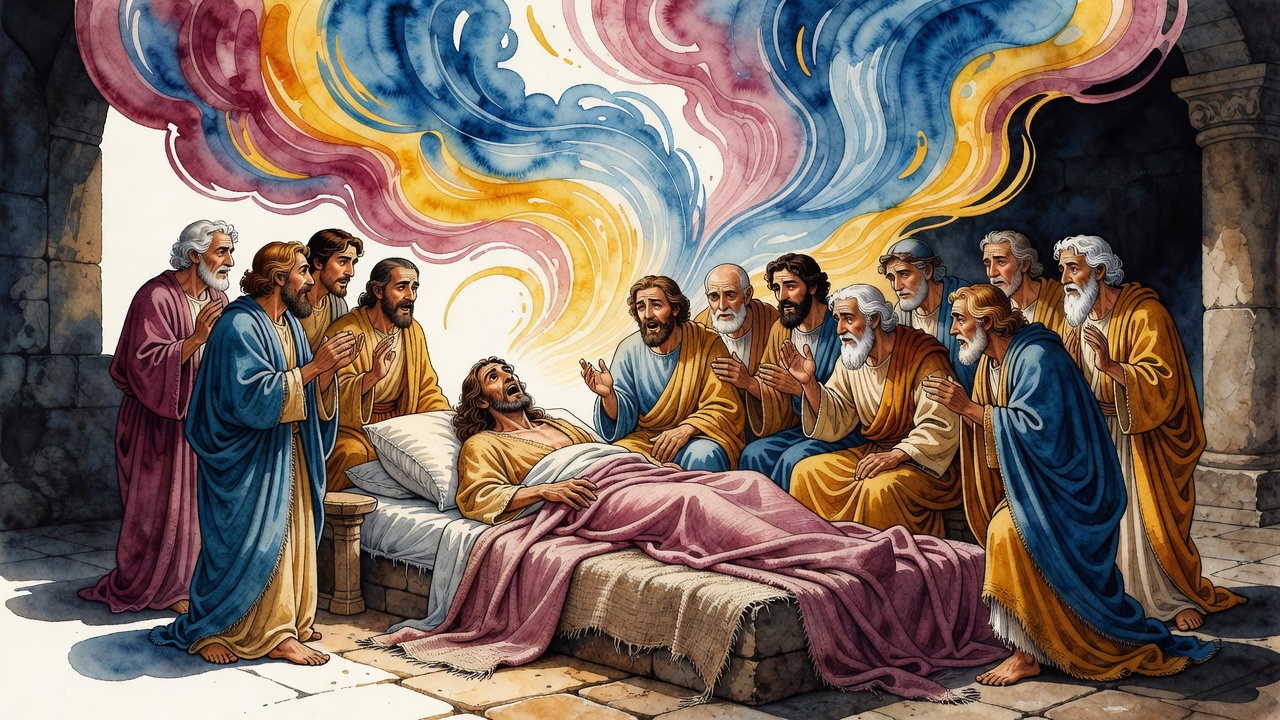
One man leaned too far into that mystery. Ben Zoma stood in the road one day so deep in thought that he did not answer when Rabbi Yehoshua greeted him, and did not answer the second time either. When Rabbi Yehoshua pressed him, Ben Zoma said he had been staring at the act of Creation, at the space between the upper waters and the lower waters, a gap so thin it was barely a gap at all.

The spirit did not blow across that water, he said. It hovered, "like a bird flying above its young, its wings beating, touching and not touching." He had climbed up into the narrowest seam in the world and stood inside it. Rabbi Yehoshua looked at him and said quietly to his students, "Ben Zoma is already gone." Not long after, Ben Zoma died. He had put his eye to the crack between the waters where the spirit of the King still hovers, and he did not come back down.


← All myths
From the tradition

Sources

2 sources

The texts behind this telling. Some cards carry a translation of the source; others are our own retelling of it, and each card says which. Every card links out to the original.

Bereshit Rabbah 2:1Bereshit Rabbah

Retold in our words. Read the original at the link below.The Sefaria Midrash Rabbah, 2022 · CC-BY

Bereshit Rabbah turns to The Deep Meaning of Tohu Vavohu in the Book of Genesis.

What does "emptiness and disorder" really mean?

The Hebrew there is tohu vavohu. Tohu vavohu. But it's more than just a pretty sound. It's a description of… nothingness struggling to become something. Raw, unshaped potential.

Rabbi Berekhya offers a fascinating take. He starts with a proverb: "Even a boy is recognized through his deeds" (Proverbs 20:11). What’s he getting at?

Rabbi Berekhya explains that even when a plant is young, before it blossoms, it shows signs of what it will become. It might even sprout thorns early. Little, tiny thorns that foreshadow the plant's nature. The tohu vavohu isn't just a blank slate. It already contains the seeds of what's to come, both good and… thorny.

This idea is echoed later by the prophet Jeremiah, who says, "I have seen the land, and behold, it is emptiness and disorder" (Jeremiah 4:23). The prophet sees the tohu vavohu not just at the beginning of creation, but as a potential state of being, a consequence of… well, of things gone wrong.

So, what does it all mean for us?

Maybe it's a reminder that even in the earliest stages, our actions have consequences. That the seeds we sow, even small and seemingly insignificant ones, can blossom into something beautiful or something… prickly. Maybe it's a call to pay attention to the potential within ourselves, within our world, and to nurture the good while carefully tending to the thorns.

Because even in the beginning, everything mattered. And maybe, just maybe, it still does.

Full source
Bereshit Rabbah 2:4Bereshit Rabbah

Retold in our words. Read the original at the link below.The Sefaria Midrash Rabbah, 2022 · CC-BY

The Rabbis certainly did. In Bereshit Rabbah, an expansive collection of Rabbinic interpretations of the Book of Genesis, we find a fascinating take on the very first verses, connecting them to the empires that dominated Israel throughout history.

Rabbi Shimon ben Lakish, also known as Resh Lakish, a prominent Amora of the second and third centuries, offers a powerful interpretation. He links the chaotic scene of creation in Genesis to the four kingdoms that subjugated Israel: Babylonia, Media, Greece, and Edom (which the Rabbis associated with Rome). It's a stunning move, finding echoes of future suffering in the very first moments of existence.

"The earth was emptiness" (tohu va-vohu) – this, says Resh Lakish, represents the Babylonian kingdom. He draws a parallel to (Jeremiah 4:23): "I have seen the land, and behold, it was emptiness and disorder." See the connection? It's not just about physical destruction, but a spiritual void.

Then comes "And disorder" (vavohu). This, he argues, alludes to the Median kingdom. He connects vavohu to the Hebrew word vayavhilu, "they hastened," from the Book of Esther (6:14): "They hastened to bring Haman." It’s a clever play on words, but it highlights the Medes' swift, almost impatient, rise to power.

“And darkness” – this signifies the Greek kingdom. But why darkness? Because, Resh Lakish explains, they "darkened Israel’s eyes with their edicts." Imagine the spiritual oppression, being told to deny your very identity: "Write on the horn of a bull that you have no portion in the God of Israel." A chilling demand.

Finally, "Upon the face of the depths" represents the "evil kingdom" of Edom. This kingdom, according to the Rabbis, is so vast and powerful, so deeply entrenched in wickedness, that it's like the depths of the ocean – immeasurable and unknowable. As Bereshit Rabbah poignantly states, "just as the depths cannot be calculated, so is it with the wicked."

But the story doesn’t end there. Even in the face of such overwhelming darkness, there is hope. "And the spirit of God was hovering" – this, Resh Lakish proclaims, is the spirit of the Messianic King. This is the promise that follows triumphantly after all those kingdoms of subjugation. As (Isaiah 11:2) says, "The spirit of the Lord will rest upon him."

So, how will this Messianic kingdom come about? “Hovering over the surface of the water” – through the merit of repentance (teshuvah), which is likened to water. As (Lamentations 2:19) urges us, "Pour out your heart like water before the face of the Lord." Repentance, like water, has the power to cleanse and renew.

Rabbi Hagai, citing Rabbi Pedat, adds another layer to this image of water. He says that a covenant is made with the water, that even when the weather is hot, the wind blows over it to cool it off. This is why the word for "hovered" (meraḥefet) is written in the present tense – it's an ongoing process, a constant promise of renewal.

Bereshit Rabbah then shares a story about Rabbi Shimon ben Zoma, a brilliant but eccentric sage. Rabbi Yehoshua finds him lost in deep contemplation, unresponsive to greetings. When pressed, Ben Zoma reveals he was contemplating the act of Creation, marveling at the incredibly thin space between the upper and lower waters. He describes the spirit of God "hovering" not blowing, "like a bird that flaps its wings… they touch [the nest] but do not quite touch.” Rabbi Yehoshua, recognizing the intensity of Ben Zoma's experience, sadly declares, "Ben Zoma is gone," implying that he was no longer fully present in this world. The text then tells us that Ben Zoma died not long after this experience.

What does this all mean? Perhaps it’s a reminder that even in the face of darkness and oppression, the spirit of God is always hovering, offering a path to repentance and renewal. Perhaps it's a caution about delving too deeply into the mysteries of creation. Or maybe it's simply evidence of the power of the human mind to confront the infinite. Whatever your takeaway, Bereshit Rabbah offers a profound and enduring message of hope and resilience.

Full source