Translation of the source text.William Davidson Edition - Vocalized Aramaic + William Davidson Edition - English · CC-BY-NC
And they are the parables concerning the following verses: “The fathers have eaten sour grapes, and the children’s teeth are set on edge” (Ezekiel 18:2); “Just balances, just weights…shall you have” (Leviticus 19:36); and “The righteous is delivered out of trouble, and the wicked comes in his stead” (Proverbs 11:8). § The Roman emperor said to Rabban Gamliel: Your God is a thief, as it is written: “And the Lord God caused a deep sleep to fall upon the man and he slept; and He took one of his sides, and closed up the place with flesh instead” (Genesis 2:21).
The daughter of the emperor said to Rabban Gamliel: Leave him, as I will respond to him. She said to her father: Provide one commander [dukhus] for me to avenge someone’s wrongdoing. The emperor said to her: Why do you need him? She said to him: Armed bandits came to us this past night, and took a silver jug [kiton] from us, and left a golden jug for us.
The emperor said to her: If so, would it be that armed bandits such as these would come to us every day. She said to him: And was it not similarly good for Adam the first man that God took a side from him and gave him a maidservant to serve him? The emperor said to her: This is what I was saying: But if it is good for Adam, let God take his side from him in the open, not during the time of his deep sleep, like a thief.
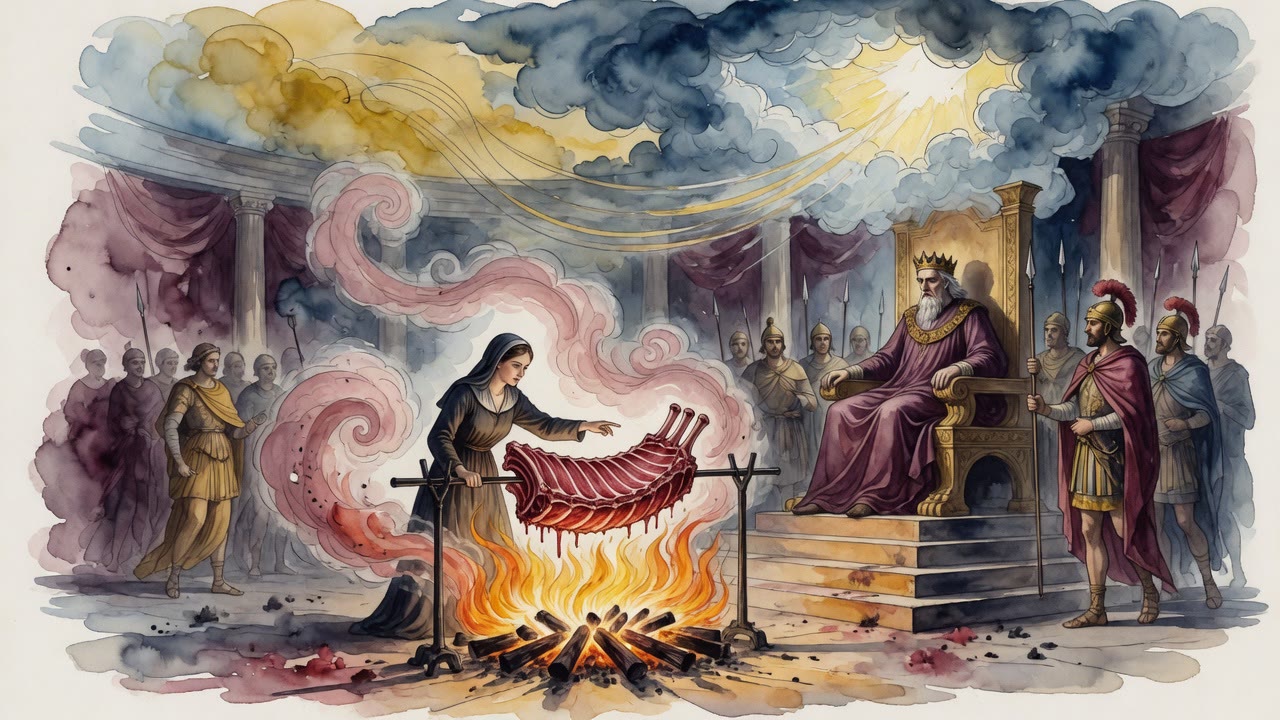
She said to him: Bring me a slice of raw meat. They brought it to her. She placed it under the embers, and removed it after it was roasted. She said to him: Eat from this meat.
The emperor said to her: It is repulsive to me. Although he knew that this is how meat is prepared, seeing the raw meat made it repulsive to him. She said to him: With regard to Adam the first man as well, had God taken her from him in the open, she would have been repulsive to him. Therefore God acted while Adam was asleep.
The emperor said to Rabban Gamliel: I know your God, what He does and where He sits. Meanwhile, the emperor was moaning and groaning. Rabban Gamliel said to him: What is this? Why are you in distress?
The emperor said to him: I have one son in the cities overseas and I miss him. Rabban Gamliel said to him: I want you to show him to me. The emperor said: Do I know where he is? Rabban Gamliel said to him: If you do not know that which is on earth, is it possible that you do know that which is in the heavens?
The emperor said to Rabban Gamliel: It is written in praise of the Lord: “He counts the number of the stars; He gives them all their names” (Psalms 147:4). What is His greatness? I can also count the stars. Rabban Gamliel brought quinces, put them in a sieve, and spun them.
He said to the emperor: Count them. The emperor said to him: Stand them still so that I can count them. Rabban Gamliel said to him: The firmament also revolves like this, therefore you cannot count the stars in it. Some say that this is what the emperor said to him: I have counted the stars.
Rabban Gamliel said to him: Tell me how many teeth and incisors you have. The emperor put his hand in his mouth and was counting them. Rabban Gamliel said to him: You do not know what is in your mouth, but you do know what is in the firmament? The emperor said to Rabban Gamliel: He Who created mountains did not create wind, rather two separate gods created them, as it is stated: “For, lo, He forms mountains and creates wind” (Amos 4:13); one is described with the verb “forms,” and the other with the verb “creates.”
Rabban Gamliel said to him: If that is so, then with regard to Adam, as it is written concerning him: “And God created” (Genesis 1:27), and also: “And the Lord God formed” (Genesis 2:7), so too should one say that He who created this did not create that? If you will claim that different gods created different parts of Adam, that will not suffice. A person has one handbreadth by one handbreadth of facial countenance, with two types of orifices in it, eyes and ears.
Should one say that He who created this did not create that; as it is stated: “He that planted the ear, shall He not hear? He that formed the eye, shall He not see?” (Psalms 94:9)? The verse employs two verbs for the eyes and ears alone. The emperor said to him: Yes, different gods created different parts of the face.
Rabban Gamliel said to him: And at the moment of death, are they all appeased? Do all these gods agree as one that the time arrived for the person to die? The Gemara relates: A certain magus said to Ameimar: From your midpoint and up is in the domain of Hurmiz, the god of good, who created the significant and important parts of the body, and from your midpoint and down is in the domain of Ahurmiz, the god of bad.
Ameimar said to him: If so, how does Ahurmiz allow Hurmiz to urinate in his territory? A person drinks with his mouth, which is in his upper half, and urinates from below. The Gemara relates: The emperor said to Rabbi Tanḥum: Come, let us all be one people. Rabbi Tanḥum said: Very well.
But we, who are circumcised, cannot become uncircumcised as you are; you all circumcise yourselves and become like us. The emperor said to Rabbi Tanḥum: In terms of the logic of your statement, you are saying well, but anyone who bests the king in a debate is thrown to the enclosure [labeivar] of wild animals. They threw him to the enclosure but the animals did not eat him, as God protected him. A certain heretic said to the emperor: This incident, that they did not eat him, happened because they are not hungry.
They then threw the heretic into the enclosure and the animals ate him. The emperor said to Rabban Gamliel: You say that the Divine Presence dwells in any place where there are ten adult male Jews. He asked, sarcastically: How many Divine Presences are there? Rabban Gamliel summoned the servant of the emperor and hit him on his neck [be’appatka].
Rabban Gamliel said to him: Why did you allow the sun to enter the house of the emperor? The emperor said to him: The sun rests upon all the world; no one can prevent it from shining. Rabban Gamliel said to him: And if the sun, which is one of ten thousand attendants that are before the Holy One, Blessed be He, rests upon all the world, the Divine Presence of the Holy One, Blessed be He, all the more so rests upon the world.
A certain heretic said to Rabbi Abbahu: Your God is a jester, as He said to Ezekiel the prophet: “Lie on your left side” (Ezekiel 4:4), and it is also written: “Lie on your right side” (Ezekiel 4:6); God had Ezekiel turn from side to side, apparently for comic effect. In the meantime, a certain student came before Rabbi Abbahu and said to him: What is the reason for the mitzva of the Sabbatical Year?
Rabbi Abbahu said to them: Now I will tell you something that is fit for the two of you. Rabbi Abbahu continued: The Holy One, Blessed be He, said to the Jewish people: Sow for six years, and withhold sowing during the seventh year, so that that you will know that the land is Mine. But the Jewish people did not do so; rather, they sinned and were consequently exiled. The manner of the world is that in the case of a flesh-and-blood king whose province sinned against him, if he is cruel, he kills them all; if he is compassionate, he kills only half of them; and if he is compassionate and is full of compassion, he afflicts the leaders among them with suffering.
Rabbi Abbahu continues: So too in this case, the Holy One, Blessed be He, afflicts Ezekiel in order to cleanse the sins of the Jewish people. God instructed him to lie down and suffer the same number of days as the number of years that the Jewish people did not observe the halakhot of the Sabbatical Year. A certain heretic said to Rabbi Abbahu: Your God is a priest, as it is written: “That they take for Me an offering [teruma]” (Exodus 25:2), and teruma is given to the priests.
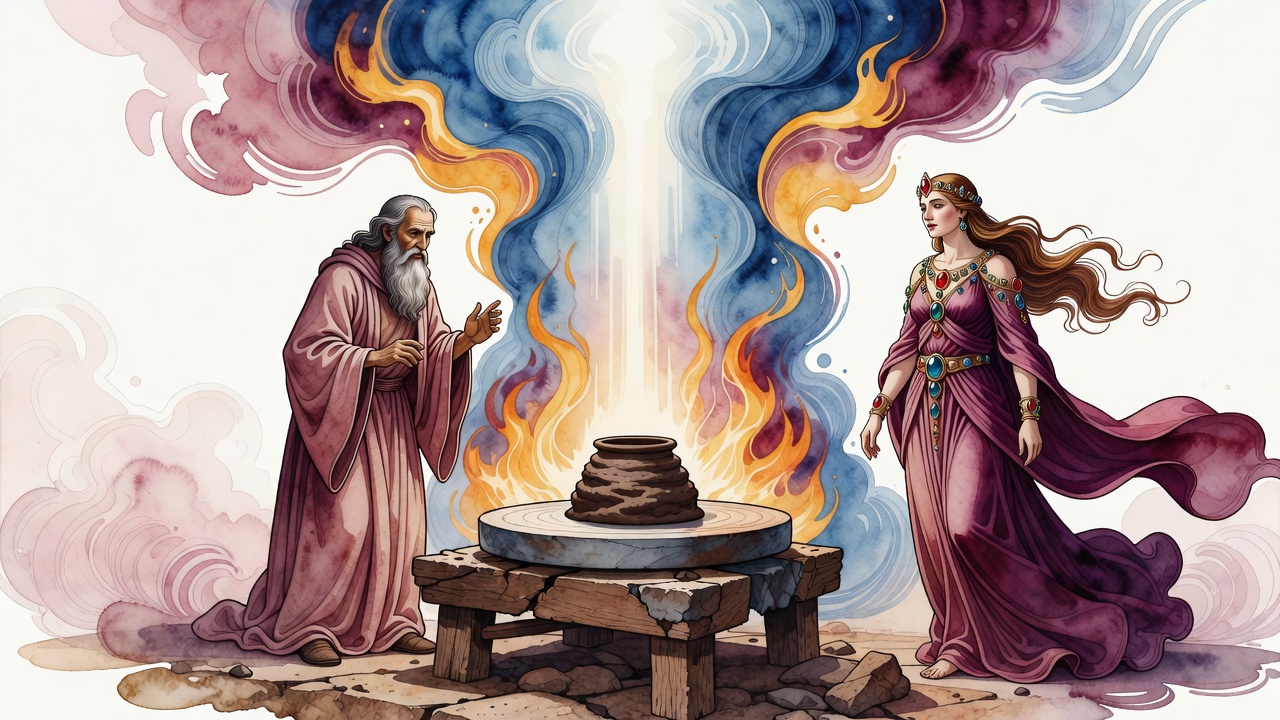
He asked, sarcastically: When He buried Moses, in what ritual bath did He immerse? A priest who contracts impurity from a corpse must immerse in order to be able to partake of teruma. And if you would say that He immersed in water, but isn’t it written: “Who has measured the waters in the hollow of His hand” (Isaiah 40:12), that all waters of the world fit in the palm of God, so He could not immerse in them.
Rabbi Abbahu said to him: He immersed in fire, as it is written: “For, behold, the Lord will come in fire” (Isaiah 66:15). The heretic said to him: But is immersion in fire effective? Rabbi Abbahu said to him: On the contrary, the main form of immersion is in fire, as it is written with regard to the removal of non-kosher substances absorbed in a vessel: “And all that abides not the fire you shall make to go through the water” (Numbers 31:23), indicating that fire purifies more than water does.
A certain heretic said to Rabbi Avina: It is written: “And who is like Your people, Israel, one nation in the earth” (II Samuel 7:23). The heretic asked: What is your greatness? You are also mixed together with us, as it is written: “All nations before Him are as nothing; they are counted by Him less than nothing and vanity” (Isaiah 40:17). Rabbi Avina said to him: One of yours, the gentile prophet Balaam, has already testified for us, as it is written:

 Click for full size