Parshat Bereshit6 min read

The Garments of Light Adam and Eve Lost in a Single Bite

Adam and Eve once wore garments of light, skin smooth as a fingernail under a cloud of glory. One bite stripped all of it away.

Curated by Arthur · Told by Maggid ·
Table of Contents
  1. The Cup God Lifted Over Them
  2. The Tree and the Sudden Cold
  3. The First Words After the Loss
  4. What God Sewed in the Twilight
  5. The Brightness They Could Not Keep

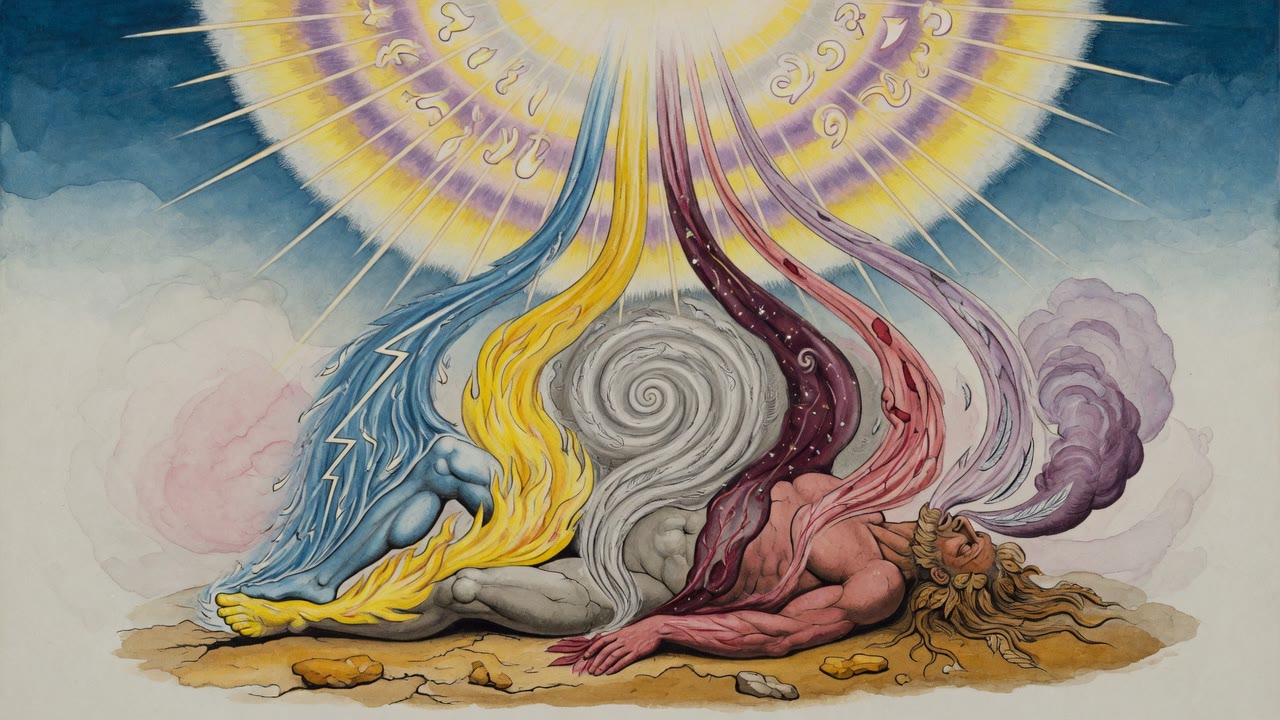
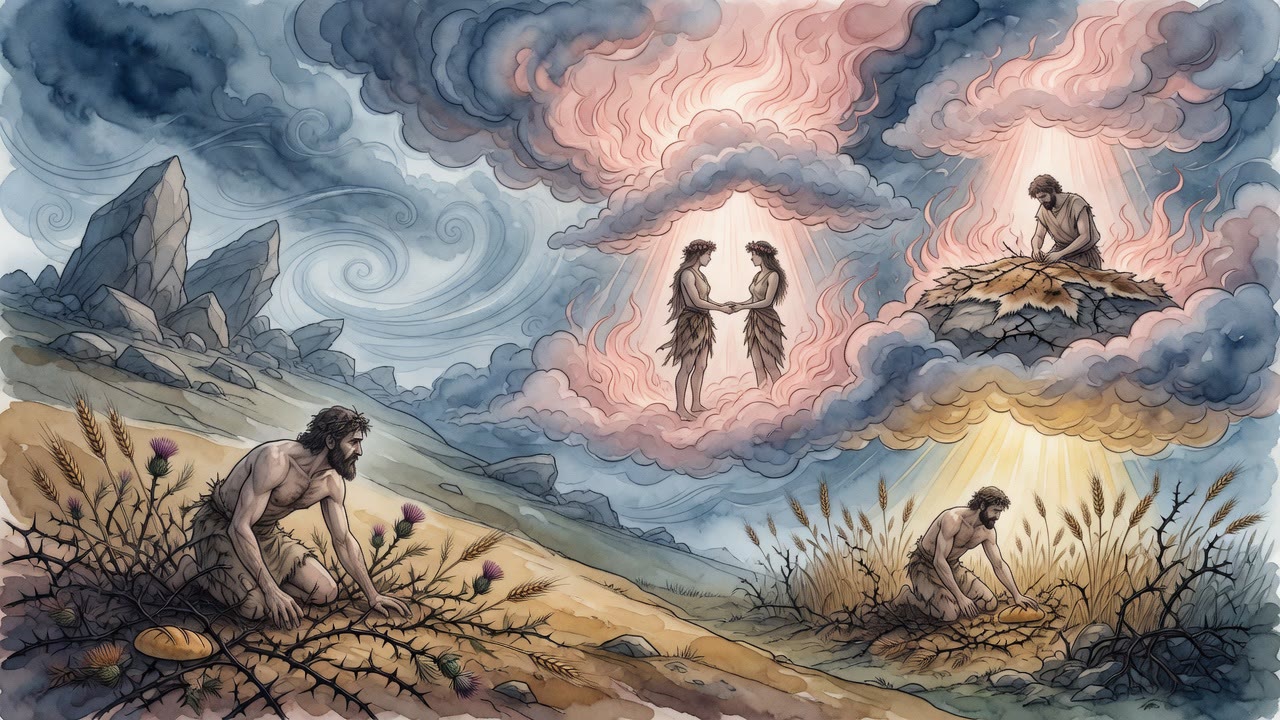
The light came off them in long shapes, broad at the bottom and narrow at the top, like flame standing upright on each shoulder. Adam and Eve moved through the garden and the brightness moved with them, never trailing, never lagging, fitted to their bodies the way warmth fits skin. Their skin itself was not the soft thing it would become. It was smooth as a fingernail, faintly hard, faintly clear, and over it lay a cloud of glory that shifted as they walked, a slow weather of brightness that no thorn could snag and no dust could dull.
They were not naked. They had never once felt naked. What wrapped them was woven of holy letters and shining cloud, and it shone like a torch held close, and it had been theirs since the hands that shaped them lifted away on the sixth day.

The Cup God Lifted Over Them

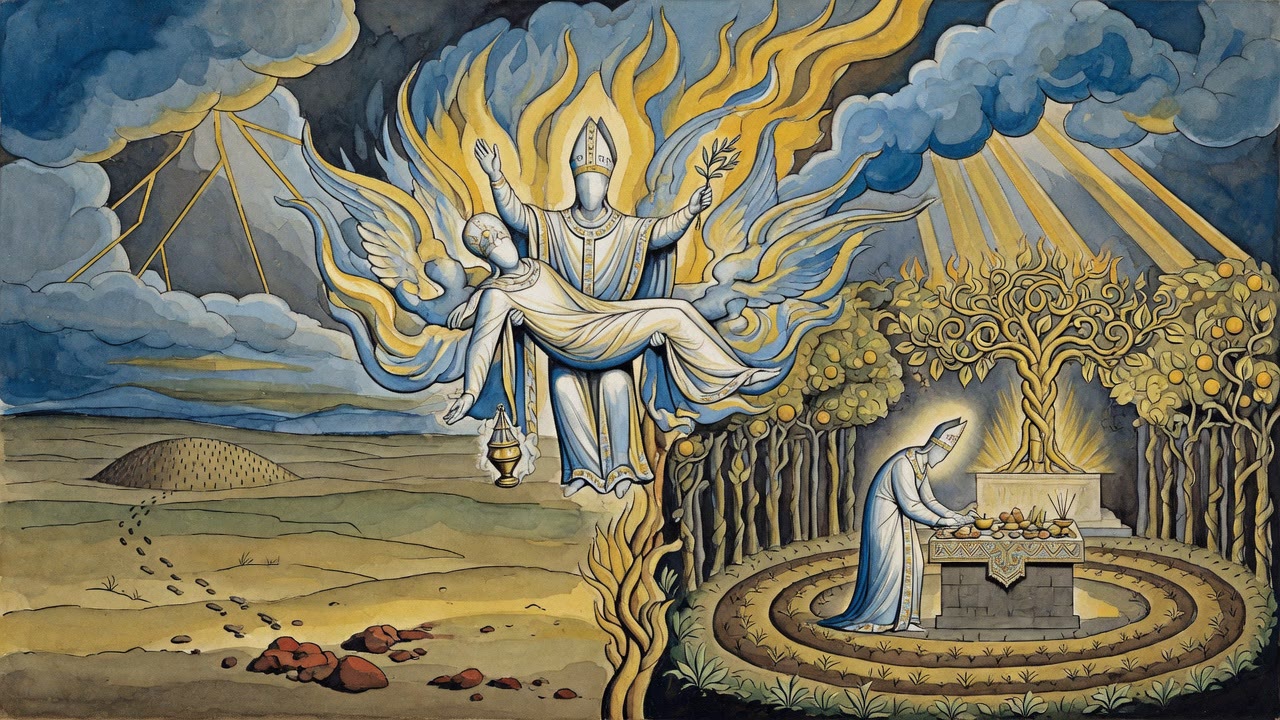
On the day they were joined, the brightness had a witness. The Holy One stood over them and lifted a cup, the same kind of cup raised over a bride and groom in every generation after, and over that cup He spoke a blessing upon them (Genesis 1:28). The two of them stood under it the way a couple stands under a canopy, and they were not alone in the standing.

Michael and Gabriel came to attend them, the great angels serving as the groomsmen of the first marriage. The light on Adam and Eve answered the light around the messengers, brightness facing brightness, and the garden held its breath around a wedding it would never see again. They were blessed, adorned, set into the world dressed in the afterglow of their own making. Nothing in them yet knew the word for loss.

The Tree and the Sudden Cold

Then there was the tree, and the fruit, and the reaching, and the bite.

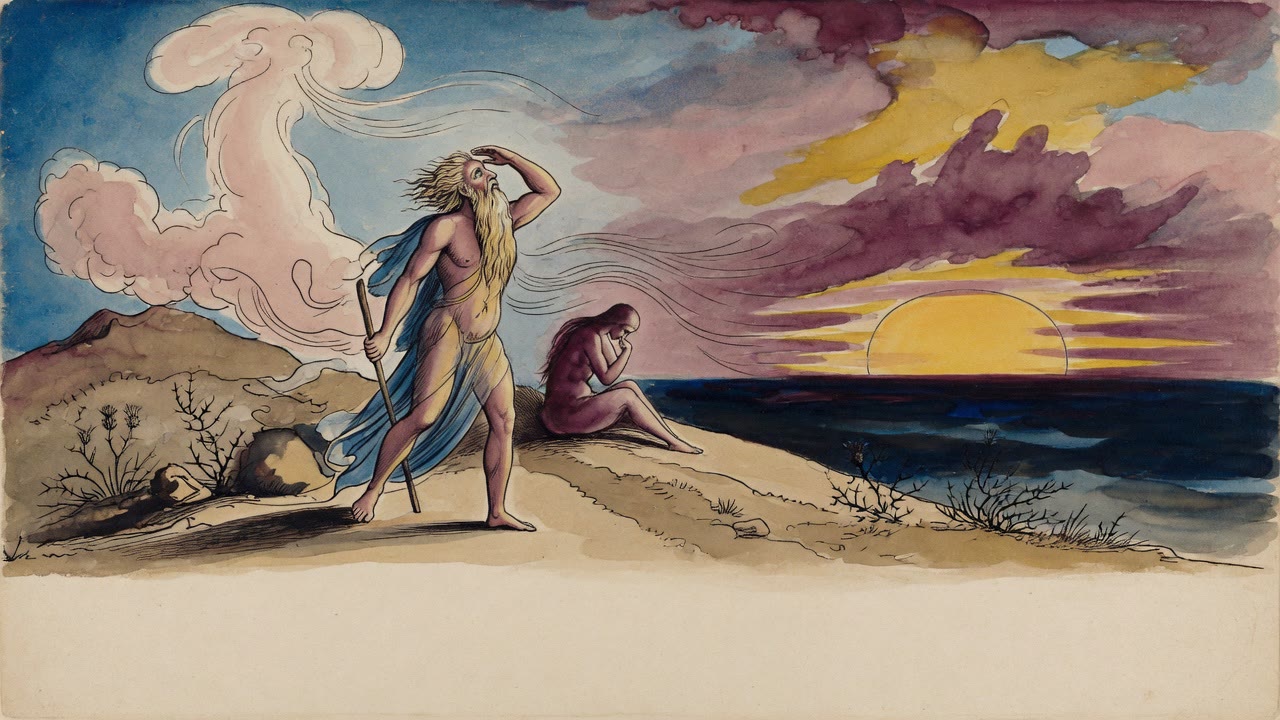
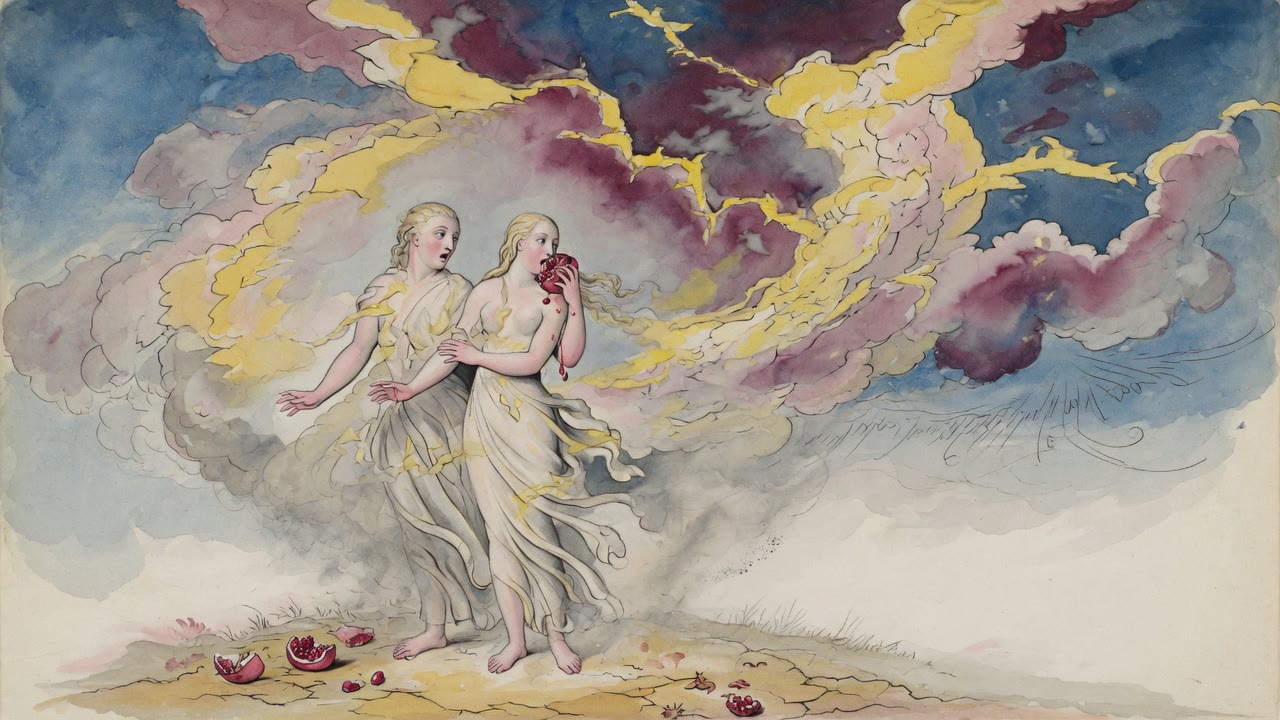
It did not fade. Light does not fade when it is taken in anger. It went out. The cloud of glory lifted clean off their shoulders the instant the fruit was in them, and the smooth bright skin fell away like a husk a seed has finished with. Where the torch-shapes had stood, there was nothing. Eve looked down and saw flesh, pale and ordinary and cold, and Adam looked down and saw the same, and for the first time the air touched them and they felt it touch.

The shame that came was not the shame of bodies. It was the shame of knowing exactly what had been on them a breath ago and was on them no longer. They had been dressed in something no loom could make, and now they were wearing only themselves, and themselves was not enough to keep the cold out.

The First Words After the Loss

Adam turned to Eve with an edge in his voice. His eyes were open now in the new way, and everything that had been sweet tasted wrong to him. He wanted to know why she had handed him the fruit he was never meant to touch, now that his teeth were set on edge by it.

Eve did not bend. If my teeth are on edge, she threw back at him, then may the teeth of everything be on edge. It was the first quarrel ever spoken aloud, two voices sharpening against each other inside two bodies that no longer felt like home. The brightness that had once stood over them like a wedding canopy was gone, and what stood between them now was only this, the taste of a fruit and the blame for it, passing back and forth.

What God Sewed in the Twilight

They were not left bare. The same hands that had lifted the cup made them something to wear. The Lord God made garments of skins for Adam and his wife, and clothed them (Genesis 3:21).

Some hold that these were no ordinary hides pulled from no ordinary beast. They were made in the last light of the sixth day, in the twilight before the first Sabbath ever fell, set aside in advance for the moment the brightness would fail. Smooth they were, smooth as a fingernail, the way the old skin had been smooth, as if even the covering of the fall remembered the covering of glory it replaced.

So the first humans walked out of the garden dressed twice over. Once in light, which they lost in a single swallow. Once in skin, which the Maker sewed for them in the dusk, the only garment that would follow them into the long ordinary years where light no longer stood up from the shoulder like flame.

The Brightness They Could Not Keep

What they carried out was the memory of weight that had no weight, of a skin that shone, of a cloud that knew their shape and never let the dust settle. The torch-shapes, broad below and narrow above. The cup. The two great messengers who had come to stand beside them. All of it had been theirs by no labor of their own, and all of it had left in the time it takes to chew.

They had been clothed in the afterglow of the day they were made, and they had reached past it, and the reaching had cost them the glow. The garden closed. The skins held the cold off. And somewhere behind them, folded back into the world that made it, the light that had once been their only clothing went on shining where they could no longer wear it.


← All myths
From the tradition

Sources

5 sources

The texts this telling draws on, in full. Open a card to read inline, or expand it for a wider, quieter read.

Legends of the Jews 2:57Legends of the Jews

It wasn't just a matter of suddenly understanding good and evil. The aftermath, according to some fascinating Jewish lore, was a whole lot messier.

The scene. Adam turns to Eve, maybe with a bit of an edge in his voice. "Did you give me that fruit? The one I wasn't supposed to eat? Because my eyes are opened, and everything tastes…off." And Eve, well, she's not backing down. "If my teeth are on edge," she retorts, "then may the teeth of everything be on edge!" Ouch. The consequences, as described in Legends of the Jews by Louis Ginzberg, were immediate and profound.

Before this moment, Adam and Eve weren't quite as we imagine them. According to the legend, their bodies were covered with a horny skin and enveloped in a cloud of glory. This wasn't just about physical appearance; it was about a state of being, a closeness to the Divine. But the instant they disobeyed, poof, the cloud of glory vanished, and the horny skin fell away. They stood there, suddenly and starkly naked, and filled with shame.

What happens next is even more poignant. Adam, desperately trying to regain some dignity, attempts to gather leaves to cover himself. But the trees refuse! One after another, they denounce him: "Thief! You deceived your Creator! Get away from me!" It's a powerful image of nature itself rejecting humanity's transgression. As we see in Legends of the Jews, they say, "Nay, the foot of pride shall not come against me, nor the hand of the wicked touch me. Hence, and take no leaves from me!" Can you imagine the isolation, the utter desolation?

Only one tree offers solace: the fig tree. Why the fig? Because, according to this tradition, the forbidden fruit was a fig. There’s a strange, almost poetic justice to it. As Ginzberg points out, it's like the story of the prince who is cast out by his father. When he seeks refuge, only the servant who caused his disgrace will offer him help. It's a stark reminder that sometimes, the source of our problems is also the only place we can find comfort, however flawed that comfort may be.

So what does it all mean? It's more than just a story about nakedness and shame. It's about the loss of innocence, the severing of a connection with the Divine, and the complex, often contradictory nature of consequences. It's a reminder that even in our darkest moments, there may be unexpected sources of solace, even if they come from the very thing that caused our downfall. Food for thought, isn't it?

Full source
Targum Jonathan on Genesis 27:15Targum Jonathan

Forget fig leaves – the story is far more dazzling than that! According to tradition, before the infamous bite of the forbidden fruit, Adam and Eve weren't just naked, they were clothed – body and soul – in garments of pure light!

That: radiating beings, draped in divine luminescence. Some say these original garments were woven from clouds of glory, shimmering and ethereal. Others describe them as being made of holy, luminous letters given to them by God, shining like a torch, broad at the bottom and narrow at the top. Can you picture it?

Then, everything changed. They ate from the Tree of Knowledge, and poof, the garments of light vanished. (Genesis 3:21) tells us, "And the Lord God made garments of skins for Adam and his wife, and clothed them." But what were these garments of skin?

The sages debate. Some say they were created in the twilight of the sixth day, right before the first Sabbath. According to some traditions, these weren't just any skins. They were smooth as a fingernail, beautiful as a jewel, almost horn-like in substance! Others suggest goatskin or camel's wool. And then there's the rather unsettling idea that they were made from the very serpent who tempted them!

What happened to these garments after the expulsion? This is where the story gets really interesting. Adam supposedly passed them down to Seth, then to Methuselah, and finally to Noah, who brought them on the ark. After the flood, they ended up with Ham (or, according to some accounts, were stolen by Nimrod).

Now, Nimrod wearing Adam's garments? That's a potent image. Midrash (rabbinic interpretive commentary) Tanhuma says when Nimrod wore them, he looked just like Adam, and all the creatures bowed down to him, mistaking him for their king!

Eventually, these powerful garments ended up with Esau after he defeated Nimrod. And yes, these were the clothes Jacob wore when he tricked his father, Isaac, to receive the blessing meant for his brother. (Genesis 27:15) tells us, "Rebecca then took the best clothes of her older son Esau, which were there in the house, and had her younger son Jacob put them on." The Targum Pseudo-Yonathan confirms that it was Adam's garments that Rebecca gave to Jacob. Isaac smelled the scent of those garments – the scent of Eden, perhaps – and bestowed the blessing.

But there's more to the story! Remember those garments of light? According to some, Adam and Eve's repentance earned them a new set of those! And in the End of Days, it is said that God will dress the Messiah in a garment of light so radiant that it will shine from one end of the world to the other! As we find in Pesikta de-Rabbi Eliezer, the Jews will bask in its light and say, "Blessed is the hour in which the Messiah was created."

This concept of a "chain midrash," linking generations from Adam to the Messiah, pops up in other traditions too, like the staff of Moses, the book the angel Raziel gave Adam, and the glowing stone called the Tzohar.

The lineage of these garments isn't always consistent. Some accounts, like the one in Midrash Tanhuma, have the garment going to the evil king Nimrod, while others say it went from Noah to Shem to Abraham, who then passed it to Isaac. Sefer ha-Zikhronot even includes the garments of Adam and Eve among the eight things created on the first day of Creation!

How can we reconcile these different versions? Well, as Genesis Rabbah 20:12 points out, the Hebrew word for "light" (or, spelled with an aleph) is very similar to the word for "skin" or "leather" (or, spelled with an ayin). In (Genesis 3:21), it's spelled with an ayin, but Rabbi Meir's Torah scroll apparently had it written with an aleph!

The Zohar goes even further, explaining that Adam was initially dressed in garments of light, like the angels. According to Zohar 2:229b, Adam couldn't even enter the Garden without them! It was only after the expulsion that he needed garments of skin.

What does it all mean? Rabbi Tzadok ha-Kohen (a priest) of Lublin suggests something truly profound: that the sin of Adam and Eve, followed by their repentance, actually elevated them to a higher state than before! The garments of skin were replaced by even more glorious garments of light! As Rabbi Yosef Hayim of Baghdad suggests in Ben Yehoyada, Torah study can even reverse the process, transforming those garments of skin back into garments of light.

So, the next time you read about Adam and Eve, remember: it's not just a story about nakedness and shame. It's a story about divine radiance, lost innocence, and the potential for transformation. It's a story about how even after we stumble, we can still find our way back to the light.

Full source
Bereshit Rabbah 8:13Bereshit Rabbah

Bereshit Rabbah turns to God Held the Wedding Cup for Adam and Eve.

The Torah tells us, plainly enough, "God blessed them" (Genesis 1:28). But what kind of blessing was it? Rabbi Abahu, in Bereshit Rabbah 8, offers a breathtaking image: that the Holy One, blessed be He, Himself, took the cup of blessing, the very same kind of cup we use today for weddings. And bestowed a blessing upon Adam and Eve.

Can you imagine?

Rabbi Yehuda ben Rabbi Simon takes it even further. He suggests that Michael and Gabriel, two of the most prominent angels, served as groomsmen!

It makes you think, doesn't it? It's not just about a couple standing under a chuppah, a wedding canopy. It’s a cosmic event, a moment of profound significance witnessed by the Divine and the angelic host.

Then Rabbi Samlai expands this idea. He says, "We have found that the Holy One, blessed be He, blesses grooms, adorns brides, visits the ill, and buries the dead." He sees these acts as fundamental aspects of God's presence in our lives, woven into the very fabric of creation.

And he finds prooftexts for each: "God blessed them" (Genesis 1:28) for blessing grooms. “The Lord God built the side” (Genesis 2:22), referring to the creation of Eve from Adam’s rib, which is interpreted as God adorning the bride. As we see in Bereshit Rabbah 18:1, this "building" wasn’t just physical. It was about bestowing beauty and grace.

For visiting the ill, Rabbi Samlai points to when “The Lord appeared to him in the plains of Mamre” (Genesis 18:1), visiting Abraham shortly after his circumcision. And for burying the dead, he references “He buried him in the valley” (Deuteronomy 34:6), speaking of Moses.

Notice the pattern? God isn't just a distant creator. He's intimately involved in the most vulnerable, most human moments.

Rabbi Shmuel bar Nachman, in the name of Rabbi Yonatan, adds another layer: God consoles the mourner. He points to the verse, “God appeared to Jacob again…[and He blessed him]” (Genesis 35:9). What was this blessing? Rabbi Yonatan suggests it was the blessing of mourners, offered to Jacob after the death of his mother, as Rashi points out.

So, what does it all mean? It suggests a God who is not just powerful, but deeply compassionate. A God who is present at our most joyous occasions and our most sorrowful ones. A God who isn't afraid to get involved, to offer comfort, to celebrate with us, and to mourn with us.

It's a beautiful, comforting thought, isn't it? That even in our most private moments, we are not alone. That the Divine is there, offering a blessing, a helping hand, a word of comfort. Maybe that's the real meaning of that first wedding, and every wedding since: a reminder of the constant, unwavering presence of the Holy One in our lives.

Full source
Yalkut Shimoni on Torah 34:1Yalkut Shimoni on Torah

In the Torah scroll of Rabbi Meir they found written "garments of light" [katenot or, read with an aleph for the word meaning 'light' rather than 'skin']. These were the garments of the first Adam, which resembled a lantern, wide below and narrow above, smooth as a fingernail and fair as a pearl, like the fine linen vessels that come from Beit She'an.

"Garments of skin" - because they clung to the skin, and in them the firstborn performed the service. Rabbi Shmuel bar Nachman said: they were of camel's wool and rabbit's wool. "Garments of skin" - because they came from skin.

Rabbi Levi said: The Torah taught you proper conduct - eat according to your means. "From every tree of the garden you may eat" (Genesis 2:16), but dress less than what you eat, "And He made for Adam and for his wife garments of skin"; and spend on others more than you wear, for behold, two of them dwelt in the whole world entire.

Full source
Bereshit Rabbah 20:12Bereshit Rabbah

The Torah tells us, "The Lord God made for Adam and for his wife garments of hide, and clothed them" (Genesis 3:21). Simple enough. But as always, the rabbis of the Midrash (rabbinic interpretive commentary) dive deeper, finding layers of meaning in even the seemingly straightforward.

Our text comes from Bereshit Rabbah, a classic collection of rabbinic interpretations on the book of Genesis. And right away, we’re presented with a fascinating textual variant. Rabbi Meir, it seems, had a Torah scroll where the word wasn't "hide" (ayin-resh), but "or" (alef-resh) – meaning light! Garments of light.

What does it even mean to be clothed in light? Well, the Midrash offers some stunning images. These weren't just any clothes. They were the garments of the first human, shimmering like common rue – a yellow plant, broad at the bottom and narrow at the top, or maybe even resembling a torch, according to one variant. Rabbi Yitzḥak Ravya goes on to say they were smooth as a fingernail and as beautiful as jewels! Rabbi Yitzḥak added they were like the fine linen garments from Beit She’an, a city known for its exquisite textiles.

So, how did we get from "garments of light" to "garments of hide?" The Midrash explains that they were called "garments of hide" because they adhered so closely to the skin. But then, the interpretations really take off!

Rabbi Elazar says they were goat hides. Rabbi Aivu suggests they were simply garments that covered the skin. Rabbi Yehoshua ben Levi says hare hides. Rabbi Yosei bar Ḥanina believes they were hides with the wool still on them. Rabbi Shimon ben Lakish paints an even more evocative picture, calling them "radiant hides." And get this – these special garments were used by the firstborn sons for religious rites, before the Levites took over that role. Rabbi Shmuel bar Naḥman envisions them as made of camel and hare wool.

It's like the rabbis are circling around the original, trying to capture its essence from every possible angle. Each interpretation, each image, adds another layer to our understanding.

Then, Rabbi Levi shifts gears, drawing a practical lesson from the story. The Torah, he says, is teaching us proper conduct: "Eat according to your means, wear clothing that is less than your means, and dwell in a place that is more than your means." He connects this back to our verse: God could have made Adam and Eve garments of precious linen or silk, but instead, He made them garments of hide. It's a lesson in humility and moderation.: two people, alone in the entire world, residing in the vastness of creation. That, Rabbi Levi suggests, is "dwelling in a place that is more than your means."

What does this all mean for us? Perhaps it's a reminder to appreciate the simple things, to find beauty and meaning in the everyday. Or maybe it's a call to remember that even in our most basic needs – like clothing – there's an opportunity for connection to something greater. Maybe, just maybe, if we look closely enough, we can still catch a glimpse of those shimmering garments of light.

Full source