5 min read

God Blessed Jacob After Laban Changed Wages Ten Times

Jacob fled with a staff and returned rich after Laban cheated him ten times. God appeared again from Padan-aram and blessed him in person.

Curated by Arthur · Told by Maggid ·
Table of Contents
  1. The Call to Return
  2. Staff Over the Jordan
  3. God Appears Again and Blesses
  4. Ladders of Rise and Fall
  5. Paths of Mercy After the Fight

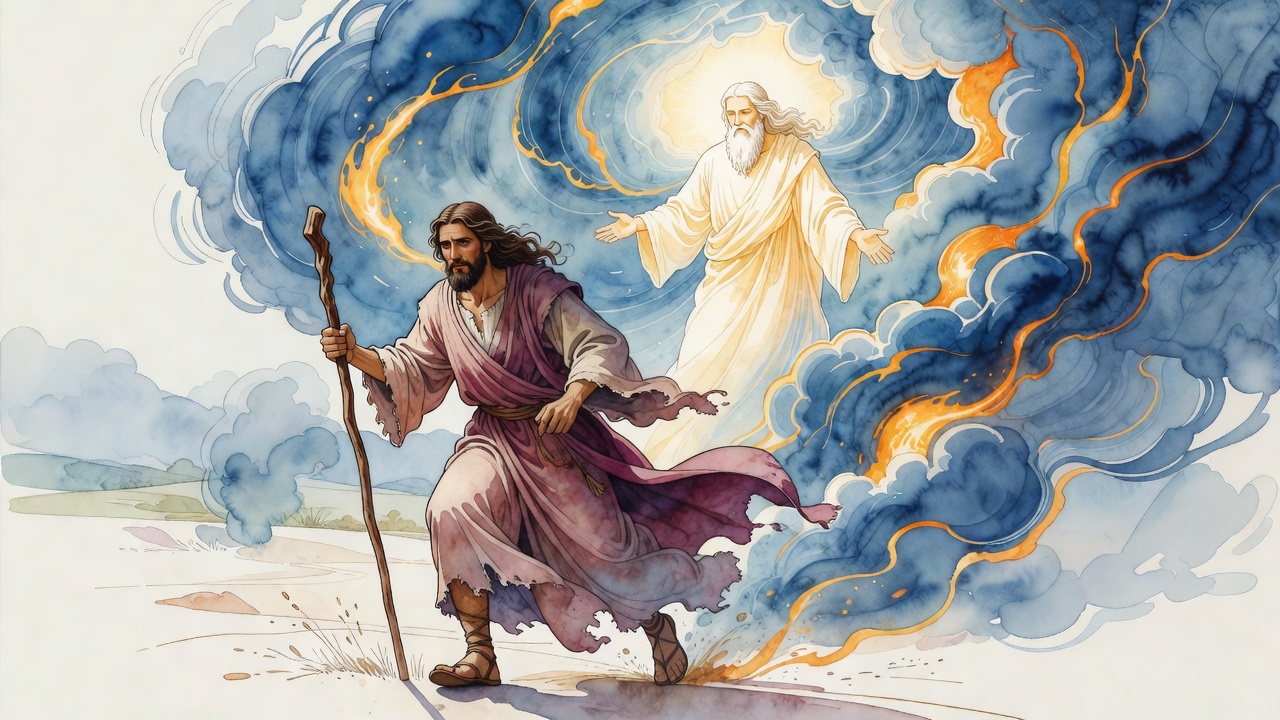
Jacob left home with a staff and a stone for a pillow. He returned from Padan-aram with flocks that made the road noisy and a face that had learned the cost of another man's grin.

God Blessed Jacob After Laban Changed Wages Ten Times Click for full size

Laban had changed his wages ten times. Mockery wore the mask of family. Jacob still labored with full strength, not as a sluggard waiting for pity.

The Call to Return

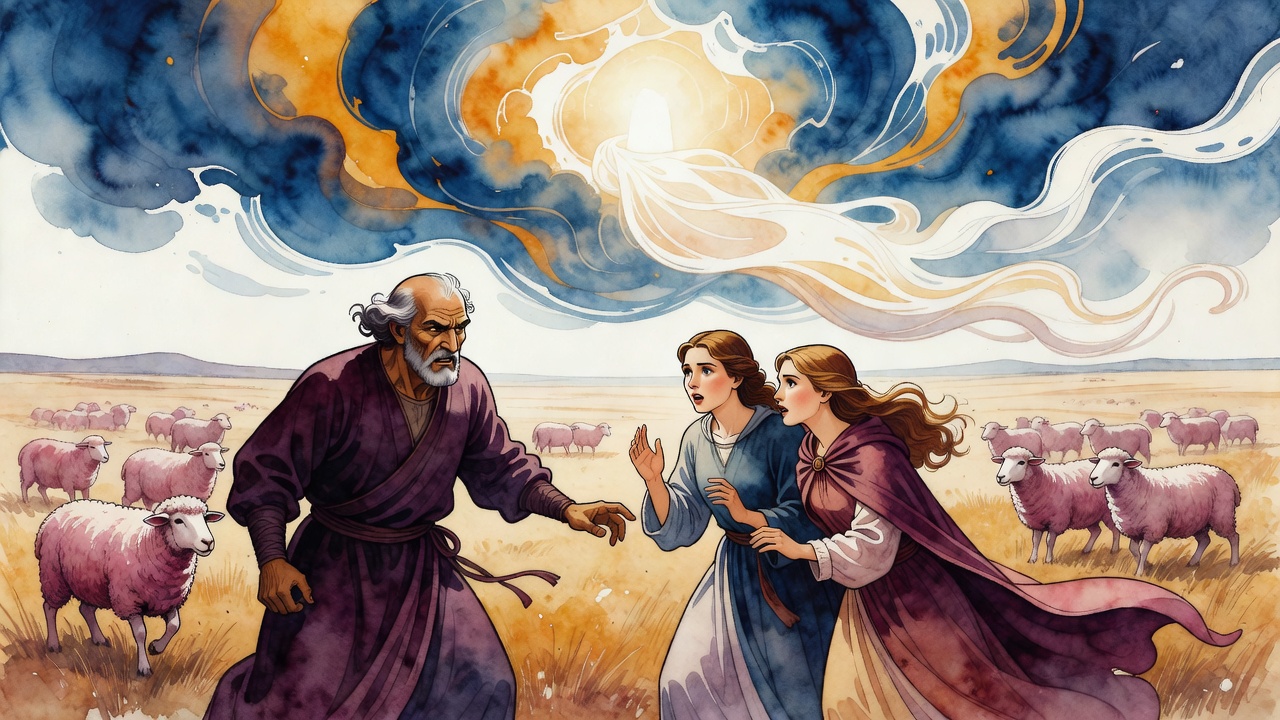
The word came while the goats still leaped streaked and spotted under a sky Jacob had begun to read like a contract. Return to the land of your fathers and to your kindred (Genesis 31:3). He called Rachel and Leah to the field and told them what their father's countenance had become. The house that had enriched him had also hunted him with small thefts dressed as business.

Good news can lift feet. The midrash remembers Jacob's steps lightened when purpose clarified. Fear of Esau still waited west, but the east had finished teaching him what a father-in-law's handshake is worth.

Staff Over the Jordan

With my staff I passed over this Jordan (Genesis 32:11). The sentence is inventory and testimony. Once, one stone under his head. No mattress. No cushion. Then the man increased exceedingly (Genesis 30:43). Why? The blessing of Abraham his father had placed on him, the blessing of being blessed in all things, worked through years of heat and frost while Laban smiled and recalculated.

Wealth did not erase the staff memory. It made the staff the first line of a ledger heaven would close in person.

God Appears Again and Blesses

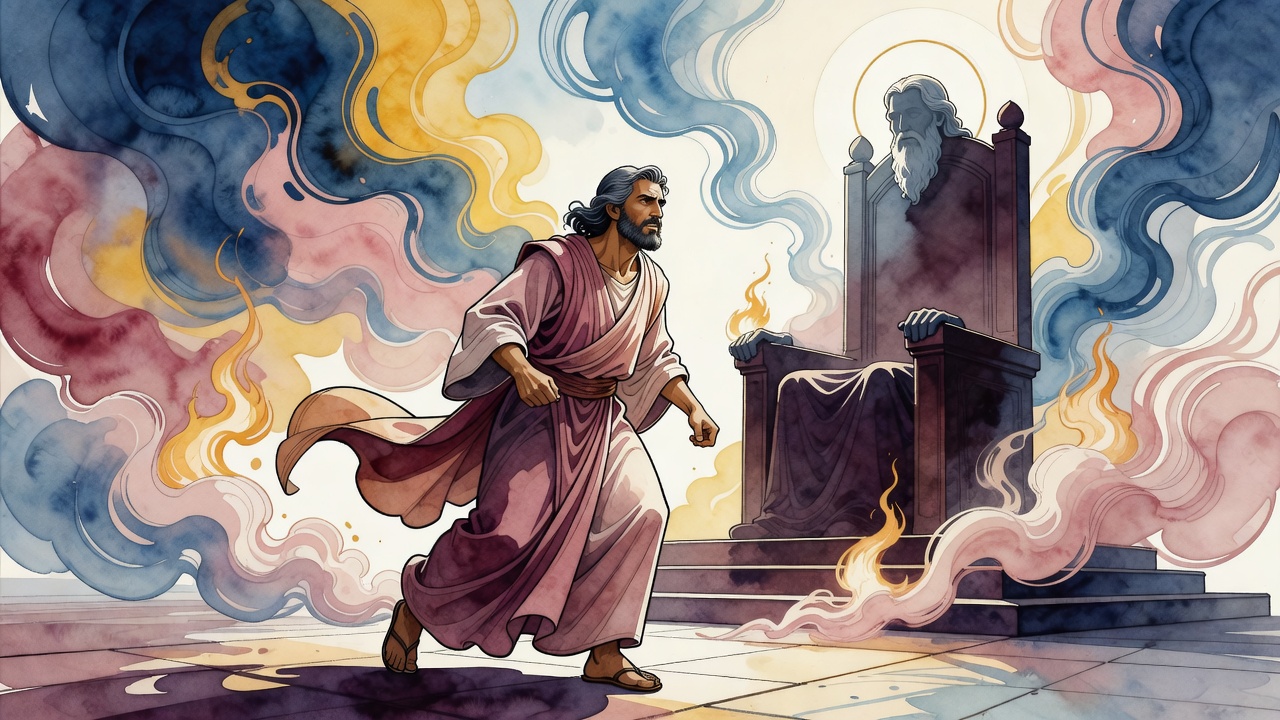
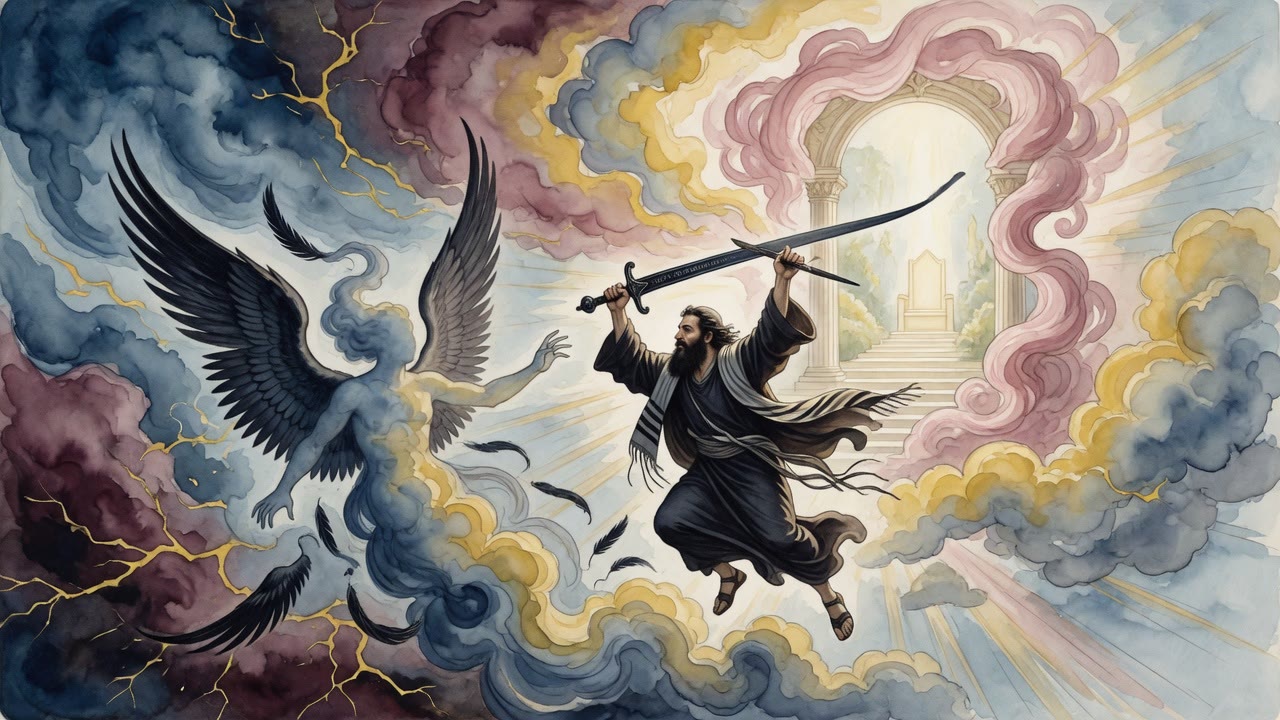
After the return from Laban's house, the Holy One said the time had come to bless Jacob directly. God appeared unto Jacob again when he came from Padan-aram and blessed him (Genesis 35:9). Not only through Isaac's mouth. Not only through a dream ladder. Appearance and blessing in the same breath.

Elsewhere the tradition sees God standing over Jacob with land-promise weight, a presence that does not borrow courage from distance. The man who once bargained for bread and clothing now stood under a sky that named him again.

Ladders of Rise and Fall

A lady once asked Rabbi Yose how long creation took and what God has done since. Six days, he said, and since then He erects ladders. One ascends, another descends. One grows rich, another poor. Jacob's own life was the parable walking. Staff, then abundance. Fear, then blessing. Laban's house as a rung that scraped skin on the way up.

The same teaching warns the landowner who blocks the poor from gleaning. God can reverse heights. The Judge puts down one and lifts another (Psalms 75:8). Jacob knew both directions in one lifetime.

Paths of Mercy After the Fight

All the paths of the Lord are mercy and truth (Psalms 25:10). Clothing the naked, visiting the sick, burying the dead mark the Torah from end to end. Jacob's road after Padan still held Esau, still held the wound of a night struggle, still held sons who would one day sell a brother. The blessing did not cancel history. It claimed Jacob inside history.

He had left with a staff. He stood blessed under open sky. Between those two facts lay ten changed wages and a God who refused to let the last word belong to Laban.

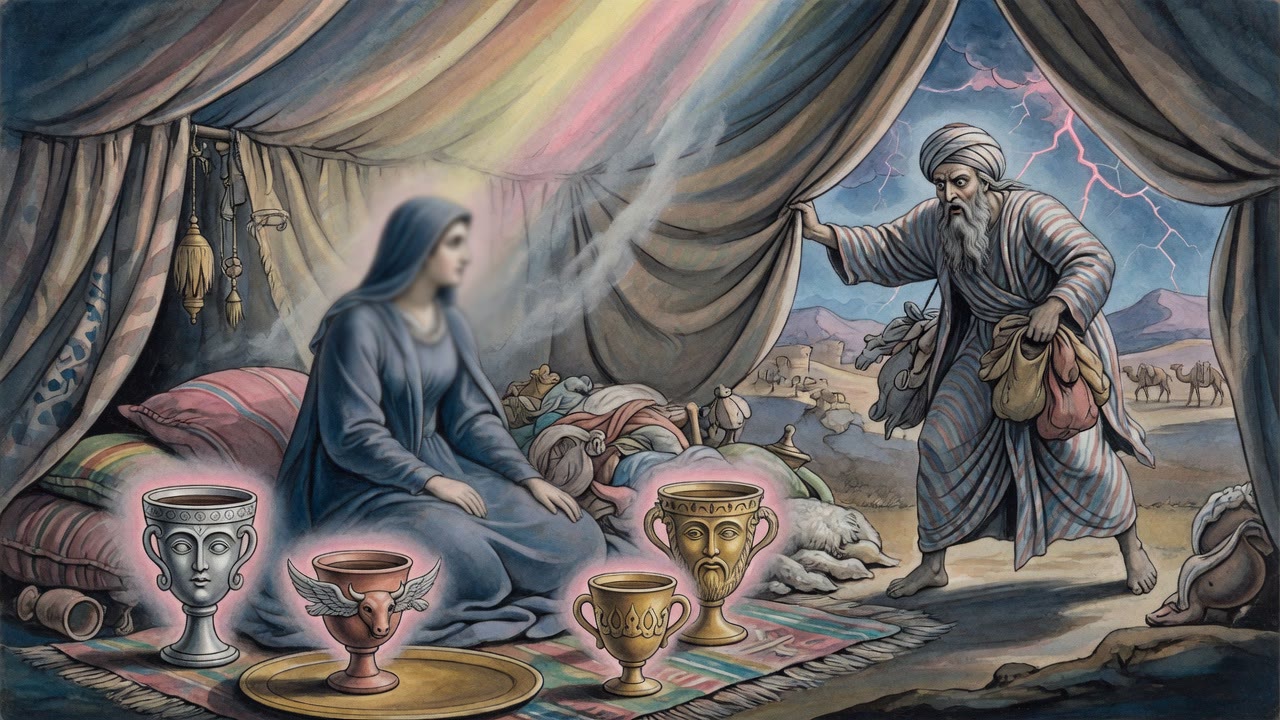
Rachel and Leah left with the flocks and the old grievances packed beside the tents. Laban pursued, still certain language could repossess what labor had earned. Jacob had already heard the return command. The staff that once crossed the Jordan alone now crossed with sons and noise. When God appeared and blessed him after Padan-aram, the blessing did not erase Esau on the road ahead. It placed a seal on the years Laban tried to meter out in cheated wages.

Jacob bowed under that seal the way a man bows under a load he asked for. Staff, stone, wages, appearance. The ladder still rose and fell, but the top rung had spoken his name again.

Ten changes of wages is not a business dispute. It is a relative inventing new ways to keep a son-in-law unpaid while still smiling at the feast. Jacob's strength in the heat and frost was his answer before the return command ever came. He worked as if the blessing of Abraham were already a contract heaven intended to honor.

When God appeared after Padan-aram, the blessing closed Laban's chapter without needing Laban's apology. Jacob still had to face Esau. He still had to limp from a night of wrestling. The appearance did not flatten the road. It marked who owned the end of the eastern exile. Staff at the Jordan. Flocks on the return. Voice in the open. That was the ledger.


← All myths

From the tradition

Sources

4 sources

The texts behind this telling. Some cards carry a translation of the source; others are our own retelling of it, and each card says which. Every card links out to the original.

Midrash Tanchuma, Vayetzei 11Midrash Tanchuma

Retold in our words. Read the original at the link below.Townsend 1989 translation of Midrash Tanhuma, S. Buber Recension · CC-BY

Return unto the land of thy fathers, and to thy kindred (Gen. 31:3). What is written above concerning this? Lift up now thine eyes, and see, all the he-goats which leap upon the flock are streaked (ibid., v. 12), and it is also written there: And Jacob sent and called Rachel and Leah to the field unto his flock, and said unto them: “I see your father’s countenance,” etc. (ibid., vv. 4–5). This teaches us that he was not slothful, but that he labored with all his strength.

And your father hast mocked me, and changed my wages ten times (ibid., v. 7). What is meant by ten times (aseret monim), and why is the (usual) word pe’amin not used instead of monim? R. Abba said: Ten monim actually indicates one hundred times, that is, ten times ten. R. Hiyya stated: It was actually a thousand times, ten times a hundred.

He would change his wages in the following manner. If he said thus: The speckled shall be thy wages; then all the flock bore speckled; and if he said thus: The streaked shall be thy wages; then bore all the flock streaked (ibid., v. 8). When Laban saw that they changed from streaked to speckled, and from speckled to streaked, he cried out: “Is there a God or not?” That is to say, Laban asked: “Did God do this or not?”

What did Laban do when the sheep conceived? He would tell Jacob: “This kind shall be yours,” and whatever kind he mentioned would be born, for the Holy One, blessed be He, changed the streaked to speckled and the speckled to streaked, as it is said: And he changed my wages ten times. Laban reversed his decision so that none would belong to Jacob. And so, after Laban had made his final decision, the Holy One, blessed be He, would tell the angel: Let them be born in accordance with his last decision. Thus Scripture says: But God suffered him not to hurt me (ibid., v. 7).

What did they respond after Jacob told them this? Rachel and Leah answered and said unto him: “Is there yet any portion or inheritance for us in our father’s house? Are we not accounted by him strangers? For he hath sold us” (Gen. 31:14–15).

And Jacob outwitted Laban (ibid., v. 20), so that Laban would not become incensed with him: Then Jacob arose, and set his sons and his wives upon camels … and carried away all his cattle…. And it was told Laban on the third day that Jacob had fled. And he took his brethren with him, and pursued after him (Gen. 31:17–18, 23). The Holy One, blessed be He, immediately appeared before him and slit his ear.

Full source
Midrash Tanchuma, Vayishlach 10Midrash Tanchuma

Retold in our words. Read the original at the link below.Townsend 1989 translation of Midrash Tanhuma, S. Buber Recension · CC-BY

And God appeared unto Jacob again, when he came from Padan-aram (Gen. 35:9). May it please our master to teach us: What is the punishment meted out to one who does not permit the poor to glean from his field? Thus do our masters teach us: One who does not allow the poor to glean from his field, or permits one and not another, or assists one of them at the time of reaping or harvesting, is considered guilty of robbing the poor. Concerning this it is said: Remove not the landmark of old ('olam) (Prov. 22:28). This should be read as “landmark of the poor” (olim).

The Holy One, blessed be He, said: I have exalted you and have humbled the poor, but I am also able to humble you and exalt the poor, for I am the Judge, as it is said: For God is judge; He putteth down one and lifteth up another (Ps. 75:8).

A lady asked of R. Yosé the son of Halafta: “In how many days did the Holy One, blessed be He, create the world?” “In six days,” he replied, “as it is written: For in six days the Lord made heaven and earth (Exod. 20:1).” “What has He been doing since then?” she asked. “He has been erecting ladders,” he answered, “upon which one ascends and another descends; one becomes wealthy and the other poor.” You know this to be so from the fact that it is written with reference to Jacob’s going to Aram-naharaim: With my staff I passed over this Jordan (Gen. 32:11). And he took one of the stones of that place and put under his head (ibid. 28:11). Surely, if he had owned a mattress or a cushion he would have placed them under his head, yet after he joined Laban’s household he became wealthy, as is said: And the man increased exceedingly (ibid. 30:43). Why did he become wealthy? Because of the power of the blessings his father had bestowed upon him, as it is said: And give thee the blessing of Abraham (ibid. 28:4). What was Abraham’s blessing? And the Lord blessed Abraham in all things (ibid. 24:1). After his return from Laban’s house, the Holy One, blessed be He, said: Now I must bless him Myself. Immediately, the Holy One, blessed be He, appeared before him and blessed him, as it is said: And God appeared unto Jacob again, when he came from Padan-aram, and blessed him (ibid. 35:9).

And God appeared unto Jacob. Scripture states elsewhere in allusion to this verse: All the paths of the Lord are mercy and truth (Ps. 25:10). When Moses commanded the Israelites: After the Lord your God shall ye walk (Deut. 13:5), he added the words: Walk ever in his ways (ibid. 19:9). “How can one possibly walk in His ways?” they inquired, since it is written: The Lord, in the whirlwind and the storm is His way, and the clouds are the dust of His feet (Neh. 1:3), and Thy way was in the sea, and Thy path in the great waters, and Thy footsteps not known (Ps. 77:20), and A fire devoureth before Him, and round about Him it stormeth mightily (Ps. 50:3). Moses replied to the Israelites: “Have I not informed you also that His ways are ways of mercy, truth, and loving-kindness,” as it is written: All the paths of the Lord are mercy and truth (ibid. 25:10).

Deeds of loving-kindness are mentioned at the beginning of the Torah, in its middle, and at its conclusion. At the beginning of the Torah, the naked are clothed, as it is said: The Lord God made for Adam and his wife garments of skin, and He clothed them (Gen. 3:21); in the middle of the Torah, the ailing are visited, as it is said: And God appeared unto him in the grove of Mamre (ibid. 18:1); and at the conclusion of the Torah, the dead are buried, as is said: And he was buried in the valley in the land of Moab (Deut. 34:6). In this way you must walk in the ways of the Holy One, blessed be He.

The Holy One, blessed be He, declared: In this world you sin because of the evil inclination within you, and therefore you are subservient to other nations. Nevertheless, My Shekhinah (the Divine Presence) will not depart from you, as it is said: In all their afflictions He was afflicted (Isa. 63:9). In their rejoicing, He rejoiced, as is said: Because I rejoice in Thy salvation (I Sam. 2:1). And He also said: I will rejoice in Jerusalem and rejoice in My people (Isa. 65:49). And it says also: And as the bridegroom rejoiceth over the bride, so shall thy God rejoice over thee (ibid. 62:5). Hence, all the paths of the Lord are mercy and truth.

Full source
Bereshit Rabbah 69:1Bereshit Rabbah

Retold in our words. Read the original at the link below.The Sefaria Midrash Rabbah, 2022 · CC-BY

It all starts with a dream. Jacob, fleeing his brother Esau, lays down to sleep, using a stone as a pillow. And he has a vision. A ladder stretching to heaven, angels ascending and descending, and then…God Himself, standing right there. “And, behold, the Lord was standing over him, and said: I am the Lord, God of Abraham your father, and God of Isaac. The land upon which you lie, to you I will give it, and to your descendants” (Genesis 28:13).

What does it mean, “the Lord was standing over him?" Bereshit Rabbah, a classic collection of rabbinic interpretations of Genesis, dives deep into this moment. Rabbi Yosei bar Zimra kicks things off by connecting this vision to a verse from Psalms: “My flesh yearns for You, in a parched and thirsty land without water” (Psalms 63:2). That feeling of being utterly parched, not just physically, but spiritually.

Rabbi Elazar, quoting Rabbi Yosei bar Zimra, takes it even further. He says, “My soul thirsts for You…yearns [kama] for You” (Psalms 63:2) – like these truffles that long for water. Truffles! Those rare, earthy delicacies that grow underground, constantly seeking moisture. It's a beautiful analogy for the soul's relentless search for connection with the Divine. A truffle, hidden in the darkness, instinctively reaching for life-giving water. Is that not a perfect metaphor for our own spiritual hunger?

It doesn’t stop there. The Rabbis in Bereshit Rabbah add that it’s not just our soul that thirsts, but all our two hundred and forty-eight limbs. Every part of us, every fiber of our being, is yearning for God. Where does this yearning take place? “In a parched and thirsty land without water.” A place of emptiness, of longing. A place that sounds a lot like…life sometimes.

The verse in Psalms continues: “Indeed, in the Sanctuary I have seen You” (Psalms 63:3) – in sanctity I have seen You; “beholding Your power” (Psalms 63:3) – this is Your entourage; “and Your glory” (Psalms 63:3) – “and, behold, the Lord was standing over him.” So, the Psalmist's experience of seeing God in the Sanctuary, of beholding His power and glory, is directly linked to Jacob's vision. The "Lord standing over him" isn't just a visual image; it's an experience of divine presence that answers that deep, primal thirst.

What does all this mean for us today? Perhaps it's a reminder that the yearning itself is sacred. That the feeling of being lost, of being parched, is not a sign of failure, but an invitation. An invitation to seek, to thirst, to connect with something bigger than ourselves. And maybe, just maybe, in that moment of deepest longing, we too will glimpse the Divine standing right there, above us, within us, ready to offer the waters of life.

Full source
Bereshit Rabbah 70:8Bereshit Rabbah

Retold in our words. Read the original at the link below.The Sefaria Midrash Rabbah, 2022 · CC-BY

There's something to that. In fact, the rabbis saw that connection way back when.

We find ourselves in (Genesis 29:1), where it says, "Jacob lifted his feet, and went to the land of the people of the east.” But the rabbis of Bereshit Rabbah, that incredible collection of interpretations on the book of Genesis, saw something deeper. Rabbi Aḥa points to (Proverbs 14:30), "A healing heart is the life of the flesh." He suggests that when someone receives good news – shenitbaser besorot – their heart literally carries their feet. It’s as if the joy itself propels them forward. The stomach, he says, bears the feet. Isn't that a beautiful image?

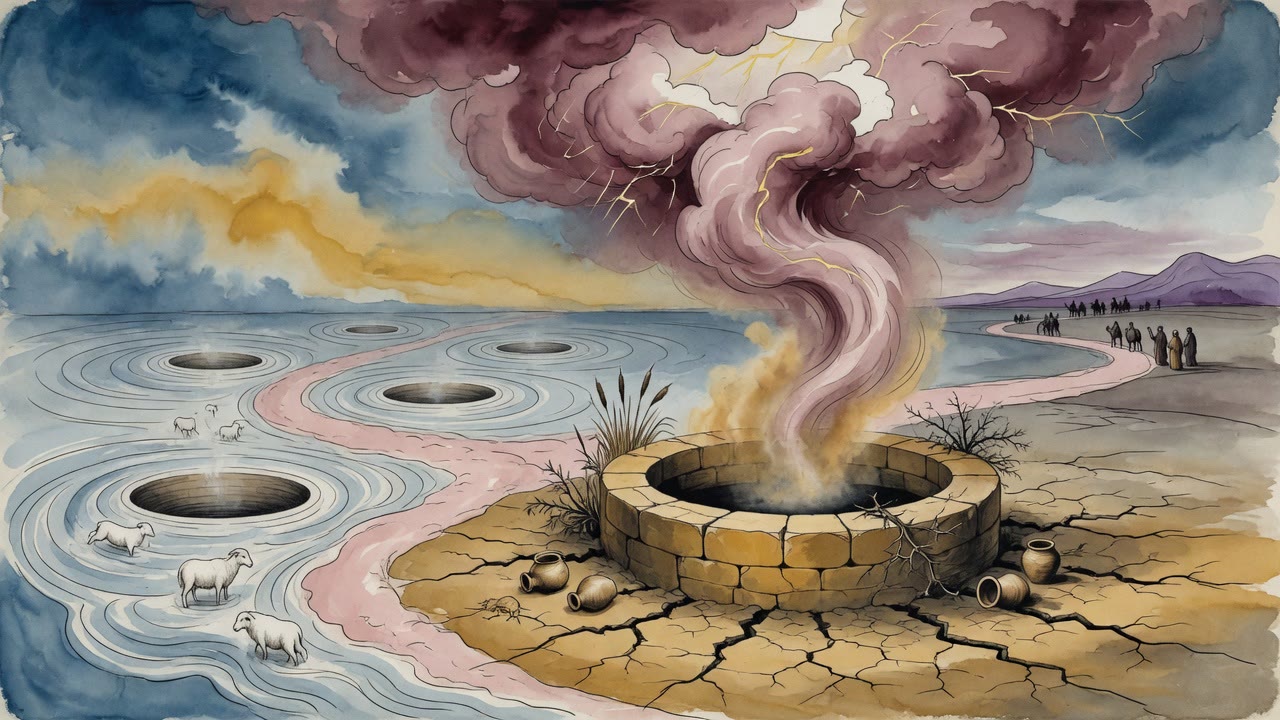
Then, Jacob sees a well. (Genesis 29:2) tells us, "He saw, and behold, a well in the field, and, behold, three flocks of sheep lying there alongside it, since from that well they watered the flocks and the great stone was on the mouth of the well.” And just one verse later: "All the flocks would gather there, they would roll the stone from the well’s mouth, and water the sheep, and return the stone onto the well’s mouth in its place."

Rabbi Ḥama bar Ḥanina, in Bereshit Rabbah, bless his heart, doesn't just see a well. He sees layers and layers of meaning. He interprets this single image in six different ways!

First, he says, the well is the well. You know, the one that miraculously accompanied the Israelites in the desert after the Exodus. The three flocks? Those are Moses, Aaron, and Miriam. The watering of the flocks represents how each leader drew water – wisdom, sustenance, guidance – for their banner, their tribe, their family. And that great stone? It was small, really, the size of a sieve. But it was "great" because of the miracle it represented. The gathering of the flocks? The times of encampment. And the returning of the stone? That was how things were during their journeys.

But wait, there's more!

Rabbi Ḥama bar Ḥanina doesn't stop there. He sees the well as Zion, Jerusalem. The three flocks become the three pilgrimage festivals – Pesach (Passover), Shavuot (Weeks), and Sukkot (Tabernacles). The water they draw is the Divine Spirit, and the great stone is the Celebration of the Place of the Drawing of the Water. As Rabbi Hoshaya explains, they called it the "Place of the Drawing" because they drew the Divine Spirit from there. All the flocks gathering? People coming from all over, from Levo Ḥamat in the north to the Ravine of Egypt in the south. And rolling the stone? That's drawing the Divine Spirit. Returning the stone? Putting it back for the next festival.

He keeps going! The well is Zion again, but this time the three flocks are the three courts: one on the Temple Mount, one at the entrance of the courtyard, and one in the Chamber of Hewn Stone. They hear the ruling from this "well," and the great stone is the High Court. The flocks gathering are the courts in the Land of Israel, rolling the stone is hearing the ruling, and returning it is deliberating until they establish it properly.

And again: the well is Zion; the flocks are the first three kingdoms (Babylon, Persia, and Greece) that ruled over Israel when there was a Temple. They got wealthy, he says, from the consecrations in the chambers. The great stone is the merit of the patriarchs. The Roman Empire is all the flocks gathering, and they got wealthy from those same consecrations. But in the future, he says, the merit of the patriarchs will prevail.

Rabbi Ḥama bar Ḥanina is on a roll! Now the well is the Sanhedrin, the ancient rabbinic court. The three flocks are the three rows of students sitting before them, hearing the halakha, the Jewish law. The great stone is the most distinguished member of the Sanhedrin, analyzing the law. The flocks gathering are the Torah scholars in the Land of Israel, rolling the stone is hearing the halakha, and returning the stone is deliberating until they establish it properly.

Finally, the well is the synagogue; the flocks are the three people called to the Torah on Mondays, Thursdays, and Shabbat (the Sabbath) afternoons. They hear the Torah from the well, and the great stone is the evil inclination, the yetzer hara (the evil inclination). The congregation is all the flocks gathering, rolling the stone is hearing the Torah, and returning the stone is the evil inclination returning to its place when they leave. Hearing Torah keeps the evil inclination in check, he says.

Six interpretations! All from one little verse about a well.

What does it all mean? It means that our tradition sees layers of meaning everywhere. A simple image can be a gateway to understanding our history, our spirituality, and ourselves. And sometimes, all it takes is a little good news to lift our feet and carry us forward.

Full source