Parshat Vayetzei4 min read

Laban's Gods Turned to Cups in Rachel's Tent

Jacob named every clause before he served for Rachel. Years later Laban hunted stolen teraphim. In Rachel's tent the idols became ordinary cups.

Curated by Arthur · Told by Maggid ·
Table of Contents
  1. Every Clause Before the Seven Years
  2. Shearing Season and the Quiet Exit
  3. My Gods, Said the Old Man
  4. The Heap of Witness
Laban's Gods Turned to Cups in Rachel's Tent Click for full size

Every Clause Before the Seven Years

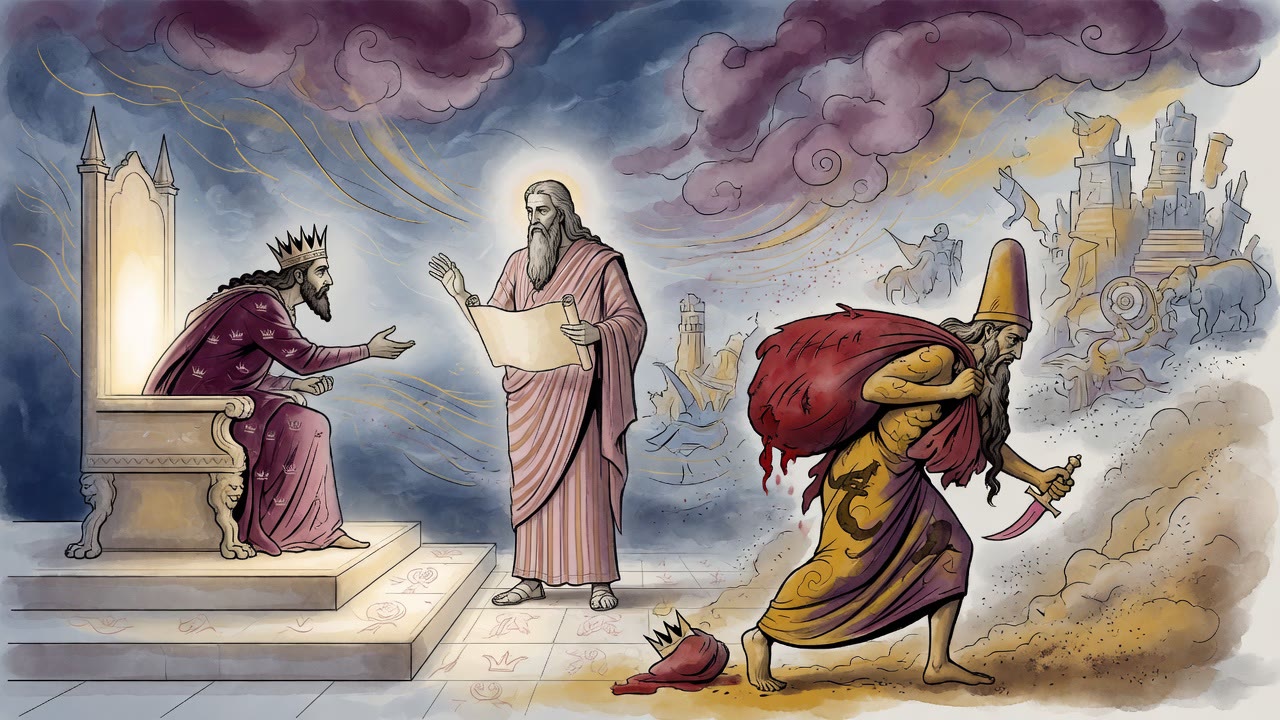
Jacob arrived wanting Rachel and knowing Laban's knavery. He named every clause. Seven years for Rachel not Leah, for the daughter, for the younger, so names could not swap. Clarity was armor with seams.

Night put Leah under the veil. Morning did the rest. Jacob worked on. Children came. Flocks shifted by rods and bargaining. The God of his fathers fattened speckled and spotted until Laban's face fell.

Shearing Season and the Quiet Exit

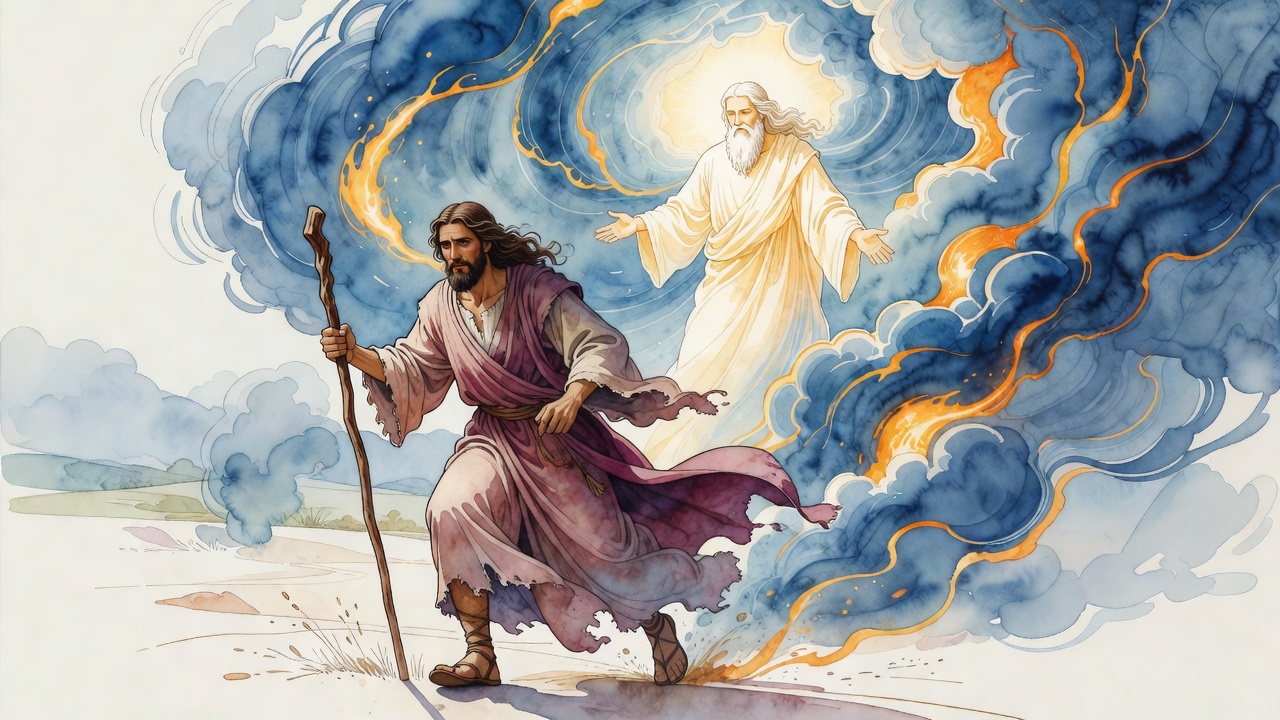
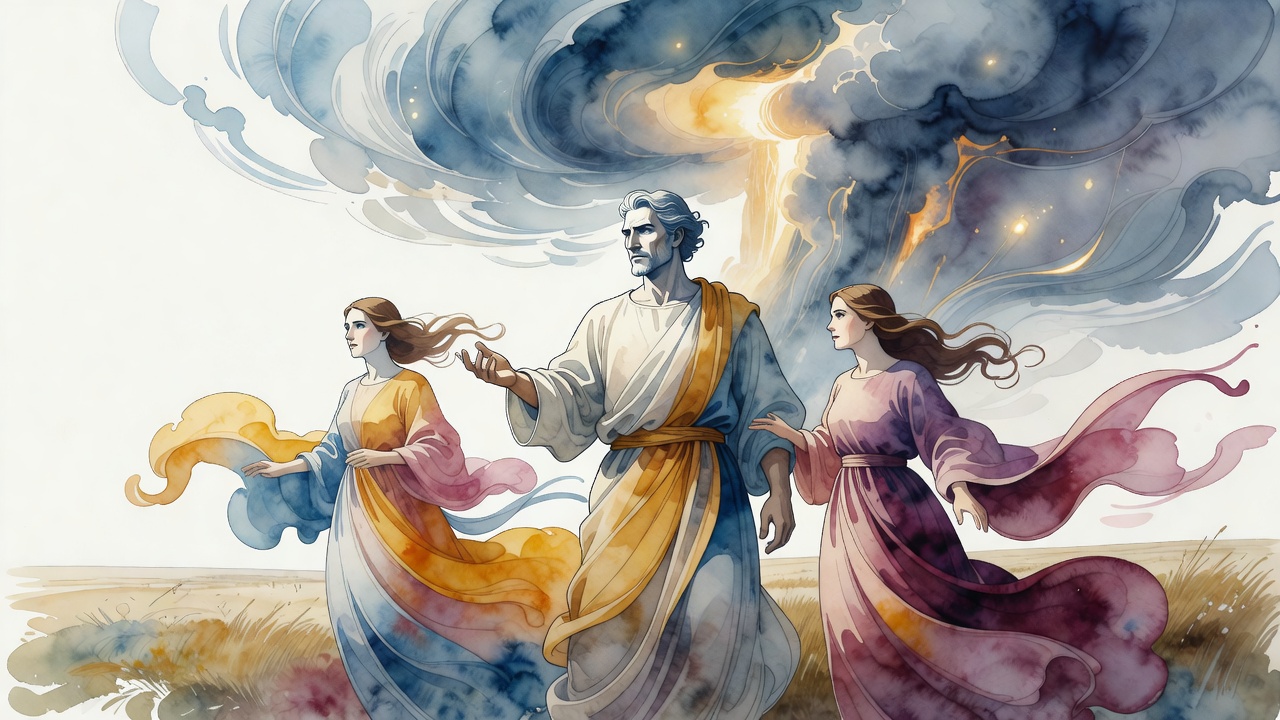
When Laban sheared sheep, Jacob called Leah and Rachel kindly and told a dream. God said return to his father's house. They left with children, cattle, and teraphim in Rachel's keeping.

Whether inheritance claim or protest, the weight started a chase when Laban found empty shelves where gods had stood. Silence was Rachel's strategy. Camels walked. Padan-aram missed flocks and idols.

My Gods, Said the Old Man

Laban raged, ending on why steal my gods. Grandchildren were ashamed an old man still said my gods. He searched tent by tent and found nothing.

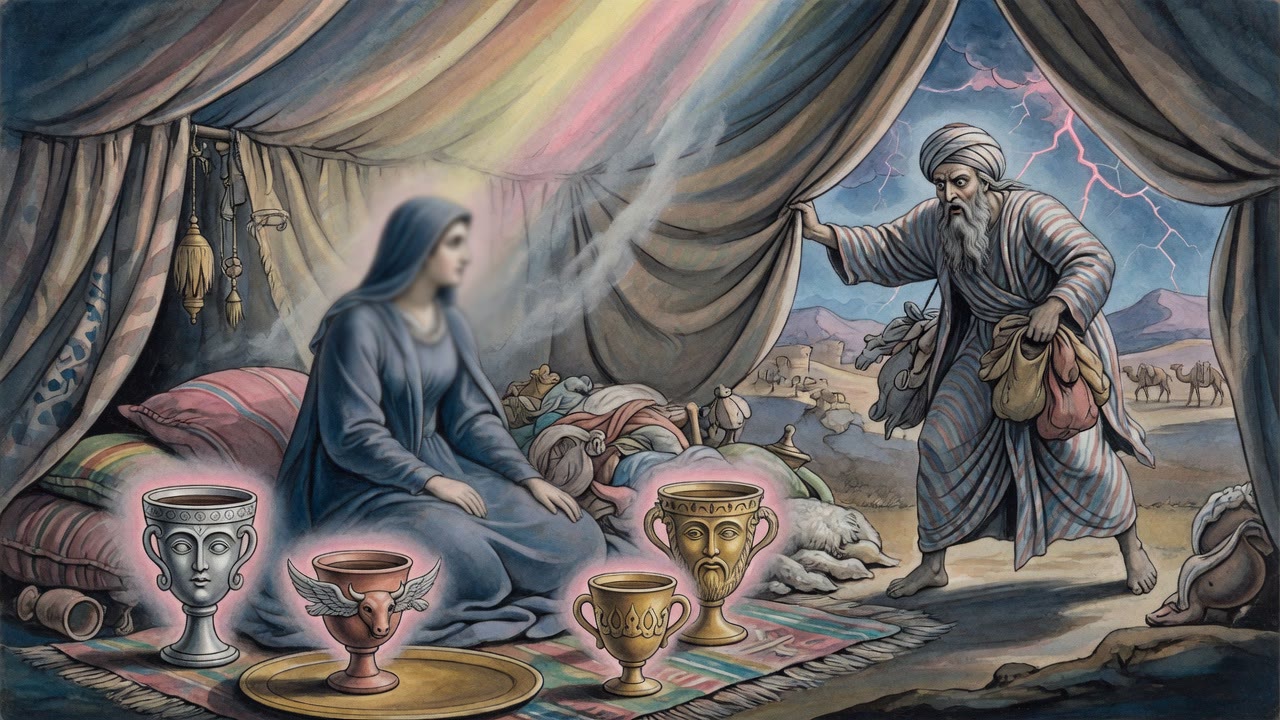
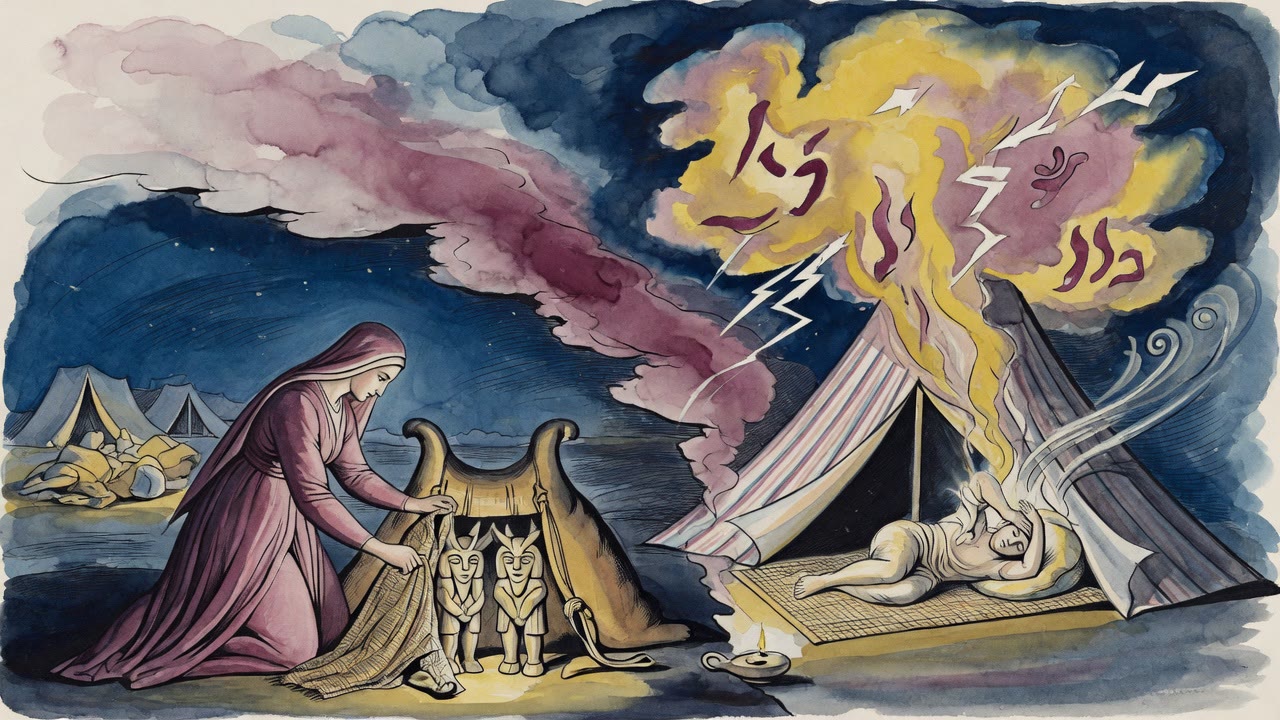
In Rachel's tent the teraphim became ordinary drinking vessels. Laban left empty-handed. Jacob had sworn dangerously in ignorance. Divine pity changed substance rather than let the oath land mid-flight.

The Heap of Witness

They raised a heap of peace. Laban kissed daughters and turned back. Jacob faced Esau. Rachel carried silence of cups that had been gods.

Contracts had failed to stop knavery. God turned idols into cups. Flight can be obedience. Some gods only look solid until a woman on a camel needs them not found.

Hands that knew work found more work without being asked. A name was repeated until it became a decision. Night stacked itself against the hills and waited. They moved because standing still had already failed. Bread was broken with less ceremony than hunger preferred.

Fear walked at the edge of the company like a stray that would not be fed or driven off. Orders passed down the line and came back altered by hope. The sky did not comment. It only changed color. A rope frayed and was knotted again with more care than pride. Between one ridge and the next, a private prayer finished itself.

Old anger sat down beside new purpose and neither spoke first. The day thinned toward evening as if worn by use. Stone underfoot was honest. Flesh was more complicated. A promise made years earlier arrived on time and demanded payment. They counted their company and pretended the number was enough.

Wind turned a corner of a cloak into a flag for no nation. The last light caught on metal and made it look like a sign. Quiet returned in pieces, not all at once. A hand found another hand and did not let go until the path widened. Memory supplied what the eyes could not yet see.

Cattle lowed in the dark as if answering a name. No one claimed the whole story. Everyone claimed a piece. Even the animals seemed to listen for a signal. Footsteps multiplied until they became a single sound. Water, when found, was rationed like silver.

On the road the cups, if they were still cups, made no sound. Rachel did not explain. Jacob did not ask the right question. The heap of stones behind them held a peace that would last only as long as both men valued grandsons more than grudges.

Padan-aram kept Laban's empty shelves as a joke the household would retell carefully. Canaan waited with a brother and a ford and a limp that had not yet been earned. Between knave contracts and miracle vessels, Jacob learned that the God of his fathers could be precise in ways no marriage clause could draft.

Clarity had been his armor at the start. Miracle was his rescue at the end. Neither canceled the years of shifted wages. Together they delivered him to the border with children, flocks, and a wife who knew how to sit on a secret until searchers left.


← All myths

From the tradition

Sources

3 sources

The texts behind this telling. Some cards carry a translation of the source; others are our own retelling of it, and each card says which. Every card links out to the original.

Legends of the Jews 6:119Legends of the Jews

Retold in our words. Read the original at the link below.The Legends of the Jews by Louis Ginzberg (1909) · Public Domain

Jacob certainly did when dealing with Laban. Laban wasn’t exactly known for his straightforward dealings.

We pick up the story of Jacob from Ginzberg's Legends of the Jews, and he's finally ready to marry Rachel. After all the drama with Esau, he's found a semblance of peace, and hopefully love, with Laban's family. But he's heard things about Laban...he's been warned. He knows he needs to be extra careful.

So, when it comes time to make the agreement for his marriage, Jacob leaves absolutely nothing to chance. He knows that Laban isn't above pulling a fast one.

"I know that the people of this place are knaves," Jacob says, according to Legends of the Jews, "therefore I desire to put the matter very clearly to thee." He's not beating around the bush, is he?

He continues, laying out the terms: "I will serve thee seven years for Rachel, hence not Leah; for thy daughter, that thou bringest me not some other woman likewise named Rachel; for the younger daughter, that thou exchangest not their names in the meantime."

Wow. Talk about covering all your bases! He's basically saying: I want this Rachel, not that Rachel, not someone pretending to be Rachel. And just to be clear, don't swap the names around either.

It's almost comical in its specificity. But you can feel Jacob's anxiety, can't you? He's so desperate to finally have what he wants, to marry the woman he loves, that he's willing to go to these extreme lengths. He anticipates deception. He knows he can't trust Laban to be honest without being held to the most precise agreement.

How much does trust – or lack thereof – shape our interactions? And how often do we find ourselves spelling things out, just to be sure? Perhaps Jacob's meticulousness is a lesson: sometimes, clarity is the greatest form of protection.

Full source
Legends of the Jews 6:158Legends of the Jews

Retold in our words. Read the original at the link below.The Legends of the Jews by Louis Ginzberg (1909) · Public Domain

The familiar story centers on Jacob working for Rachel's hand, being tricked into marrying Leah, and eventually leaving Laban to return to his homeland. But what about those little details.. like the stolen idols?

Laban, not one to let bygones be bygones, really laid into Jacob as he was leaving. According to Legends of the Jews by Louis Ginzberg, Laban really went for the jugular, ending his rant with a pointed accusation: "And now, though thou wouldst needs be gone, because thou sore longedst after thy father's house, yet wherefore hast thou stolen my gods?"

It’s tense, emotions are running high, and suddenly..Laban's own grandchildren chime in! "We are ashamed of thee, grandfather," they supposedly said, "that in thy old age thou shouldst use such words as 'my gods.'"

Laban, undeterred, begins his search. He hunts through all the tents, starting with Jacob's, which, interestingly, also served as Rachel's. Ginzberg points out that Jacob always lived with his favorite wife. A small detail, perhaps, but it speaks volumes about the dynamics within that family.

Finding nothing in Jacob's (and Rachel's) tent, Laban moves on to Leah's tent and then to the tents of the two handmaids. And then, he notices something. Rachel, in her tent, is "feeling about here and there." Suspicion ignited, Laban re-enters her tent.

This is where things get really interesting. He's about to find the teraphim (household idols), the objects of his search, when...a miracle occurs! The teraphim are transformed into ordinary drinking vessels! Laban, completely unaware of the divine intervention, is forced to abandon his search.

It makes you wonder: what was the significance of these teraphim? Why did Rachel steal them? Were they just valuable objects, or did they hold some deeper spiritual or cultural significance? We don't get a complete answer here. What we do have is a brief glimpse into the anxieties of a family and a moment when the divine seems to act in a surprising and somewhat whimsical way.

This short passage reminds us that even in the grand narratives of the Bible, there are often hidden stories, small moments of intrigue, and glimpses of a world where the line between the ordinary and the miraculous is wonderfully blurred. What other hidden stories are waiting to be uncovered?

Full source
Book of Jubilees 29:5Book of Jubilees

Retold in our words. Read the original at the link below.Sefaria Community Translation · CC-BY

Laban, his father-in-law, is off shearing sheep – a detail that might seem trivial, but remember, in those days, that was a big deal, a whole event. And Jacob? He senses a shift. He knows it's time to move on.

So, what does he do? He calls Leah and Rachel, his wives, to him. He speaks to them "kindly," the text emphasizes. It's not a demand, not an order. It's a heartfelt conversation. He shares with them the dream he had, a dream where He – meaning God – told him to return to his father's house.

Dreams, were incredibly important. They were considered a direct line to the Divine. As we find in numerous places, including the stories retold in Ginzberg's Legends of the Jews, dreams often carried divine messages, warnings, and guidance.

Their response? It’s simple, powerful, and speaks volumes about their bond. "To every place whither thou goest we will go with thee." No hesitation, no questions. Just unwavering loyalty and love. Can you imagine that kind of devotion?

Jacob, overwhelmed with gratitude, blesses "the God of Isaac his father, and the God of Abraham his father's father." He's acknowledging the generations of faith that have come before him, the covenant that binds him to his ancestors and to God. It's a beautiful moment of connection and recognition.

Then, the wheels are literally set in motion. Jacob "arose and mounted his wives and his children, and took all his possessions and crossed the river, and came to the land of Gilead." It’s a brisk, almost cinematic ending to the chapter. A whole family, their belongings, their dreams, all heading towards a new destiny.

It's a reminder that sometimes, the greatest journeys begin with a simple conversation, a shared dream, and the unwavering support of those we love. And perhaps, a gentle nudge from something bigger than ourselves.

Full source