The King's Executioner Put All Four Death Penalties on Himself
He rode for the king with a good horse under him and taunted his uncle about it. The answer that came back killed him before the day was out.
Table of Contents
 Click for full size
The Man Who Rode Ahead of the Condemned
He had the best job a man of his town could get. He rode a horse at the head of the king's business, out in front of the men going to be executed, and he was the nephew of Rabbi Yose ben Yoezer, who had no horse and no office and nothing but a name for keeping the commandments.
He rode over to his uncle to say so.
"Look at the animal under me," he said. "Some men are carried by a master who is gentle with them. Some men are carried by a master who is hard."
He meant the two of them. He had gone over to the king and he was mounted and armed and out in the sunlight; his uncle had gone over to God and had gotten a life of obligations and no horse at all.
One Sentence Went In
Yose ben Yoezer did not defend himself.
"If this is what God gives to the ones who anger Him," he said, "how much more to the ones who do His will."
The nephew heard it and pushed back. "And has anyone done His will more than you?"
"If this is what He gives to the ones who do His will," Yose said, "how much more to the ones who anger Him."
The words went into him. That is the phrase the source uses, that the thing entered him, and it entered the way poison enters, not the way an argument does. He had a sword on his hip and a horse and a commission from the throne, and he had just been shown, in two sentences, which side of that account he was standing on and what was going to be collected.
Four Deaths in a Single Afternoon
He did not go to a court. There would have been no charge to bring, and the court that could have brought one had no power over the king's man. So he became the court.
He planted a beam upright in the ground. He tied a cord to the top of it. He stacked wood underneath, built a low wall of stones around the whole arrangement, fixed a sword point up in the middle of it, and lit the fire.
Then he hanged himself from the beam. The cord gave way. He came down onto the sword and into the fire, and the stones came in over him. Strangling, beheading, burning, stoning. Four executions the court is permitted to impose, carried out on one man in one afternoon, by that man, on the strength of two sentences from an uncle he had ridden over to insult.
Why the Potter Only Knocks on the Strong Jars
Nobody had ever tested him. Rabbi Yonatan explained the principle with a potter. A potter does not go around knocking on his flimsy jugs, because he could not strike one of them a single time without breaking it. He knocks on the sturdy ones, and he knocks several times, and they hold. Rabbi Yosei ben Hanina said the same thing about flax. Good flax gets better the more you crush it and better still the more you beat it. Bad flax comes apart at the first blow, so nobody wastes a blow on it. Rabbi Elazar put it in a field. A man with two cows, one strong and one failing, does not stand there wondering which one gets the yoke.
God tests the righteous. He does not test the wicked, because there is nothing to learn from a jar that shatters. The nephew was never going to be knocked on. What reached him was not a test at all. It was a remark from a man walking on foot.
Twelve Months With the Door Shut
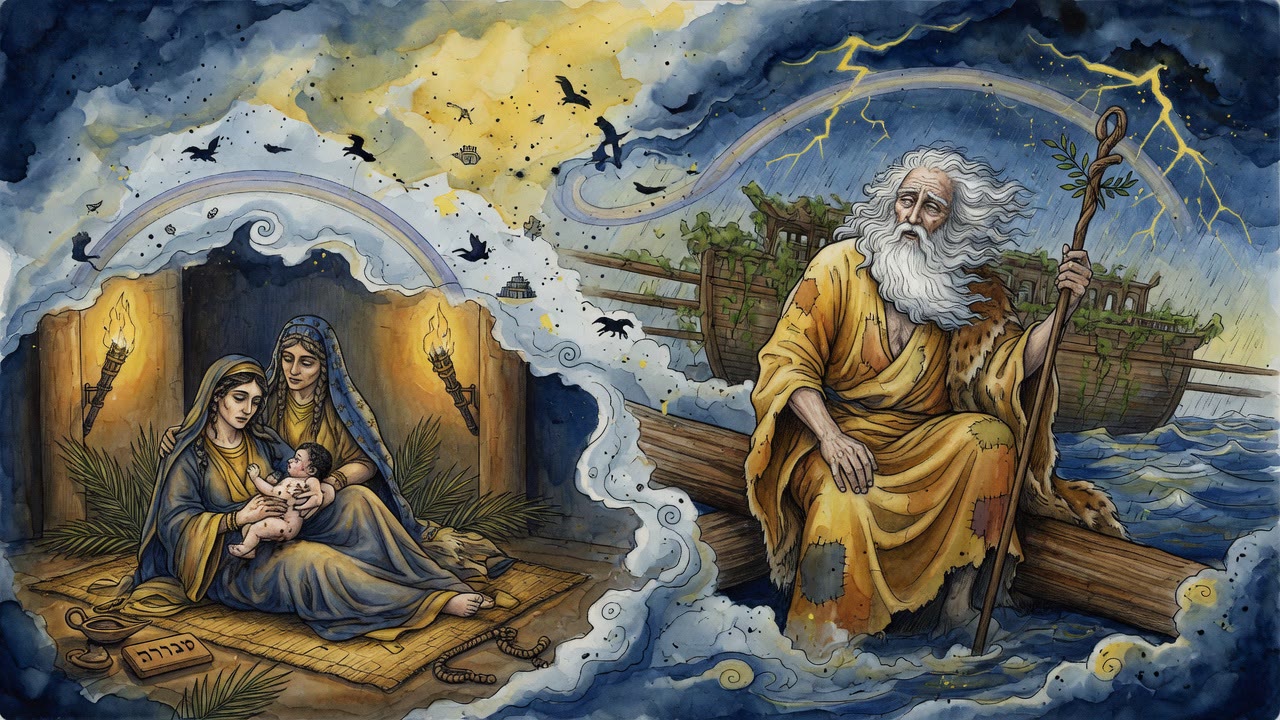
The ones God does knock on get Noah's arrangement. Noah was called righteous to his face, though only part of the praise was said in his hearing and the rest behind his back, which is the courtesy the sages kept. Then the door of the ark closed, and God was the one who closed it, and Noah stayed inside for twelve months while the world he had grown up in was taken apart outside the hull.
What he said in there was a prisoner's line. Release me from confinement, so that I can thank Your name. The righteous will crown You through me. Twelve months later God opened it and told him to come out, and that release is counted as a kindness done to him rather than a sentence served.
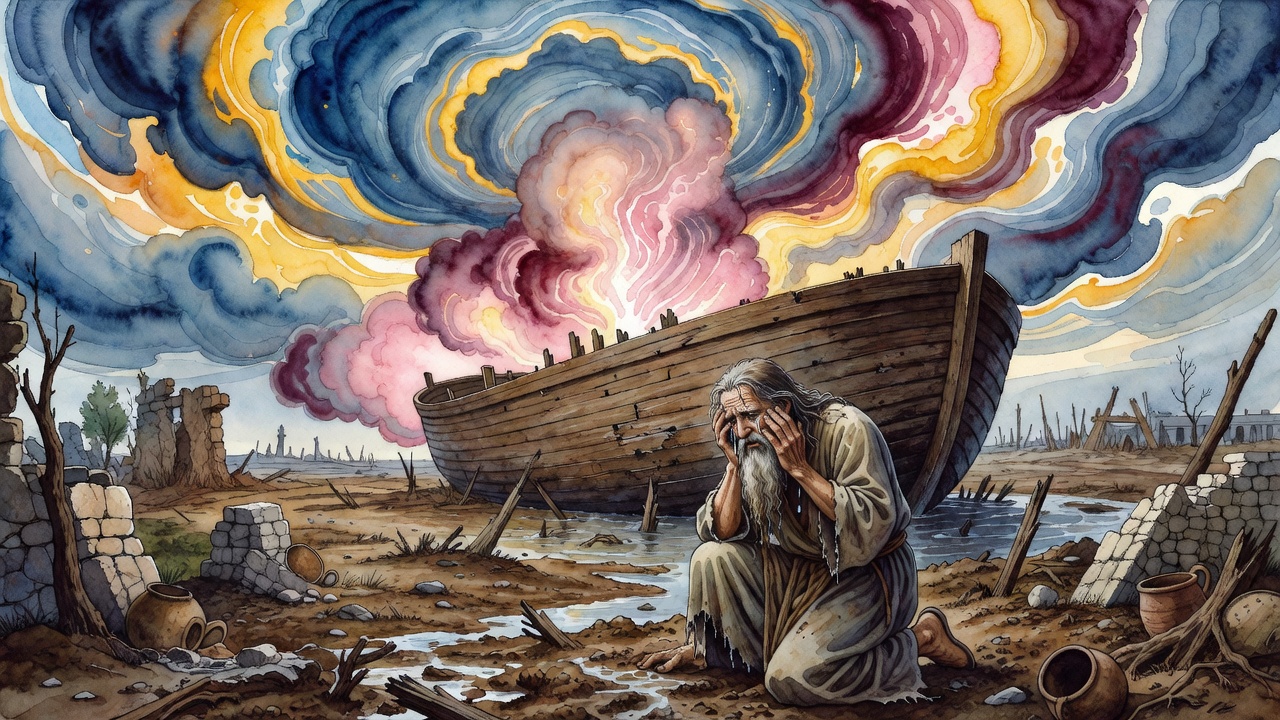
Every trade in the world resents the man across the street doing the same work, except two. A scholar loves the scholar who is beating him, the way Rabbi Hiyya and Rabbi Hoshaya kept handing each other pieces of the same argument. And God, whose trade is righteousness, is glad to see anyone else practicing it, which is why the verse about loving righteousness gets attached to a farmer standing in a ruined world with a boat behind him.
Yose ben Yoezer dozed off later and saw a bed floating past him in the air, and he understood what had been prepared, and where.
← All myths