5 min read

Why God Waited Twenty Generations to Find Abraham

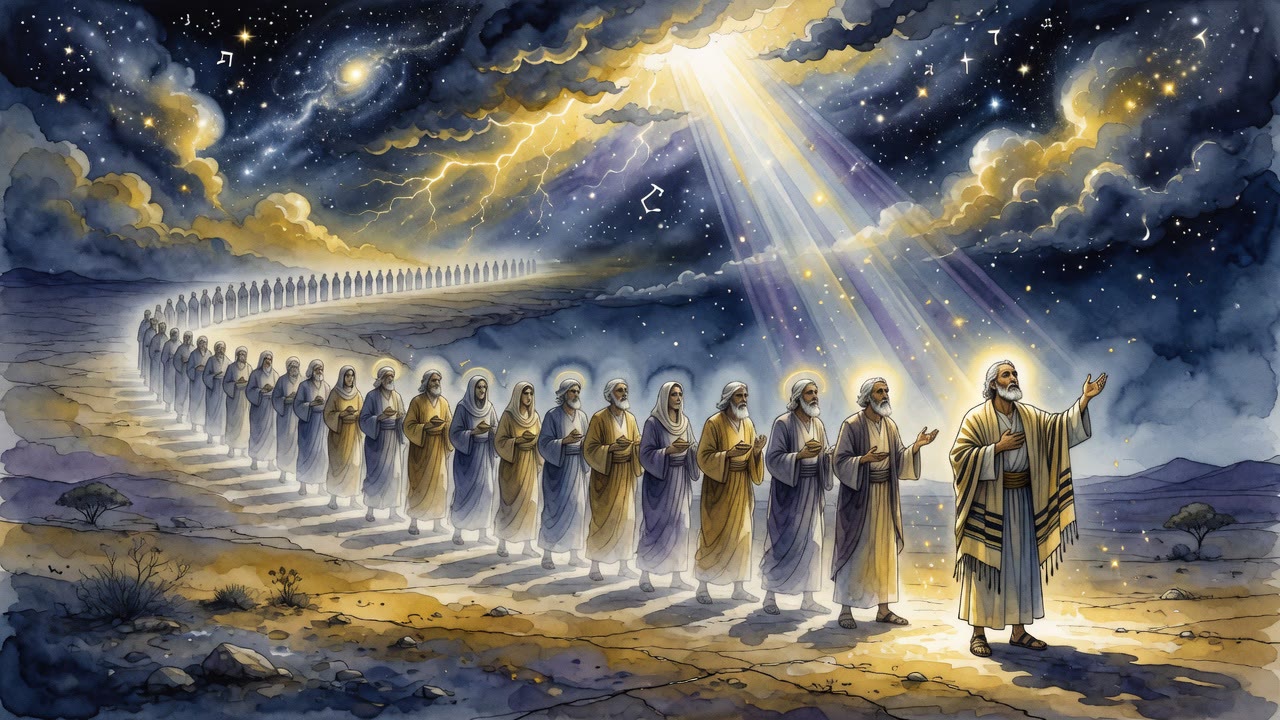
From Adam to Noah was ten generations. From Noah to Abraham was ten more. God spoke to only two men in all that time.

Curated by Arthur · Told by Maggid ·
Table of Contents
  1. Twenty Generations of Silence
  2. What Righteousness Means When No One Is Watching
  3. The Double Command
  4. What Philo Saw in the Covenant
  5. Why He Stopped at Ten

Twenty Generations of Silence

The genealogies in Genesis read like a list of missed opportunities. Adam begat Seth. Seth begat Enosh. Generation after generation, names and lifespans, and in almost all of them, nothing. No divine conversation. No call to go somewhere. No covenant. God created the world and then, by the measure of the Torah, spent ten generations barely speaking to it.

Then came Noah, and God spoke again. And after Noah, another ten generations of near-silence until Abraham. Rabbi Azarya, in Bereshit Rabbah, the Palestinian midrash on Genesis compiled in the 5th century CE, looked at this pattern and asked the obvious question: God's patience across all those generations was not indifference. It was something more intentional than that.

What Righteousness Means When No One Is Watching

The verse Rabbi Azarya quoted was from Psalms: you love righteousness and hate wickedness, therefore God has anointed you above your companions. The Psalm was not about Abraham. Rabbi Azarya applied it to Abraham anyway, because the structure it described matched his case exactly.

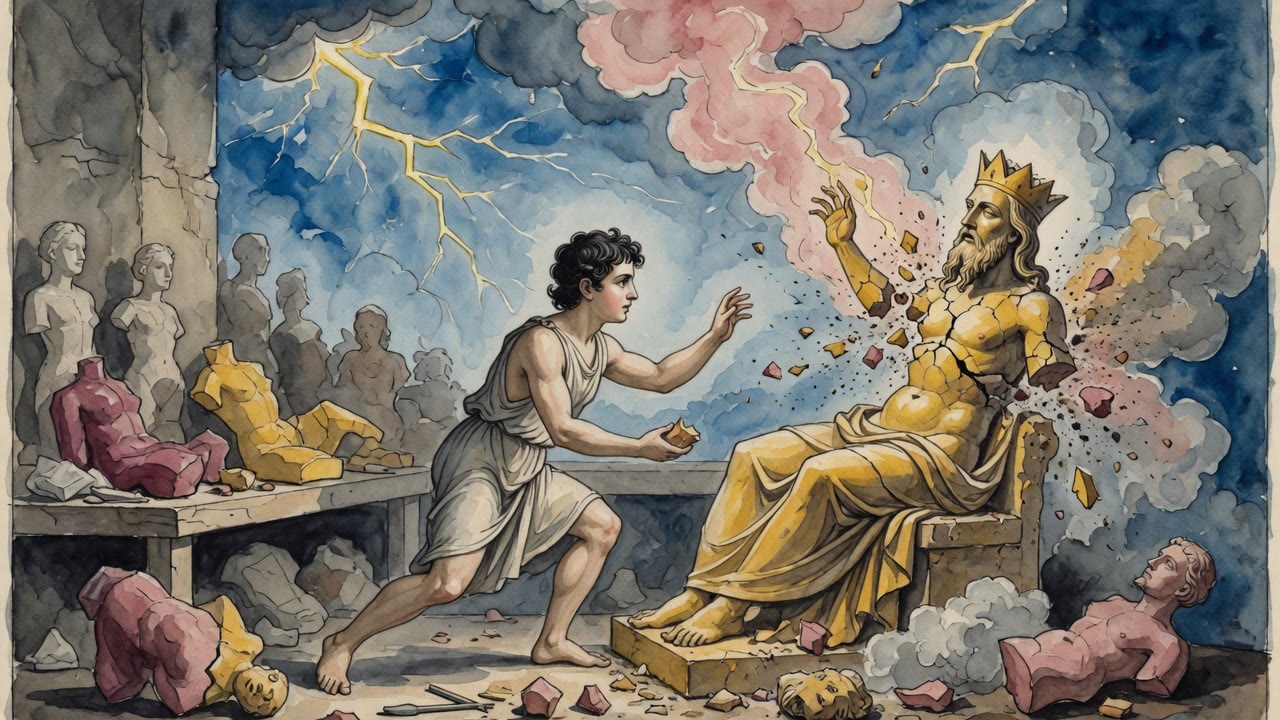
God did not love righteousness in the abstract. God loved the person who chose righteousness in the particular conditions of his own life. Abraham had been born into a world of idols, into a family that made them, in a culture that organized itself entirely around their worship. His father Terah ran a shop selling idols. Abraham had grown up behind the counter. When he began to see through the system, there was no tradition to support him, no community of skeptics, no accumulated argument he could borrow. He reasoned himself to monotheism alone.

The Double Command

When God finally spoke to Abraham, the command came in an unusual form. Lekh lekha. Go forth. The phrase doubled back on itself, it literally meant something like go to yourself, go for yourself, go from yourself. Rabbi Yehuda in Bereshit Rabbah read it as promise: this journey will be for your benefit and your good. Rabbi Nehemya read it differently: it was calling Abraham toward himself, toward the self that existed beneath the accumulated layers of where he had come from.

Both readings assumed that the command to leave was inseparable from the question of who Abraham actually was. God was not simply moving a useful person to a useful location. God was asking Abraham to become, through the act of departure, more fully what he already was in potential.

What Philo Saw in the Covenant

The Alexandrian Jewish philosopher Philo, writing in the first century CE in Greek, read the covenant between Abraham and God through a different lens. The covenant, in Philo's reading, was not primarily about land or descendants. It was about the quality of the person with whom God was making an agreement. God was not looking for perfection. Perfection was an impossible standard for any creature bound to a material body. God was looking for someone whose direction was consistently upward, whose failures were overcome by genuine effort.

Abraham's failures were real. He lied about Sarah twice. He complied with Sarah's demand to send Hagar and Ishmael away. He was not a figure of consistent virtue in the narrative. What he was, in Philo's reading and in the rabbinic reading both, was a figure who moved toward God even when the movement was imperfect.

Why He Stopped at Ten

In the famous negotiation over Sodom, Abraham bargained God down from fifty righteous people to ten. At ten he stopped. The tradition asked why. He did not stop because he ran out of nerve. He stopped because he calculated that ten was the minimum necessary for a community to constitute itself as a moral unit, and below that number, there was no community to save. He stopped not from cowardice but from precision.

The rabbis found in this stopping the same quality they found in all of Abraham. He was not performing righteousness for an audience. He was reasoning toward what was actually correct and then acting on his reasoning, even when the action was to stop bargaining for a city's survival.


← All myths

From the tradition

Sources

6 sources

The texts this telling draws on, in full. Open a card to read inline, or expand it for a wider, quieter read.

Bereshit Rabbah 39:6Bereshit Rabbah

Rabbi Azarya, quoting Rabbi Aḥa, starts with a verse from Psalms (45:8): "You love righteousness and abhor wickedness. Because of this, God, your God, has anointed you over your counterparts with the oil of joy.” Now, Rabbi Azarya applies this verse directly to Abraham. What's so special about Abraham that merits this praise? It all comes down to that famous scene where Abraham pleads for Sodom.

Remember the story? God's about to rain fire and brimstone on Sodom and Gomorrah because of their wickedness. And Abraham, ever the righteous one, steps in. "Far be it from You," he argues, "to do a thing like this, to kill the righteous with the wicked!" (Genesis 18:25). He's basically saying, "God, is that fair?"

Rabbi Aḥa elaborates on Abraham's argument, and it's pretty bold. He reminds God of the oath made after the Flood, the promise never to destroy the world again. "Are You seeking to evade Your oath?" Abraham asks, incredulously. "You [swore that You] will not bring a flood of water, but you may bring a flood of fire? If so, You have not fulfilled Your oath." – Abraham is calling God out on a technicality!

Rabbi Levi takes it even further. Quoting (Genesis 18:25), “Shall the Judge of all the earth not practice justice?” he has Abraham essentially saying, “God, You can't have it both ways! If You demand perfect justice, the world can't exist. And if You want a world to exist, You have to ease up on the strict justice.” It's a powerful idea: that divine mercy is necessary for the world to continue. That without some flexibility, some giving, and some grace, the whole thing collapses.

Rabbi Levi continues to explain Abraham's thinking: "If You wish to have a world, there can be no strict justice, and if you wish strict justice, there can be no world... if You do not ease up a bit, the world will be unable to endure."

So, what does God say to all this? According to Bereshit Rabbah, God acknowledges Abraham's point. "You love righteousness and abhor wickedness," God says, echoing the verse from Psalms.

But then comes the kicker: "Over your counterparts" – what is "over your counterparts"? From Noah until you there were ten generations, and from among all of them, I did not speak with any of them except for you."

What does this mean? Well, it suggests that Abraham's unique quality wasn't just his righteousness, but his willingness to stand up for righteousness, to challenge even God in the name of justice and mercy. As Louis Ginzberg retells the story in Legends of the Jews, Abraham's actions demonstrate an unparalleled devotion to divine principles, even when they seemed to clash with divine actions.

He was chosen, in other words, because he dared to argue. He dared to care.

This passage invites us to consider our own relationship with justice and mercy. Do we passively accept the world as it is, or do we dare to question, to challenge, to advocate for a more just and compassionate world? Are we willing to engage, like Abraham, even when it means challenging the very foundations of our beliefs?

Maybe, just maybe, that's what it means to truly love righteousness and abhor wickedness. And perhaps, like Abraham, that's how we earn the right to be called a partner with the Divine.

Full source
Bereshit Rabbah 39:8Bereshit Rabbah

Bereshit Rabbah turns to The Double Command of Lekh Lekha to Abraham.

Our source is Bereshit Rabbah, a classic collection of rabbinic interpretations of the Book of Genesis. In section 39, we find two Rabbis, Rabbi Yehuda and Rabbi Neḥemya, offering their takes on this double expression.

Rabbi Yehuda suggests that the two "go's" refer to two different places Abraham was told to leave: Aram Naharayim and Aram Naḥor. It's like God is saying, "Leave this place, and leave that place!" Get out of both of them.

Rabbi Neḥemya has a slightly different perspective. He agrees about leaving Aram Naharayim and Aram Naḥor, but adds another layer. The second "go" also refers to when God, according to Seder Olam Rabbah, supernaturally transported Abraham from the "Covenant Between the Pieces" (Genesis 15) back to Ḥaran. This happened when Abraham was seventy years old. He then left again at seventy-five, as our verse recounts. So, the command is about leaving not just physical locations, but also a state of being, a previous destiny.

But wait, there's more! The Rabbis don't just stop at geographical interpretations. They explore the why behind Abraham's willingness to leave. They bring in a verse from (Psalms 110:3): “Your people [amekha] will volunteer on your day of battle [ḥeilekha]”. The Rabbis cleverly read this as “I was with you [imekha] when you volunteered on My behalf to descend into the fiery furnace.” This is a reference to the story (found in other sources) of Abraham being thrown into a fiery furnace for refusing to worship idols. His willingness to face that ordeal is seen as the ultimate act of volunteering for God.

And the Psalm continues: “In sacred glory [hadrei]…from the womb of the dawn [mishḥar]”. These phrases are interpreted as allusions to the east, where the sun rises, specifically Ur of the Chaldeans. God says, "From there, I sanctified you; from the very beginning, I sought you out [sheḥartikha]."

But what about Abraham's past? What about his history of idol worship? He might have been worried about that. That's where the final part of the verse comes in: “Yours is the dew of youth.” God reassures Abraham that just as dew evaporates, so too will his past sins. And just as dew is a blessing, so too will Abraham be a blessing. What a beautiful image!

The Rabbis continue, drawing on (Psalm 55:7-8), imagining Abraham longing to leave his homeland and find rest in the Land of Israel. "I said: Would that I had wings like a dove; I would fly away and come to rest." Why a dove? Because, unlike other birds that rest on stones or trees, a dove can fold one wing and keep flying with the other. It's a symbol of persistent dedication to the journey. The Psalm goes on, "I would wander [nedod] far away" – which is interpreted as "movement after movement, wandering after wandering," from Ur of the Chaldeans to Ḥaran and then to Canaan. "To repose in the wilderness, Selah" – finding more peace in the wilderness of Israel than in the palaces elsewhere.

Finally, Rabbi Levi adds a fascinating observation. When Abraham was traveling through Aram Naharayim and Aram Naḥor, he saw people indulging in excessive eating, drinking, and revelry. He thought, "I don't want my portion in this land." But when he reached the Promontory of Tyre and saw people diligently working the land, he said, "I want my portion in this land." And that's when God said, "To your descendants I will give this land" (Genesis 12:7).

So, what does all this mean? It’s not just about leaving places. It's about leaving behind old ways of thinking, embracing a new destiny, and choosing a life of purpose and meaning. Lekh lekha – “Go, go!” – is an invitation to begin a journey of transformation, both physical and spiritual. And maybe, just maybe, that invitation extends to us, here and now. What are we being called to leave behind? What new land awaits our arrival?

Full source
The Midrash of Philo 1:8The Midrash of Philo

The Midrash of Philo turns to God's Covenant with Abraham in Philo's Reading.

The Midrash (rabbinic interpretive commentary) suggests that God isn't necessarily looking for perfection, an impossible standard for us mere mortals trapped in these earthly bodies. Instead, the focus is on striving for goodness, on actively distancing ourselves from wickedness and evil. It’s not about being flawless from the get-go, but about the journey from infirmity to sanity, from darkness to light. Think of it like this: it’s more admirable to overcome a struggle than to have never struggled at all.

"Keep thyself free from stain," God implores. The Midrash understands this not as demanding absolute purity, but as a call to live a life worthy of praise, free from actions and words that invite rebuke. It's about striving for a life that pleases the Divine. But how do we achieve that? The text implies a beautiful reciprocity: pleasing God means avoiding actions that would bring reproach, and avoiding reproach naturally leads to pleasing God. It’s a virtuous cycle, a dance between the human and the Divine.

What are the rewards for this striving? A double blessing, according to the Midrash. First, God promises to make us "the guardian of the deposits of the divine covenant." What does that even mean? Philo interprets the "treaty" or covenant as the very incorporeal word of God, the blueprint of the universe itself! So, to be a guardian of the covenant is to be entrusted with a profound truth, a cosmic responsibility.

Second, God promises to "multiply thee exceedingly." And here, the Midrash makes a crucial distinction. It’s not necessarily about multiplying individual virtue, though that's certainly important. But about the increase of the people as a whole. It’s a promise of a thriving community, a lineage that stretches far and wide. The repetition of "I will multiply thee exceedingly" emphasizes the sheer, boundless nature of this promise.

So, what does this all mean for us today? Perhaps it's a reminder that the pursuit of goodness is a continuous process, a journey rather than a destination. It's about striving to live a life that is pleasing to God, not through unattainable perfection, but through genuine effort and a commitment to avoiding wickedness. And in that striving, we not only become guardians of a sacred truth, but contribute to the flourishing of our communities for generations to come. What could be a more worthy aspiration?

Full source
Bereshit Rabbah 49:13Bereshit Rabbah

The story of Abraham pleading with God to spare Sodom and Gomorrah is more than just a negotiation; it’s a glimpse into the very nature of divine justice and collective responsibility.

We find ourselves in (Genesis 18:32), where Abraham, ever the bargainer, is trying to save the cities from destruction. "Please, let my Lord not be incensed, and I will speak only this time. Perhaps ten will be found there." And God responds, "I will not destroy for the ten." But why ten? Why did Abraham stop there?

That's the question that Bereshit Rabbah 49 wrestles with. Why not nine? Or five? What's so special about the number ten?

One explanation, the text suggests, is the concept of an "assembly." In Jewish tradition, a group requires at least ten individuals to constitute a minyan, a quorum for communal prayer and other sacred acts. The idea here is that if ten righteous people could be found across those five doomed cities, they would form a kind of holy nucleus, a spiritual force strong enough to tip the scales. A group, the text says, is only called an assembly if it consists of ten individuals.

Another explanation casts our minds back to the Flood. Remember Noah? He and his family – eight souls in total – were spared, but their righteousness wasn't enough to save the rest of the world. So perhaps, the midrash (rabbinic interpretive commentary) suggests, ten represents a threshold, a minimal requirement for collective redemption.

There's also a more personal, almost heartbreaking, reason offered. Perhaps Abraham believed that ten righteous people already existed in Sodom: his nephew Lot, Lot's wife, their four daughters, and their four sons-in-law. He might have thought he was pleading for a group that already existed.

But the most striking interpretation comes from Rabbi Yehuda ben Rabbi Simon and Rabbi Ḥanin, in the name of Rabbi Yoḥanan. They make a distinction between Sodom and Jerusalem. Sodom needed ten. But Jerusalem? It only needed one! As (Jeremiah 5:1) says, "Wander through the streets of Jerusalem…[if you will find [timtze’u] a man, if there is a performer of justice, a seeker of faithfulness, I will forgive it]." And (Ecclesiastes 7:27) echoes, "One for one to find a tally."

Rabbi Yitzḥak takes this idea even further. How much is the minimum [mitzui] amount for one city? Jerusalem, he says. It is even one! As in, if even one righteous person could be found, justice would be deferred. One person. One act of kindness, one moment of truth, one spark of righteousness can be enough to hold back the tide.

What does this all mean for us? Perhaps it's a reminder that even in the darkest of times, individual actions matter. That even when faced with overwhelming negativity, the choice to be righteous, to seek justice, to embody faithfulness can have a profound impact. We may not be able to save the entire world, but maybe, just maybe, we can save our own little corner of it.

Full source
Bereshit Rabbah 61:2Bereshit Rabbah

He shows us that even in old age, we can still blossom and bear fruit.

It all starts with a beautiful verse from Psalms (92:14-15): "Planted in the House of the Lord, they blossom in the courts of our God. They will continue to yield fruit even in old age. They will remain full and fresh.” The sages in Bereshit Rabbah, that wonderful collection of rabbinic interpretations on the Book of Genesis, see this as a direct reference to Abraham. He's the ultimate example of someone who remained vibrant and productive, even in his later years.

How does Bereshit Rabbah connect this idea to Abraham's life? It points to the verse, "Abraham took another [wife]." Even after the death of Sarah, his beloved wife, Abraham found love and created more life. He remained "full and fresh," as the Psalm says.

There's more! The Rabbis explore the Book of Job (14:7-9) for further insights. "For the tree has hope," it says. "If it is hewed [yikaret], it will yet regenerate.” Bereshit Rabbah brilliantly connects the word "hewed" (yikaret) to the act of making a covenant (kerot brit), specifically the covenant of circumcision. Even after the pain and challenge of circumcision, Abraham regenerated, constantly increasing his performance of mitzvot (commandments), good deeds. It also refers to the fact that after his circumcision at an old age, he fathered Isaac!

"And its roots will not cease," Job continues. This, the Rabbis say, refers to Abraham's incredible vitality. Even after all he'd been through, his spirit remained strong, his connection to God unwavering.

Then comes the poignant line: “If its root grows old in the earth… And its trunk dies in the dirt.” The Rabbis connect this directly to Abraham growing old, as (Genesis 24:1) states, and to Sarah's death and burial (Genesis 23:2). It's a reminder that even the greatest among us experience loss and the passage of time.

But here's where the story takes a hopeful turn: “It will blossom from the scent of water,” Job continues. Bereshit Rabbah interprets this "scent of water" as the "scent of mitzvot and good deeds." Because of Abraham’s righteous actions, he was able to father more children even in his old age.

And finally, “And produce branches.” Now, this is fascinating. The text doesn’t say “[branches] of a sapling,” but rather “[branches] like a sapling.” The addition – the new growth – is greater than the original tree itself! This refers to the children Abraham had with his new wife. Through her, he produced even more offspring than he had before.

So, what does Abraham's story teach us? It's a powerful reminder that life isn't a straight line. There will be challenges, losses, and times when we feel like we're past our prime. But like Abraham, we can find new sources of vitality, new ways to blossom, and new opportunities to create and contribute, even in our later years. We can constantly increase our performance of mitzvot and good deeds, and continue to have hope for the future. It's a message of resilience, faith, and the enduring power of the human spirit. What "branches" are you hoping to grow in your own life?

Full source
Avot DeRabbi Natan 33Avot DeRabbi Natan

THERE WERE TEN GENERATIONS FROM NOAH TO ABRAHAM. What need is there for mankind to [know] this? It is to teach that all those generations were provoking Him, and there was not one man who would walk in the ways of the Holy One, blessed be He, until Abraham our father came and walked in His ways; as it is stated, Because that Abraham hearkened to My voice, [and kept My charge, My commandments, My statutes, and My laws.]1Gen. 26, 5. The verse does not say ‘law’ but laws. But whence did he learn them?2In the plural. So according to a variant reading. V reads, ‘Did he keep one law? Surely he kept many laws!’ It teaches you that the Holy One, blessed be He, provided Abraham with two reins which, like two Sages, instructed him, counselled him, and taught him wisdom all the night long, as it is stated, I will bless the Lord who hath given me counsel; yea, in the night seasons my reins instruct me.3Ps. 16, 7. Cf. above XXXI, 3, p. 148f. where the kidneys are said to act as counsellors. Our father Abraham was wont to practise righteousness first and justice afterwards, as it is stated, For I have known him, to the end that he might command [his children and his household after him, that they may keep the way of the Lord, to do righteousness and justice].4Gen. 18, 19. In this description of Abraham righteousness precedes justice. Whenever two disputants came before our father Abraham with a lawsuit, the one claiming a mina from the other, he would take out a mina, give it to the defendant, and say to him, ‘Argue your case before me’. After their case had been argued, if [he found that] one was in debt to the other, he would say to the defendant in whose hand was the mina, ‘Pay the mina to your companion’; but if [the claim was] not [proved], he would say to them, ‘Divide it between you and depart in peace’. King David, on the other hand, did not act so; he was wont to do justice first and righteousness afterwards, as it is stated, And David executed justice and righteousness unto all his people.52 Sam. 8, 15. When disputants came before king David with a lawsuit, one claiming a mina from the other, he said to them, ‘Argue your case’. After their case had been argued, if [he found that] one owed a mina to the other, he would take out a mina of his own and give it to the claimant; but if [the claim was] not [proved] he would say to them, ‘Depart in peace’.6In V the text reads, as with Abraham, ‘Divide it between you and depart in peace’. This is an obvious error, because where the case was not proved, king David made no gift of money. Consequently the words ‘divide it between you’ are incorrectly interpolated.

WITH TEN TRIALS WAS ABRAHAM OUR FATHER TRIED BY THE HOLY ONE, BLESSED BE HE, AND HE WAS FOUND STEADFAST IN THEM ALL.7The version in Aboth 5:4 (Sonc. ed. V, 3, p. 59) is ‘and he stood firm in them all’. They are: twice when he had to leave his home,8The first time when he was bidden to leave his native land (Gen. 12, 1), and the second time when he set out for Egypt because of a famine in the land (ibid. 10). twice with his two sons,9First when he was induced to drive his son Ishmael out of the house (ibid. XXI, 10), and then in the supreme test of the binding of Isaac (ibid. XXII). twice with his two wives,10When Sarah was taken to Pharaoh’s palace (ibid. XII, 15), and when he was induced to send Hagar from his home (ibid. XXI, 10). Alternatively, the second trial was the occasion when Sarah was taken by Abimelech (ibid. XX, 2). once [when he fought] against the kings,11ibid. XIV. once at the Covenant between the Pieces,12ibid. XV, 7ff. once in Ur of the Chaldees13According to a tradition, Abraham had been thrown by Nimrod into a fiery furnace because of his belief in God, from which he came forth unharmed. The name Ur means ‘fire’ in Heb. and once at the Covenant of Circumcision.14Cf. ibid. XVII, 10. [30a] Why [was he subjected to these trials]? So that when our father Abraham will come to claim his reward, the angels15GRA reads ‘all will say’. There is a variant ‘the nations of the world will say’. will say, ‘Far more than all of us is our father Abraham worthy of claiming his reward’; as it is stated, Go thy way, eat thy bread with joy, and drink thy wine with a merry heart.16Eccl. 9, 7. Midrash Rabbah, Ecclesiastes, ad loc. applies the verse to Abraham when, after his many trials, he was steadfast in his faith.Corresponding to the ten trials with which our father Abraham was tried, in all of which he was found steadfast, the Holy One, blessed be He, performed ten miracles for his children in Egypt.17The children of Israel were immune from the ten plagues which afflicted the Egyptians. On account of them He brought ten plagues [upon the Egyptians]; so, too, on account of them ten miracles were wrought for Israel at the Red Sea;18These are enumerated in the passage which follows, each miracle being introduced by the formula ‘we will not cross until’. and also on account of them He brought ten plagues upon the Egyptians at the Red Sea.19Implied in the ten expressions used in Ex. 15 describing the complete destruction of the Egyptians.The Egyptians thundered against Israel with their voices; so did the Holy One, blessed be He, thunder against them with His voice at the Red Sea, as it is stated, God thundereth marvellously with His voice.20Job 37, 5. The Egyptians advanced towards the Red Sea with bow and arrow; and the Holy One, blessed be He, likewise revealed Himself to them with bow and arrow, as it is stated, Thy bow is made quite bare,21Hab. 3, 9. and it is also stated, And He sent His arrows, and scattered them.22Ps. 18, 15. The Egyptians advanced towards the Red Sea with swords; and the Holy One, blessed be He, also came against them with swords and spears, as it is stated, And He sent out His arrows, and scattered them; and He shot forth lightnings and discomfited them;23ibid. ‘lightning’ indicates nothing else than the sword, as it is stated, A sword, a sword, it is sharpened, and also furbished; it is sharpened that it may make a sure slaughter, it is furbished that it may be as lightning.24Ez. 21, 14f. The last words of the quotation are rendered as in the Revised Version. The Egyptians gloried in shield and buckler; and the Holy One, blessed be He, did likewise, as it is stated, Take hold of shield and buckler, and rise up to my help.25Ps. 35, 2. The Egyptians advanced with spears; so, too, did the Holy One, blessed be He, as it is stated, At the shining of Thy glittering spear.26Hab. 3, 11. The Egyptians advanced with stones and slings; and the Holy One, blessed be He, triumphed over them with great hailstones, as it is stated, At the brightness before Him, there passed through His black clouds, hailstones and coals of fire.27Ps. 18, 13.At the time when our ancestors stood at the Red Sea, Moses said to them, ‘Rise up and cross’; but they replied, ‘We will not cross until the Sea appears to us as yawning holes’.28Here are enumerated ten miracles which God wrought for Israel at the Red Sea. Cf. on this passage Mekilta, Beshallaḥ, on Ex. 14, 16. Moses took his staff and struck the Sea so that it became like yawning holes, as it is stated, Thou hast stricken through with his own rods the head of his rulers.29Hab. 3, 14. The verb naḳabta, Thou hast stricken through, is of the same root as neḳabim, ‘holes’. Moses said to them, ‘Rise up and cross’; but they replied, ‘We will not cross until the Sea will become before us like a valley’. Moses struck the Sea and it became before them as a valley, as it is stated, He cleaved the sea and caused them to pass through;30Ps. 78, 13. The verb baḳa’, He cleaved, is of the same root as biḳ‘ah, ‘valley’. and it is also stated, As the cattle that go down into the valley.31Is. 63, 14. Moses said to them, ‘Rise up and cross’; but they replied, ‘We will not cross until it will be divided before us into parts’.32i.e. into lanes, a separate lane for each tribe. [Moses struck the Sea so that it was divided into parts,] as it is stated, To Him who divided the Red Sea into parts.33Ps. 136, 13. E.V. in sunder. Moses said to them, ‘Rise up and cross’; but they replied, ‘We will not cross until it will become for us like clay’.34Or, ‘like a heap’. Moses took his staff and struck the Sea so that it became for them like clay, as it is stated, Thou hast trodden the sea with Thy horses, the clay of the mighty waters.35Hab. 3, 15. E.V. the foam of the mighty waters. The noun, ḥomer, is the same as for ‘clay’. According to the alternative rendering, ‘heap’, the end of the verse should read, ‘the heap of the mighty waters’. Moses said to them, ‘Rise up and cross’; but they replied, ‘We will not cross until it will become for us as a wilderness’. Moses took up his staff and struck the Sea [and it became for them as a wilderness], as it is stated, And He led them through the depths, as through a wilderness.36Ps. 106, 9 Moses said to them, ‘Rise up and cross’; but they replied, ‘We will not cross until it will crumble into pieces before us.’ Moses took his staff and struck the Sea [so that it crumbled into pieces], as it is stated, Thou didst break the sea in pieces by Thy strength.37ibid. LXXIV, 13. Moses said to them, ‘Rise up and cross’; but they replied, ‘We will not cross until it will turn into rocks for us’. Moses took his staff and struck the Sea [and it turned into rocks], as it is stated, Thou didst shatter the heads of the sea-monsters on the waters,38ibid. and you must say that the heads of sea-monsters can only be shattered on rocks. Moses said to them, ‘Rise up and cross’; but they replied, ‘We will not cross until it will become dry land for us’. Moses took his staff and struck the Sea [and it became dry land], as it is stated, He turned the sea into dry land,39ibid. LXVI, 6. and it further states, But the children of Israel walked upon dry land in the midst of the sea.40Ex. 14, 29. Moses said to them, ‘Rise up and cross’; but they replied, ‘We will not cross until it will stand up before us like walls’. Moses took his staff and struck the Sea [so that it stood up like walls], as it is stated, And the waters were a wall unto them on their right hand, and on their left.41ibid. Moses said to them, ‘Rise up and cross’; but they replied, ‘We will not cross until it will stand up for us [as in] bottles’. Moses took his staff and struck the Sea [so that it stood up as in bottles], as it is stated, The floods stood upright as in bottles.42ibid. XV, 8. E.V. as a heap. The noun נד is homiletically read as נאד, ‘bottle’. And whence do we know that from between the several divisions a fire came forth which licked them up?43The sea lanes were licked dry by the fire so that Israel might walk in comfort along the paths. For it is stated, As when fire kindleth melting waters, and the fire causeth the waters to boil; to make Thy name known to Thine adversaries.44Is. 64, 1. E.V. kindleth the brush-wood. The bottles produced a flow of oil and honey into the mouths of the infants from which they drew nourishment, as it is stated, And He made him to suck honey out of the crag.45Deut. 32, 13. Some say that fresh water issued for them from the Sea which they drank when they were in the sea-lanes, because sea-water is salty, as it is stated, the floods [nozelim],46Ex. ibid. The Heb. word signifies ‘flowing streams’. and by nozelim sweet water is meant, as it is stated, A well of living waters, and flowing streams [nozelim] from Lebanon.47Cant. 4, 15. Above them were clouds of glory that the sun should not overpower them, and so Israel passed through that they might suffer no discomfort. R. Eliezer said: He arched the deep over them like a vault, and Israel passed through that they should suffer no discomfort. R. Eliezer and R. Simeon said: The upper and lower waters [combined] to overthrow the Egyptians, as it is stated, And the Lord overthrew the Egyptians in the midst of the sea.48Ex. 14, 27.

Full source