Parshat Bereshit5 min read

God Said Enough and the Heavens Stopped Stretching

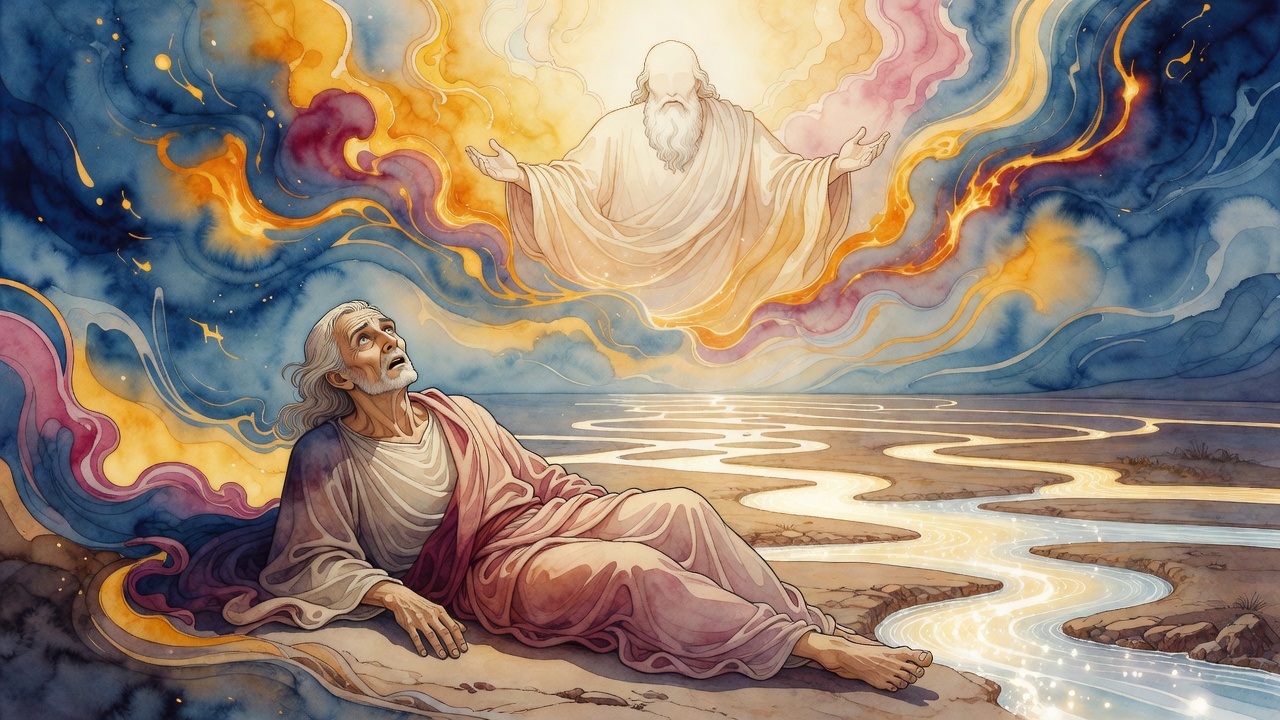
When creation would not stop expanding, God spoke one syllable, dai, and the heavens held still so a world of limits could live.

Curated by Arthur · Told by Maggid ·
Table of Contents
  1. The Sky That Would Not Stop
  2. Bet Went First
  3. Twenty-Six Generations of Not Saying It
  4. The King and the Artist
  5. The Thousandth Generation
God Said Enough and the Heavens Stopped Stretching Click for full size

The Sky That Would Not Stop

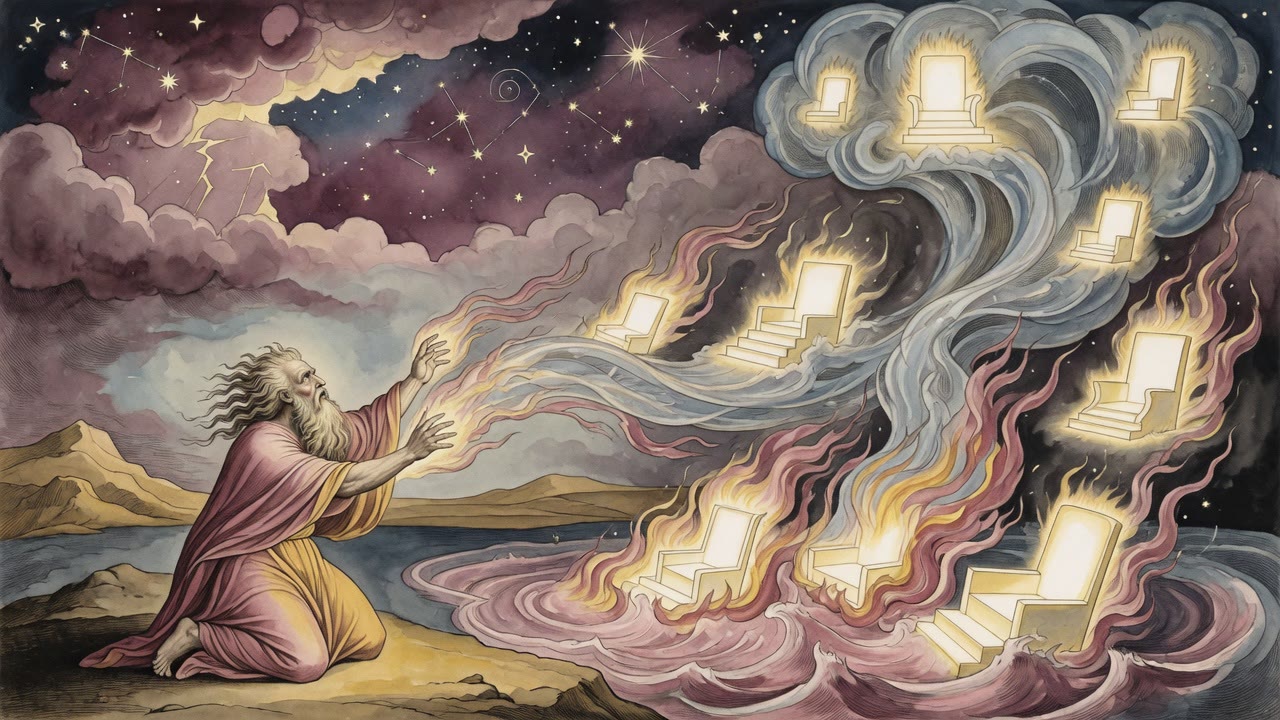
When God spoke to the heavens and told them to be, they came out and kept coming. The stretch did not slow down, because there was no far edge anywhere for it to reach and stop against, and if the word had not been said it would have gone on opening until the dead stood up out of the ground and the last day arrived inside the first morning. The word that stopped it was one syllable long: dai (די), enough. It sits inside the name Shaddai (שדי) like a hinge, the One who said enough, and the heavens heard it and held, and because they held there was now an over and an under, and a floor could be laid.

So the first thing said after the making of something was a refusal.

Bet Went First

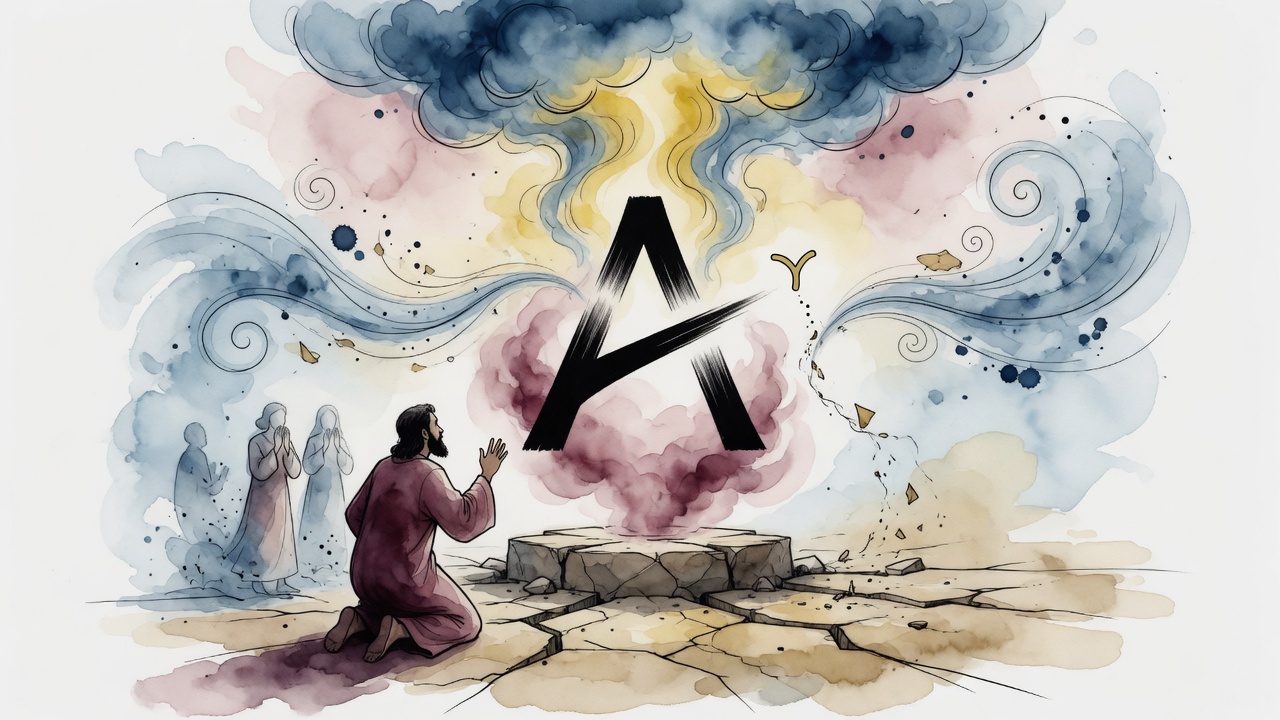
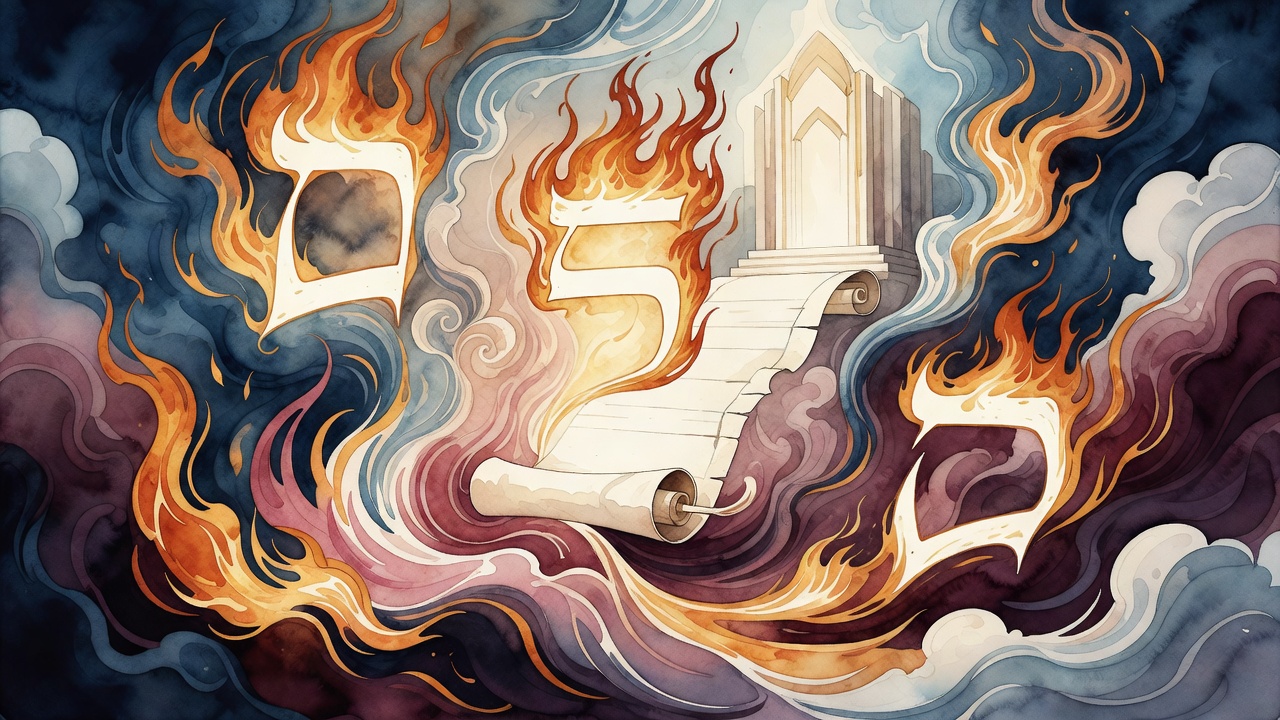
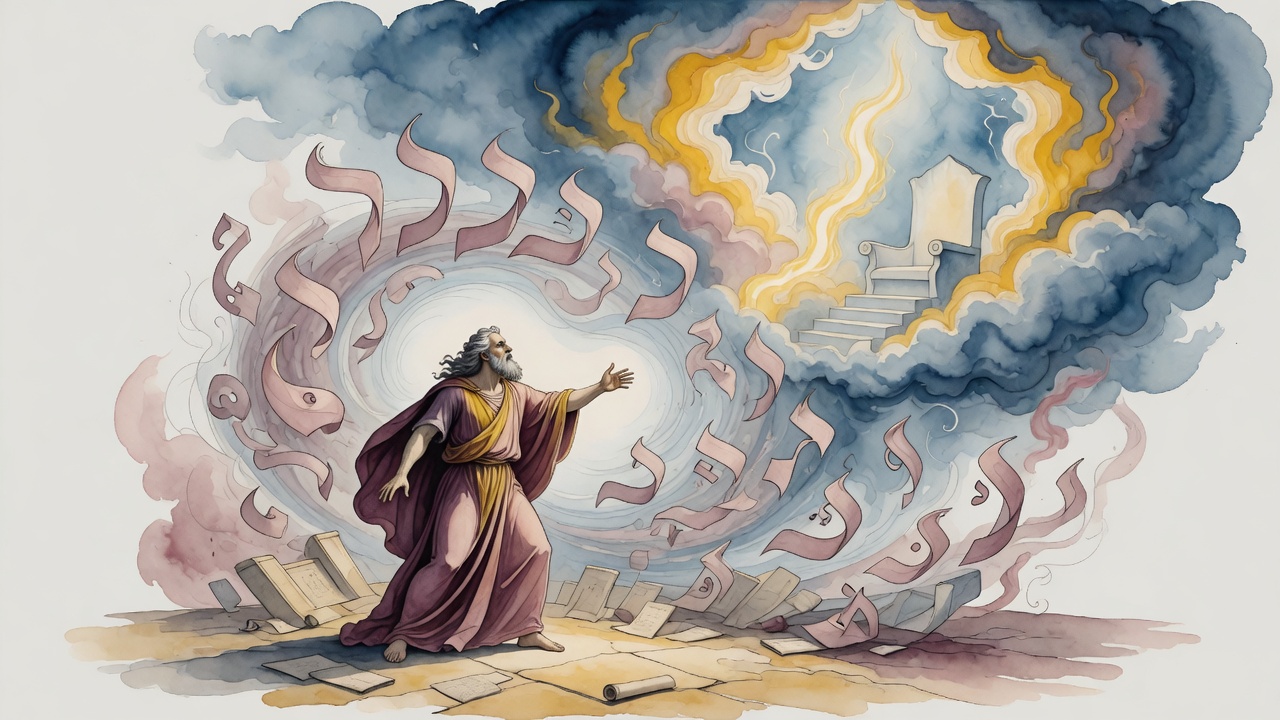
The letters were standing there for it. Alef stood at the head of them, first in the row and one in number, and one is the number of the God who is one and of the Torah that is one, so Alef had every reason to expect the opening word of the book to open with itself. Instead the world was begun with Bet, because bet is the first letter of berakhah, blessing, while alef starts arur, cursed, and God would not hand a doorway to some clever man who wanted to stand up later and say the world had been founded on a curse and therefore had no business standing at all.

Bet took the first place in the first word. Alef stayed in the row and said nothing.

Twenty-Six Generations of Not Saying It

It held the complaint for twenty-six generations. Adam went out of the garden, the flood came and drained off, towers went up and came down, and the whole time the first of the letters watched a book it had not been allowed to open. Then it came before the Holy One and said it. "Master of the world, I am the head of all the letters, and you did not create your world with me."

The answer came back in two pieces, and the first piece was worse than silence: the world and everything crowding it were created only for the sake of the Torah, so the honor Alef was asking about had never been the real honor at all. Alef stood in front of that, and then the second piece landed. On Sinai the Holy One would come down and give the Torah to a people standing at the bottom of a mountain, and the first word out of His mouth would not begin with any letter but this one. Anochi, I am the LORD your God.

Twenty-six generations of standing at the head of a row that led nowhere, and the wait turned out to have been for the sentence that starts the Ten Words.

The King and the Artist

A king of flesh and blood does not raise a palace out of his own head alone. He leans on an artist who holds the plan of rooms and corridors, and the artist does not invent the plan either. He works from knowledge already set. The Holy One looked into the Torah and created the world. There is no beginning but Torah. The same book that would open with Bet had already been the measure by which the floors were drawn.

Enough is not the fear of a small god who might run short. The same hand that shut a sky mid-stretch had already held the plan. Alef, which had wanted the first place and been passed over for a letter shaped like a house with the front left open, carries the number of a thousand, and a thousand generations was how long the Holy One agreed to wait before handing the Torah down.

The Thousandth Generation

In the third month they were standing at the foot of the mountain, on ground that was solid because a word had once stopped the sky from taking all the room. The mountain smoked. Then the first word came down over their heads with Alef at the front of it, where it had been waiting since before there was a world to be late for.

The heavens that would not stop had been told enough. The letter that would not go first had been promised Anochi. Between those two refusals, a people could stand and hear.


← All myths
From the tradition

Sources

2 sources

The texts behind this telling. Some cards carry a translation of the source; others are our own retelling of it, and each card says which. Every card links out to the original.

Midrash Tanchuma Buber, Bereshit 11:3Midrash Tanchuma Buber, Bereshit

Retold in our words. Read the original at the link below.Midrash Tanhuma, S. Buber Recension, trans. John T. Townsend (1989) · CC-BY

There was once a moment. So the rabbis taught, when the universe would not stop growing. Midrash Tanchuma Buber, Bereshit 11:3 preserves a cosmology that would sound at home in modern physics.

R. Aha's teaching

R. Aha described the moment of creation this way: "When the Holy One spoke to the heavens that they should be created, they went on expanding. If He had not said: Enough, they would have gone on expanding out until the dead arose."

The Hebrew word for "enough" is dai, דַּי. R. Aha read this into the divine name Shaddai (שַׁדַּי), one of the names of God, as meaning "the one who said dai", the one who set the limit. The midrashic tradition developed this wordplay into a whole theology. God's role in creation was not only to start the process but to stop it.

A universe without a limit

Picture the image the midrash is drawing. God speaks, and the heavens begin to unfold. But they keep unfolding. The cosmic fabric continues to stretch, outward and outward. Without an upper boundary, the expansion would have gone on "until the dead arose", until the messianic future folded back into the present moment. Space itself would have overflowed time.

Only the divine word dai imposed a limit. Enough heaven. Enough distance. Enough stretching.

The ethics of "enough"

The rabbis drew a moral lesson from this physical observation. The universe was created with the principle of dai built into its structure. Things have natural limits, and holiness often lies in recognizing them.

This echoes across Jewish practice. Shabbat is dai for work. The sabbatical year is dai for agriculture. The laws of charity require giving, but the rabbinic code also caps it, you should not impoverish yourself. Even in Passover seder liturgy, the song Dayenu, "it would have been enough", celebrates the virtue of sufficiency.

The cosmological parallel

Modern cosmology postulates that the early universe expanded rapidly in an event called inflation, which then slowed dramatically. Whatever one makes of the coincidence, R. Aha was working with an ancient intuition, that unchecked expansion is its own kind of death, and that the world requires a word of limitation to become a home.

Without dai, the heavens would be infinite and uninhabited. With dai, they are finite and full of stars.

The takeaway: the universe was created by the word "let there be" and preserved by the word "enough." Both are divine. And learning when to say which one is part of what it means to live inside creation.

Full source
Yalkut Shimoni on Torah 2Yalkut Shimoni

Retold in our words. Read the original at the link below.Sefaria Community Translation · CC0

From where is "Aleph" called one, it is said, "How shall one rout one thousand?" And from where is the Holy One, blessed be He, called one as it is said "Hear O Israel the Lord our G-d the Lord is One". And from where is the Torah called one, as it is said, "One Torah will be for you." I am the head of all the pronouncements and "Aleph" is the head of all the letters:...

R. Yehuda bar Shalom said, "From before and from the beginning created Elokim is not written ere rather from the first, in the merit of Israel, which was called first, as it is written," The Holy of Israel is to God, the beginning of its crop. " As a metaphor, why does this resemble: a king of flesh and blood who did not have a son, and says, "Take him from Lenin and Kalmarin to Livni, and everyone would say, 'He has no son,' and he says: 'Take him out of Lenin and Kalmarin.' Rabbi Yehudah ben Pazi expounded why with "Bet": to tell you that there are two worlds, this world and the world to come.

Another interpretation: Why (does the Torah begin) with the letter Bet? Because it is the language of blessing. And why (did it not begin) with the letter Alef? Because it is the language of cursing.

Another reason why not in the first place is not to give an opening here to the Epicurean to say how the world can stand and it was created in the language of Arida, but God said: I create it in the language of blessing that I wish.

Another thing is why in the house, according to the fact that she has two poles up and one below, behind him he says to the Creator, "Who created you in the world?". Rabbi Elazar bar Avina says 26 generations was a challenging challenge before God Almighty said before him, Master of the Universe I am the first of letters and you did not create your world in me God told him the world and its entirety were created only thanks to the Torah says God with wisdom founded I am destined to rest in the Sinai, and I will not open it except to you, as I say, I am the Lord your God. Bar Chunya said why his name is called Aleph that the Holy One, blessed be He, agrees to give the Torah to a thousand generations, as it is commanded by a thousand generations. Rabbi Hoshayah Rabbah I will be the master of the art of God, in the manner in which a king of flesh and blood builds Palatrin and does not build him from his own knowledge but from the knowledge of the artist and the artist does not build from his own knowledge, but rather he is hypocritical and has a knowledge of how he makes rooms And how does he do such a thing? The Holy One, blessed be He, looked at the Torah and created the world. And there is no beginning but Torah as to how the Lord said, "I will begin his journey." Rabbi Brachya says in the merit of Moses that the world was created, as it is stated in the beginning and the writing, and Rabbi Huna saw it first in the name of Rabbi Menahem because of three things the world was created in the merit of Challah and the merit of the tithes. And there is no beginning, but there is a certain portion that says the beginning of your cradles applies. And there is no beginning but a tenth of what you have said, the beginning of your fish. And there is no beginning but the firstborns. How many are the firstborn of your land? Tanna Debi Rabbi Yishmael Do not read Bereshit, but rather, by the beginning of Shitin from the six days of creation, it is said: "My thighs are like those wreaths that will flow from the hollow and descend to the abyss. Made by an artist The work of God's art: Shimon ben Azzai says and your answer is Rabbinic. Flesh and blood mentions his name and then praises Pelan Agusta flan fratata but God is not so but the needs of his world and then mentioned his name is said Genesis God then created:

Full source