7 min read

Abraham Carved Letters from Air and Fire

Under a sky full of foreign stars, Abraham learned creation's grammar. Spirit became air. Air became water. Water became fire and thrones.

Curated by Arthur · Told by Maggid ·
Table of Contents
  1. Air Engraved Out of Spirit
  2. Mud and Loam, Laid Like a Garden Bed
  3. Fire, and the Throne Cut Out of It
  4. Saturn Was a Made Thing
  5. Five Against Five

Abraham was counting on his fingers, and the count would not come out any other way. Ten, and not nine. Ten, and not eleven. Ten measures with no matter in them at all, twenty-two letters of foundation underneath, and no permission anywhere in the teaching to round any of it off.
Abraham Carved Letters from Air and Fire Click for full size

Then it opened.

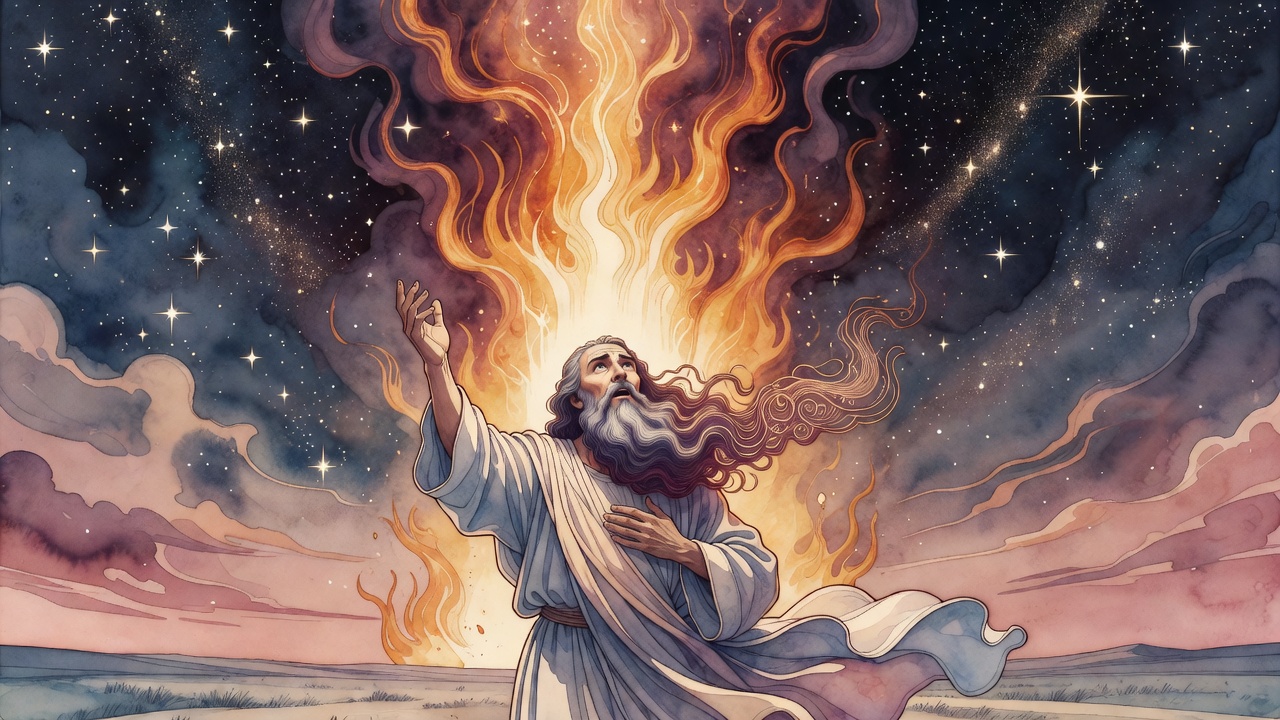
The whole depth of the thing came at him the way lightning opens a plain at night, all of it at once and none of it for long: a depth of beginning and a depth of end, a depth of good and a depth of evil, above and below, east and west, north and south, and standing over every one of them a single Master ruling from His own holy dwelling, to the eternity of eternities. Abraham reached. The measures ran out from the word that sent them and came back to it, out and returning and out again, the way breath does, and they went past him in both directions and did not stop for him.

He was left standing in the dark with his hands out and nothing in them.

Air Engraved Out of Spirit

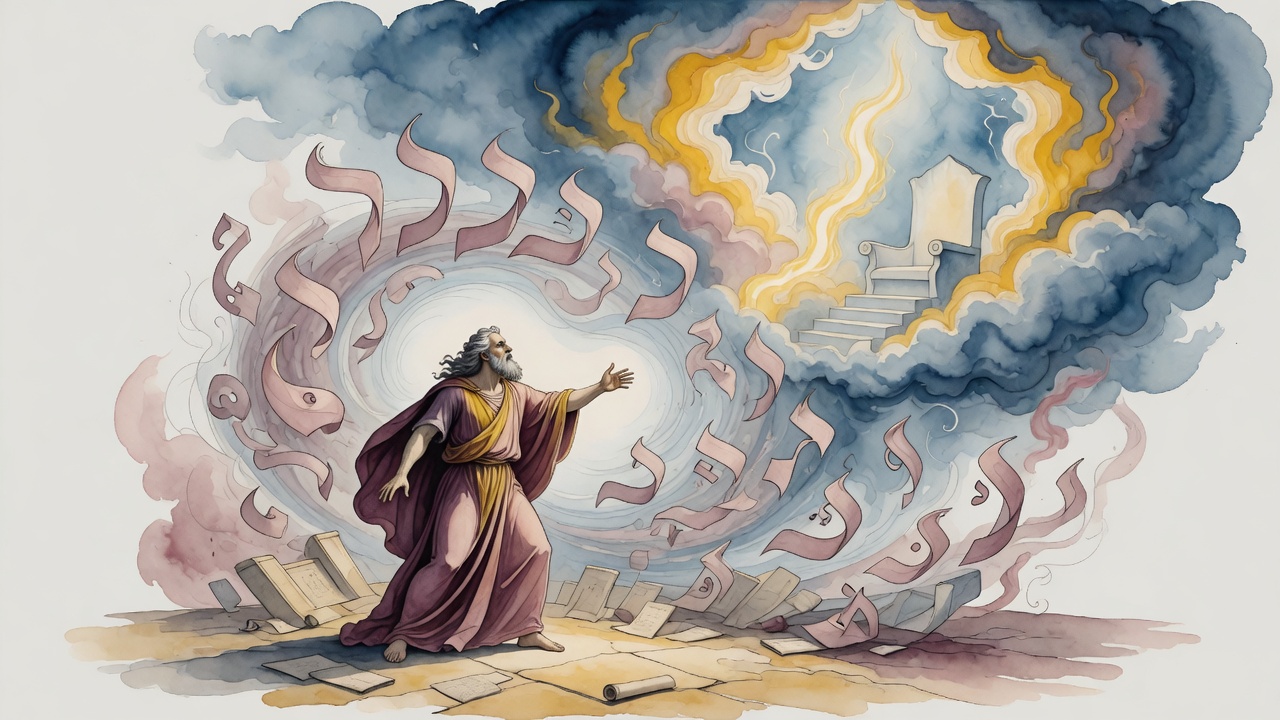
What he had been shown starts with something cut out of almost nothing. God engraved air out of spirit. Not built it and not poured it: cut it, the way a mason cuts, taking away everything that was not going to be air. Then out of that air God carved the twenty-two letters of foundation, three of them mothers, seven doubles, twelve plain, and air is the first of them, so the letters and the breath that says them came out of the same block.

Abraham's hands moved while he watched. Empty hands at his sides, doing the small pointless work of a man who cannot help copying a cut he is seeing made.

Mud and Loam, Laid Like a Garden Bed

Water came next, engraved out of the air, and out of the water God carved tohu (formless void) and bohu, which do not stay abstract for a single line. Mud and loam. Wet dirt, and the heavier stuff under it.

Then three verbs that belong to a working yard rather than a heaven. God engraved them like a garden bed, erected them like a wall, covered them like pavement. Trenches cut into flat ground, a course of stone going up, slabs laid over the top so the whole thing would take weight.

Nothing in it was grand, and that was the part Abraham could not get past. The beginning of the world was a job of digging and walling and paving, done in that order, by somebody who knew what would settle and what would not.

Fire, and the Throne Cut Out of It

Out of the water came fire, and out of the fire came the household.

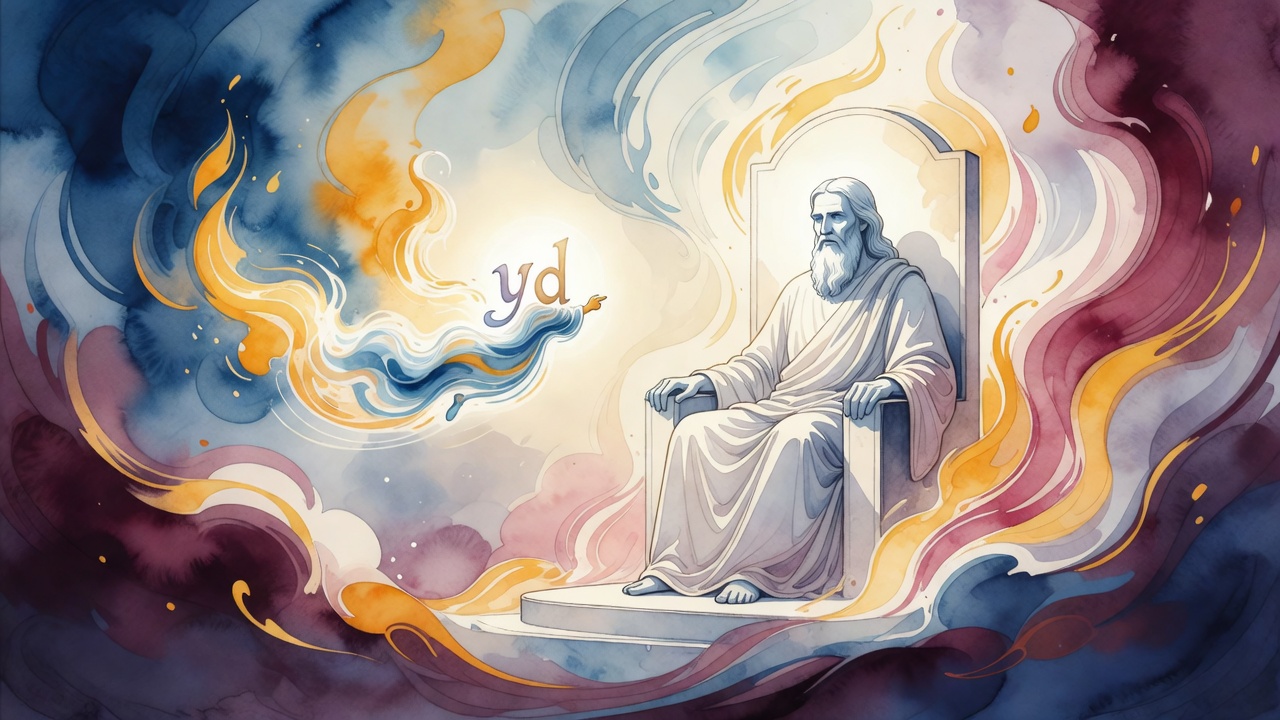
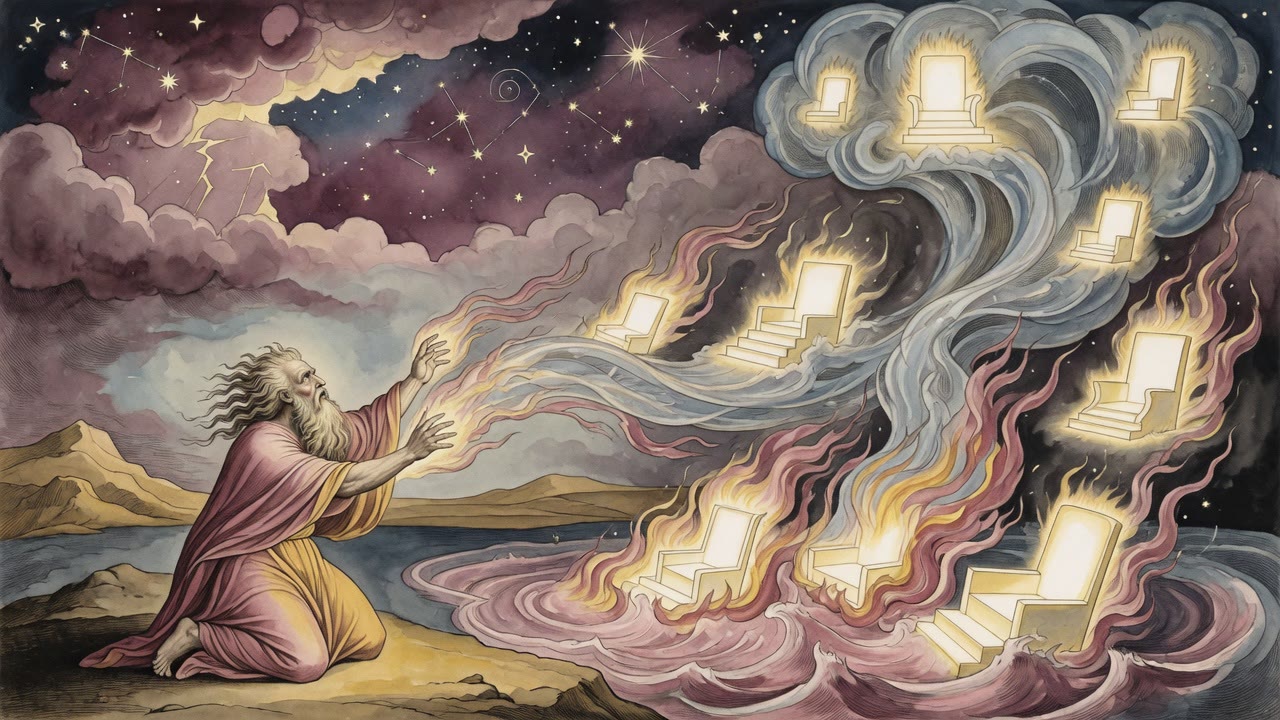
The throne of glory was cut first. Then the serafim, then the ofanim, then the holy living creatures, then the ministering angels, all of them carved from the same fire in the same pass, so that the burning things around the throne and the throne itself are one piece of work and not a court assembled from elsewhere. From the three of them, air and water and fire, God founded His own dwelling. He makes the winds His messengers, and burning fire His servants (Psalms 104:4).

Servants. Abraham held onto that word, because it settled a question he had been carrying around under a very crowded sky.

Saturn Was a Made Thing

The letters went out and did work, and the work has addresses.

The letter bet, strongest in wisdom, was crowned and combined and formed into Saturn out in the universe, into the first day of the week in time, and into the right eye in a human face. Gimel, strongest in health, made Jupiter, and the second day, and the left eye. Dalet, strongest in fertility, made Mars, and the third day, and the right ear. Kaf, strongest in life, made the sun, and the fourth day, and the left ear.

Abraham went out under those stars afterward, and the arithmetic had changed on him. Saturn is a made thing. It was crowned out of a letter and set going, the same way the wind is a messenger and the fire is a servant, and a servant does not receive petitions. The bright things overhead were not the parliament. They were the staff.

And whatever letter had been used on Saturn had been used again, in the same pass, on the right side of his own face.

Five Against Five

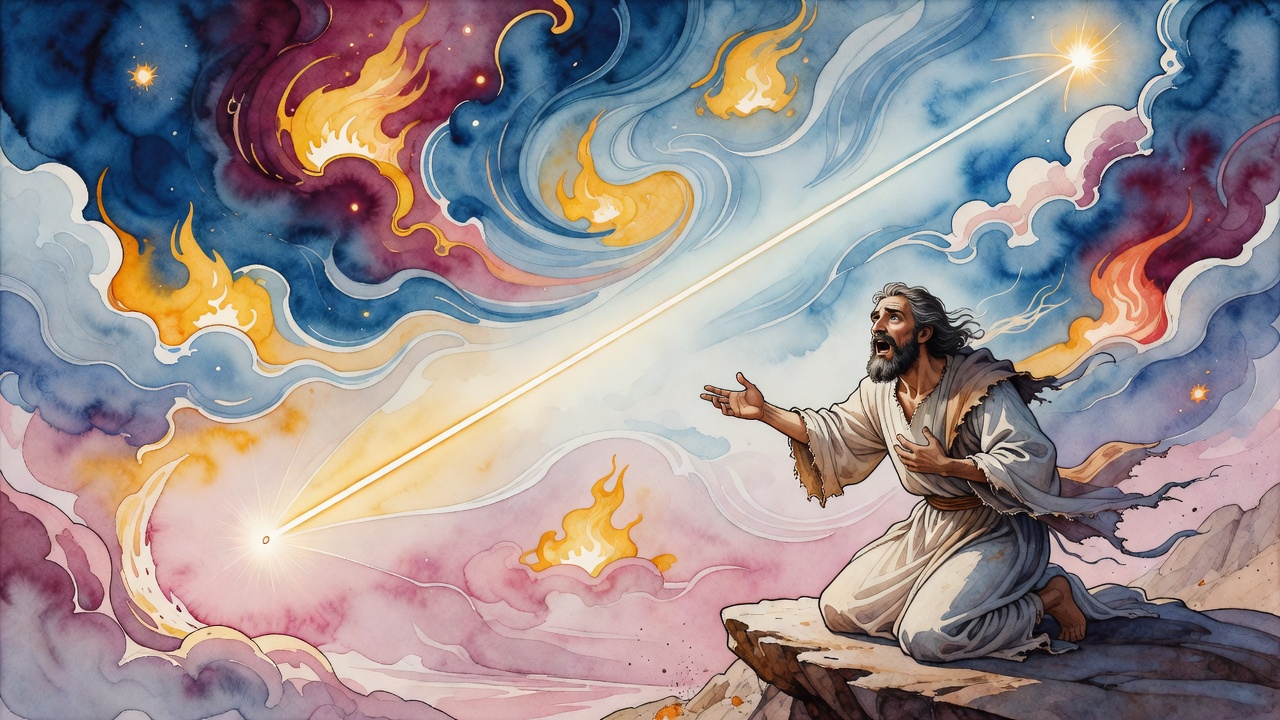
He kept waiting for the lightning to come back and hold still, and it did not, because holding still is not what it does. The measures rush to His saying like a whirlwind and throw themselves down before His throne, and a man standing underneath that gets a flash and then the plain again.

So he stopped reaching upward and looked at what was already on him.

Ten fingers. Five against five, and the covenant of the One fixed in the middle of them, in the word of the tongue and in the cut of the flesh. The count was not out there at all, or not only out there. It had been issued to him in his own body, one hand's worth on each side, and the same four letters that had gone into the planets had gone into his two eyes and his two ears, so the sky and his own skull were carrying the same marks in the same hand.

The teaching had told him to understand with wisdom and be wise with understanding, to examine the measures and get what he could out of them, and then to give the matter back to its Maker and put the Maker back in His own place. He had taken that as an instruction about the sky, since the sky was where the lightning had been. It turned out to be an instruction about handing something back, which a man can only do if he is holding it, and he was holding it.

He closed his hands. The lightning did not come again that night, so he went on counting in the dark, where the count was.


← All myths
From the tradition

Sources

4 sources

The texts behind this telling. Some cards carry a translation of the source; others are our own retelling of it, and each card says which. Every card links out to the original.

Sefer Yetzirah 1:4Sefer Yetzirah

Retold in our words. Read the original at the link below.Sefaria-hosted English translation · CC-BY

Jewish mysticism offers some pretty mind-bending answers, and it all starts with a little book called the Sefer Yetzirah, the "Book of Formation." It’s a short text, incredibly dense, and attributed (though probably falsely!) to Abraham the Patriarch himself. The Sefer Yetzirah is one of the earliest and most important texts of Jewish esotericism.

Right from the start, the Sefer Yetzirah throws us into the deep end, declaring that the entire cosmos was created through "Ten Sefirot (the divine emanations) without matter, and twenty-two letters of foundation." Okay, unpack that!

What are these Sefirot? The text calls them "without matter," meaning they’re not physical things. They're more like divine emanations, or perhaps blueprints for creation. Think of them as the ten fundamental attributes or powers of God through which the universe unfolds. We will explore the concept of Sefirot further in later discussions.

Then we have the "twenty-two letters of foundation." These aren't just any letters; they're the letters of the Hebrew alphabet, which in Kabbalistic thought, are seen as the very building blocks of reality. Each letter possesses a unique energy and vibration, and by combining them in different ways, God brought everything into existence.

These letters are further divided into three categories: "Three mothers, seven pairs, and twelve simple ones." These classifications hint at the intricate relationships and interactions between the letters, and how they manifest in the world around us. The three "mother" letters are Aleph, Mem, and Shin, representing air, water, and fire, respectively. The seven "double" letters correspond to the seven planets and also represent opposing qualities like life/death or peace/war. Finally, the twelve "single" letters correspond to the twelve months of the year and the twelve signs of the zodiac.

The text continues, "Ten matterless Sefirot: The number of ten fingers, five against five, covenant of the One fixed in the middle, like a word of the tongue or circumcision of the genitals." What does that even mean?

Well, the analogy to our ten fingers, five on each hand, suggests a balance, a duality that is ultimately unified. The "covenant of the One fixed in the middle" refers to the brit milah, circumcision, a physical sign of the covenant between God and the Jewish people. It’s a powerful symbol of connection and commitment, mirroring the way the Sefirot are interconnected and bound to the divine source.

The "word of the tongue" refers to the power of speech. Just as we use language to create and communicate, God used the letters of the Hebrew alphabet to bring the universe into being.

Then comes a crucial affirmation: "Ten are the numbers of the matterless sefirot. Ten and not nine, ten and not eleven." This isn't just a mathematical statement; it's an insistence on the completeness and perfection of the divine structure. The number ten represents a whole, a cycle completed. Adding or subtracting from it would disrupt the harmony of creation.

The Sefer Yetzirah then urges us: "Understand with wisdom and be wise with understanding, examine them and glean from them." It’s not enough to just passively accept these teachings; we must actively engage with them, using both our intellect and our intuition to unravel their mysteries.

The final sentence is perhaps the most profound: "Render the matter to one’s Creator, and return the Maker to [the Maker's] site." This suggests a cyclical process of creation and return. We, as creations, must recognize our dependence on the Creator and strive to reconnect with our source. It speaks to the ultimate goal of mystical practice: to transcend the limitations of the material world and return to the divine unity from which we came.

So, what do we take away from all this? The Sefer Yetzirah offers a glimpse into a universe built on divine energy, expressed through the power of language and structured by a perfect, balanced system. It’s a call to delve deeper, to seek understanding, and ultimately, to find our way back to the source of all creation. Pretty heady stuff.

Full source
Sefer Yetzirah 1:12Sefer Yetzirah

Retold in our words. Read the original at the link below.Sefaria-hosted English translation · CC-BY

This ancient text, attributed to the patriarch Abraham himself in some traditions, isn't about history. It’s about the very building blocks of existence. It’s about how God, using divine language, brought everything into being. And it all starts with… well, pretty much nothing.

The Sefer Yetzirah (the World of Formation) lays out a fascinating cosmology. It tells us that God began by "engraving" air from spirit. But instead of marble, And from this air, God carved twenty-two foundational letters. These aren't just any letters; they are the Hebrew alphabet, imbued with cosmic power. They are divided into three "mothers" (alef, mem, shin), seven "pairs" (double letters, each with two sounds), and twelve "simple" ones. These letters, in different combinations, are said to be the very DNA of the universe!

Next that God engraved water from air. From this primordial water, God carved tohu and bohu – often translated as "chaos and void," but more literally meaning "mud and loam." Imagine a cosmic artist shaping the raw materials of creation. The Sefer Yetzirah beautifully describes God engraving them "like a garden bed, erected them like a wall, covered them like pavement." It's a vivid picture of divine craftsmanship, building the very foundations of reality.

Then, from water, came fire. "God engraved fire from water," the text says, "and with it carved the throne of [God's] glory, serafim and ofanim, and the holy living beings and the ministering angels." Now we're getting into some serious celestial architecture! Serafim are fiery, serpent-like angels, and ofanim are the whirling wheels of God's chariot, as described in the book of Ezekiel. These aren't just pretty decorations. They are integral parts of the divine realm.

The Sefer Yetzirah concludes this section by stating that from these three elements – air, water, and fire – God founded God's abode. As we find in (Psalms 104:4), "[God] makes the winds [God's] messengers, burning fire [God's] servants." These elements aren't just physical components; they are extensions of God's will, acting as agents in the unfolding of creation.

So, what does it all mean? Well, the Sefer Yetzirah offers a profound vision of creation. It's not just about a single moment of "bang," but a continuous process of divine artistry, using language, letters, and elemental forces to shape the world around us. It suggests that everything is interconnected, woven together by the divine breath and the power of the Hebrew alphabet. It is a potent reminder that even the most seemingly mundane aspects of our world are imbued with divine energy and purpose.

The Sefer Yetzirah continues delving into how these letters interact, how they form constellations, time, and the very fabric of space. But perhaps the most important takeaway is this: creation isn't just something that happened once upon a time. It's an ongoing, dynamic process, and we are all, in some small way, participants in it. What will you create with the building blocks you've been given?

Full source
Sefer Yetzirah Gra Version 1:6Sefer Yetzirah Gra Version

Retold in our words. Read the original at the link below.Sefaria-hosted English translation · CC-BY

The Sefer Yetzirah, or "Book of Formation," is a foundational text of Jewish mysticism, attributed to the patriarch Abraham himself by some traditions!

So, what does this ancient text tell us? It begins with these enigmatic words: "Ten Sephirot of Nothingness."

Sephirot (singular: Sephirah). What are they? Think of them as emanations, or divine attributes, through which the infinite God manifests in the created world. And here, they're described as being "of Nothingness," or Belimah. This isn't just empty space This is a realm prior to creation, a potentiality so vast it defies comprehension. It’s the ultimate source from which everything springs.

The text goes on: "Their measure is ten which have no end." Ten Sephirot, but they are limitless. Paradoxical. That's the point. We're dealing with concepts that stretch beyond our finite minds.

These ten dimensions, if you will, contain "A depth of beginning, a depth of end, a depth of good, a depth of evil, a depth of above, a depth of below, a depth of east, a depth of west, a depth of north, a depth of south." Everything. All possibilities. Every conceivable aspect of existence is rooted in these ten Sephirot. It’s a complete and utter totality.

And who governs this awesome, overwhelming power? "The singular Master, God faithful King, dominates over them all, from His holy dwelling, until eternity of eternities." There's a reassuring presence at the heart of it all: God, the ultimate unity, the faithful ruler who oversees this cosmic dance.

But the Sefer Yetzirah doesn't stop there. It continues to paint a vivid picture, saying, "Their vision is like the 'appearance of lightning.'" image for a moment. Lightning is sudden, brilliant, and fleeting. It illuminates the darkness for an instant, revealing the landscape in stark detail. That’s how the Sephirot reveal themselves, in flashes of insight and understanding.

"Their limit has no end," the text repeats, reinforcing the idea of infinity. "And His Word in them is 'running and returning.'" This phrase, "running and returning," ratzo v'shov, is crucial. It describes the dynamic flow of divine energy. It's a constant process of emanation and return, of creation and renewal. The Zohar, the central text of Kabbalah, elaborates on this concept, describing it as a fundamental principle of the universe.

Finally, the text concludes with a powerful image: "They rush to His saying like a whirlwind, and before His throne they prostrate themselves." The Sephirot are not independent entities. They are instruments of God's will, constantly striving to fulfill His purpose. They are in perpetual motion, swirling and bowing before the divine presence.

So, what does this all mean for us? Are we supposed to fully grasp these complex ideas? Perhaps not. But by contemplating the Sephirot, by wrestling with the concepts of infinity and nothingness, we can gain a deeper appreciation for the mysteries of creation and our place within it. We can glimpse, however briefly, the lightning flash of divine truth. And maybe, just maybe, we can catch a whisper of the whirlwind that carries all things back to their source.

Full source
Sefer Yetzirah 4:8Sefer Yetzirah

Retold in our words. Read the original at the link below.Sefaria-hosted English translation · CC-BY

The Sefer Yetzirah, the “Book of Formation,” is a short but incredibly dense Jewish mystical text. It's traditionally attributed to the patriarch Abraham, though scholars believe it was likely written much later, sometime between the 3rd and 6th centuries CE. It outlines a system of creation based on the sefirot (divine attributes) and the Hebrew alphabet. And within its complex teachings lies a fascinating mapping of the cosmos, time, and the human body.

Ready to dive in?

The passage describes how God "caused and produced" certain letters, each "predominant" in a specific attribute. These letters are then "crowned, combined, and formed" connections that link macrocosm and microcosm.

First, the letter bet (ב). The Sefer Yetzirah tells us that bet is predominant in wisdom. This letter is then associated with Saturn in the Universe, representing structure, limitations, and the passage of time. It also corresponds to the first day of the week (Sunday, or perhaps even the entire year, depending on the interpretation) and the right eye in man. The right eye, symbolically associated with wisdom and discernment.

Next, the letter gimel (ג). This letter is predominant in health. It’s connected to Jupiter in the Universe, often linked to expansion, benevolence, and good fortune. This corresponds to the second day of the week (Monday) and the left eye in man. Think of the left eye as perceiving the world with a sense of overall well-being.

Then comes the letter dalet (ד). Dalet is predominant in fertility. It’s associated with Mars in the Universe, known for its energy, passion, and sometimes, aggression. This is tied to the third day of the week (Tuesday) and the right ear in man. Perhaps the right ear, in this context, is attuned to the sounds of growth and potential.

Finally, the letter kaf (כ). This letter is predominant in life. It is crowned, combined, and forms the Sun in the Universe, the source of light, warmth, and vitality. It is associated with the fourth day of the week (Wednesday) and the left ear of man. The left ear, perhaps, attuned to the inner voice of life itself.

What does all this mean?

The universe, time, and even our own bodies are not separate entities but rather different expressions of the same divine energy. The Sefer Yetzirah offers a profound and poetic way to understand our place within the cosmos.

It suggests that by understanding the connections between these elements, we can gain a deeper understanding of ourselves and the world around us. It's a complex, beautiful, and enduringly fascinating piece of mystical thought.

Full source