5 min read

Hate in the Heart Marked Jerusalem for the Destroyers

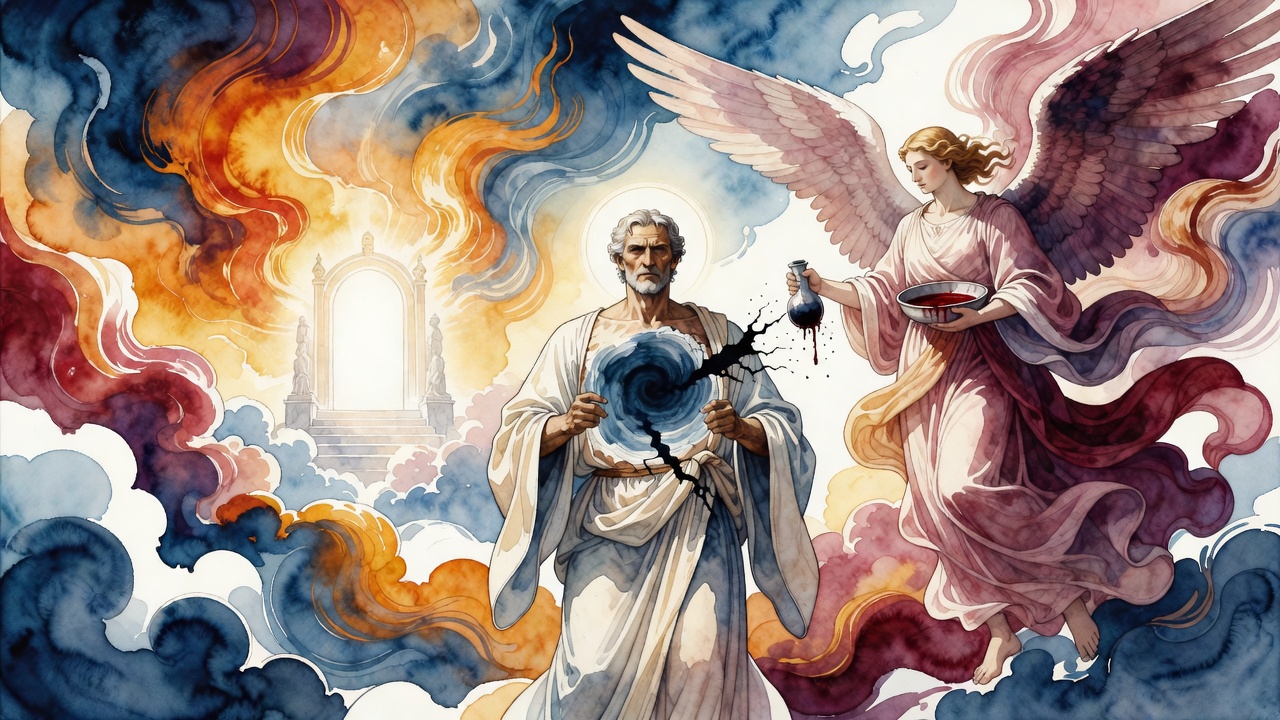
Gabriel walked Jerusalem with two pens, ink for the men who wept over the city and blood for the men who ran it. Then Justice asked her question.

Curated by Arthur · Told by Maggid ·
Table of Contents
  1. Two Pens for Gabriel
  2. A Hundred Zuzim in the Street
  3. The Lender Argued With Heaven
  4. Justice Would Not Sit Down
  5. Begin at My Sanctuary
Hate in the Heart Marked Jerusalem for the Destroyers Click for full size

Two Pens for Gabriel

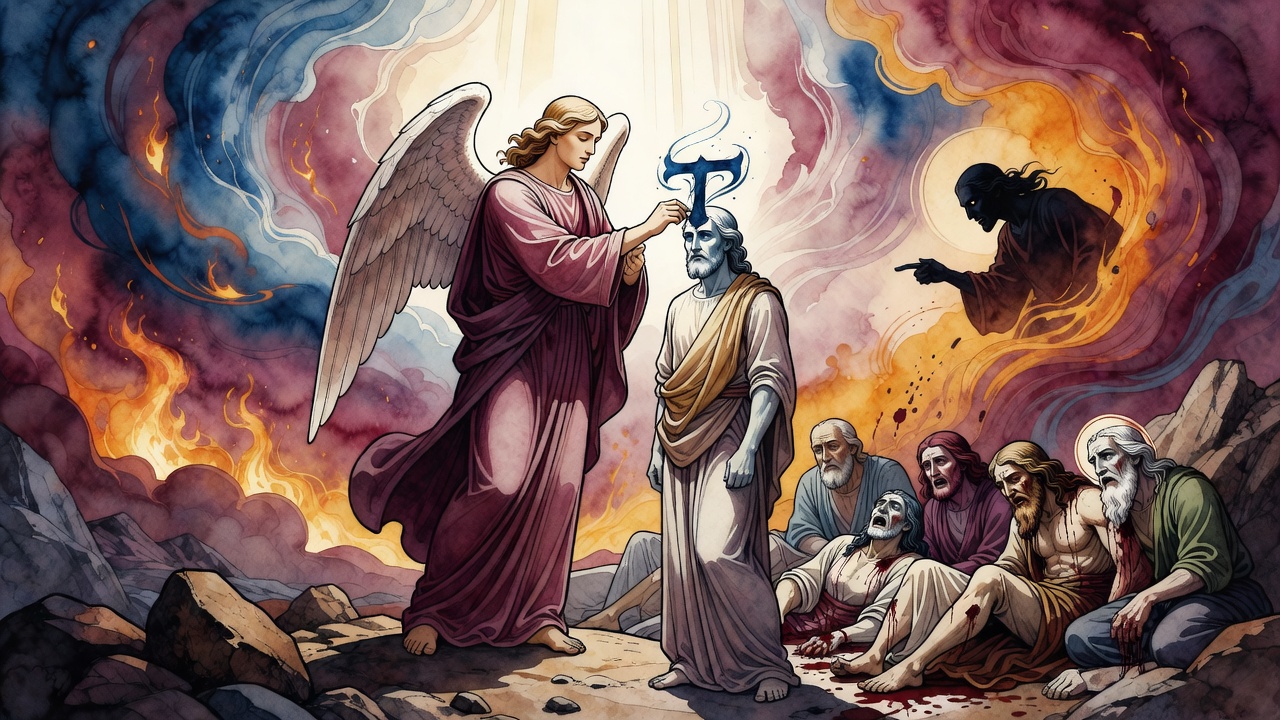
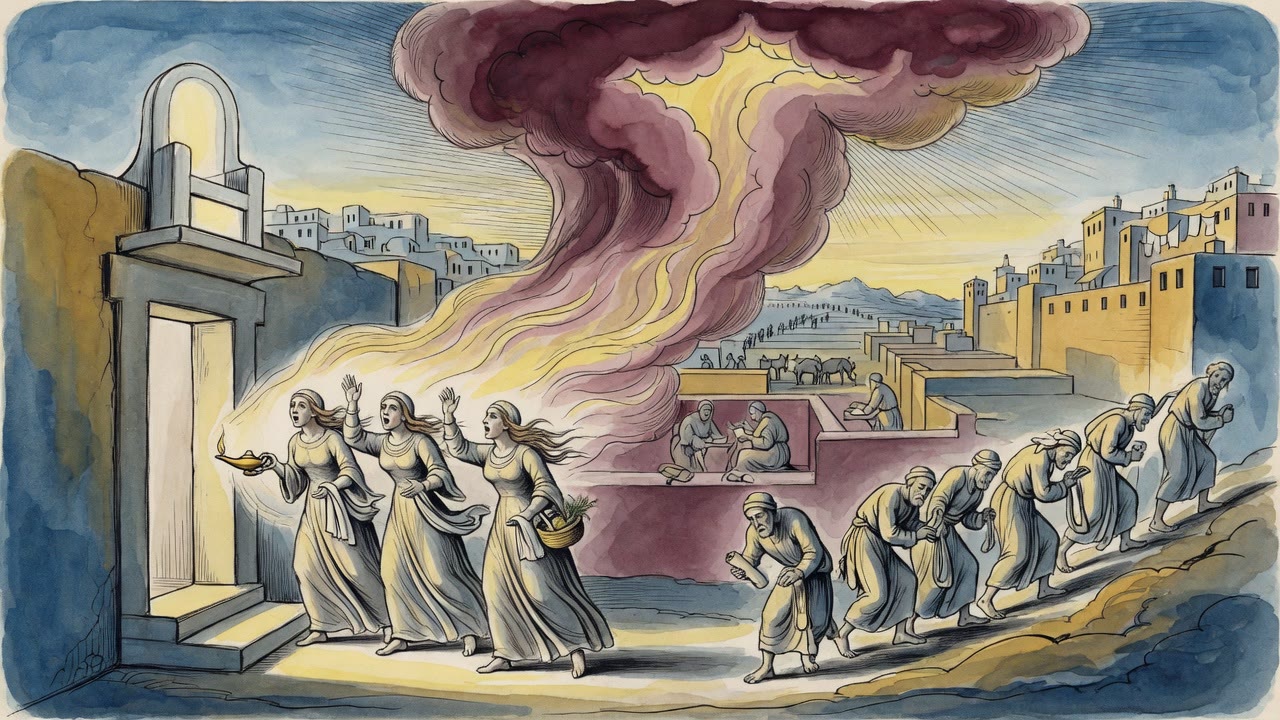
The order came before the killing did. God called Gabriel and sent him the length of Jerusalem with instructions about the living. Write a tav in ink on the forehead of every man who sighs and cries over what is done in this city. Write a tav in blood on the forehead of every man who does it.

One letter, two inks. It is the letter that begins the word for live and the word for die.

Gabriel went down into the streets. Behind him the destroyers waited, and a wet letter on a man's skin was the whole difference between a house they could enter and a house they had to walk past.

A Hundred Zuzim in the Street

What Gabriel walked through was ordinary. A creditor had a neighbor down in the dust over a hundred zuzim. He beat him, stripped the coat off his back, took what he could carry, and then went and broke the pledges the man had left in his keeping so there would be nothing to argue about afterward.

Further along, a widow counted what she owed and found the sum had grown again while she slept. A naked man went door to door asking charity and got laughed down the road, which the Holy One had already named as blasphemy against his Maker.

The doors on both sides of that street stayed shut. Behind them lived men who knew every name in the business. Not one of them had ever struck a neighbor or cursed him. They kept their hate in the heart, where nothing shows and no court can reach it, and they said nothing.

The Lender Argued With Heaven

One of the lenders had his answer ready and said it out loud. "Do You not take payment from Your own world? From the earth You water, from the flowers You raise, from the light You let in. From the soul You breathe into a man and the body You keep for him. You collect. So do I."

The Holy One answered him. "Look how much I have loaned out, and I take no interest on any of it. Look how much the earth has loaned you, and she charges you nothing. I take back the principal and not a coin over. The dust goes back to the ground. The breath comes back to Me."

A king once opened his treasury to a man he trusted. The man went out with the king's silver and used it to break the poor, kill widows, shame the naked at his gate, and swear to whatever suited him, and by the time the money was gone the whole treasury had turned into lies. Mine is the silver and Mine is the gold, said the Holy One. I handed him a storehouse of truth and he made it a storehouse of falsehood.

Justice Would Not Sit Down

Divine Justice had been standing there the whole time, and she spoke before Gabriel finished his round.

"Master of the Universe. What is the difference between the two of them?"

"One is wholly righteous," He said. "The other is wholly wicked."

"It was in their power to hold the wicked back. They never tried."

"It is open and known to Me that if they had tried, the wicked would not have listened to them."

She did not move away from Him. "It was revealed to You. Was it revealed to them?"

He gave her no answer.

Begin at My Sanctuary

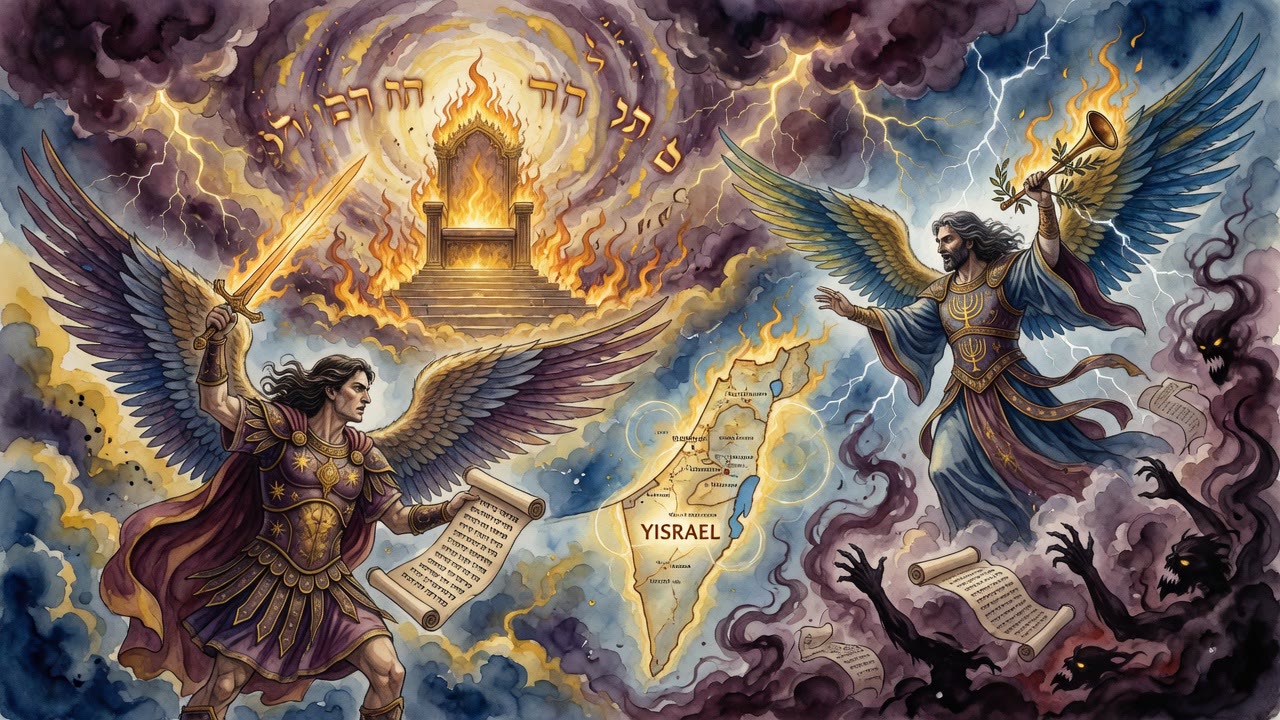
He turned and gave the destroyers their orders. Kill the old man and the young man, the girls, the small children, the women. Come nowhere near a man who carries the mark. Begin at My sanctuary.

Rabbi Joseph refused to hear the word as sanctuary. Read it as My sanctified ones, he said. It means the men who took the whole Torah on themselves and kept it from alef to tav.

They began with the elders standing in front of the house.

The rule those elders had been given was never a gentle one. Rav said a man goes on rebuking his neighbor until the neighbor strikes him. Samuel said until the neighbor curses him. Rabbi Johanan said until the man's anger catches. All three of them took the measure from one supper at Saul's table, where Saul turned on his own son, called him the son of a perverse rebellion, and then picked up his spear and threw it at him.

That was the price, and the elders had weighed it in their doorways with the street running in front of them, and decided not to pay. King Josiah, whom Scripture will not compare to any king before him, was charged with his own generation the same way. The ink was still drying on the foreheads of men who had wept for the city when the destroyers reached them, and they were the first ones reached.


← All myths
From the tradition

Sources

2 sources

The texts behind this telling. Some cards carry a translation of the source; others are our own retelling of it, and each card says which. Every card links out to the original.

Midrash Tanchuma, Mishpatim 7Midrash Tanchuma

Retold in our words. Read the original at the link below.Townsend 1989 translation of Midrash Tanhuma, S. Buber Recension · CC-BY

It has been taught: thou shalt not hate thy brother in thy heart (Lev. 19:17). You might say that this means you must not strike him or curse him. However, since Scripture says in thy heart, the verse refers only to hate in one’s heart. How do we know this? If someone observes something unseemly in his friend’s behavior, he is obliged to reprove him, as Scripture says: Thou shalt surely rebuke him (ibid.). However, if he does rebuke him and he refuses to accept the rebuke, he must continue to rebuke him. How do we know this? Because Scripture says: Thou shalt surely rebuke him. It is possible that one might continue to rebuke him to the point at which his countenance will change (from embarrassment). Hence Scripture states: Thou shalt not bear sin because of him (ibid.).

It has been taught because of this verse Thou shalt surely rebuke him that the master (must rebuke) his disciple. How do we know that the disciple must also rebuke his master? We learn from what Scripture states: Thou shalt surely rebuke him.

He who does not rebuke a sinner is considered culpable for the sin that was committed. Mar said: Everyone who is able to restrain the men of his household from committing a sin, yet fails to do so, is held responsible for the sins committed by the men of his household. If he is able to restrain the men of his city, and does not do so, he is held responsible for the men of the city, and if he could have restrained the inhabitants of the world from sinning, he is held culpable for the sins of the inhabitants of the world. R. Hanina said: Why is it written: The Lord will enter into judgment with the elders of His people and the princes thereof (Isa. 3:14)? After all, if it is the princes who have sinned, why should the elders be considered as having sinned? The elders have sinned because they failed to dissuade the princes from sinning.

R. Judah declared that Rav said: Why is it written: And the Lord said unto him: “Go through the midst of the city, through the midst of Jerusalem, and set a mark upon the foreheads of the men that sigh and that cry for all the abominations that are done in the midst thereof” (Ezek. 9:4). The Holy One, blessed be He, said to Gabriel: Go, mark a tav with ink on the forehead of the righteous men so that the angel of destruction shall not prevail over them, and place a tav with blood upon the forehead of the wicked men so that the angel of destruction shall have power over them. Divine Justice said to the Holy One, blessed be He: Master of the Universe, what really is the difference between the two? He answered: One is wholly righteous and innocent, while the other is wholly wicked. But Master of the Universe, she responded, it was in their power to at least attempt to restrain the wicked from behaving as they did, but they did not seek to prevent it. Whereupon He retorted: It is disclosed and known to Me that even if they had tried to prevent them, they would not have obeyed. Forthwith she retorted: Master of the Universe, this was revealed to You, but was it known to them?

He turned and said: “Slay utterly the old man and the young man, the maiden, the little children and women; but come not near any man upon whom is the mark; and begin with My Sanctuary.” Then they began with the elders that were before the house (Ezek. 9:6). Why does it say begin with My Sanctuary? R. Joseph taught: Do not read mikdashi (“My Sanctuary”) but rather mekudeshi (“My sanctified ones”). These are the men who accepted and fulfilled the Torah in its entirety, from alef to tav. Hence you learn that even the completely righteous are held responsible for their generation.

Similarly, it states: That I will cut off from thee the righteous and the wicked (Ezek. 21:8). The righteous ones were cut off because they did not try to restrain the wicked ones. That is why you find that King Josiah was held responsible for the acts of his generation, even though it is written concerning him: And like unto him there was no king before him (II (Kings 23:2)5). How far should one go in reproving one’s neighbor? Rav said: Until his neighbor strikes him. Samuel contended: Until he curses him. R. Johanan held: Until he becomes angry. All three reached their conclusions from the same verse, where it is said: Then Saul’s anger was kindled against Jonathan, and he said unto him: “Thou son of perverse rebellion” (I Sam. 20:30). And then it is written: And Saul cast his spear at him to smite him (ibid., v. 33).

It is taught that Rabbi said: What is the proper way for a man to react to the reproof of his neighbor? He should accept the rebuke, for as long as rebuke is accepted in the world, ease, goodness, and blessing will prevail as well, and evil will vanish from the world, as it is said: But to them that rebuke shall be delight, and a good blessing shall come upon them (Prov. 24:25). That is, to the one who rebukes and to the one who is rebuked. Others say: He will be strengthened by his increased faith, as it is said: Mine eyes are upon the faithful of the land, and they may dwell with Me (Ps. 101:6).

R. Samuel the son of Nahmani said that R. Jonathan stated: Whoever rebukes his companion for religious reasons earns a share of divine grace, as it is said: He that rebuketh a man shall in the end find more favor (Prov. 28:23). And furthermore a thread of divine favors will be drawn about him, as is said: He shall find favor. Scripture says: Mine ordinance shall ye do (Lev. 18:4). These are ordinances which, if they were not enumerated in the Torah, ought to have been. Scripture is speaking here of idolatry and blasphemy. My statutes shall ye keep, to walk therein (ibid.). These are the commandments against which the evil inclination contends, and against which the peoples of the earth rebel. These are: the wearing of garments made of wool and linen, the eating of pig, the spittle of a childless sister-in-law, mixing seeds, stoning an ox for killing a human being, the heifer whose neck was broken, the bird sacrifice brought by a leper, a firstling of an ass, meat prepared in milk, and the goat that has been sent away (the scapegoat). You might maintain that these are unimportant prohibitions. Hence Scripture says: I am the Lord: I have decreed them, and you art not permitted to repudiate them.

Full source
Midrash Tanchuma, Mishpatim 12Midrash Tanchuma

Retold in our words. Read the original at the link below.Townsend 1989 translation of Midrash Tanhuma, S. Buber Recension · CC-BY

If thou lend money to any of my people (Exod. 22:24). Scripture states elsewhere in reference to this verse: Well is it with the man that dealeth graciously and lendeth, that ordereth his affairs rightfully, for he shall never be moved (Ps. 112:5). All of God’s creations borrow from each other; day borrows from night, and night from day, but they do not bring charges against each other in court as mortals do, for it is said: Day unto day uttereth speech, and night unto night revealeth knowledge; there is no speech, there are no words (Ps. 19:3).

The moon and the stars borrow from each other, and when the Holy One, blessed be He, wills it, they do not go forth, as it is said: Who commandeth the sun, and it riseth not; and sealeth up the stars (Job 9:7). The night borrows from the sun, and the sun from the night, yet it is said: The sun and moon stand still in their habitation (Hab. 3:11). Wisdom borrows from understanding, and understanding borrows from wisdom, as it is said: Say unto wisdom: “Thou art my sister,” and call understanding thy kinswoman (Prov. 7:4). Mercy and righteousness borrow from each other, as it is said: He that followeth after righteousness and mercy (Prov. 21:21). Heaven and earth borrow from each other, as it is said: The Lord will open unto thee His good treasure the heaven (Deut. 28:12). The Torah and the commandments, likewise, borrow from each other, as is said: Keep My commandments and live (Prov. 7:2).

All the creations of the Holy One, blessed be He, borrow from each other yet live at peace with each other; only man borrows form his fellow man and the lender seeks to devour the borrower through interest and robbery. One who takes interest is actually saying to the Holy One, blessed be He: Do You not take payment from Your world in which Your creatures reside? Payment from the earth which You water, from the flowers which You cause to grow, from the light You make shine, from the soul which You breathe (into us), from the body which You protect? The Holy One, blessed be He, replied: See how much I have loaned, yet I do not take interest, and see how much the earth has loaned you for which it does not take interest. I take only the principal which I have loaned, and the earth takes back only her principal, as it is said: And the dust returneth to the earth as it was, and the spirit returneth unto God who gave it (Eccles. 12:7).

What is written about one who takes interest? He that hath given forth upon interest, and hath taken increase; shall he then live? He shall not live (Exod. 18:13). This may be compared to a king who makes his treasures available to a certain individual who later begins to oppress the poor, kill the widows, embarrass the needy, despoil the naked, do violence and theft, indulge in falsehood, and squander the king’s treasures. Similarly, the Holy One, blessed be He, opens His treasure to the wealthy, with all that He possesses in it, as it is said: Mine is the silver, and Mine the gold (Hag. 2:8). Then the rich man begins to loan money on interest. And he starts to taunt the widows and oppress them with interest, to embarrass the poor, and to humiliate the naked who seek charity from him, even though the Holy One, blessed be He, had declared: Whoso mocketh the poor blasphemeth his Maker (Prov. 17:5). If a man’s neighbor is in debt to him for a hundred zuzim, he beats him, strips him, does violence to him, steals from him, and destroys the pledges he entrusted to him. Then the Holy One, blessed be He, says: Woe to thee that spoilest, and thou was not spoiled; and dealest treacherously, and they dealt not treacherously with thee! When thou hast ceased to spoil, thou shalt be spoiled (Isa. 33:1). The Holy One, blessed be He, gave him wealth from His treasure house, which was a treasure house of truth, and he made it into a treasure house of falsehood, as it is said: Ye have plowed wickedness, ye have reaped iniquity, ye have eaten the fruit of lies, for thou didst trust (Hos. 10:13). Hence, when the whirlwind passeth, the wicked is not more (Prov. 10:25). And that is why Solomon proclaimed: Rob not the weak, because he is weak, neither crush the poor in the gate; for the Lord will plead their cause (ibid. 22:22).

Thou shalt not revile God (Exod. 22:7). Observe that the Holy One, blessed be He, warned the people concerning their judges and their leaders. You find that Korah and his followers would not have been destroyed had they not embarrassed Moses and Aaron. Similarly, the men of Jerusalem were stricken only because they despised the words of the prophets, as it is said: That they mocked the messengers of God, and despised His words; until the wrath of the Lord arose against His people, till there was no remedy (II Chron. 36:16). It is also written: They have made their faces harder than a rock; they have refused to return (Jer. 5:3). Thus the Holy One, blessed be He, reminded the Israelites concerning the respect due to elders, who had warned Israel against idolatry, as it is said: And in all things that I have said unto you take ye heed; and make no mention of the name of other gods (Exod. 23:13).

What is written following this? Three times thou shalt keep a festival unto Me in the year (ibid., v. 14). The Holy One, blessed be He, established the festival of unleavened bread, on which He performed miracles in their behalf in Egypt; the harvest festival (Shavuot), on which He gave them the Torah, the fruits of which they were to enjoy in this world and their interest in the world-to-come, as it is said: My fruit is better than gold, yea, than fine gold; and My produce than choice silver (Prov. 8:19); and the feast of ingathering (Sukkoth), on which the Holy One, blessed be He, fills their homes with blessings, as is said: Honor the Lord with thy substance, and with the first-fruits of all thine increase; so shall thy barns be filled with plenty, and thy vats shall overflow with new wine (Prov. 3:9–10). Thus it is said: The choicest first-fruits of thy land thou shalt bring into the house of the Lord thy God (Exod. 23:19).

Full source