Parshat Naso6 min read

The Spirit of Folly Slips In Before Any Door Is Opened

Nobody betrays a marriage until a spirit of madness has taken the room first, and God waits at the outer gate where the laughing stops.

Curated by Arthur · Told by Maggid ·
Table of Contents
  1. The Architect Who Built Every Hiding Place
  2. The Prisoner Who Laughed at the First Guard
  3. The Whisper Under the Roof Beams
  4. Ten Broken in a Single Night
  5. The Boy Who Stacked Wood on the Sabbath

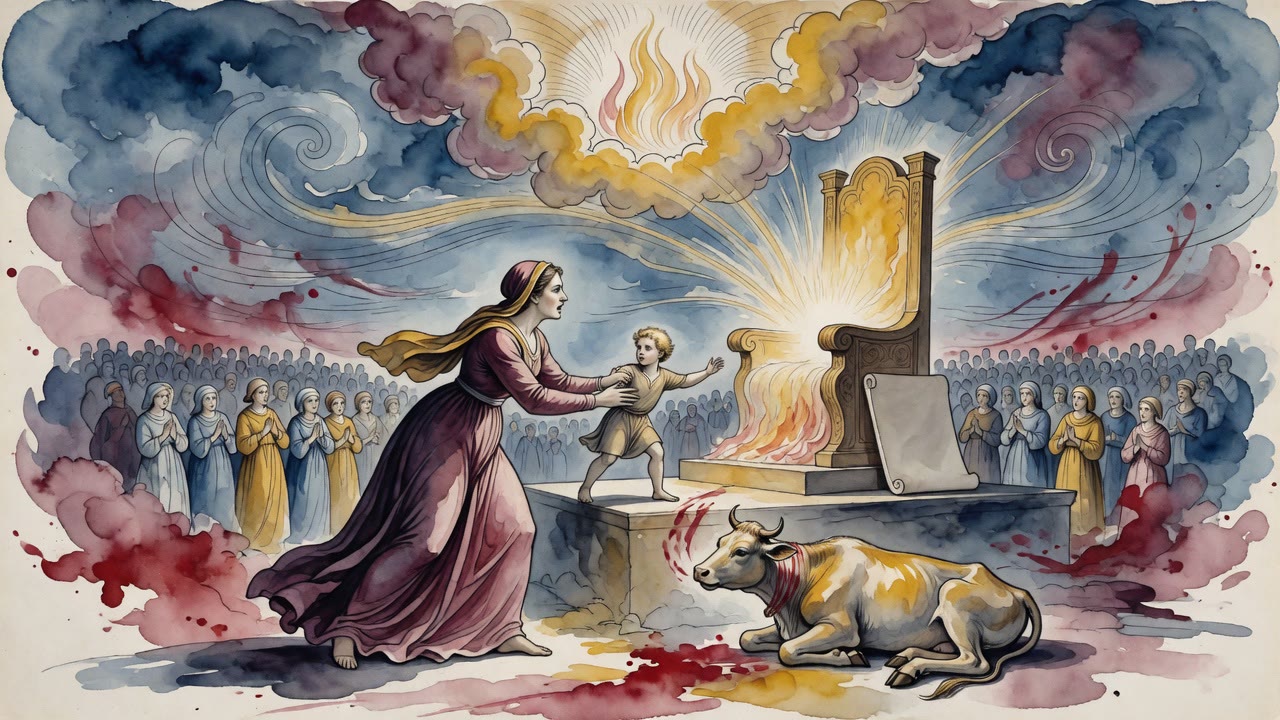
It slips in before the husband comes home, before any door is opened. Doors are nothing to it. That evening it came through the seam where the lamplight ran along the wall and settled on her the way dust settles on oil. A spirit of folly. Shetut is the name for it, and nobody lies down in another man's bed until that spirit has taken the room first.
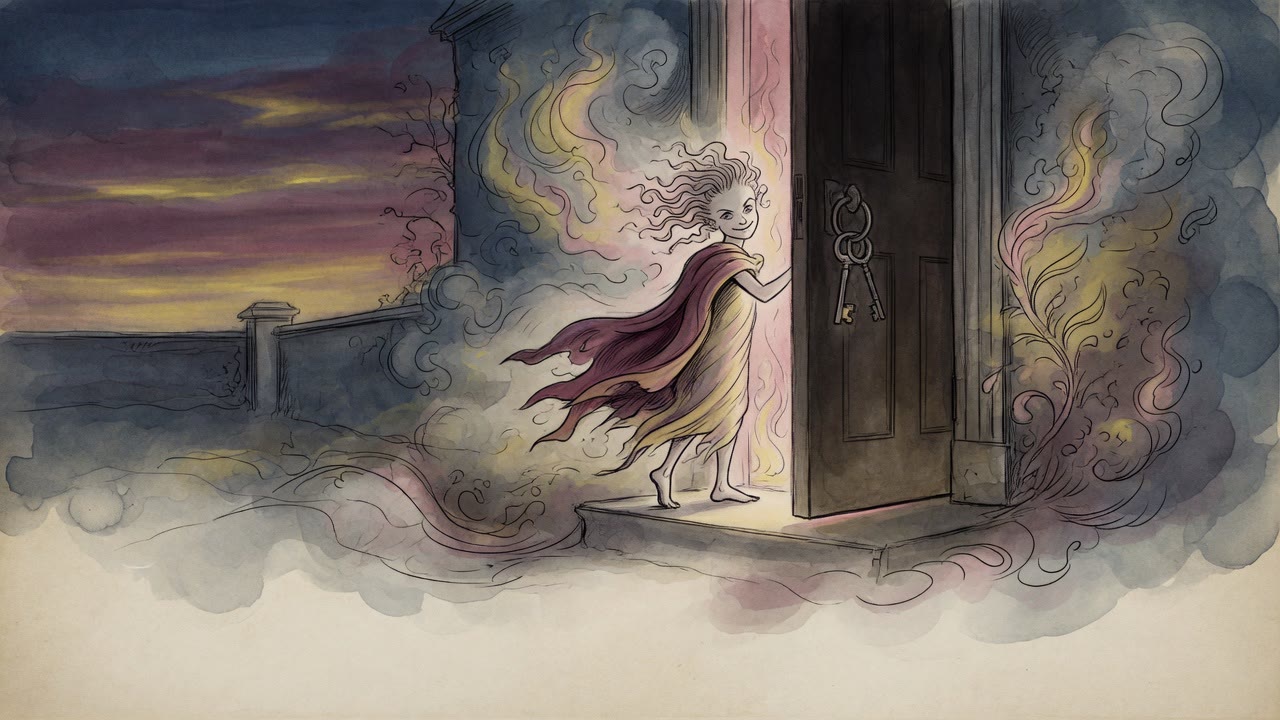
The Spirit of Folly Slips In Before Any Door Is Opened Click for full size

She did not shout or stumble. She poured the water, set down the bread, folded her hands while her husband talked about barley. By the time she rose to bank the fire she had chosen the hour, the lane, and the excuse. Solomon wrote that a man who does this has no heart. The heart goes earlier, quietly, while the household is still eating.

The Architect Who Built Every Hiding Place

An architect laid the streets of a province nobody bothered to name, and cut storerooms into the rock under its houses, hollow chambers for grain and wine and whatever a family wanted out of sight. Then he went away.

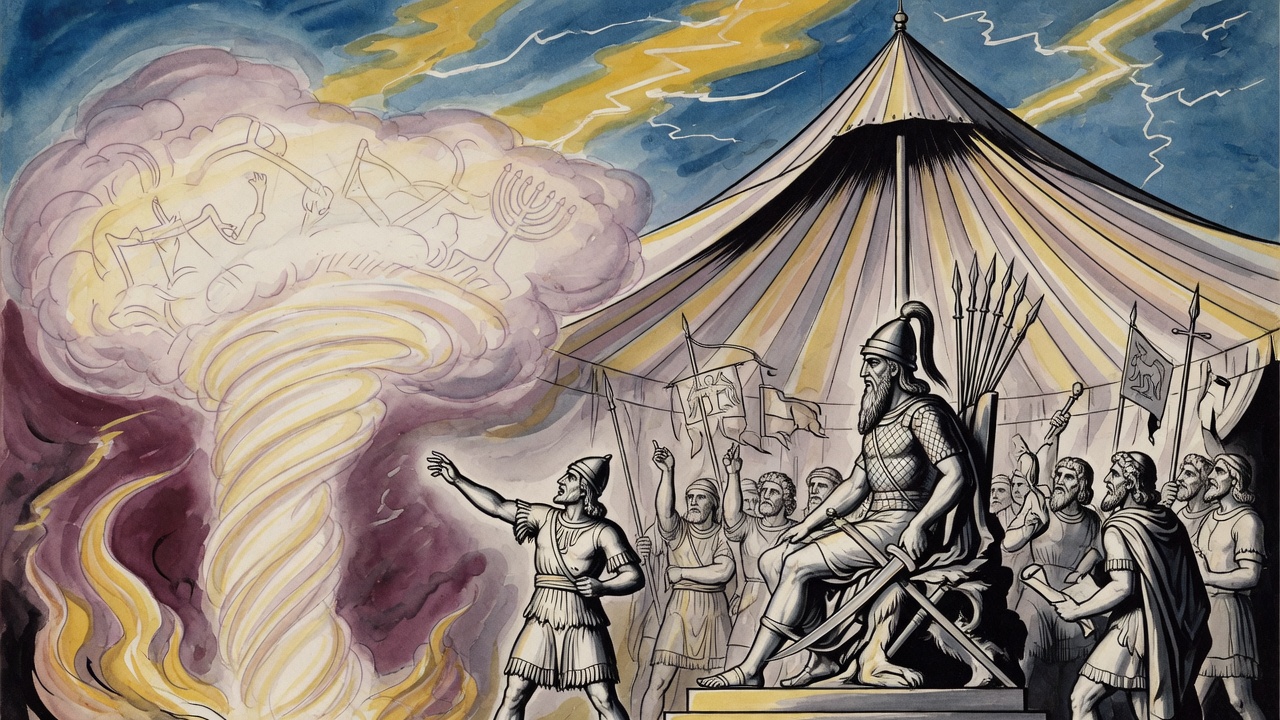
Years later he came back wearing the seal of a katarikos, a tax official counting what the province was worth. The people knew what to do. All night they carried silver down the stairs he had cut for them, pushed gold deep into the rock, rolled the stones back, and slept well.

In the morning the architect stood in the square and laughed at the ground under his feet. "I built this province," he said. "I cut those treasuries with my own hands. From me you thought to hide?"

The Holy One says the same to every man who goes into his neighbor's house after dark. "I made you. I hollowed out every cavity in you Myself. Which one did you plan to crawl into?" The heavens are His throne and the earth His footstool, and He promised to draw near for judgment, a swift witness against adulterers.

The Prisoner Who Laughed at the First Guard

A man was shut inside a house that stood within another house, and two guards held him, one in the inner yard and one at the outer gate. He worked the inner bolt for three nights until it gave. The door swung and the guard inside never lifted his head.

He crossed the yard between the two houses, and it was easy, and he began to smile in the dark.

Then the outer door. He had it open a hand's width, cold air coming through the gap, when a fist closed on his arm and held him in the opening.

"At that one inside you made sport," the outer guard said. "At me you cannot make sport."

The Whisper Under the Roof Beams

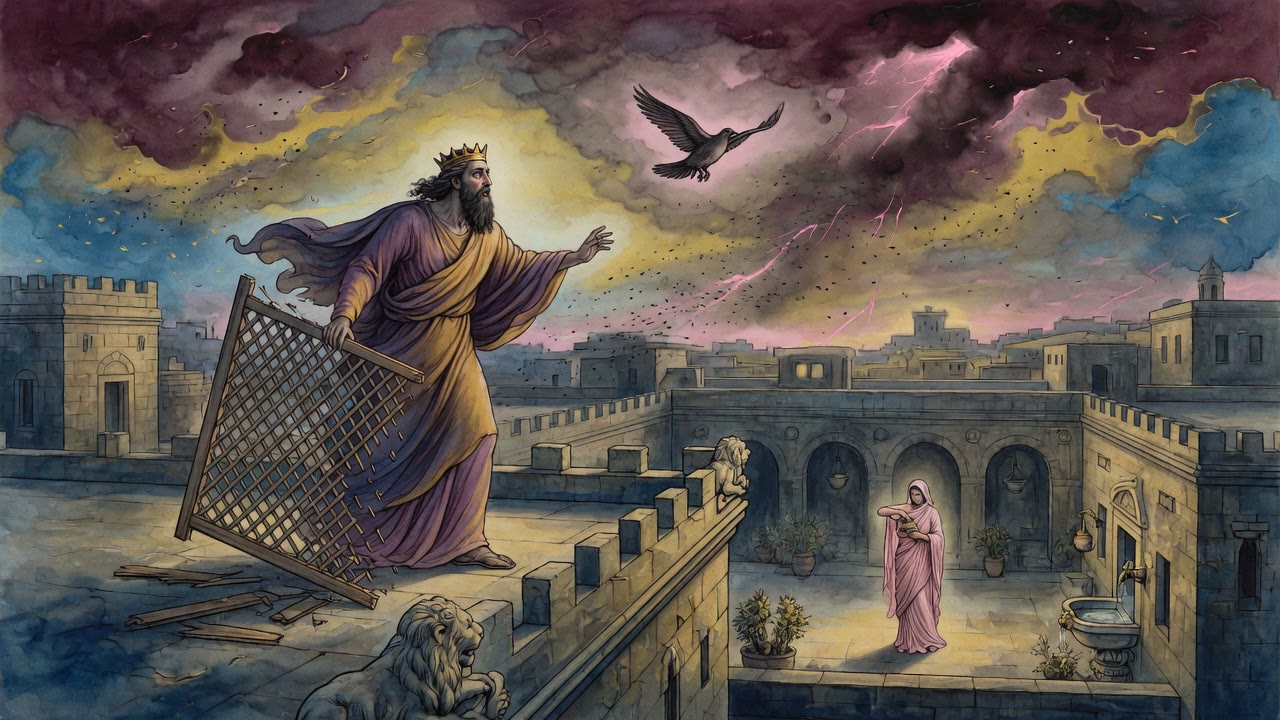
A woman who goes astray is false with two at once, with her man in the house below and with the Man of war above, and the second was in the room the whole time. He bent close in the dark she had picked so carefully.

"You made sport of your husband down here," He said. "Did you suppose you could make sport of Me?"

She had counted on the walls, and the count was right. The brick was thick. The bolt held. No lamp burned at the end of that lane. The One who sits in the heavens laughs, and He was laughing then, and the sound of it was not kind.

Ten Broken in a Single Night

Rabbi Hanina, the father of Rabbi Aha, said it flat across the study house floor. The adulterer and the adulteress break all ten of the commandments given at Sinai.

"Nine we grant you," his students said. So he counted them out.

A man who goes in to his neighbor's wife has already denied the Holy One, and Jeremiah heard that generation say it aloud, "He does not exist." He provokes a jealous God, and the meal offering of jealousies stirs two jealousies, one in the husband and one in heaven. He swears by the Name that he never touched her. The child of that hour honors the wrong man at the table and strikes the right one in the market. He walks in ready to kill or be killed. He commits the adultery, which needs no argument. He steals his neighbor's source, and stolen waters are sweet. The woman lies to her husband's face, "I am pregnant from you." The coveting takes the rest, since the husband dies believing the boy is his and writes him the whole estate.

The Boy Who Stacked Wood on the Sabbath

"That is nine," the students said. "Where is the Sabbath in this?"

Rabbi Hanina told them about a priest with a priestly wife, and an Israelite who went in to her. The household counted her son a priest's son, and he grew up counting himself one. When his turn came he went up to serve, and on a Sabbath morning he stacked the wood and lifted the portions and did the work that belongs to the sons of Aaron alone. He stood glad in his linen while the smoke rose, profaning the day with every motion, and nobody in the court knew it.

Solomon said he found the woman more bitter than death, her heart snares and nets. A net takes fish in the water and takes nothing on dry ground. This one takes on the water and on the ground both, in this world and in the world coming.

The daughters of Israel do not walk loud or laugh coarse in a doorway. If a woman laughed that way with a man in the lane, her husband warned her before two witnesses. "Why are you laughing with him? Why do you stand there talking?" If she had only talked, her door stayed open and she ate terumah at her own table. If she went in with him and lingered to be defiled, the door did not open again.

She stood in the lane with the bolt on the other side of the wood. The spirit that came in first had already gone out looking for another lamp.


← All myths

From the tradition

Sources

3 sources

The texts behind this telling. Some cards carry a translation of the source; others are our own retelling of it, and each card says which. Every card links out to the original.

Midrash Tanchuma, Nasso 5Midrash Tanchuma

Retold in our words. Read the original at the link below.Townsend 1989 translation of Midrash Tanhuma, S. Buber Recension · CC-BY

(Numb. 5:12:) “If anyone has his wife go astray (tisteh).” Our masters have taught, “The adulterers do not commit adultery, until a spirit of madness (shetut) enters them. Thus it is stated (ibid.), ‘If anyone has his wife go astray.’” [Here] we have learned about the woman. Where is it shown about the man? Where it is stated (in Prov. 6:32), “The one who commits adultery with a woman is has no sense (literally, is lacking heart).” Another interpretation (of Numb. 5:12), “If anyone has his wife go astray.” This text is related (to Jer. 23:24), “If someone hides in secret places, [shall I not see him?]” See, is it not already written (Psalms 16:3), “The eyes of the Lord are everywhere, observing the bad and the good.” And so too is it written (in Zech. 4:10; cf. II Chron. 16:9), “the eyes of the Lord; they roam around all the earth.” [So] what do we learn to say (in Jer. 23:24), “Shall I not see Him (ar'ennu)?” [Interpret these words as follows:] Shall I not show him (ar'ennu) to the people and publish his works? (Jer. 23:24, cont.), “’Do I not fill the heavens and the earth,’ says the Lord.” I fill the realms above and the realms below, as stated (Is. 66:1), “The heavens are My throne and the earth is My footstool.” Another interpretation of (Jer. 23:24), “[If someone hides in secret places], shall I not see him? It is comparable to an architect [who] went out as a katarikos (tax official) over a certain province. The inhabitants of the province began hiding their silver and gold within the very caves [that he had built]. The architect said to them, ‘I built the province, and I made the hidden treasuries. Will you hide [anything] from me?” Similarly, the Holy One, blessed be He, has said to adulterers, “Will you hide yourselves from me?” [It is as in (Jer. 23:24),] “If someone hides in secret places, I have created you and made your every cavity (mehilim mehilim).” [It is so stated (in Deut. 32:18),] “but you forgot the God who generated you (meholelekha).” Nothing will be useful to you, wherever you hide yourselves, because (according to Jer. 17:10:) “I the Lord search the heart, probe the kidneys, to render to each according to his ways, according to the fruit of his deeds.” I am the one who brings (rt. qrb) you to judgment, as stated (in Mal. 3:5), “Then I will draw near (rt. qrb) unto you in judgment; and I will be a swift witness against sorcerers, against adulterers […].” Therefore, you shall not go astray after the evil drive, so that none of you have his wife go astray, according to what is stated (in Numb. 5:12), “If anyone has his wife go astray.” Another interpretation (of Numb. 5:12), “If anyone (literally, if a man a man) [has his wife go astray].” [These words are] to teach you that she is going astray and being false with two, with the “Man of war” (as in Exod 15:3) above and with her man (husband) below. The Holy One, blessed be He, says to her, “You lie to your husband, can you perhaps lie to Me? A parable: To what is the matter comparable? To someone who was imprisoned within two houses, one inside the other. Now two guards were there, one on the inside and one on the outside. [The prisoner] opened [the door of] the inner [house] and left, and the guard did not notice him. When he came to leave the outer one, [the guard] did notice him. He seized him and said to him, “At that [guard] on the inside you laughed, but at me you cannot laugh.” Similarly the Holy One, blessed be He, has said to the adulterous woman, “At your husband you laugh, but at me you cannot laugh. Rather I sit and laugh at My creatures.” It is so stated (in Ps. 2:4), “The One sitting in the heavens shall laugh […].

Full source
Midrash Tanchuma Buber, Nasso 9:2Midrash Tanchuma Buber, Nasso

Translation of the source text.Midrash Tanchuma (Buber), Public Domain, on Sefaria · CC-BY-SA

Another interpretation of (Numbers 5:12): "Any man whose wife goes astray." The Holy One, blessed be He, said to her: You make sport with your husband below; do you suppose you can mock Me? A parable: To what may the matter be compared? To one who was imprisoned within two houses, one inside the other, and there were two guards there, one inside and one outside. He opened the inner one and went out, and the guard did not notice him. When he came to go out from the outer one, the guard noticed him and seized him. He said to him: At that one inside you made sport, but at me you cannot make sport. So too the Holy One, blessed be He, said to the adulterous woman: At your husband you made sport, but at Me you cannot make sport. Rather, I sit and make sport of My creatures, as it is said (Psalms 2:4): "He who sits in the heavens shall laugh."

Full source
Midrash Tanchuma, Nasso 2Midrash Tanchuma

Retold in our words. Read the original at the link below.Townsend 1989 translation of Midrash Tanhuma, S. Buber Recension · CC-BY

Our masters have said in the name of R. [Hanina] (Huna) the father of R. Aha, “The adulterer and adulteress transgress the Ten Commandments.” [They] said to [him], “In the case of nine, we concede [his transgressing them].” How is this? In the case of (Exod. 20:2 = Deut. 5:6:) “I [am the Lord your God],” because anyone who commits adultery with the wife of his acquaintance is, as it were, denying the Holy One, blessed be He. It is so stated (in Jer. 5:8, 12), “They have denied the Lord and said, ‘He does not exist.’” (Exod. 20:5 = Deut. 5:7:) [“You shall have no other Gods”], since it is written of Him (in Exod. 20:5 = Deut. 5:9), “for [I] the Lord your God am a jealous God.” Also it is stated two times concerning the adulteress (in Numb. 5:14), “If the spirit of jealousy came over him, and he is jealous of his wife.” But why two times? Because it (i.e., the meal offering of the next verse) excites jealousy for the Holy One, blessed be He, and for her husband, as stated (in Numb. 5:15), “for it is a meal offering of jealousies.” Thus it is a case of two jealousies. (Exod. 20:7 = Deut. 5:11:) “You shall not take the name of the Lord your God [in vain].” [One breaks this commandment] because he commits adultery and swears in vain that he has not done so. (Exod. 20:12 = Deut. 5:16:) “Honor your father.” When one commits adultery with the adulteress, she becomes pregnant from him. Then she says to her husband, “I am pregnant from you.” When the fetus is grown, it honors her husband, [since it] thinks that he is its father. Moreover, [the grown child] passes through the market and hits the adulterer, since he thinks that he is not his father. (Exod. 20:13 = Deut. 5:17:) “You shall not murder.” The adulterer goes in on condition that, if he is caught, he will kill or be killed. (Exod. 20:13, cont. = Deut. 5:17, cont.) “You shall not commit adultery.” Obviously [this commandment is broken], because he is committing adultery. (Exod. 20:13, cont. = Deut. 5:17, cont.) “You shall not steal.” [This commandment is broken] because he is stealing his neighbor's source (i.e., his wife's womb), and so it says (in Prov. 9:17), “Stolen waters are sweet […].” (Exod. 20:13, cont. // Deut. 5:17, cont.) “You shall not bear [false witness] against your neighbor.” [The commandment is broken] in that [the adulteress] bears false witness [to her husband] and says, “I am pregnant from you.” (Exod. 20:14; cf. Deut. 5:18:) “You shall not covet your neighbor's house, and you shall not covet your neighbor's wife […].” [The commandment is broken] because whoever covets his friend's wife and commits adultery with her, covets everything that belongs to his friend. How? When the husband comes to depart from the world, he thinks that this son is his and writes him a will of all his assets. So he bequeaths to him whatever he has without knowing that he is not his son. It turns out that the adulterer covets whatever belongs to his friend.

They said to R. Hanina, “Here we have told you nine [commandments]. In regard to] (Exod. 20:8; cf. Deut. 5:12:) ‘Remember [the Sabbath (day)],’ how does he transgress against it?” He said to them, “I will tell you: Sometimes when a priest has a priestly wife, and a [lay] Israelite adulterer has sexual intercourse with her, such that she bears [a child] from him, they consider him (i.e., the child) to be the son of a priest. Then when the baby goes on to minister in the Temple, arrange wood, and sacrifice on the Sabbath, he is found to be profaning the Sabbath. Hence the Ten Commandments are violated by the adulteress with the adulterer. Solomon also has said concerning her (in Eccl. 7:26), “And I find [the woman] more bitter than death, [(the woman) who has snares and nets (in her heart)].” What is the meaning of “snares (rt. tswd)?” She lies in wait (rt. tswd) in this world and for the world to come. And “nets?” The net catches [prey] in the water but does not catch [any] on dry land. The woman, however, catches [her prey] in the sea and on the dry land. (Eccl. 7:26:) “And I find [the woman] more bitter than death.” Not to be loud, arrogant of gait, or bawdy in laughter: This is the way of the daughters of Israel. But if [a woman] was bawdy in the presence of one of them, one would warn her on the evidence of two [witnesses] and say to her, “Why should you be laughing with so and so? Why should you be speaking with him?” If she has [merely] spoken [with him] up to now, she is allowed into her house and may eat the terumah. [If] she has entered with him in secret and lingered to be defiled, she is forbidden her house and eating the terumah.

Full source