5 min read

He Bound the Sign on His Weaker Arm at Dawn

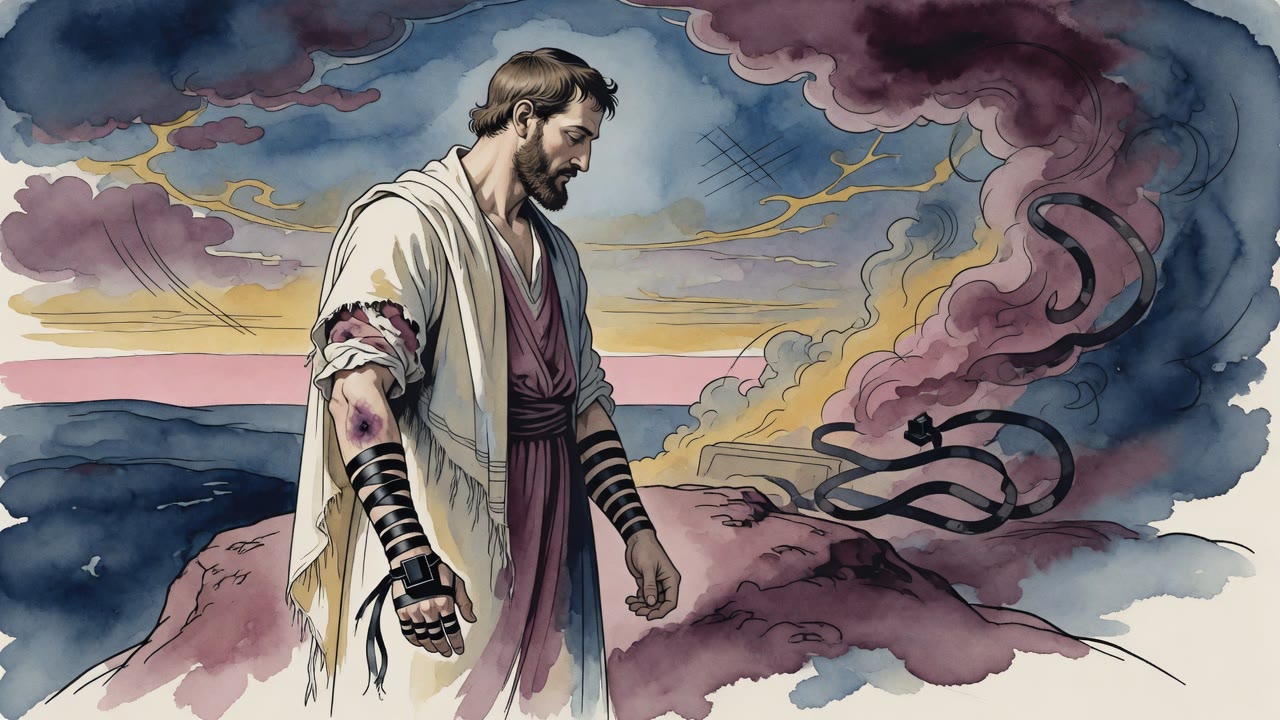
A man with a damaged right arm still bound tefillin at dawn, while night and Sabbath claimed the straps must rest as other signs.

Curated by Arthur · Told by Maggid ·
Table of Contents
  1. Which Hand Holds the Bond
  2. Days That Wear a Sign Without Leather
  3. Merit That Does Not Need Perfect Limbs
  4. The Sign and the Silence

Dawn found him fumbling the black straps with the hand that still obeyed. The other arm hung useless from an old wound, and for a long season he had thought the commandment had left him behind. Then a teacher placed the boxes where law places them for a maimed body: the sign moves to the arm that can carry it. "Upon your hand" does not vanish because the preferred hand is gone (Deuteronomy 6:8). The leather found skin. The knot closed. He stood inside the mitzvah again.
He Bound the Sign on His Weaker Arm at Dawn Click for full size

Outside, the street still slept. Inside, a damaged man and an intact command shared one morning.

Which Hand Holds the Bond

The ordinary case begins with the hand that writes. Bind them and write them sit near each other in the verse, so binding seems to belong with the strong, skilled side. Scripture can even call the right hand simply "hand," as when Jacob crossed his arms over Ephraim and Manasseh (Genesis 48:14). Strength and writing look like the natural seat of the sign.

The same words open for damaged bodies. A man whose arm is maimed places the hand tefillin (the leather prayer-box bound on the arm) on the side that remains. A left-handed man binds on his right, because for him that side is the weaker one. The spelling of "from your hand," the sages press, points toward the weak hand, not the hand of force. If pure strength were meant, the letters would lean another way. The law looks at the actual person in the room, not a diagram of an ideal soldier.

Order follows mercy into the body. Hand first, then head. Remove head first, then hand. "Between your eyes" is not the bridge of the nose but the soft place on an infant's crown, the seat of four compartments and one remembrance. Four parchments may house four passages, yet they must remain one sign, not a scatter of souvenirs. The body is not a costume rack. It is a single claim.

Days That Wear a Sign Without Leather

Night arrives, and the straps come off. If "a sign upon your hand" stood alone, a man might sleep in them as the mezuzah (the scroll fixed to the doorpost) watches the door without pause. The phrase "from days to days" narrows the window. By day you bind them, and not at night. The same grammar pushes the Sabbath and festivals outside the circle. There are days for tefillin (prayer boxes bound on arm and head) and days that refuse them.

Rabbi Yitzchak and Rabbi Azaryah reach for a deeper reason than calendar alone. The Sabbath is itself called a sign. Tefillin are also called a sign. One does not lay a sign on top of a sign. And which yields? Never the Sabbath. The day of rest is named not only a sign but a covenant, sealed so tightly that its violation carries the law's hardest edge, while tefillin bear no such weight. The lesser token steps aside before the greater. Six days a man marks the bond with straps. On the seventh, the day itself does the marking, and the leather rests.

Merit That Does Not Need Perfect Limbs

Israel once complains before Heaven that day and night labor in Torah leaves no leisure, and Heaven answers with paths of merit that meet a person where he stands. The man with the damaged arm is not a side case in that answer. He is the proof. The commandment adjusts to the body without abandoning the body. Merit accrues to the act performed, not to an imaginary anatomy.

Watch him on Friday as the sun drops. He removes the head box first, then the arm. The Sabbath will not wear leather. It will wear light and bread and the refusal of labor. He is not less bound because the straps are gone. He is bound by a larger sign that needs no black boxes to announce itself.

On ordinary mornings he returns to the weaker arm. The knot remembers him. Children who watch learn that holiness is not reserved for the symmetrical. A left hand that is strong for its owner, a right hand that is weak for another, a maimed limb that still hosts parchment: the Torah is arguing, without speech, that the covenant is measured for human flesh.

The Sign and the Silence

Between dawn leather and Sabbath air sits the whole theology of marks. Some marks are placed by the hand. Some marks are placed by the calendar. None of them is a fashion. When night falls and the boxes sleep, the mezuzah (a doorpost scroll) still watches. When Friday ends and the straps stay folded, the day itself testifies. The man who once thought his wound had erased him walks into both regimes whole enough for Heaven's purpose.

He will never forget the first morning the teacher tied the knot for him. Shame and relief shared the same breath. The sign did not mock the scar. It used the remaining strength. That is the quiet scandal of the law: it prefers a living arm that can bind to a perfect theory that cannot.


← All myths
From the tradition

Sources

2 sources

The texts behind this telling. Some cards carry a translation of the source; others are our own retelling of it, and each card says which. Every card links out to the original.

Yalkut Shimoni on Torah 222:1Yalkut Shimoni on Torah

Translation of the source text.Torat Emet (Yalkut Shimoni) · CC-BY-NC

Rabbi Nathan says: "And you shall bind them" and "you shall write them" (Deuteronomy 6:8-9): just as writing is with the right hand, so binding is with the right hand. Rabbi Yose the Snub-nosed says: We have found that the right hand is called "hand"; even though there is no proof for the matter, there is a remembrance of the matter, as it is said, "for his father placed his right hand" and so on (Genesis 48:14). And what does Scripture therefore teach by "upon your hand"? To include one whose arm is maimed, that he places it on the right. "And it shall be for you as a sign upon your hand" (Exodus 13:9): whenever the hand tefillin is on the hand, place the head tefillin on the head. From here they said: the commandment of tefillin is that when one puts them on, he puts on the hand tefillin and afterward puts on the head tefillin; and when he removes them, he removes the head tefillin and afterward removes the hand tefillin. "Between your eyes" means on the height of the head. Do you say on the height of the head, or perhaps "between your eyes" in its plain sense? Scripture therefore teaches, "You are children of the LORD your God; you shall not cut yourselves" and so on (Deuteronomy 14:1): just as "between your eyes" stated there is on the height of the head, so "between your eyes" stated here is on the height of the head. Rabbi Judah says: Since the Torah said to place tefillin on the head and on the hand, just as on the hand means a place fit to become impure through one plague-spot, so on the head means a place fit to become impure through one plague-spot.

The Rabbis taught: "for frontlets," "for frontlets," "for frontlets" - here there are four; these are the words of Rabbi Ishmael. Rabbi Akiva says: this is not necessary; tat in Katfi means two, and pat in Afriki means two. The Rabbis taught: Could one write them on four parchments and place them in four houses? Scripture therefore teaches, "and for a remembrance between your eyes" (Exodus 13:9): I told you one remembrance, not two or three remembrances. How is it done? One writes it on four parchments and places them in four houses in one leather. And if he wrote them on one parchment and placed them in four houses, he has fulfilled his obligation. The Rabbis taught: How does one write the hand tefillin? He writes it on one parchment and places it in one house in one leather. And if he wrote it on four parchments and placed them in one house, he has fulfilled his obligation; but he must join them together, as it is said, "And it shall be for you as a sign upon your hand" (Exodus 13:9). It is understandable that when one puts them on, he puts on the hand tefillin and afterward the head tefillin, for it is written, "And you shall bind them as a sign upon your hand, and they shall be for frontlets between your eyes" (Deuteronomy 6:8). But when he removes them, from where do we know that he removes the head tefillin and afterward the hand tefillin? Scripture says, "and they shall be for frontlets between your eyes" (Deuteronomy 6:8): as long as they are between your eyes, there shall be two. The tanna of the school of Menasheh taught: "upon your hand" means the upper arm; "between your eyes" means the crown of the head. Where? The school of Rabbi Yannai said: the place where an infant's brain is soft. Rabbi Yose the Snub-nosed says: from where does he derive placement on the left? It comes from the place from which Rabbi Nathan derives it. Rav Ashi said: "from your hand" - the weak hand. And say it means your hand that is with strength. He said to him: is "strength" written here with a het? The Rabbis taught: a left-handed person places tefillin on his right, which is his left. But it was taught: he places it on his left, which is the left of every person. Abaye said: that teaching was taught about one who controls both hands.

"And it shall be for you as a sign upon your hand and for a remembrance between your eyes, so that the Torah of the LORD shall be in your mouth" (Exodus 13:9). The whole Torah was compared to tefillin: just as tefillin is a positive commandment caused by time and women are exempt, so all commandments and so on. And from the fact that women are exempt from positive commandments caused by time, it follows that women are obligated in positive commandments not caused by time. This works well for the one who says tefillin is a positive commandment caused by time; but for the one who says tefillin is a positive commandment not caused by time, what can be said? Whom have you heard say this? Rabbi Meir. He holds like the one who says that two verses that come as one do not teach. And according to Rabbi Judah, who says they do teach, and that tefillin is a positive commandment not caused by time, what can be said? Because matzah, rejoicing, and Hakhel are three verses that come as one, and they do not teach. Rabbi Eleazar said: Israel said before the Omnipresent, We want to labor in the Torah day and night, but we have no leisure. The Holy One, blessed be He, said to them: Fulfill the commandment of tefillin, and I will account it to you as though you labor day and night. Rabbi Yohanan said: it is a full verse, "And it shall be as a sign upon your hand" and so on, "so that the Torah of the LORD shall be in your mouth" (Exodus 13:9). Rabbi Yehoshua ben Levi said: what Rabbi Eleazar said is only with regard to the nights, for the commandment of tefillin is fulfilled only by day, as it is said, "And you shall keep this statute" and so on (Exodus 13:10). And how do you fulfill, "and in His Torah he meditates day and night" (Psalms 1:2)? This is the recitation of the Shema, which a person recites morning and evening; it is accounted to him as though he labored in the Torah day and night.

Full source
Yalkut Shimoni on Torah 222:5Yalkut Shimoni on Torah

Translation of the source text.Torat Emet (Yalkut Shimoni) · CC-BY-NC

"From days to days" (Exodus 13:10). Why is this said? Because Scripture says, "And it shall be for a sign" (Exodus 13:9), I might understand that the nights too are included. And there is reason to argue so: since the mezuzah is a positive commandment and tefillin is a positive commandment, if you have learned about the mezuzah that it applies at night as by day, perhaps tefillin too applies at night as by day. Therefore Scripture teaches, "From days to days": by day you put them on, and you do not put them on at night.

Another interpretation: "From days to days," why is this said? Because Scripture says, "And it shall be for a sign," I might understand that Sabbaths and festivals too are included. And there is reason to argue so, as above with the mezuzah; therefore Scripture teaches, "From days to days," excluding Sabbaths and festivals.

Rabbi Yoshiyah says: "from days", there are days when you put them on and days when you do not put them on; this excludes Sabbaths and festivals. Rabbi Yitzchak says: since the Sabbath is called a sign and tefillin are called a sign, one does not place a sign within a sign. Or should one place a sign within a sign? You say: the Sabbath, which is called a sign and a covenant, shall not be set aside for tefillin, which are called only a sign and not a covenant. Rabbi Azaryah says: since the Sabbath is called a sign and tefillin are called a sign, one does not place a sign within a sign. Or should one place a sign within a sign? You say: the Sabbath, for which one is liable to karet [excision] and death by the court, shall not be set aside for tefillin, for which one is liable neither to karet nor to death by the court.

Full source