Translation of the source text.Wikisource Talmud Bavli · CC0
"I make a festive day for the Sages." Rava said: Let merit come to me, for when a young Torah scholar comes before me for judgment, I do not lay my head on the pillow until I have turned over every possible argument in his favor. Mar bar Rav Ashi said: I disqualify myself from judging a young Torah scholar. What is the reason? Because he is beloved to me like my own body, and a person does not see liability for himself.
Rabbi Hanina would wrap himself and stand at twilight on Shabbat eve, saying: Come, let us go out to greet Shabbat the queen. Rabbi Yannai would put on his garments on Shabbat eve and say: Come, bride; come, bride. Rabba bar Rav Huna happened to come to the house of Rabba bar Rav Nahman. They brought before him three seah of oiled cakes. He said to them: Did you know that I was coming? They said to him: Are you more important to us than she is?
Rabbi Abba bought meat from thirteen butchers for thirteen plain staters, and would bring it to the hinge of the doorway, saying to them: Hurry, prepare it; hurry, prepare it. Rabbi Abbahu would sit on an ivory stool and fan the fire. Rav Anan would wear a simple dark garment, as the school of Rabbi Yishmael taught: With the garments in which one cooked a pot for his master, he should not pour a cup for his master.
Rav Safra would singe the head. Rava would salt shibuta fish. Rav Huna would light lamps. Rav Pappa would twist wicks. Rav Hisda would cut beets. Rabbah and Rav Yosef would chop wood. Rabbi Zeira would prepare small kindling. Rav Nahman bar Yitzhak would shoulder loads and bring them in, shoulder loads and take them out. He said: If Rabbi Ami and Rabbi Asi came to visit me, would I not carry on my shoulder before them? And some say that Rabbi Ami and Rabbi Asi would shoulder loads and bring them in, shoulder loads and take them out, saying: If Rabbi Yohanan came to visit us, would we not carry on our shoulders before him?
Joseph, who honored Shabbat, had a certain gentile in his neighborhood who possessed very great wealth. The astrologers said to him: Joseph who honors Shabbat will consume all your property. He went and sold all his property, bought a pearl with it, and placed it in his turban. As he was crossing a ferry, the wind blew it off and threw it into the water, and a fish swallowed it. They brought the fish up and brought it on the afternoon of Shabbat eve. They said: Who will buy at such a time? They said to them: Go, bring it to Joseph who honors Shabbat, for he is accustomed to buying. They brought it to him; he bought it, cut it open, and found the pearl inside. He sold it for thirteen upper rooms' worth of gold dinars. A certain elder met him and said: Whoever lends to Shabbat, Shabbat repays him.
Rabbi asked Rabbi Yishmael son of Rabbi Yosei: By what do the wealthy in the Land of Israel merit their wealth? He said to him: Because they tithe, as it is said, "You shall surely tithe" (Deuteronomy 14:22): tithe so that you become wealthy. And those in Babylonia, by what do they merit it? He said to him: Because they honor the Torah.
And those in other lands, by what do they merit it? He said to him: Because they honor Shabbat. For Rabbi Hiyya bar Abba said: One time I was hosted by a householder in Laodicea, and they brought before him a table of gold that took sixteen men to carry, with sixteen silver chains fixed to it, and bowls, cups, pitchers, and flasks fixed to it. On it were every kind of food, every kind of delicacy, and spices. When they set it down, they said, "The earth is the LORD's, and the fulness thereof" (Psalms 24:1), and when they removed it, they said, "The heaven, even the heavens, are the LORD's; but the earth hath he given to the children of men" (Psalms 115:16). I said to him: My son, by what did you merit this? He said to me: I was a butcher, and whenever I saw a fine animal, I said: This shall be for Shabbat. I said to him: [Blessed are you that you merited this,] and blessed is the Omnipresent who granted you this merit.
The emperor said to Rabbi Yehoshua ben Hananiah: Why does the fragrance of a Shabbat dish spread? He said to him: We have one spice, and Shabbat is its name; we put it into the dish, and its fragrance spreads. He said to him: Give us some of it. He said to him: For one who keeps Shabbat, it is effective; for one who does not keep Shabbat, it is not effective.
The Exilarch said to Rav Hamnuna: What is the meaning of what is written, "And the holy of the LORD honorable" (Isaiah 58:13)? He said to him: This is Yom Kippur, when there is neither eating nor drinking; the Torah said to honor it with clean clothing. And "you shall honor it": Rav said, by making the meal earlier, and Shmuel said, by making it later. The sons of Rav Pappa bar Abba said to Rav Pappa: People like us, for whom meat and wine are common every day, how should we make it different? He said to them: If you are accustomed to eating early, delay it; if you are accustomed to delaying it, make it early. In the summer, Rav Sheshet seated the Sages where the sun would reach; in the winter, he seated the Sages where the shade would reach, so that they would rise quickly.
Rabbi Zeira would go around among pairs of Sages and say to them: Please, do not desecrate it.
Rava said, and some say Rabbi Yehoshua ben Levi said: Even an individual who prays on Shabbat evening must say Vaykhullu, "And the heavens and the earth were finished" (Genesis 2:1-3). For Rav Hamnuna said: Whoever prays on Shabbat evening and says Vaykhullu, Scripture accounts it to him as though he became a partner with the Holy One, blessed be He, in the work of creation, as it is said, "And they were finished." Do not read vaykhullu, "they were finished," but vaykhallu, "they finished." Rabbi Elazar said: From where do we know that speech is like action? As it is said, "By the word of the LORD were the heavens made" (Psalms 33:6).
Rav Hisda said that Mar Ukva said: Whoever prays on Shabbat evening and says Vaykhullu, the two ministering angels who accompany a person place their hands on his head and say to him, "Your iniquity is taken away, and your sin purged" (Isaiah 6:7). It was taught: Rabbi Yosei bar Yehuda says: Two ministering angels accompany a person on Shabbat evening from the synagogue to his home, one good and one evil. When he comes to his home and finds a lamp burning, a table set, and his bed arranged, the good angel says: May it be His will that it be so for another Shabbat. And the evil angel answers Amen against his will. But if not, the evil angel says: May it be His will that it be so for another Shabbat. And the good angel answers Amen against his will.
Rabbi Elazar said: A person should always set his table on Shabbat eve, even if he needs only an olive-bulk. And Rabbi Hanina said: A person should always set his table at the conclusion of Shabbat, even if he needs only an olive-bulk. Hot water at the conclusion of Shabbat is a remedy; warm bread at the conclusion of Shabbat is a remedy. They would prepare for Rabbi Abbahu, at the departure of Shabbat, a choice third-grown calf, and he would eat a kidney from it. When Avimi his son grew up, he said to him: Why should you waste all this? Let us leave a kidney from Shabbat eve. They left it, and a lion came and ate it.
Rabbi Yehoshua ben Levi said: Whoever answers "Amen, may His great name be blessed" with all his strength, they tear up his decree, as it is said, "When punishments break out in Israel, when the people willingly offer themselves, bless the LORD" (Judges 5:2). What is the reason for "when punishments break out"? Because "bless the LORD." Rabbi Hiyya bar Abba said that Rabbi Yohanan said: Even if there is a trace of idolatry in him, he is forgiven. It is written here, "when punishments break out," and it is written there, "for it had broken loose" (Exodus 32:25). Reish Lakish said: Whoever answers Amen with all his strength, the gates of the Garden of Eden are opened to him, as it is said, "Open ye the gates, that the righteous nation which keepeth the truth may enter in" (Isaiah 26:2). Do not read shomer emunim, "keeping faithfulness," but she-omerim amen, "who say Amen." What is Amen? Rabbi Hanina said: God, faithful King.
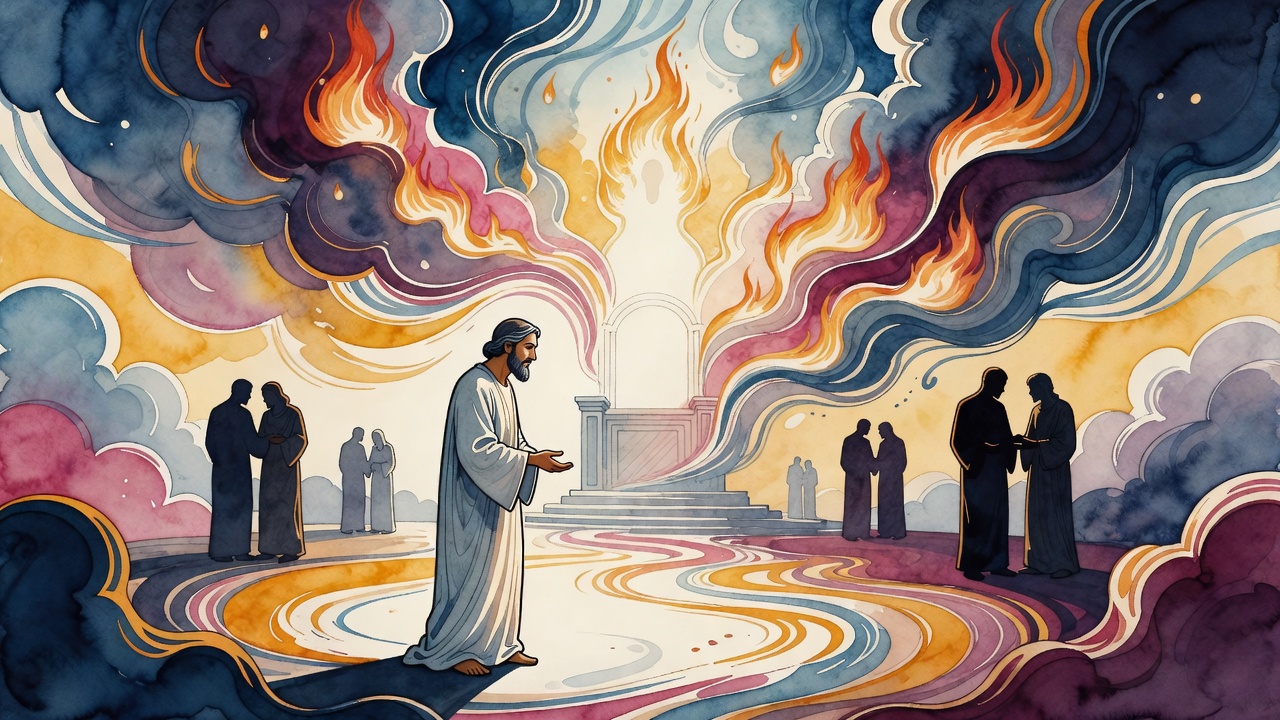
Rav Yehuda son of Rav Shmuel said in the name of Rav: Fire is found only in a place where there is desecration of Shabbat, as it is said, "But if ye will not hearken unto me to hallow the sabbath day, and not to bear a burden," and so on, "then will I kindle a fire in the gates thereof, and it shall devour the palaces of Jerusalem, and it shall not be quenched" (Jeremiah 17:27). What is meant by "it shall not be quenched"? Rav Nahman bar Yitzhak said: At a time when people are not present to extinguish it. Abaye said: Jerusalem was destroyed only because they desecrated Shabbat in it, as it is said, "And have hid their eyes from my sabbaths, and I am profaned among them" (Ezekiel 22:26).
Rabbi Abbahu said: Jerusalem was destroyed only because they neglected the recitation of Shema morning and evening, as it is said, "Woe unto them that rise up early in the morning, that they may follow strong drink," and so on (Isaiah 5:11). And it is written, "And the harp, and the viol, the tabret, and pipe, and wine, are in their feasts; but they regard not the work of the LORD" (Isaiah 5:12). And it is written, "Therefore my people are gone into captivity, because they have no knowledge" (Isaiah 5:13).
Rav Hamnuna said: Jerusalem was destroyed only because they interrupted the schoolchildren there, as it is said, "Pour it out upon the children abroad," and so on (Jeremiah 6:11). What is the reason for "pour it out"? Because "children are abroad." Ulla said: Jerusalem was destroyed only because they had no shame before one another, as it is said, "Were they ashamed when they had committed abomination? nay, they were not at all ashamed," and so on (Jeremiah 6:15). Rabbi Yitzhak said: Jerusalem was destroyed only because small and great were made equal, as it is said, "And it shall be, as with the people, so with the priest" (Isaiah 24:2), and after it is written, "The land shall be utterly emptied" (Isaiah 24:3).
Rav Amram son of Rabbi Shimon bar Abba said that Rabbi Shimon bar Abba said that Rabbi Hanina said: Jerusalem was destroyed only because they did not rebuke one another, as it is said, "Her princes are become like harts that find no pasture" (Lamentations 1:6). Just as this deer has the head of one beside the tail of another, so Israel in that generation pressed their faces to the ground and did not rebuke one another. Rabbi Yehuda said: Jerusalem was destroyed only because they despised Torah scholars in it, as it is said, "But they mocked the messengers of God, and despised his words, and misused his prophets, until the wrath of the LORD arose against his people, till [there was] no remedy" (2 Chronicles 36:16). What is meant by "till no remedy"? Rav Yehuda said that Rav said: Whoever despises Torah scholars has no cure for his wound.
Rav Yehuda said that Rav said: What is the meaning of what is written, "Touch not mine anointed, and do my prophets no harm" (1 Chronicles 16:22)? "Touch not mine anointed" - these are the schoolchildren. "And do my prophets no harm" - these are Torah scholars. Reish Lakish said in the name of Rabbi Yehuda Nesia: The world exists only for the breath of schoolchildren. Rav Pappa said to Abaye: What about mine and yours? He said to him: Breath that contains sin is not like breath that contains no sin. And Reish Lakish said in the name of Rabbi Yehuda Nesia: One does not interrupt schoolchildren even for building the Temple. And Reish Lakish said to Rabbi Yehuda Nesia: Thus I have received from my fathers, and some say, from your fathers: Any city that has no schoolchildren, they destroy it. Ravina said: They place it under the ban.
And Rava said: Jerusalem was destroyed only because trustworthy people ceased from it, as it is said, "Run ye to and fro through the streets of Jerusalem, and see now [and know, and seek in her broad places, if ye can find a man] (if there is a man) that executeth judgment, that seeketh faithfulness, and I will pardon it" (Jeremiah 5:1). Is that so? But did Rav Ketina not say: Even at the time of Jerusalem's downfall, trustworthy people did not cease from it, as it is said, "When a man shall take hold of his brother of the house of his father, saying, Thou hast clothing, be thou our ruler" (Isaiah 3:6): matters that people cover like a garment are in your hand. "And let this ruin be under thy hand."

 Click for full size