5 min read

Joshua Held the Sun Until Vengeance Ended

Joshua ordered sun and moon to stand, and the midrash says the righteous rule the lights, holding day open until Israel's battle was done.

Curated by Arthur · Told by Maggid ·
Table of Contents
  1. Stop, Over Gibeon
  2. The Righteous Rule the Lights
  3. Who May Ascend
  4. Vengeance with a Stopped Clock
  5. Day That Belonged to the Upright
Joshua Held the Sun Until Vengeance Ended Click for full size

Stop, Over Gibeon

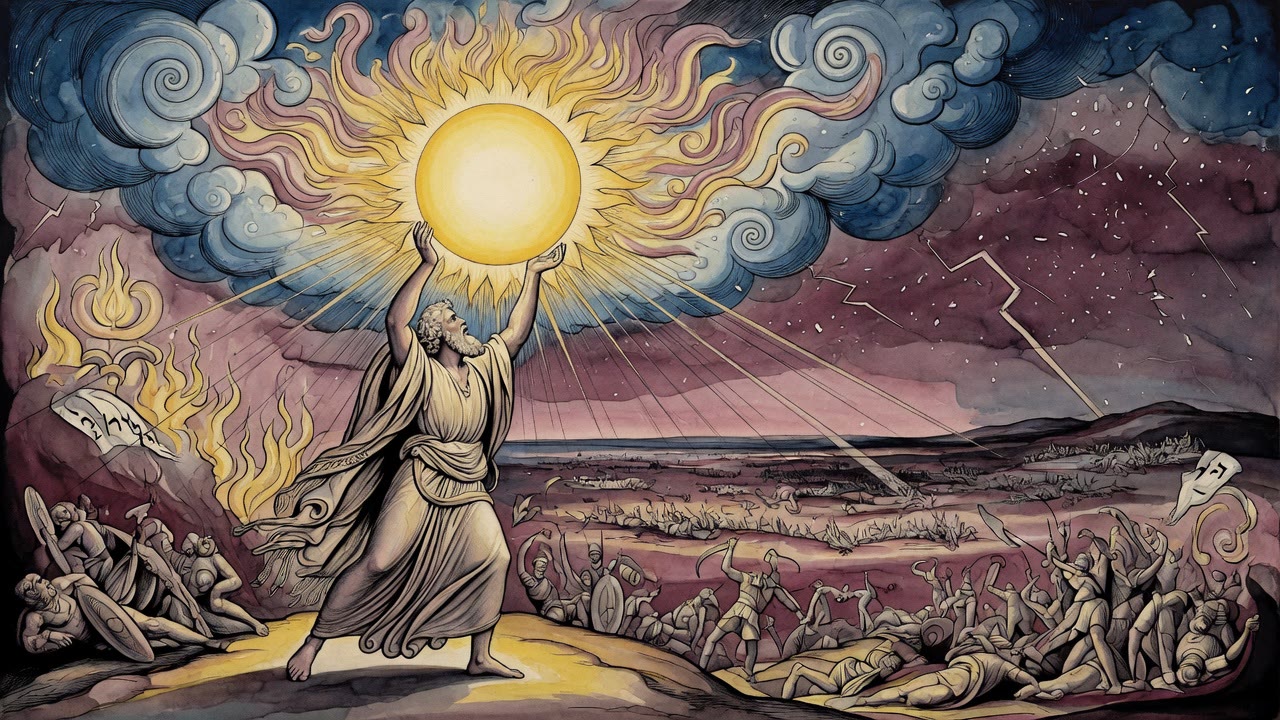
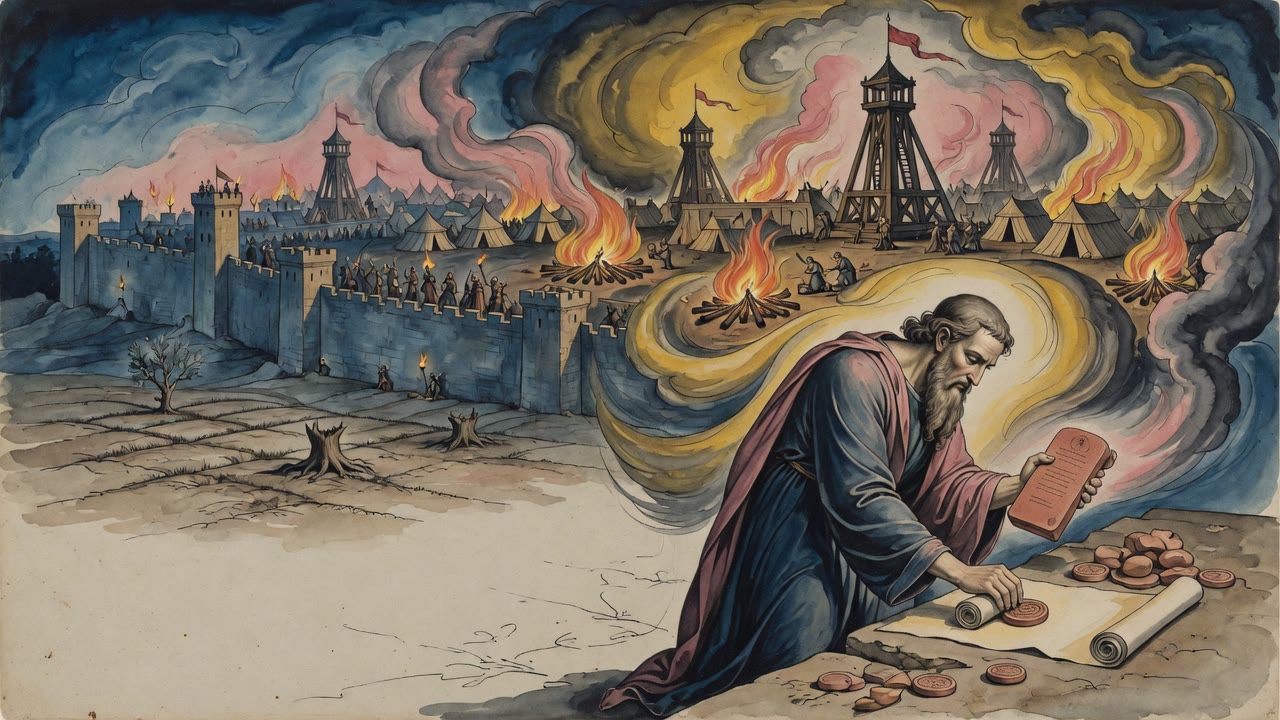
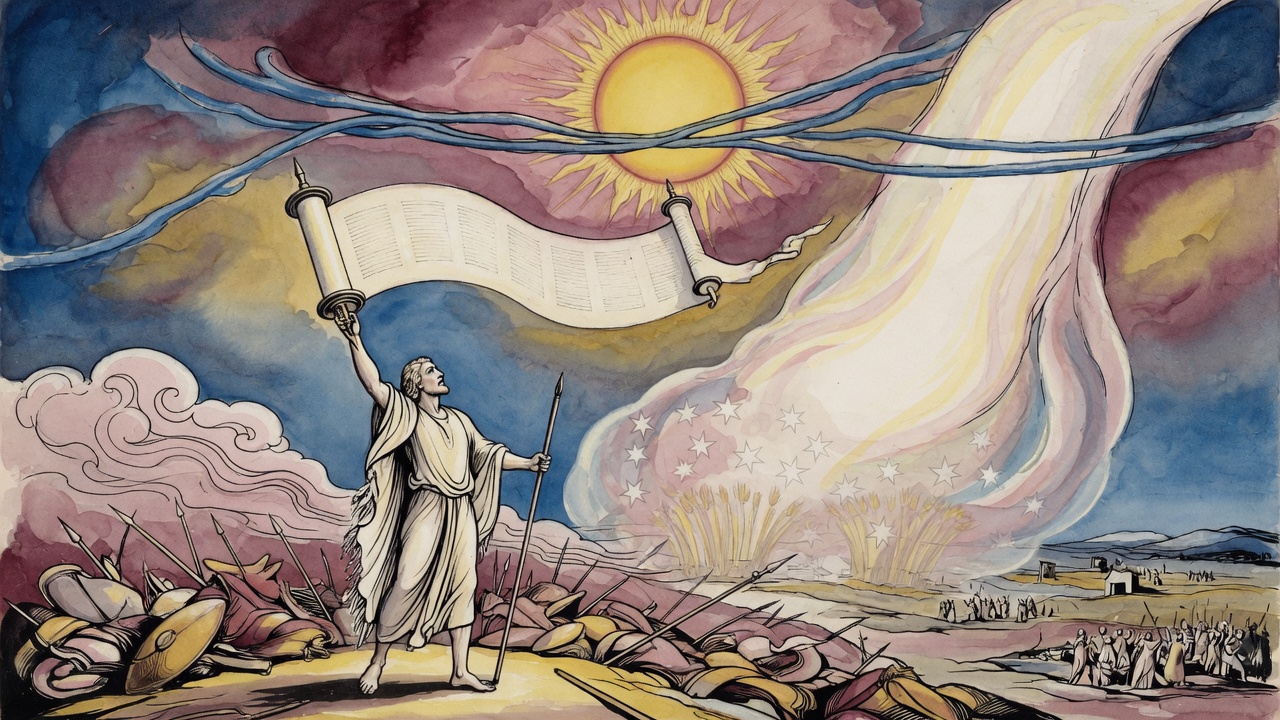
Joshua looked up in the middle of a fight that was running out of light and spoke to the sky as if it were a soldier under his command. Sun, stand still over Gibeon, and moon in the Valley of Aijalon (Joshua 10:12). The greater light that rules the day froze. The lesser light that rules the night held its place. The book of the upright records that the sun stayed and the moon stopped until the nation took vengeance on its enemies (Joshua 10:13).

Warriors who had expected dusk felt the afternoon stretch like leather. Spears that should have been shadows stayed bright. A king who had planned escape under cover of dark found the cover refused to fall.

This was not poetry after the fact for the men on the field. It was overtime ordered by a prophet-general. Shields grew heavy. Throats dried. Still the disk refused the west, and the coalition that had counted on night's mercy found the sky enlisted against them.

The Righteous Rule the Lights

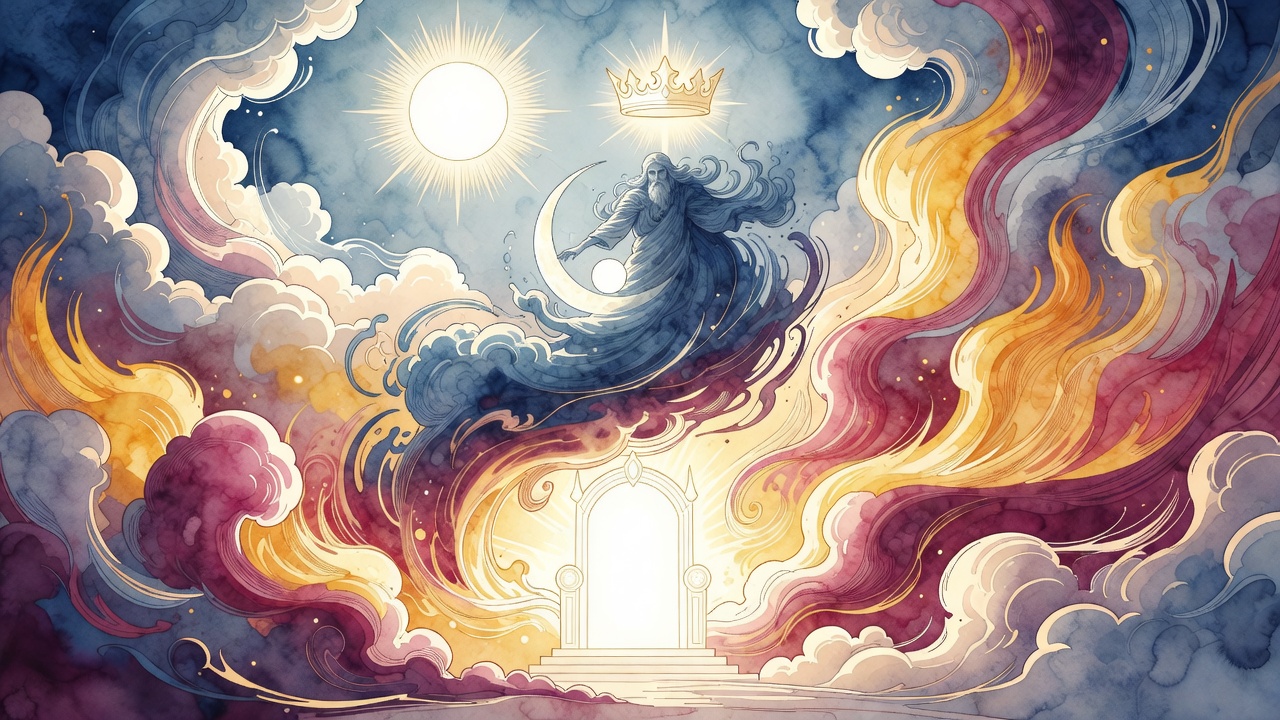
Rabbi Ilfa read Genesis against the miracle. Scripture already said the greater light rules the day. Why add that they rule during the day and at night (Genesis 1:18)? He answered: it refers to the righteous, who exert control over the body made to light the day and the body made to light the night.

Joshua becomes the proof. A man upright enough, fighting a war the tradition frames as judgment, can hold the clock. The book of the upright is called the book of Abraham, Isaac, and Jacob, the upright ones whose deaths even Balaam wished to die (Numbers 23:10). Joshua stands in their line when he commandeers the sun.

Rabbi Halafta applies the same lesson to the creation verse: the lights serve more than astronomy. They answer the righteous when the hour itself becomes a weapon against Israel.

Who May Ascend

Not every climber of hills receives that kind of sky. The midrash braids Jacob's ascent to Beit El with the question of who may ascend the mountain of the Lord and stand in His holy place. Blessings gather around the man of faith who abounds with blessings (Proverbs 28:20). Jacob is named as that man. Esau, who hurried after wealth and wives, is set as the counter-image, blood on his pursuit of a brother, mercy suppressed (Amos 1:11).

Joshua's standing sun is an ascent of another kind. He does not climb a ladder in a dream. He climbs a day that will not end until justice on the field is finished. The mountain of the Lord, in battle form, is a plateau of light held open by command.

Esau's haste and Joshua's held hour face opposite directions. One grabs wives, land, and advantage until mercy is suppressed. One waits with a weapon until the work of judgment is complete, even if the work needs a borrowed afternoon. Who may ascend the mountain of the Lord? In battle dress, the answer includes the commander whose day does not end until the upright book can record a finished line.

Vengeance with a Stopped Clock

The verse does not hide the word vengeance. The miracle serves a settling of accounts with kings who had marched on Gibeon. Moral unease about holy war is a later reader's luxury. Inside the scene, the stopped sun is mercy for Israel and doom for the coalition that chose the wrong enemy.

A wounded soldier watching the disk hang without sliding west may have whispered the Name without knowing the midrash of Ilfa. He only knew that night, which usually protects the fleeing, had been drafted into Israel's army.

When the sun finally moved again, the field was quieter. Bodies of kings and soldiers marked the cost of a day that had refused to close on schedule.

Day That Belonged to the Upright

Creation's lights were never only lamps. In this telling they are instruments that recognize the upright. Joshua's voice did not invent physics. It claimed a relationship older than Gibeon: the God who set sun and moon in Genesis still lets His fighters borrow them.

Children learning the conquest stories later feel the strangeness first, then the claim. If the righteous can rule the day-body and the night-body, then history is not only the story of stronger iron. It is also the story of who may speak to the sky and be answered.

Over Gibeon the answer was stillness. Stillness long enough to finish what blood and promise had started. When motion returned to the sky, it returned to a field already decided.

Ilfa's reading keeps the miracle from floating free as a wonder-tale only. Genesis gives the lights rule; the righteous claim a share of that rule when history jams. Joshua did not invent a new sun. He called in a debt older than Canaan, as old as the first week when God hung lamps and already knew which mouths would one day dare to command them. The book of the upright, the book of the fathers, stands open behind his shout. The day obeyed because the chain of uprightness still held.


← All myths
From the tradition

Sources

2 sources

The texts behind this telling. Some cards carry a translation of the source; others are our own retelling of it, and each card says which. Every card links out to the original.

Bereshit Rabbah 6:9Bereshit Rabbah

Retold in our words. Read the original at the link below.The Sefaria Midrash Rabbah, 2022 · CC-BY

The familiar reading treats the Creation story in Genesis and think we understand it. But what if there's a deeper layer, a secret code waiting to be unlocked?

Seems straightforward. But hold on. Rabbi Ilfa asks a crucial question in Bereshit Rabbah, a classical collection of Rabbinic homilies on the Book of Genesis. If this verse is about the sun and moon ruling, hasn’t that already been stated earlier, "The greater light to rule the day"? (Genesis 1:16). So, what’s really going on here?

Rabbi Ilfa suggests that this verse isn't just about the celestial bodies. It's also about the righteous. The righteous have a unique power: they can exert control over their physical selves – the "body that was created to illuminate during the day and the body that was created to illuminate at night." They have the power to transcend the limitations of the physical world.

This idea is then connected to the story of Joshua, who famously made the sun and moon stand still (Joshua 10:13). The verse states, "The sun stood still, and the moon stopped, until the nation took vengeance against their enemies. Is it not written in the book of the upright?” What is the book of the upright? It is the book of Abraham, Isaac, and Jacob. Why is it called the book of the upright? It is as it is written: “Let me die the death of the upright” (Numbers 23:10). The power to command the sun and moon – to bend reality itself – is linked to the spiritual stature of these patriarchs. Rabbi Halafta, continuing Rabbi Ilfa's idea, applies it back to our verse: "And to rule during the day and at night." It’s about the power of the righteous to influence the world.

But the Rabbis don't stop there. Rabbi Hanin, in the name of Rabbi Shmuel, takes this concept further, applying it to the end of the book of Genesis and then to the end of the Torah, connecting Joshua to both Ephraim and Joseph. He sees Joshua not just as a military leader, but as a descendant of Joseph, fulfilling a prophecy. How could Ephraim be greater than Manasseh when Manasseh was larger? (Genesis 48:19, (Numbers 26:34-3)7). How could Joseph be a "firstborn bull" who gores the nations when no king arose from Joseph to conquer the world? (Deuteronomy 33:17). The answer, they suggest, is in Joshua, who descended from them and whose actions resonated throughout the world.

Rabbi Shimon ben Yoḥai adds another layer, saying that the book of Deuteronomy was like a standard for Joshua. When God appeared to him, Joshua was studying Deuteronomy. God encouraged him, saying "“Be strong” Joshua, “be courageous” Joshua, “this book of the Torah shall not depart…”’ (Joshua 1:6–8). He then showed him the orb of the sun. Joshua, empowered by the Torah, commanded the sun to stand still.

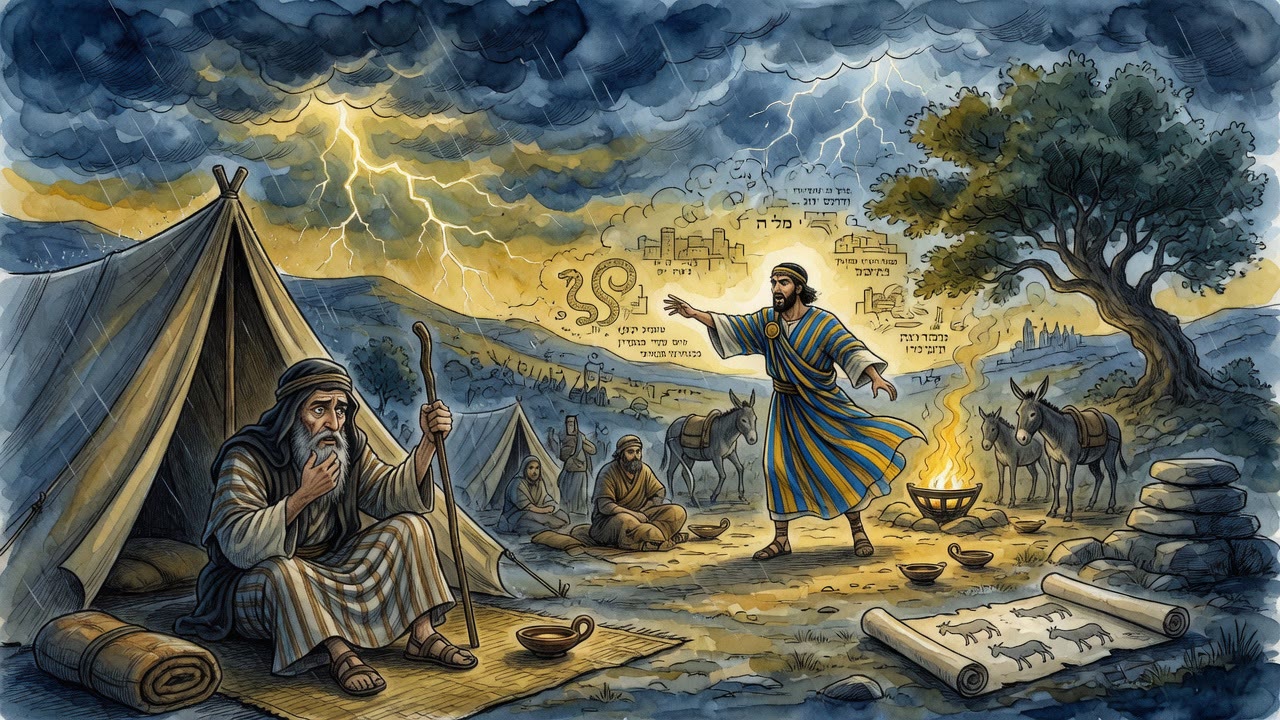
And here’s where it gets really interesting. Rabbi Yitzḥak provides another perspective: Joshua, as a descendant of Joseph, reminded the sun of Joseph's dream where the sun and moon bowed down to him (Genesis 37:9). "Wayward slave," he essentially said, "don't you belong to my ancestor? You already bowed down to him in a dream!" Thereupon, “the sun stood still, and the moon [stopped].”

So, what does this all mean?

It's more than just a literal interpretation of the Creation story. It’s about the potential within each of us to connect to something larger than ourselves. It’s about the power of righteousness, Torah study, and fulfilling our potential to influence the world around us, maybe not by stopping the sun, but by making a difference in our own way. The ability to "rule during the day and at night" might just reside within each of us, waiting to be awakened.

Full source
Bereshit Rabbah 82:2Bereshit Rabbah

Retold in our words. Read the original at the link below.The Sefaria Midrash Rabbah, 2022 · CC-BY

Who May Ascend the Mountain of the Lord and Stand There is the question behind this passage from Bereshit Rabbah.

The blessings don't stop there. "So said the Lord of hosts, God of Israel: They will again say…the Lord will bless you, abode of righteousness, mountain of sanctity…" (Jeremiah 31:23). The Midrash understands this blessing, referring to the God of Israel, as applying directly to Jacob, who, of course, is also known as Israel. Again, Etz Yosef highlights this interpretation. It’s as if the prophets themselves are echoing the divine favor bestowed upon him.

Then we turn to Proverbs: "A man of faith will abound with blessings" (Proverbs 28:20) – and the Midrash declares, “this is Jacob.” But the verse continues, "and one who hastens to become rich will not be absolved" (Proverbs 28:20). Ah,

The Midrash contrasts Jacob with his brother. Esau, in his haste to acquire wealth through his marriages to Yehudit, Basmat, and Maḥalat, will never be cleansed of his actions. The passage quotes (Joel 4:21), "I will cleanse; their blood I will not cleanse," linking it to (Amos 1:11), "For his pursuit of his brother with the sword; and suppressing his mercy." Esau’s pursuit of earthly riches stands in stark contrast to Jacob's faith and devotion, highlighting the different paths they chose and the consequences thereof. It's not just about having wealth, but how you acquire it. The Midrash continues, drawing parallels between offering sacrifices to God and the merit of Jacob. "God appeared to Jacob again, upon his arrival." Rabbi Yitzḥak begins with a powerful a fortiori argument, a method of reasoning from the lesser to the greater: “You shall craft for Me a stone altar…[I will come to you and I will bless you]” (Exodus 20:21) – If someone who builds an altar receives divine appearance and blessing, how much more so Jacob, whose image is fixed on God’s throne! Wow.

Rabbi Levi offers a similar argument: “And a bull and a ram for a peace offering…[for today the Lord shall appear to you” (Leviticus 9:4) – If sacrificing a ram merits divine appearance, how much more so Jacob! The recurring theme? Jacob's unique relationship with God, a relationship so profound that it surpasses even the most sacred rituals.

“God appeared” – “Blessed are you upon your arrival, and blessed are you upon your departure” (Deuteronomy 28:6). Jacob was blessed both upon arriving at his father-in-law’s house ("May God Almighty bless you…" Genesis 28:3) and upon leaving ("God appeared to Jacob…[and He blessed him]"). He’s surrounded by divine favor, coming and going!

Finally, the passage touches upon the role of angels in transmitting God's word. "Who confirms the word of His servant and fulfills the counsel of His messengers" (Isaiah 44:26). Rabbi Berekhya, in the name of Rabbi Levi, explains that an angel appeared to Jacob, foretelling God's appearance in Beit El and the changing of his name. This is supported by (Hosea 12:5): “In Beit El He will find us and there He will speak with us." It wasn't just about God's promise, but the confirmation and preparation through divine messengers. The Zohar, the central text of Kabbalah, expands on the role of angels as intermediaries and guides on our spiritual path.

So, what does it all mean? This passage from Bereshit Rabbah paints a portrait of Jacob as a figure of unwavering faith, blessed beyond measure. His actions, his devotion, and his very being are intertwined with the divine presence. And perhaps, if we strive for that same connection, we too can tap into that endless wellspring of blessing.

Full source