5 min read

Jeremiah's Burned Scroll Was Written Again

Jehoiakim fed Jeremiah's scroll to the winter fire, column by column, but God sent Baruch back to write the words again.

Curated by Arthur · Told by Maggid ·
Table of Contents
  1. The Prophet Sent His Voice Without His Body
  2. The King Fed the Fire
  3. The Hiding Place Held
  4. The Second Scroll Grew Heavier
  5. The King Could Not Burn the Voice

The knife entered the scroll one column at a time.

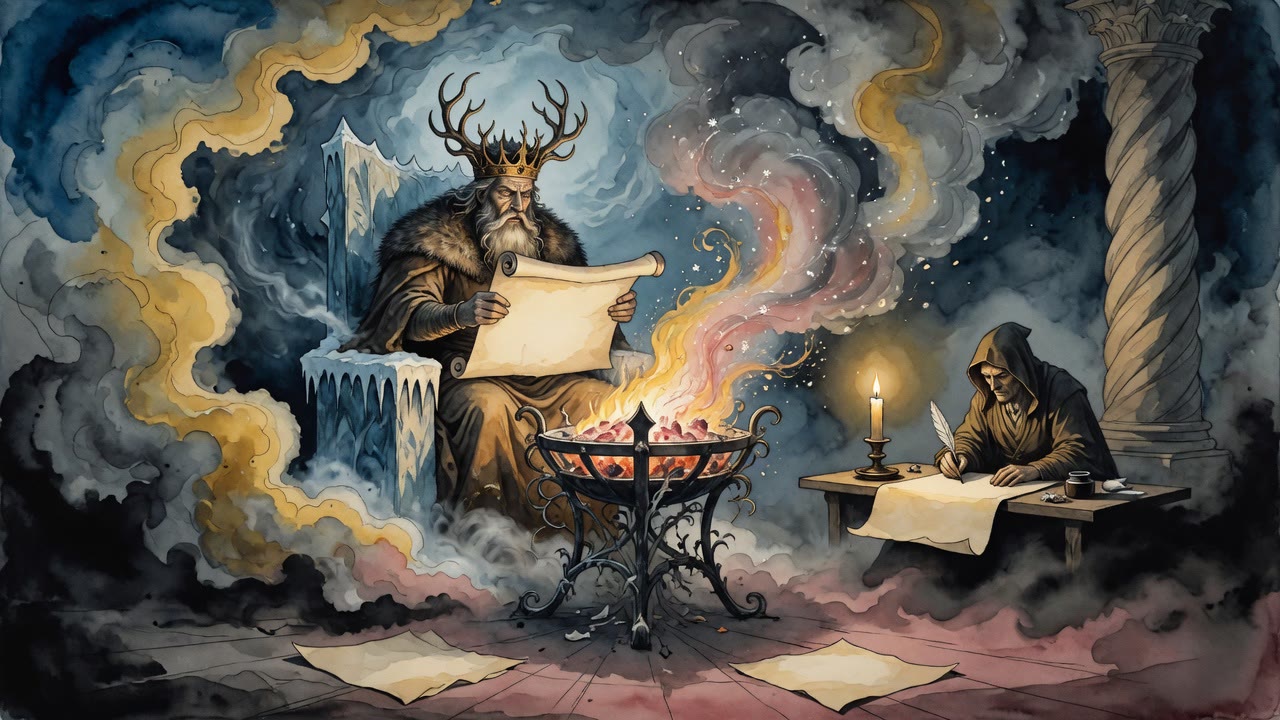
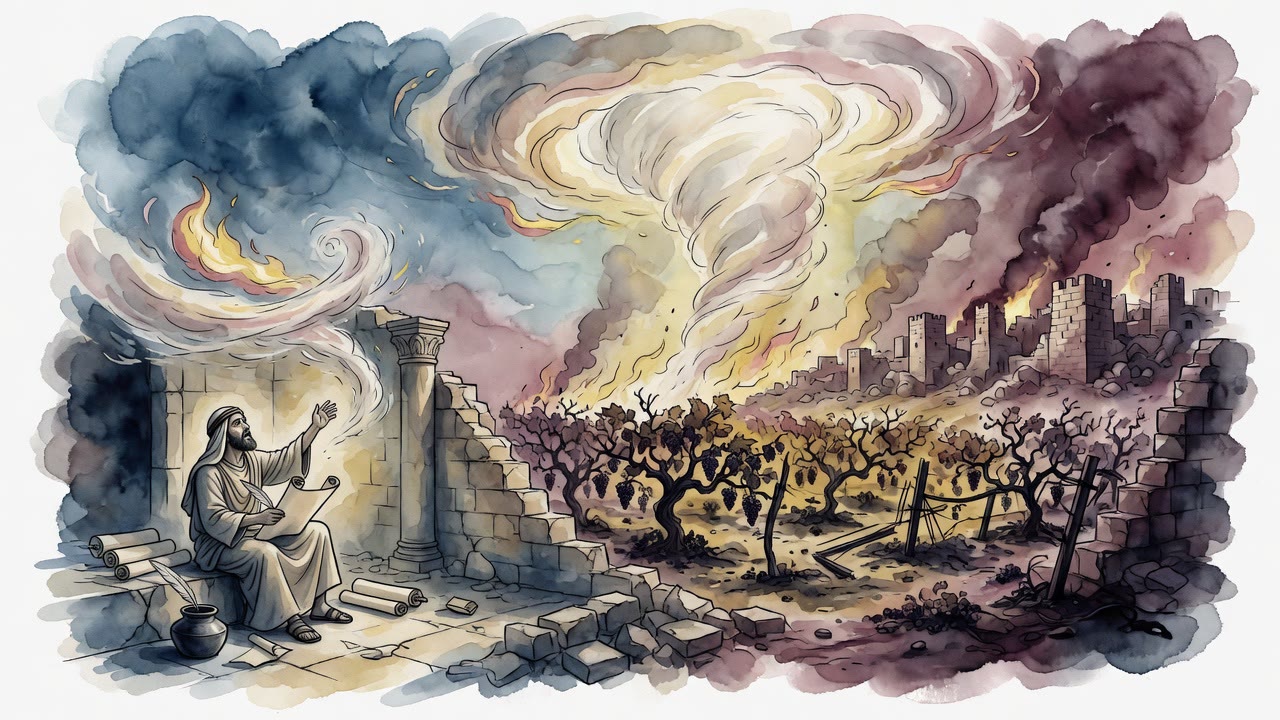
Jehoiakim sat in the winter house with the brazier burning before him. Outside, Jerusalem was cold enough for a king to keep flame near his knees. Inside, a courtier read the words of Jeremiah, words the prophet himself could not carry into the Temple anymore.

The voice moved across the room. Three columns. Four. The king reached for the scribe's knife, cut the written skin, and dropped the severed piece into the fire. Ink blackened. Parchment curled. Prophecy became smoke.

The Prophet Sent His Voice Without His Body

Jeremiah had been barred from the Temple, but a barred body still had a voice. He called Baruch ben Neriah, a scribe trained for careful lines and dangerous messages, and dictated the words he had received from God. Baruch wrote them down until the scroll held years of warning.

On a fast day, when the city gathered hungry and frightened in the Temple courts, Baruch stood where Jeremiah could not stand. He read aloud. The words passed from his mouth into the stone courts, then from the courts into the ears of officials who knew at once that the scroll could not be treated like an ordinary complaint.

They brought Baruch into a chamber and made him read again. This time the listeners leaned in. The danger had a shape now. They asked how the words had been written, and Baruch told them plainly. Jeremiah had spoken every word. Baruch had written them with ink.

The King Fed the Fire

The officials understood the risk before the king did. They told Baruch and Jeremiah to hide. No ceremony, no farewell. Hide. Then they carried the scroll into the winter house, where Jehoiakim sat among servants and heat and royal ease.

A courtier began to read. After three or four columns, the knife came down. The king did not snatch the scroll in a rage and burn it whole. He made destruction slow. Cut. Burn. Listen. Cut. Burn. Listen. Every few columns, another strip of warning fell into the brazier.

Three men pleaded with him to stop. Their fear did not move him. No one tore his garments. No one fell to the floor. The room watched prophecy burn with the dull discipline of men who had learned to keep their faces still around power.

The Hiding Place Held

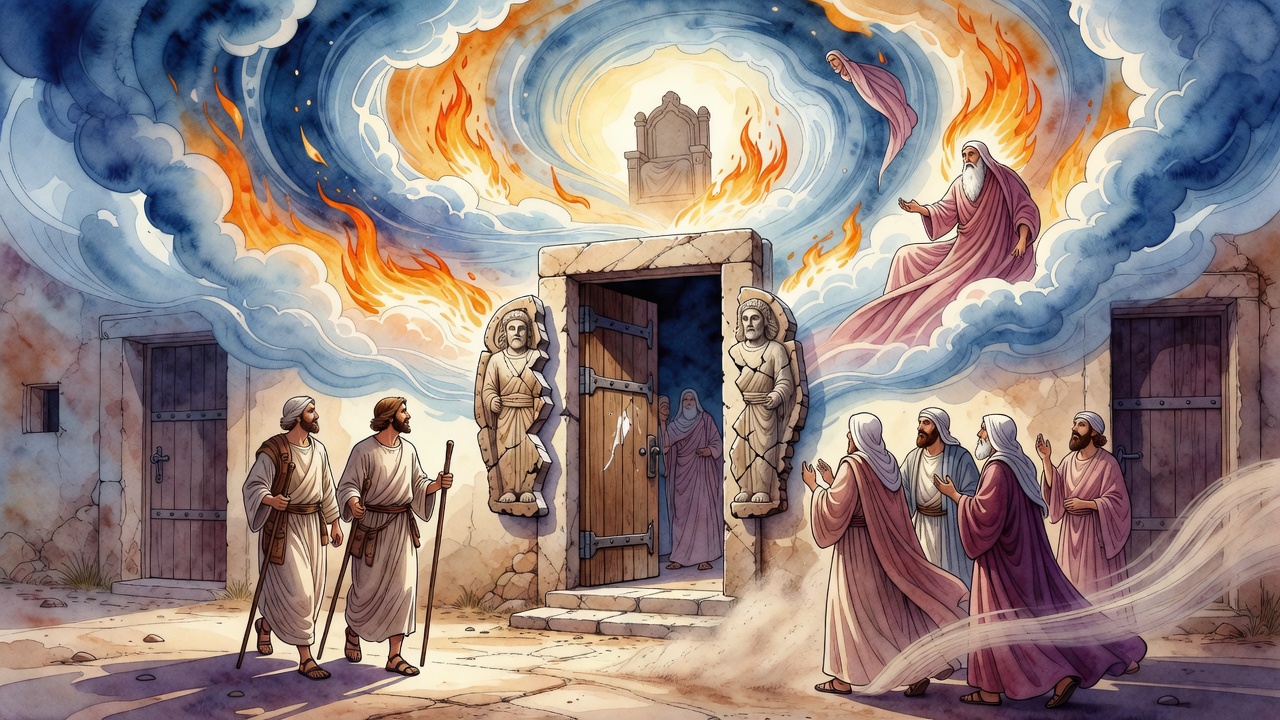
Jehoiakim ordered Baruch and Jeremiah seized. The order ran through the city like a blade through cloth, but it did not find them. God hid them. The king had servants, rooms, guards, a throne, a knife, a fire. The prophet and the scribe had a hiding place no royal hand could open.

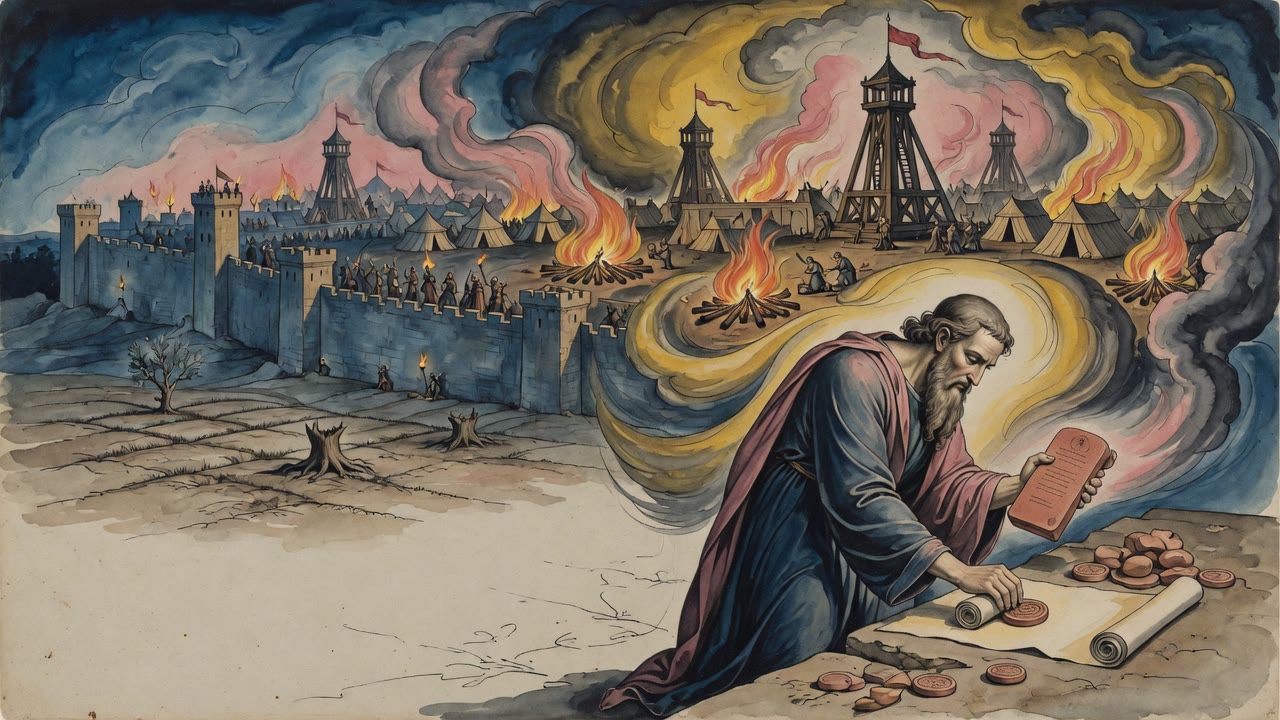
Somewhere beyond the king's reach, Baruch waited with the memory of the first scroll still warm in his body. He had heard every word before he wrote it. He had carried it into the Temple. He had watched officials turn pale over it. Now the scroll was ash, and the work had to begin again.

That is the terror of being a scribe in a prophetic age. Ink is fragile. Skin burns. A hand cramps. A king can destroy the page before supper. But the voice behind the page does not live in the page.

The Second Scroll Grew Heavier

God sent the answer back through Jeremiah. Take another scroll. Write all the former words on it. Not some. Not the safer parts. All of them.

Baruch bent over the new surface. The words returned, line after line, as if the fire had swallowed nothing. The first scroll did not come back smaller. It came back with more. Jehoiakim had not shortened the prophecy. He had lengthened it. His burning was folded into the judgment until the act meant to erase the words became one more word against him.

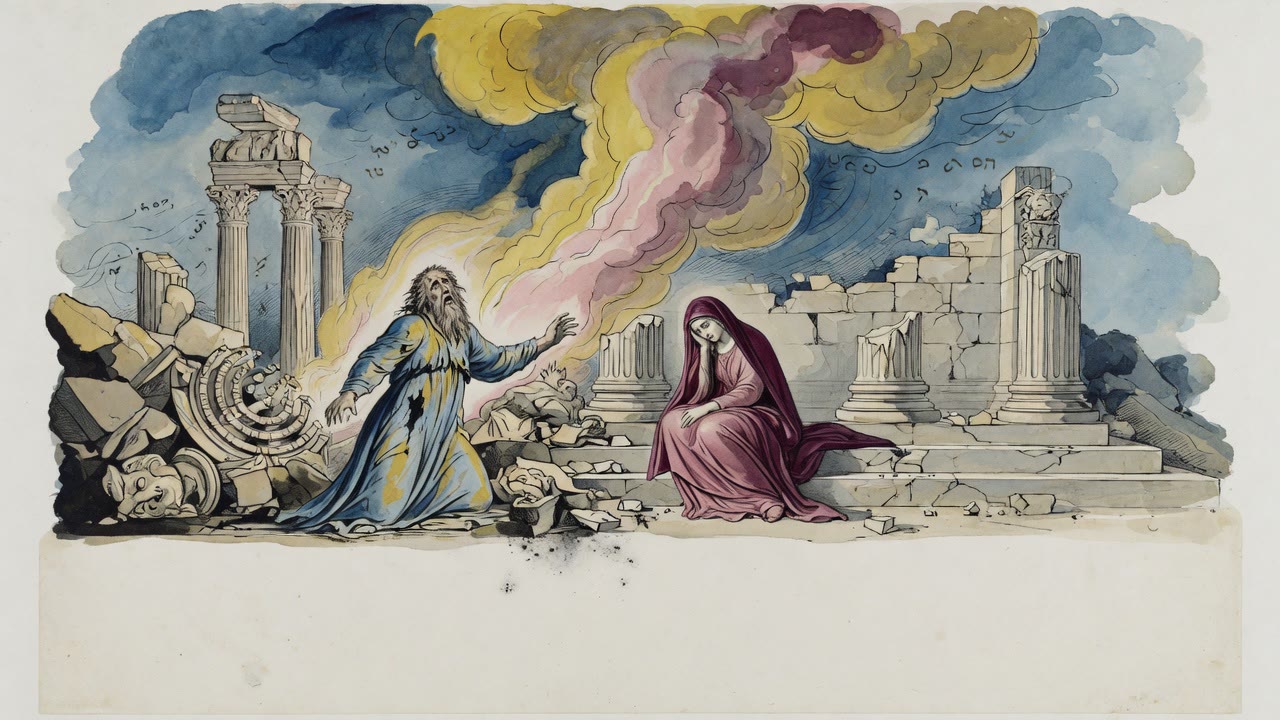
The second scroll carried a harder sentence. The king who sat warm by the brazier would not be carried with royal honor to the grave. His body would be thrown out to heat by day and frost by night. He had treated the word of God like refuse. His own flesh would be treated like something a city wanted outside its gates.

The King Could Not Burn the Voice

Jehoiakim had already made himself a figure of contempt. His garments mixed what should not be mixed. His body bore signs of foreign worship. When danger came from Babylon, he tried to bargain with the lives of others, then found his own life demanded instead.

The scroll fire belongs to that same royal sickness. A king mistakes possession for power. He holds the page, so he thinks he holds the message. He owns the room, so he thinks he owns the sound inside it. He commands the fire, so he thinks the fire answers him.

Morning came. The brazier cooled. Ash settled where the columns had been. Far from the winter house, Baruch's pen moved again.


← All myths
From the tradition

Sources

4 sources

The texts this telling draws on, in full. Open a card to read inline, or expand it for a wider, quieter read.

Legends of the Jews 10:70Legends of the Jews

The story goes that Baruch, a figure shrouded in reverence, penned a book filled with sacred prayers and wisdom. This wasn't just any book; it was so valued that it was read aloud in the Temple in Jerusalem on special occasions. Imagine the power of those words, echoing through the holy space!

Baruch’s story goes far beyond just writing a revered book. He was granted an extraordinary experience: a visit to Paradise itself. Can you imagine? As the tale unfolds in Legends of the Jews, Baruch was deep in mourning, lamenting the destruction of Jerusalem. It was during this time of sorrow that an angel of the Lord appeared to him. This wasn't just a comforting visit; it was an invitation to something far grander.

The angel whisked Baruch away, not just to another place, but to other realms! He was taken on a tour of the seven heavens, a concept often explored in Jewish mystical thought. He witnessed the place of judgment, where the fate of the wicked is decided, and then, the opposite: the blissful abodes of the righteous. It's a journey through the entire spectrum of existence, a glimpse behind the curtain of reality.

Here’s a fascinating detail: Baruch lived during the time when CYRUS, the Persian king, allowed the Jews to return to Palestine and rebuild their Temple. A moment of incredible historical importance! Yet, Baruch, due to his advanced age, couldn't make the journey.

And this is where his devoted disciple, EZRA, enters our story in a pivotal role. As long as Baruch was alive, Ezra remained by his side in Babylonia. Why? Because, according to this legend, "the study of the law is more important than the building of the Temple." This gives you a sense of the priorities, doesn’t it? The spiritual and intellectual connection, the passing down of wisdom, held a weight equal to, or perhaps even greater than, rebuilding a physical structure.

It was only after Baruch's death that Ezra finally decided to gather the exiles and lead them back to the Holy Land to rebuild the Temple in Jerusalem. You can almost feel the weight of that responsibility, the dedication to his teacher's legacy.

So, what are we left with? A story of divine encounters, of priorities, and of the enduring power of knowledge. It makes you wonder, doesn't it? What are our priorities? What kind of legacy will we leave behind? And what secret realms might be waiting just beyond our understanding?

Full source
Legends of the Jews 9:57Legends of the Jews

Legends of the Jews turns to Death of Jehoiakim.

So, here’s the setup: After the death of Josiah, the people chose Jehoahaz as their king, even though his brother, Jehoiakim, was actually older. According to Legends of the Jews, to solidify Jehoahaz's claim, he underwent an anointing ceremony. This was done to essentially silence any argument Jehoiakim might have had about being the rightful heir. But Jehoahaz’s reign was short-lived. Just three months later, Pharaoh came along, exiled him to Egypt, and installed Jehoiakim in his place.

Jehoiakim… he wasn’t exactly known for his piety. He’s painted as one of the most sinful monarchs the Jews ever had. He was uncharitable and disobedient to God's laws. But it goes further. We hear of his garments being made of sha’atnez (forbidden mixtures of fabrics) and his body tattooed with the names of idols. To really drive home his rejection of Jewish identity, it was said he even performed an epipost on himself, a procedure to reverse circumcision.

It doesn't stop there. According to the legends, he committed incest, murdered men to take their wives, and seized their property. He's not just a bad ruler; he's actively violating the core principles of morality and justice.

But perhaps the most shocking thing about Jehoiakim was his outright blasphemy. The text attributes to him the statement: "My predecessors did not know how to provoke the wrath of God. As for me, I say frankly, we have no need whatsoever of Him; the very light He gives us we can dispense with, for the gold of Parvaim can well replace it."

Can you imagine? To declare that you don't need God, that wealth can replace divine light… it’s a pretty bold statement. It speaks to a level of arrogance and disregard for the sacred that is almost unfathomable.

What does this all mean? It's a powerful reminder that leadership isn't just about power; it's about responsibility. It's about upholding justice, honoring tradition, and recognizing something larger than ourselves. Jehoiakim’s story serves as a cautionary tale. What happens when a leader loses sight of those principles? Perhaps more importantly, what does it say about the people that put him there?

Full source
Legends of the Jews 9:58Legends of the Jews

As Ginzberg tells us in Legends of the Jews, He held back, specifically because the people were leading God-fearing lives during the reign of Jehoiakim.

Even the righteous couldn't save Jehoiakim. After eleven years on the throne, Nebuchadnezzar came knocking, ready to end his rule.

This scene: Nebuchadnezzar, the mighty Babylonian king, arrives with his army at Daphne, near Antioch. There, he's met by the Sanhedrin, the Jewish high court, from Jerusalem. What do they want? They need to know if he’s planning to destroy the Beit Hamikdash, the Temple. Nebuchadnezzar assures them that all he wants is Jehoiakim, who had rebelled against him.

So, the Sanhedrin returns to Jerusalem and tells Jehoiakim the news. And here's where things get ethically sticky. Jehoiakim asks the elders: is it right to sacrifice one life to save many? They point him to a story about Joab, who, acting under David's direction, saved the city of Abel of Beth-maacah by surrendering a rebel named Sheba.

The Sanhedrin, despite Jehoiakim's objections, decides to follow Joab's example. They lower Jehoiakim down from the city walls in chains, right into the hands of the Babylonians.

What happens next is brutal. Nebuchadnezzar takes Jehoiakim in chains through all the cities of Judah. Then, consumed by rage, he kills him, throws his corpse to the dogs after sticking it into the carcass of an ass. According to Legends of the Jews based on various Midrashim (rabbinic interpretive commentary), the dogs devour everything but his skull, on which a disturbing inscription appears: "This and something besides."

Centuries later, a rabbi finds this skull near the gates of Jerusalem. He tries to bury it, but the earth rejects it. Concluding it must be the remains of Jehoiakim, he wraps the skull in a cloth and puts it in a closet.

Then comes the final, bizarre twist. The rabbi's wife finds the skull. Thinking it belongs to her husband's deceased first wife, whom he still cherishes, she burns it in a fit of jealousy.

What does it all mean? This story, pieced together from various sources like Kings II 24, the Babylonian Talmud, and retold by Ginzberg, is a stark reminder of the consequences of leadership, rebellion, and the enduring power. And horror, of the past. It makes you wonder, doesn't it? What burdens do we carry, even unknowingly, and what will future generations make of our stories?

Full source
Legends of the Jews 10:12Legends of the Jews

That was life for the prophet Jeremiah.

Jeremiah's debut on the public stage happened during the reign of Josiah. He didn't mince words. He went right into the streets and declared, "If you abandon your wicked ways, God will elevate you above all nations. But if you don't, He will hand over His house, the Temple, to your enemies, who will do with it as they please." Pretty direct. Think about the courage it took to deliver that message. He was essentially saying, "Change your ways, or face utter destruction." It wasn't a popularity contest, that's for sure.

Jeremiah wasn't working in a vacuum. He had contemporaries, fellow prophets also trying to guide the people. Zechariah was active in the synagogue, focusing on communal worship and ritual. And then there was Huldah, whose prophetic domain was particularly among women. It's interesting to consider how prophecy wasn't a monolithic thing – different prophets, different audiences, different approaches.

Later, during the reign of Jehoiakim, things got even more complicated. Jeremiah found support in the form of other prophets, including his relative Uriah of Kiriathjearim, who, according to some accounts, was a friend of the prophet Isaiah. Imagine that lineage! The weight of tradition, the shared burden of prophecy.

But here's where the story takes a dark turn. Uriah, this fellow prophet, this ally, was put to death by the ungodly King Jehoiakim. And it gets worse. This same king, in an act of defiance and utter disrespect, burned the first chapter of Eichah, the Book of Lamentations, after obliterating the Name of God wherever it appeared. Can you imagine such blatant disregard?

But Jehoiakim's attempt to silence the word of God didn't work. That Jeremiah responded to this act of desecration by adding four more chapters to Lamentations. In the face of destruction, in the face of silencing, he amplified the message. He refused to be quieted. What an act of defiance! What a evidence of the power of belief!

So, what are we left with? A story of courage, warning, defiance, and ultimately, hope. Even in the darkest of times, the prophetic voice, the voice of truth, can still find a way to be heard. It makes you wonder, doesn't it, what kind of voice we choose to lend to the world.

Full source