6 min read

Hiyya Put the Strange Starling on the Roof

Nobody could name the bird, and dinner depended on the ruling. Hiyya opened no scroll. He had it set on the tiles and waited to see what landed beside it.

Curated by Arthur · Told by Maggid ·
Table of Contents
  1. Put It on the Roof
  2. The Raven Came Down
  3. Let This One Marry That One
  4. Names That Prune and Names That Drum

The bird came into the Land of Israel in a basket, alive, because nobody was willing to kill a thing they could not name.
Hiyya Put the Strange Starling on the Roof Click for full size

It was a starling, or near enough to one that the men who caught it called it that. Gray body, dark head, a hard beak, the size of a fist. Nobody there had ever seen the kind before, so the argument started before they were out of the field: eat it or let it go. A permitted bird is meat, and meat in a poor season is a whole evening. A forbidden bird in the pot is another thing entirely, and it stays in the pot, and in the house, and on the man who cooked it.

They carried it to Rabbi Hiyya the Great.

Put It on the Roof

He looked at it in the basket. The Torah names the forbidden birds by kind, and every one of those names had been argued over for generations, since a name is only as good as the last man who could point at the animal and say it. This bird was not on anybody's list, because the men who wrote the list had lived somewhere else.

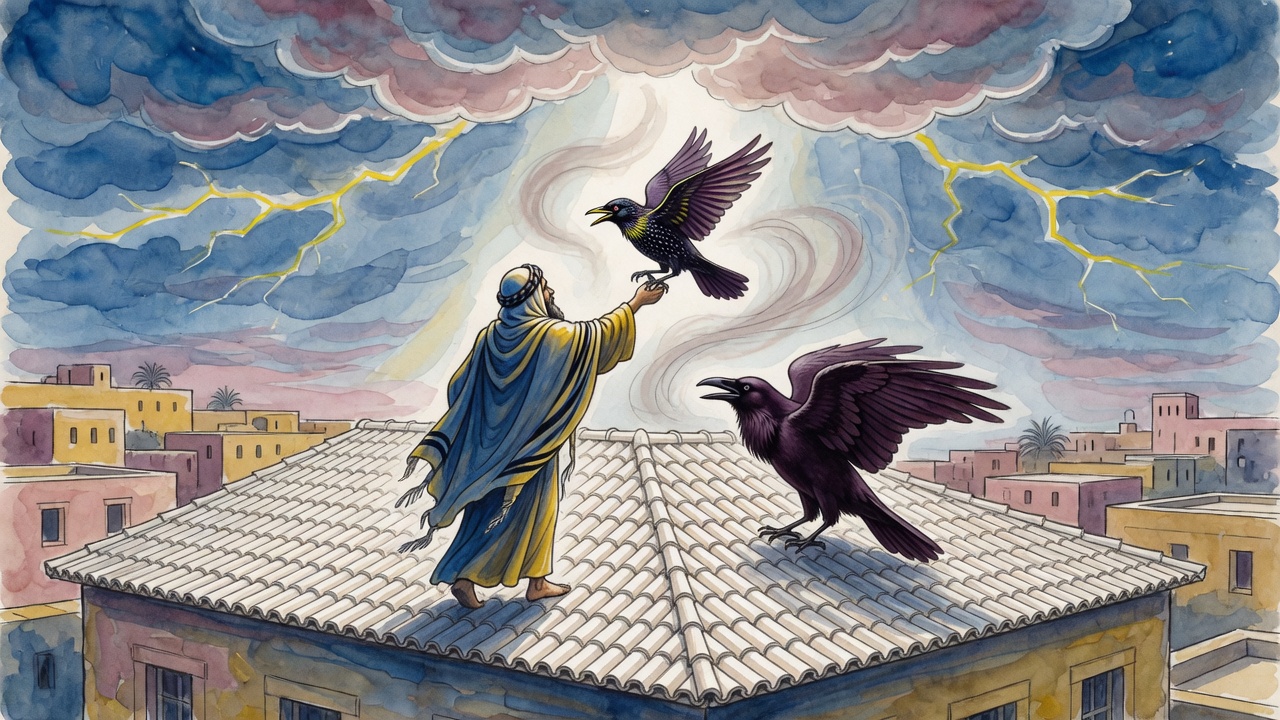
So Hiyya sent them up. "Put it on the roof," he said. "Whatever bird comes and settles down next to it is of its kind."

They took the basket up the outside stairs and set the starling loose on the flat tiles, and then they came back down and stood in the courtyard with their heads tipped back. A woman on the next roof stopped pretending to hang laundry. The tiles were hot enough to make the air over them shake. The bird walked a little, and preened, and did not fly off, and for a long time nothing in the sky came anywhere near that house.

The Raven Came Down

Then something black slid across the corner of the sky and dropped.

It came down hard the way ravens do, wings out at the last moment, and it walked two steps and stopped a hand's width from the gray bird. An Egyptian raven. Neither of them moved away from the other. They stood there on the hot tiles like two birds who had been standing on roofs together their whole lives, and every man in the courtyard understood the ruling before Hiyya opened his mouth.

"Impure," he said. "It is of that kind." Every raven after its kind, the verse says, and the verse had just walked down out of the air and folded its wings.

Somebody laughed the short laugh of a man who had nearly boiled a raven's cousin for his children. The raven went to the starling for one reason only, and the reason was kinship. Nothing else brings a bird down onto a strange roof in the heat of the day.

Let This One Marry That One

Hiyya's students did not stay with the bird, because the same principle was standing in the room with a much sharper edge on it, and one of them said it out loud.

Scripture commands that the nations of Canaan be utterly destroyed. So, the saying goes, let this one, may his name be blotted out, go and marry that one, may her name be blotted out. The wicked find the wicked. Nobody has to arrange it. Put two of a kind anywhere within sight of each other and they will close the distance on their own, the way the raven closed it, and afterward nobody has to ask how the match came about.

The men in the courtyard heard their own households in that. Everyone there had a daughter, or a brother with a daughter, and everyone there had watched some match come together in a season and had said nothing at the time.

Names That Prune and Names That Drum

The reading ran backward from there into the genealogies, where the same rule works on names instead of feathers.

Abraham had six more sons late, by Keturah, and Rami bar Yehezkel would not take their names as decoration. Zimran, he said, from the root that means to prune: his descendants would go through the world thinning it, cutting men down the way a man cuts back a vine. Yokshan he read as hardness, a line that would deal with everybody by force. Other sages heard the same two names as music and heard it worse. Zimran meant they sang, and what they sang was praise, and the praise was aimed at idols. Yokshan meant they beat, and what they beat was drums, in front of the same idols, all day.

Then Yokshan fathered Sheva and Dedan, and Dedan's sons came down in the verse as Ashurim, Letushim, and Le'umim. The Aramaic translators had softened those into trades, merchants and ironworkers and chiefs. Rabbi Shmuel bar Nahman refused the softening and said all three were heads of nations, every one of them, which is to say the line kept its weight and simply moved it into governments.

Then somebody read out the next verse in the scroll, and it was not about Keturah at all. Esau was forty years old, and he took to wife Yehudit the daughter of Beeri the Hittite, and Basemat the daughter of Elon the Hittite. Nobody in the courtyard needed that explained either. The starling had not been told what it was. It had simply stood still on a hot roof until its own kind came down out of the sky and stood beside it.


← All myths
From the tradition

Sources

2 sources

The texts behind this telling. Some cards carry a translation of the source; others are our own retelling of it, and each card says which. Every card links out to the original.

Bereshit Rabbah 65:3Bereshit Rabbah

Retold in our words. Read the original at the link below.The Sefaria Midrash Rabbah, 2022 · CC-BY

Bereshit Rabbah turns to How a Starling Helped Determine Kosher Bird Species.

Rabbi Ḥiyya Rabba doesn’t just consult a book. He uses a bit of practical ornithology, a dash of ancient wisdom, and a whole lot of cleverness. He instructs them to put the starling on a roof. “Any bird that comes and alights next to it,” he says, “it is of that species.” It’s an incredibly simple, yet insightful way to determine the bird’s true nature. Back then, they didn't have DNA testing!

So, they follow his instructions. They place the starling on the roof, and lo and behold, an Egyptian raven lands next to it. Now, the implications are clear. Rabbi Ḥiyya Rabba declares the starling tamei, impure. It is, he reasons, of the same species as the raven, which is not kosher. "Every raven after its kind," (Leviticus 11:15) tells us, solidifying the decision. This isn’t just about birds; it’s about understanding the world through the lens of Torah.

The story doesn’t end there. There’s a fascinating, almost mischievous, twist. The text in Bereshit Rabbah then says, "The raven went to the starling only because it is of the same species." It's a rather obvious statement. Then comes the zinger. "So, because it is written: 'Rather, you shall destroy them' (Deuteronomy 20:17) – let this one, may his name be blotted out, come and marry that one, may her name be blotted out." Whoa!

What does that mean? Well, the verse "you shall destroy them" refers to the nations that the Israelites were commanded to eradicate from the land of Canaan. In this context, the rabbis are using it to make a point about forbidden unions. The raven and the starling, deemed to be of the same impure "species," are then symbolically linked to those who should not intermarry. It’s a powerful, albeit harsh, analogy.

And then, as if to abruptly shift gears, the text concludes with: "Esau was forty years old." Just like that. Why the sudden jump to Esau?

It's a classic rabbinic move: juxtaposing seemingly unrelated ideas to spark deeper thought. Perhaps the connection lies in the idea of lineage and separation. Esau, who married outside of his people, represents a similar breach of boundaries, a mixing of species, if you will. It's all about maintaining distinctions, about not blurring the lines that define who we are.

This short passage from Bereshit Rabbah is more than just a quirky bird story. It's a glimpse into a world where every detail, every observation, could be used to unlock the secrets of Jewish law and tradition.

Full source
Bereshit Rabbah 61:5Bereshit Rabbah

Retold in our words. Read the original at the link below.The Sefaria Midrash Rabbah, 2022 · CC-BY

Bereshit Rabbah treats the names of Keturah's sons as clues to the character of their descendants.

The passage tells us these were the sons born to Abraham through Keturah. And right away, the Rabbis pounce on the names themselves, eager to unlock their secrets. Bereshit Rabbah, a classic Midrashic (rabbinic interpretive commentary) text, dives deep into these seemingly innocuous names, finding clues to the character and destiny of their descendants.

Rami bar Yeḥezkel offers a rather… stark interpretation. He suggests that the name hints at a future where Zimran's descendants will "prune" (mezamrin) the world – meaning they would be fierce warriors, thinning the population through violence. Yikes! A bit grim, wouldn't you say?

Hold on! The Rabbis, in their infinite wisdom, offer another, completely different take. They suggest mezamrin shouldn't be understood as "pruning," but rather as "singing praises." But here's the catch – they weren't singing praises to God, but to idols!

Then there's Yokshan. Rami bar Yeḥezkel sees in this name a reflection of the descendants' ferocity (mitkashin) in the world. They were a tough bunch, these Yokshanites. But again, the Rabbis offer a contrasting view, associating Yokshan with the sound of banging (makshin) on drums – again, in the context of idol worship. So, either they were fierce, or they were musically inclined idol worshippers. Take your pick!

And it doesn't stop there. The passage continues, "Yokshan begot Sheva and Dedan; and the sons of Dedan were Ashurim, Letushim, and Le'umim" (Genesis 25:3). Now, regarding these last three names, Rabbi Shmuel bar Naḥman makes a fascinating observation. the Aramaic translators offer interpretations like "merchants," "iron workers," and "heads of nations." But Rabbi Shmuel insists that they were all heads of nations! He’s pushing back against a simple, literal reading, asserting that even these seemingly minor figures held positions of power and influence.

What's the point of all this interpretive wrestling? Why delve so deeply into these names? Well, it's a reminder that the Torah isn't just a history book. It's a living text, constantly being reinterpreted and re-understood by each generation. The Rabbis saw these names as keys, unlocking hidden truths about human nature, destiny, and the eternal struggle between good and evil.

As The Zohar tells us, nothing in the Torah is superfluous. Everything has a purpose, a meaning waiting to be discovered. And even a seemingly simple list of names can reveal profound insights into the complexities of our world. It might just be a hidden door, waiting to be opened.

Full source