4 min read

The Idol City Is Razed and Spoil Hits the Dead Sea

Men of belial cast off heaven's yoke and turn a whole town. Judges search, houses fall, and even a stolen stick must drown in the Dead Sea.

Curated by Arthur · Told by Maggid ·
Table of Contents
  1. Men Without a Yoke
  2. Search, Ask, Cross-Examine
  3. The Stick That Must Drown
  4. Altars Broken and Left
  5. What Remains After the Salt
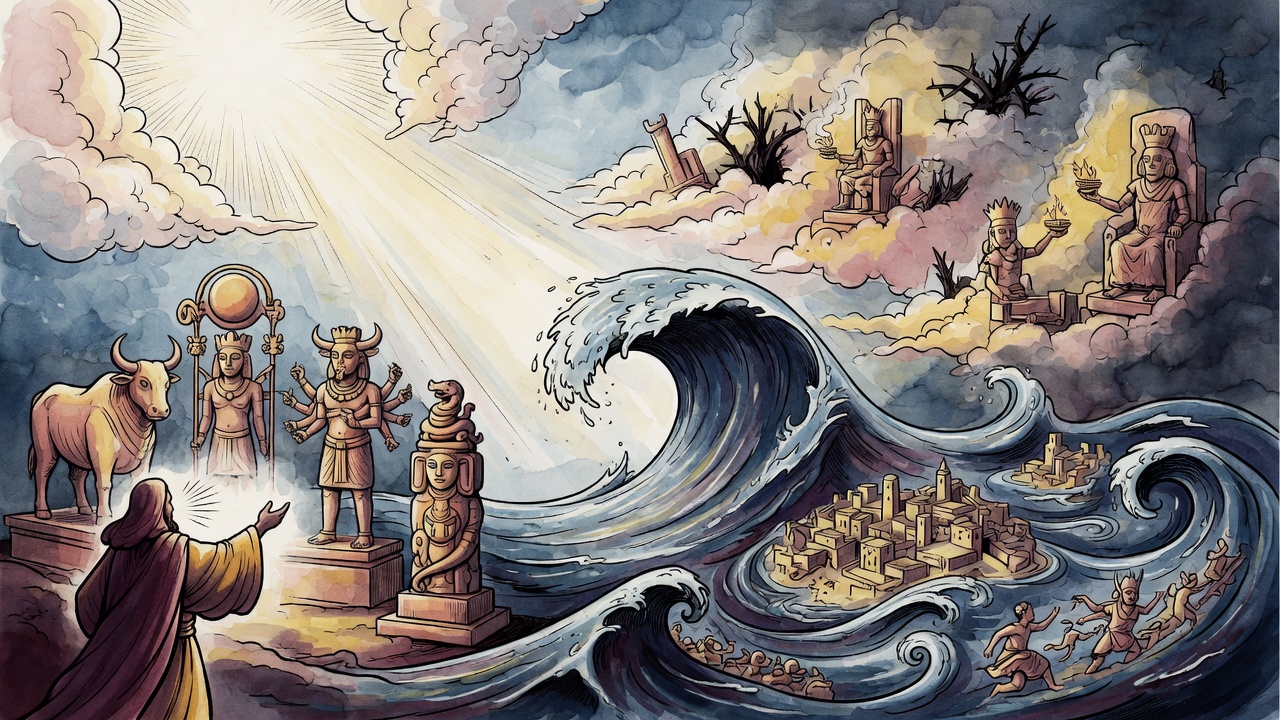
The Idol City Is Razed and Spoil Hits the Dead Sea Click for full size

Men Without a Yoke

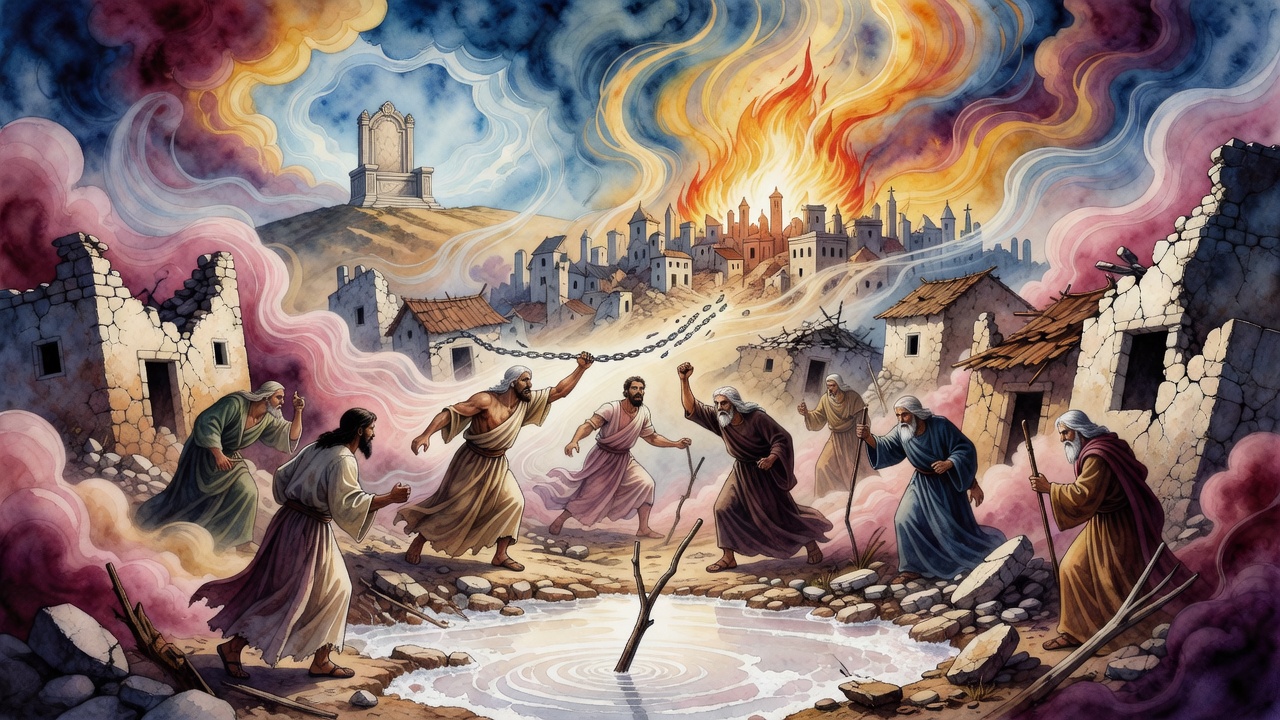
They called themselves free. Neighbors later named them men of belial, men without a yoke. They threw off heaven the way a draft animal throws a harness in a muddy field, then smiled as if the field would plow itself. From the midst of a city, not from a border town of mixed loyalties, they turned their own streets. Two witnesses. Warning spoken in the open. The law would not let rumor do the work of proof.

A boy watched an older cousin bow to something that was not the Name. The cousin laughed and pulled him closer. "Everyone does it now." The boy felt the yoke slide on his own shoulders and, for one night, left it on the ground. He slept badly and woke with the taste of metal in his mouth.

Search, Ask, Cross-Examine

Judges entered the gates at dawn. They did not burn first and measure later. They inquired of Torah. They searched out the witnesses. They asked until seven cross-examinations had pressed every story flat. "From your midst," the charge had to hold. Not another city. Not a traveler's gossip. The city itself had to be shown to have turned.

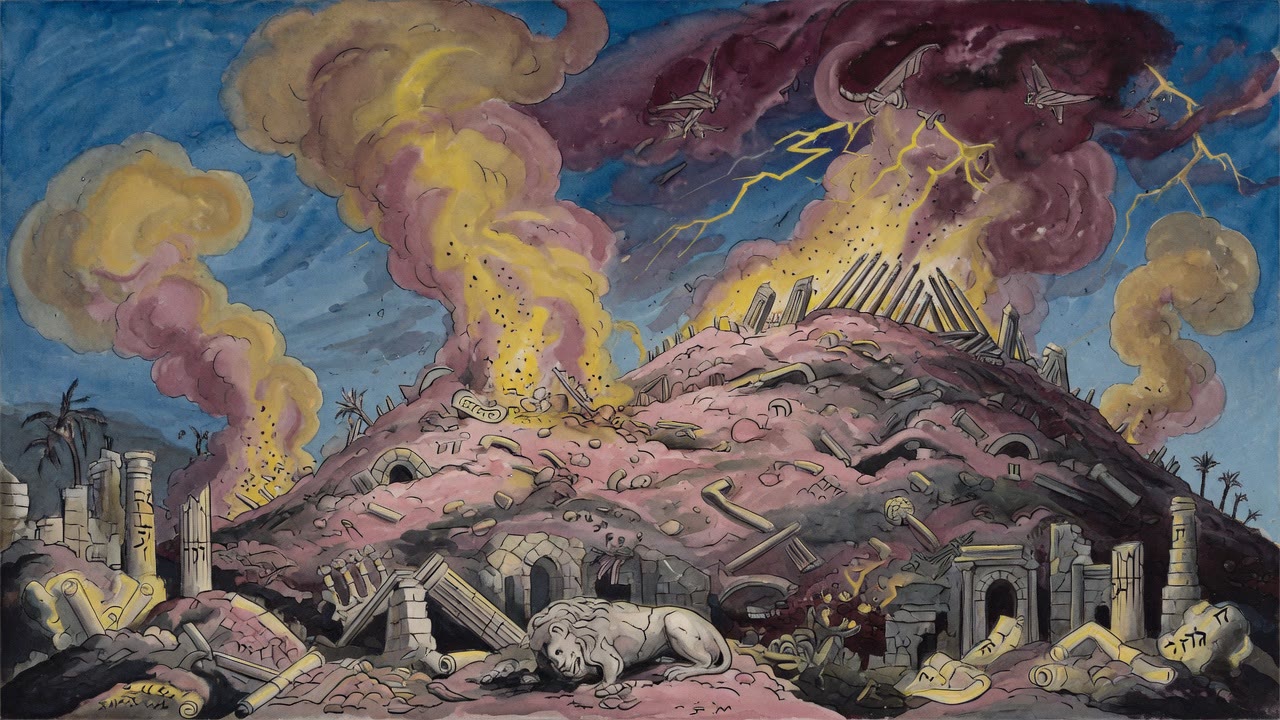
A house built from the first stone for idolatry was forbidden and marked for razing. Men raised hammers and struck the walls until dust filled their lungs. A house only plastered and decorated for the cult lost its additions. Workers cut the painted beams and threw them into a pile. A house that merely held an idol and then was emptied could stand once the name of the thing was made lost from that place. Men argued over plaster while the air still smelled of incense that was not theirs.

The Stick That Must Drown

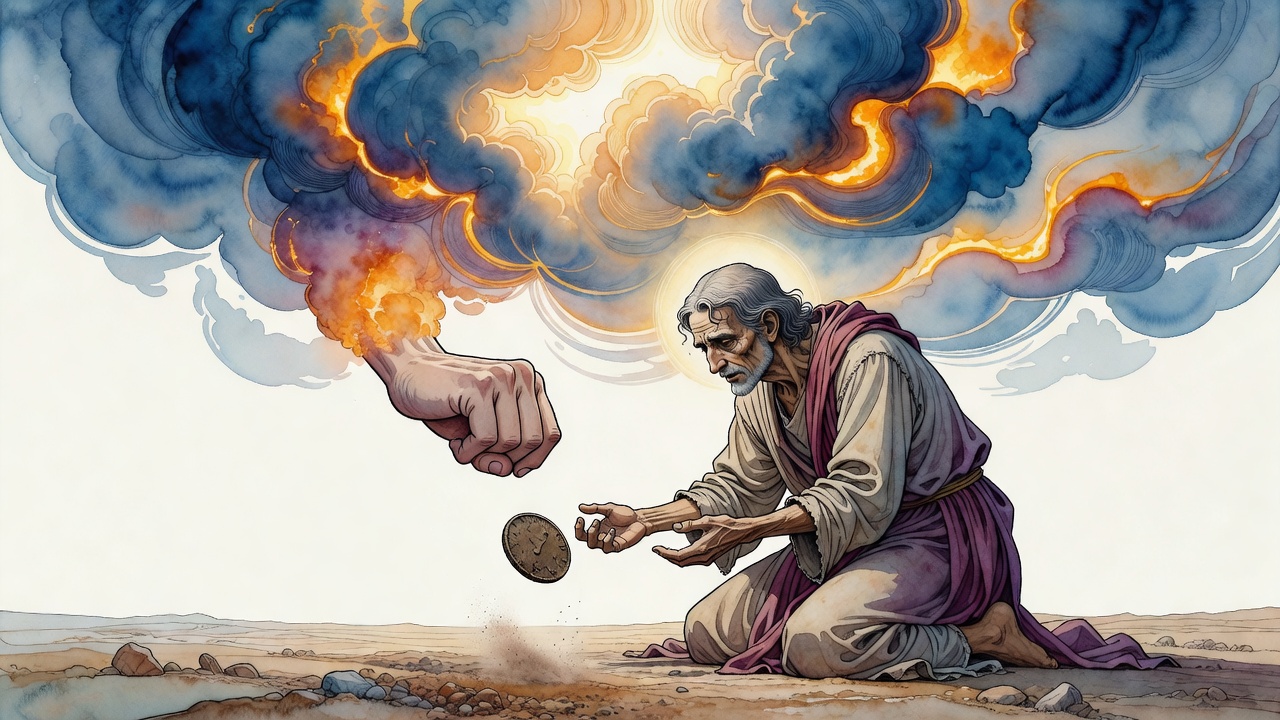
When judgment finally fell, the city did not become a market of trophies. Nothing of the spoil might adhere to a hand. A man pocketed a stick, a fork, a shuttle, a staff. Each was small enough to excuse. Each was large enough to keep the wrath alive. The law answered with a hard road: take the benefit to the Sea of Salt. Drown it where nothing grows.

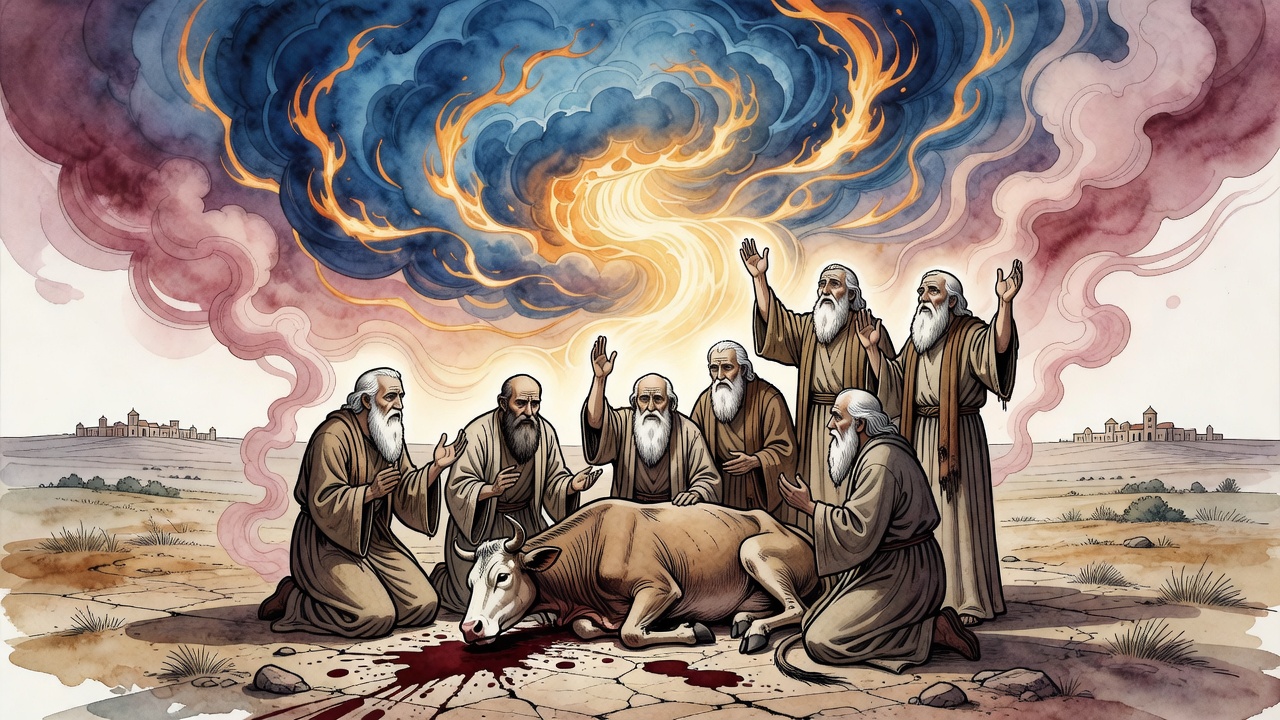
He walked with the stick under his cloak, still hoping to keep it. At the white shore the air bit his face. He stood a long time, then threw. The wood vanished into water that refused life. So long as idolatry remains in the world, fierce wrath remains. When it departs, the wrath departs. The splash was small. The theology was not.

Altars Broken and Left

They razed altars and left the rubble. They broke monuments and left the shards. Pursuit of the name was total in the land, not as theater for foreigners but as hygiene for a people that had felt heaven's anger. Outside the land the rules shifted. Inside it, the chase was relentless.

The boy who dropped the yoke for one night watched the stick sink. He picked the yoke up again, not because he was pure, but because he had seen what "without a yoke" costs a street of ordinary houses. The free men were not free. They were a fire that ate its own city and then asked why the sky was hot.

What Remains After the Salt

Weeks later, dust settled where doors once hung. Someone planted a vine that had no idol-name carved into its stake. Judges went home with ink-stained fingers. The cousin was gone into the judgment the city earned. The boy grew into a man who flinched when he heard easy laughter about "only a little bow."

He carried water past the empty lots and refused to pocket so much as a nail. The Dead Sea kept its dead things. The living kept a different inventory: yoke on, hands clean of spoil, houses measured by what they were built for. Wrath is not a mood. It is a climate that lifts when the last stolen shuttle hits the salt. At night he dreamed of the stick falling forever through white water, and he woke grateful that his own hands were empty.


← All myths

From the tradition

Sources

3 sources

The texts behind this telling. Some cards carry a translation of the source; others are our own retelling of it, and each card says which. Every card links out to the original.

Sifrei Devarim 93:6Sifrei Devarim

Retold in our words. Read the original at the link below.Sifrei by Rabbi Shraga Silverstein · CC-BY

In the book of Sifrei Devarim, they grappled with just that. They explored the idea of people so lost, so rebellious, that they were called "men of belial."

What does belial mean? Literally, it means "without a yoke." But the rabbis in Sifrei Devarim aren't just talking about farmers whose oxen have run off. They're talking about something far more profound: men who have thrown off the yoke of Heaven, who refuse to submit to any higher authority. It conjures up images of defiance, of a complete rejection of moral responsibility.

When these men of belial arise, what then? The text continues, speaking of those who "turned away the inhabitants of their city." Now, notice the specificity here. The rabbis emphasize "from your midst," meaning not from a border city, but from within the heart of the community. This isn't some external threat; it's a rot that festers from within. And furthermore, they only turned away the inhabitants of their city, not those of another. The corruption is localized, contained, but still incredibly dangerous.

The text even explores the legal procedures surrounding such a grave accusation. It states that "two witnesses and warning are required for each of the cities." This isn't a witch hunt. There are safeguards, protections built into the system to prevent injustice.

But how do you determine the truth? How do you know if these accusations are valid? The text lays out a process of rigorous investigation: "And you shall inquire… and you shall search out… and you shall ask." According to this passage, inquiry must be directed to three separate sources: the Torah, the witnesses, and the Talmud.

This process of inquiry isn't just a casual chat. No, it's a deep dive. The text draws a parallel between this investigation and the investigation of scheming witnesses, using a gezeirah shavah (a hermeneutical method using similar wording in different verses to draw a connection). The word "well" appears in both contexts, teaching us that the witness undergoes seven cross-examinations, or chakiroth. Seven! Every detail, every inconsistency, is picked apart.

Why all this effort? Why all this care? Because the stakes are incredibly high. The well-being of the community, the very fabric of society, depends on justice being served, on truth prevailing. It emphasizes the importance of due process, of not rushing to judgment, even in the face of seemingly overwhelming evidence.

So, what does all this mean for us today? Are there "men of belial" in our midst? Maybe not in the literal sense, but perhaps in the sense of people who have rejected responsibility, who have cast off the yoke of morality. And when we encounter such situations, do we have the courage to inquire, to search out, to ask the hard questions? Do we hold ourselves and others to a high standard of accountability?

The passage in Sifrei Devarim challenges us to be vigilant, to be discerning, and to never compromise on the pursuit of truth and justice.

Full source
Sifrei Devarim 96:3Sifrei Devarim

Retold in our words. Read the original at the link below.Sifrei by Rabbi Shraga Silverstein · CC-BY

This text, a collection of legal interpretations on the Book of Deuteronomy, doesn’t just say "stay away from idols." It gets incredibly specific.

The passage What do you do with the stuff you’ve captured? Seems like a simple question.

Sifrei Devarim (Ibid. 18) quotes the verse: "And let there adhere to your hand naught from the spoil." Now, the rabbis of old weren't ones to let a single word go unexamined. They asked: What does "naught" really mean?

Their answer is pretty astonishing: "From here they ruled: If he took from it (the spoil) a stick or a fork, or a shuttle, or a staff, he may not benefit from any of them."

A stick? A fork? These sound like pretty innocuous items. But the text is adamant. If these objects were taken as spoil from an idolatrous culture, they are tainted. You can't use them. You can’t benefit from them.

So, what do you do with them?

"What shall he do with them? He shall take them to the Sea of Salt." That’s right. The Dead Sea. Throw them in. Let them sink into the salty depths, irretrievable and unusable. A deliberate act of destruction, signifying a complete and utter rejection of anything associated with idolatry.

The text sums it up powerfully: "In sum: All who would benefit from idolatry, let him take that 'benefit' to the Sea of Salt!" No half-measures. No lingering attachments. Just a clean break.

But why such a drastic measure for something as seemingly insignificant as a stick or a fork?

The answer, according to Sifrei Devarim, lies in the consequences of idolatry itself: "so that the L-rd turn from the fierceness of His wrath." The text suggests that idolatry isn't just a theological error; it's a source of divine wrath. "So long as there is idolatry in the world, there is fierce wrath in the world."

The flip side is equally powerful: "When idolatry departs, the wrath departs."

Therefore, getting rid of the remnants of idolatry is presented as a way to alleviate divine anger and bring peace to the world. It's a form of spiritual purification, a way to cleanse not just ourselves, but the very atmosphere around us.

What seemingly small things might be worth tossing into our own metaphorical Dead Sea?

Full source
Sifrei Devarim 61:6Sifrei Devarim

Retold in our words. Read the original at the link below.Sifrei by Rabbi Shraga Silverstein · CC-BY

Jewish tradition actually has some pretty specific ideas about how to deal with buildings that have been used for… less-than-holy purposes, specifically idolatry.

The Sifrei Devarim, a legal midrash on the Book of Deuteronomy, lays out some fascinating guidelines. It's all about context, you see. Was the house built to be a temple to idols from the very beginning? Then, according to the Torah’s instruction "And you shall raze" (Deuteronomy 12:2), it’s a total teardown. Gone. Kaput. No redeeming it.

What if someone just, say, added a few idolatrous touches later on? Maybe plastered over the walls with images or decorated with pagan symbols? Well, that's a different story. In that case, the Sifrei Devarim says you only need to remove the additions. The verse "shall you cut down" (Deuteronomy 12:3) is understood to mean precisely that, cut down the offending parts, not the whole structure. Think of it like removing a bad branch from a tree, not chopping down the whole tree.

What if idols were just placed inside a house, and then later removed? Good news! The house is considered permissible. The verse "and you shall cause their name to go lost from that place" (Deuteronomy 12:3) is interpreted to mean that it's the name of the idolatry that needs to be erased, not the physical structure itself. It’s as if the house can be cleansed and given a fresh start.

The text goes on to elaborate on this idea with an interesting nuance: "And you shall raze their altars": Once you have razed the altar, leave it. "and you shall break their monuments": Once you have broken it, leave it. ("and you shall cause their name to go lost) from that place."

So, destroy the implements of idol worship, and make sure to obliterate any trace of its name, but that's it.

Now, here's a twist! The text adds one more layer. All this destruction, all this razing and cutting down… it's especially important within Eretz Yisrael, the Land of Israel. Inside the land, you must pursue its complete destruction. Outside the land? Not so much.

Why this distinction? Perhaps because the spiritual purity of the Land of Israel held (and continues to hold) a unique significance. Maybe because the threat of idolatry was seen as a more immediate danger within its borders. Whatever the reason, it highlights the special relationship between the Jewish people and their ancestral homeland.

So next time you pass an old building, remember this teaching from the Sifrei Devarim. Think about the stories it might tell, the history it might hold, and the delicate balance between remembrance and renewal. It’s a reminder that even the stones beneath our feet can carry echoes of the past, and that we have a role in shaping their meaning for the future.

Full source