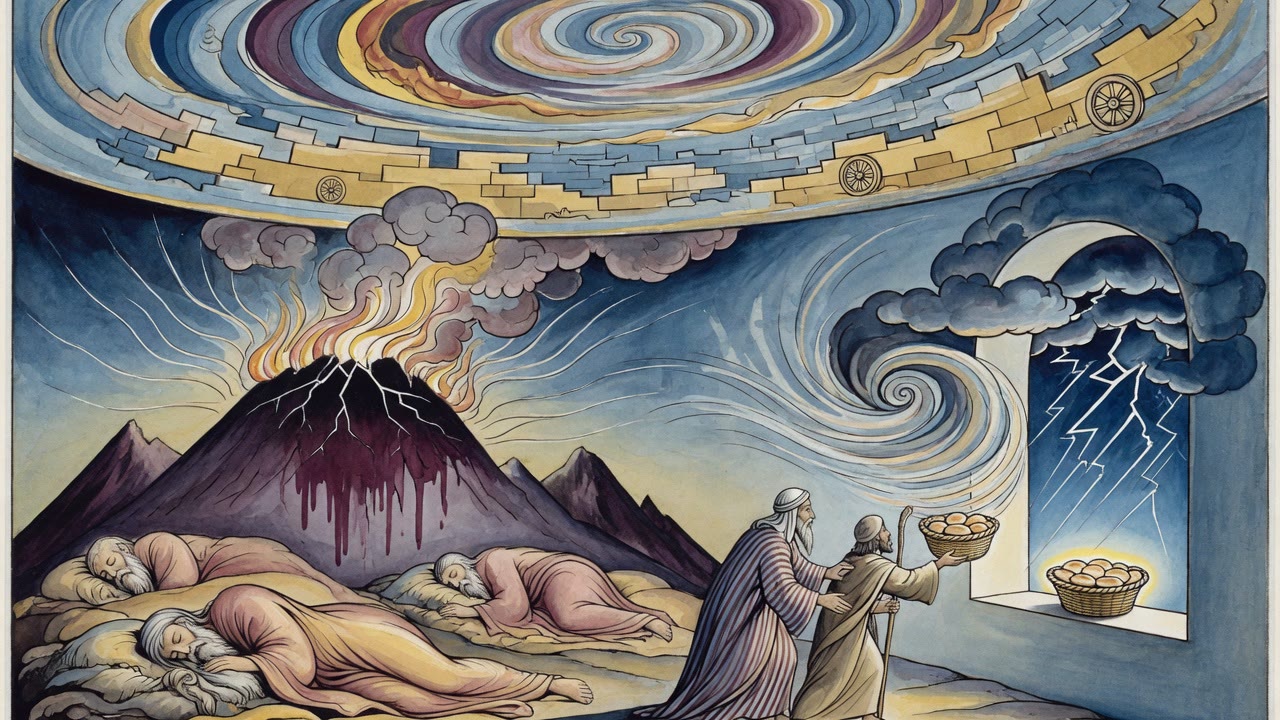
Ishmael Read Every Age Upon the Pargod Curtain
Behind a curtain of divine names, Metatron showed Rabbi Ishmael every generation to come. The light hurt. The knowledge did not make the path easy.
Table of Contents
 Click for full size
The Curtain Before the Throne
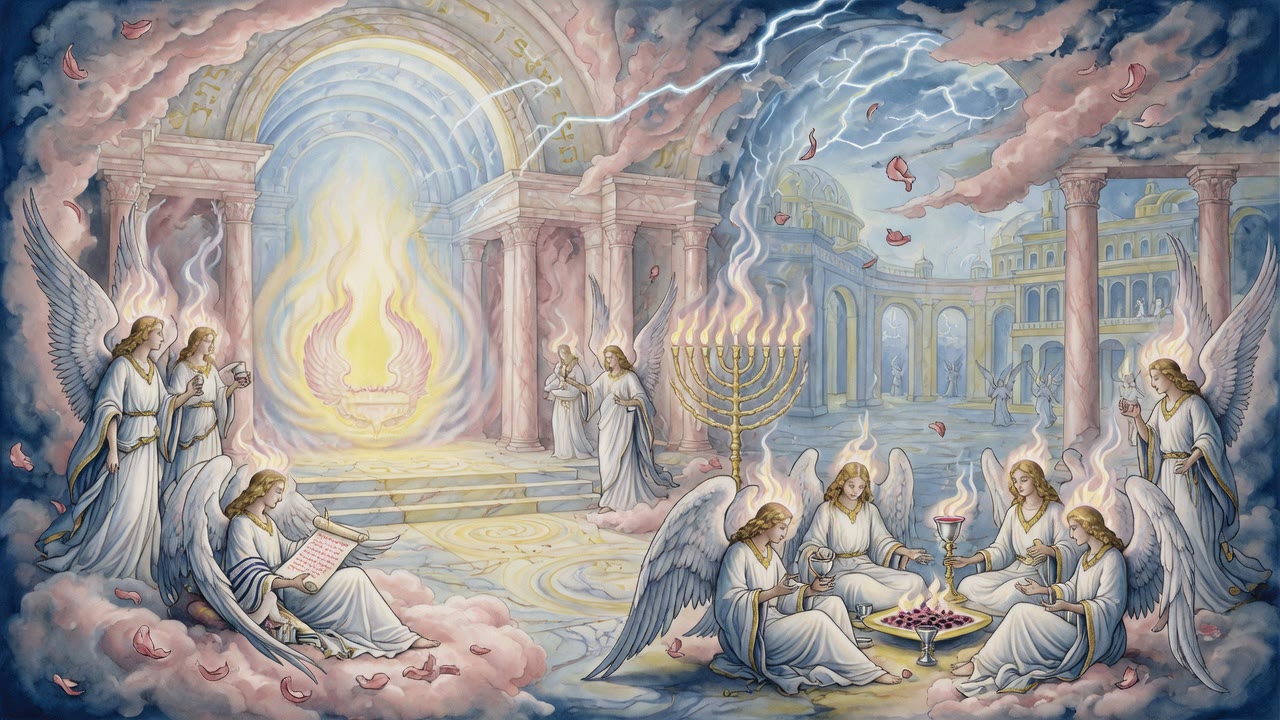
Rabbi Ishmael rose through courts of fire with Metatron as guide. At last they stopped before a curtain that was not cloth in any earthly sense. The Pargod (פרגוד) hung in Paradise light, covered with the letters of the complete Name, shimmering with forms of everything that exists below.
Only the Bride of God, the Shekhinah (the indwelling presence of God) in her nearness, and Metatron the Prince of the Presence may stand fully beyond it. Ordinary angels do not stroll past. Hiddenness is not only a human problem.
Ishmael's eyes watered. The curtain held more history than a library. Heat from the letters pressed his skin the way noon presses a traveler who has no shade.
"Do not look away too soon," Metatron said, not unkindly. "And do not look as if you can own what you see."
Generations Etched in Light
Metatron showed him the deeds of generations, past, present, and future, printed on the Pargod out to the days of the Messiah. The angel taught him the way a father teaches letters to a son. Ishmael did not only see. He tasted the weight of ages that had not yet learned to walk.
Somewhere on that surface a drought waited. Somewhere a teacher would light a path or refuse to. The curtain did not flatter. It disclosed.
Ishmael understood why most souls are not brought here. Knowledge of the whole can crush a single life.
He saw empires rise like smoke and thin the same way. He saw a child in a future alley laugh without knowing the Pargod already held the shape of that laugh. Mercy and severity braided through the light until his knees softened.
When the Sighted Close Their Eyes
Later ages would borrow an image from Maimonides and press it hard. A thousand blind people walk a dangerous road. If one can see, he may lead. If even the sighted turn away from inner Torah, the generation stumbles together.
Baal HaSulam felt that drought in his own time, a darkness in which even those dedicated to service neglected the nistar, the hidden. The pain, he said, was too great to speak fully. The Pargod's lesson returns here without a heavenly tour. Someone must keep looking into what others call too hard.
Ishmael had been forced to look. Ordinary teachers choose.
On the dangerous road of a later century, a man with sight who prefers comfort becomes a more serious danger than honest blindness. At least the blind know they need a hand. The sighted who refuse the inner path lead others into pits with confident steps.
Gold Mixed With Straw
Even sacred books that claim high origin can pick up barley and straw in transmission. The Mitpachat Sefarim dares to say so of parts of the printed Zohar, pointing to corrupted Aramaic in places, language that chirps like a mockingbird instead of speaking clean mystery. The core, it insists, remains pure. The edges need sifting.
The holy Ari built wisdom on that crown of mystical teaching and still the later wrapper-book warns against swallowing every line without judgment. Heavenly curtains are one thing. Printed pages are handled by human hands.
Ishmael's vision was not a printed page. It was still a test of discernment. Not every form on the Pargod is a command to despair. Some are warnings. Some are work orders.
A student who loves mystery more than truth will swallow straw and call it gold. A student who loves truth will sift, even when sifting feels like disloyalty. The curtain taught Ishmael both reverence and care.
Back Below the Curtain
When Ishmael returned to the thickness of earth, market sounds replaced letter-light. He carried what he could hold without breaking. He did not publish every future he had seen. Some seals are mercy, as Jacob learned in another story. Some disclosures are only for the one who must lead a few steps.
The Pargod still hangs where only a few may pass. Generations still write themselves onto it whether they know or not. And somewhere a teacher with ordinary eyes decides whether to stay blind on purpose or to risk the light that hurts and guides.
Ishmael washed his face. The water was common. The memory was not. He opened a scroll and taught the next line of law as if the curtain had never opened, which is also a kind of faithfulness, because the lower world is where the forms on the Pargod must finally be lived.
A student asked a simple question about a case of damages. Ishmael answered simply. Behind the simple answer, the curtain still shimmered in his private sight, reminding him that even a case of damages is already etched somewhere in light.
← All myths