God Called Heaven and Earth to Answer Jacob
He had crossed the Jordan with nothing but a staff and been given everything after that. Then a king asked his age and got a complaint.
Table of Contents
 Click for full size
He Said It in Front of Pharaoh
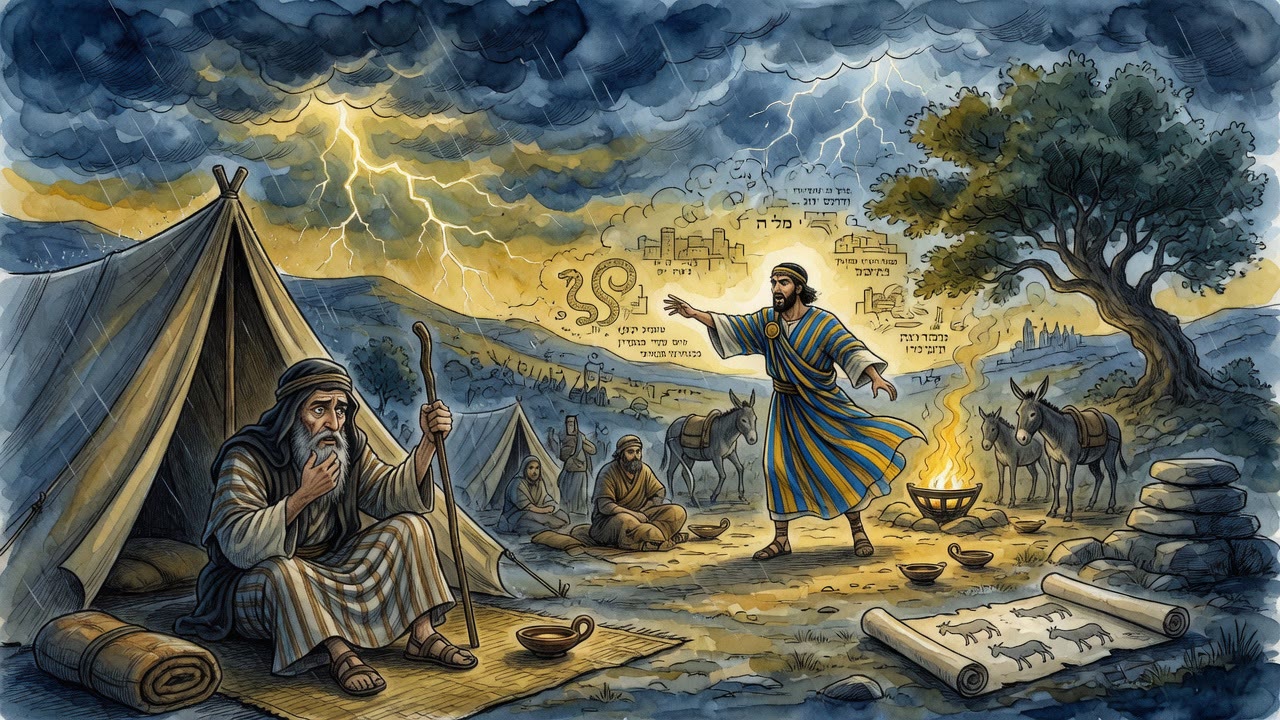
An old man was brought into the throne room in Egypt, where his son was second in the kingdom and the famine had been broken and the whole family had come down and been given the best land in the country.
Pharaoh asked him how old he was.
"Few and evil have been the days of the years of my life."
Jacob had crossed the Jordan with nothing in his hand but a staff, and everything after that had been given to him. God heard the answer he gave the king of Egypt.
"Have I done you evil, Jacob, that you speak like this?"
The Rest of the Family Had Done It Too
There were thirteen kinds of fragrant plants in the garden of Eden and ten chambers in it, and the man who lived there was not left alone in it, because it was not good for a man to be alone.
Adam owed a thank-you for that. What he said instead, standing among the plants with the juice still on his hands, was: the woman You gave me.
Abraham went to war and came back a king over sixteen kings with all the captives freed, and he took that for his payment. So God told him the payment had not started yet, your reward is very great. He owed a thank-you there too. What he said was, Lord God, what will You give me?
And the people in the desert, who had been carried the way a man carries his son, looked at the bread coming down out of the sky and said their souls were sick of this light bread.
Four generations, one habit. Why do you say, Jacob, and speak, Israel, that your way is hidden from the Lord?
The Man Who Married Off His Daughter
God answered him with a story about a wedding.
A man gave his daughter away and then set about making friends with the son-in-law, and in the middle of the courting he said the thing that was really on his mind. "I am not going to be feeding her."
The son-in-law did not argue with him. He said, "It is not what you say. It is what the third one between us says."
Jacob's daughter is the Assembly of Israel. The son-in-law is God. Jacob had started in on the terms, and the answer came back the same way.
"Not what you say. Let heaven be the witness that I fed your children, because it is written, behold, I will rain bread from heaven for you. Let the earth be the witness that I gave them water, because it is written, the well that the princes dug. Both of them stood there while it happened. Ask them."
I Praised You Before You Existed
"And all of this comes out of the love I have for you. I have loved Jacob. When Israel was a child, I loved him.
"Can a king praise a man he has never laid eyes on? I praised you before you were made."
The hiddenness Jacob was complaining about had been in the terms from the beginning, and he had been told. Before he was born it was said of him that his way would be hidden and that his hand would come out holding his brother's heel. A hedged road was what he was given. He walked it for a hundred and thirty years and then described it to a foreign king as short and bad.
Rabbi Shmuel said a living man has no business complaining about his own sins, the ones his own hands could have stopped. Rabbi Shimon put it lower than that. Why should a man complain at all? He is alive. He can see this sun.
Go Back to Your Staff
"Return to your staff," God told him.
He had crossed the river with it. He was going to bless the twelve of them leaning on it, propped up on the bed with his sons around him, handing out futures. In the middle of that blessing, between Dan and Gad, he broke off and said something that was not a blessing for anyone in the room. I wait for Your salvation, Lord.
That is the sentence. Say that one.
And the sentence he ended with was not the one he gave Pharaoh. Great troubles have surrounded me from my youth, Jacob said, and even so, they were not able to overcome me. Not the adversary, and not the inclination inside me either.
The Assembly of Israel took the line and sang it going up the steps. They had been embittered in Egypt with mortar and brick. They rebelled at the sea itself, with the water standing open on both sides. They were struck in the wilderness. And through all of it God's own son stayed put between the two sons of Amram, with Aaron on one side and Moses on the other, and the pressure came from outside and inside at once and did not get through.
Many have afflicted me from my youth. That is the first line of the song. It is not the last one.
← All myths