5 min read

Jacob Saw His Face Carved in Heaven Above

Jacob sleeps on stones while banished angels climb home, border guardians change posts, and heaven sees his face above and below.

Curated by Arthur · Told by Maggid ·
Table of Contents
  1. The Exiles Climbed First
  2. Heaven Recognized the Sleeping Face
  3. The Guardians Reached the Border
  4. The Angels Came Down Angry
  5. The Ladder Became Fire and Empire

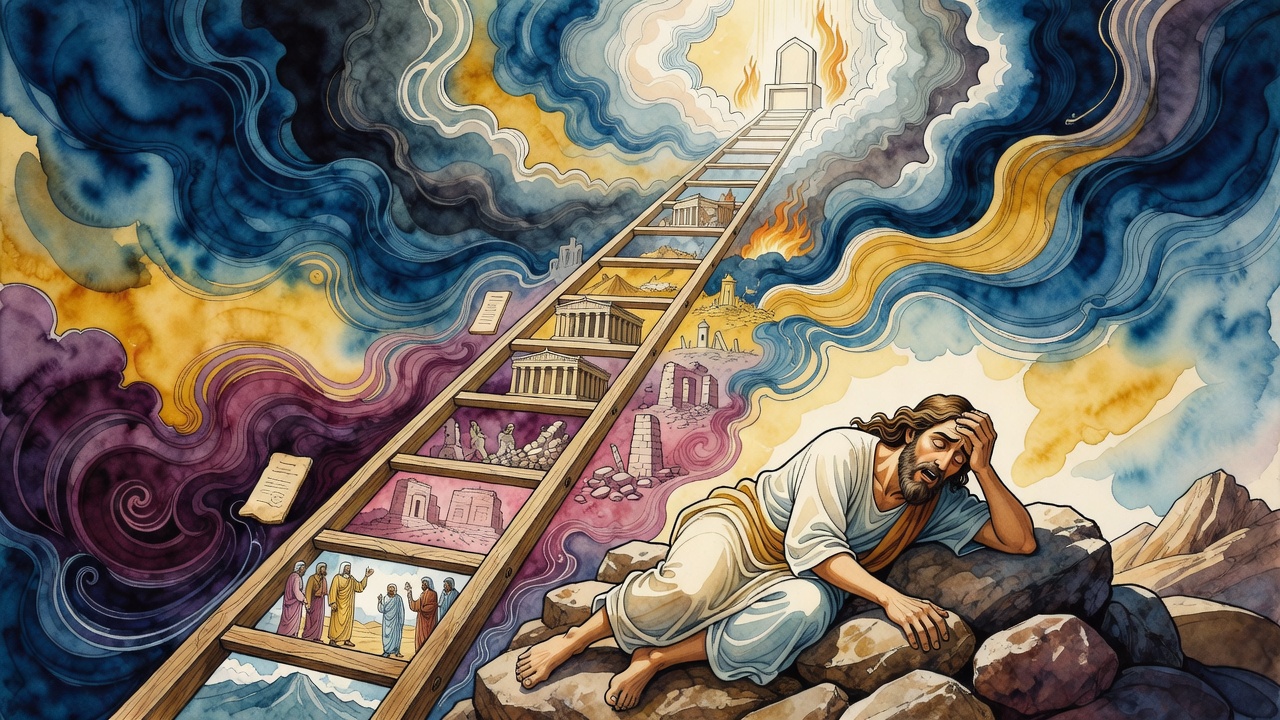
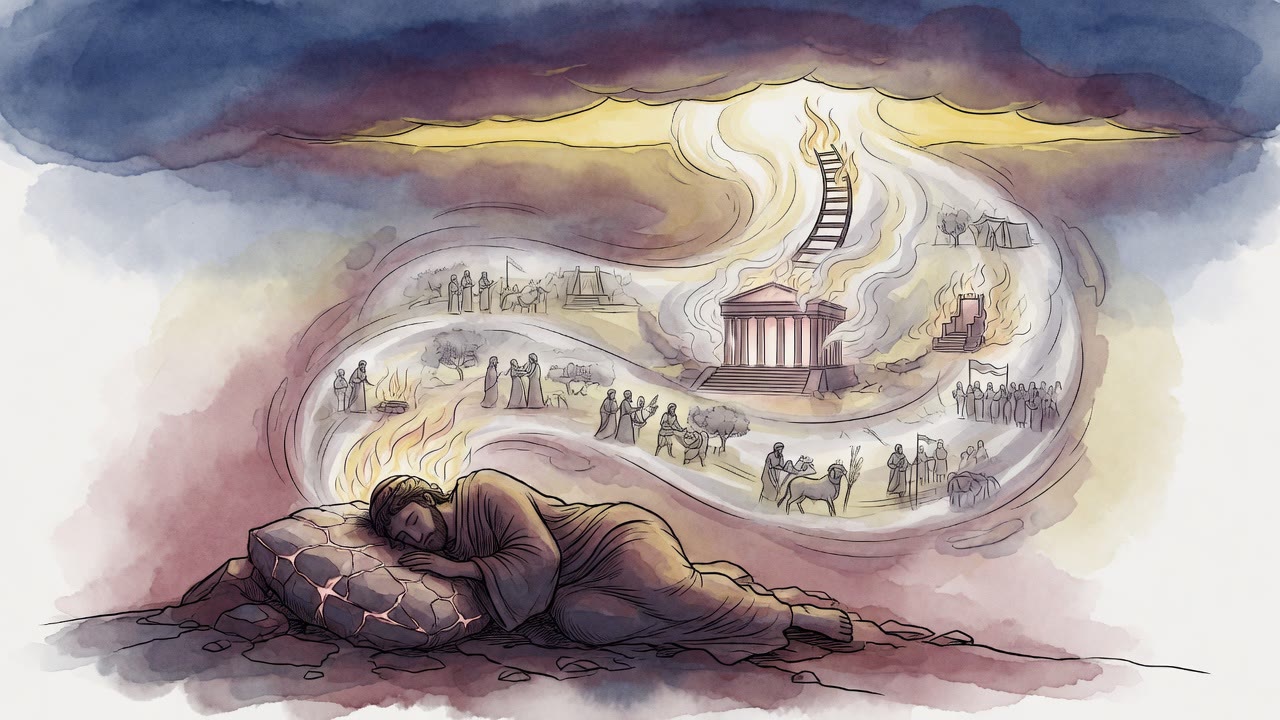
Jacob slept with stones under his head because no house would take him in. Esau's anger was behind him. Laban's house waited ahead. In the dark between them, heaven lowered a ladder over the body of a fugitive.
The Exiles Climbed First

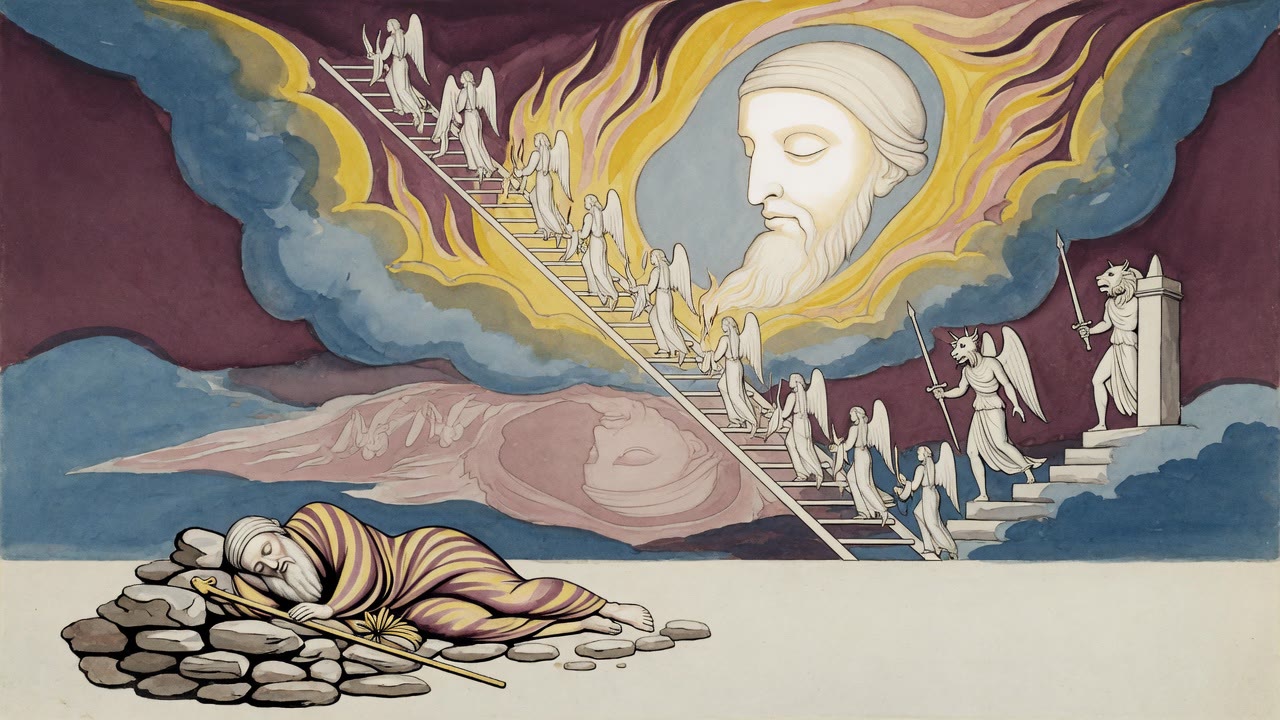
The first angels on the ladder were going up. That was the strange part. Heaven should descend toward earth before earth rises toward heaven, but Jacob watched the order reverse. Two angels climbed first, and they were not strangers to human ruin.

They had once gone to Sodom in Abraham's day. There, before the command had fully gone out, they revealed the secret of the coming destruction to Lot. For that breach they were driven from the upper world. One hundred thirty-eight years passed with their feet on dust instead of cloud. They walked the earth through Abraham's old age, Isaac's household, Esau's hunt, Rebecca's fear, and Jacob's flight.

When Jacob left his father's house, they attached themselves to him. They did not carry a sword. They escorted him with kindness until he reached Bethel. There, by the stones, their own exile ended.

Heaven Recognized the Sleeping Face

The two angels climbed into the highest places and called to the hosts above. Come see him. Come see the pious Jacob. Come see the man whose likeness is fixed in the Throne of Glory.

Then the hosts came down the ladder, not to rescue him, but to look. The face they had desired to behold was not crowned or washed or standing in prayer. It was pressed with sleep, marked by travel, half-buried in the night air. Above, that same face was carved into the throne. Below, it lay on stones.

Heaven had been passing the image for generations. Earth had just thrown the man out of his own house.

The Guardians Reached the Border

Another company moved on the ladder with stricter orders. The angels who guard inside the Land of Israel cannot cross its border. They had escorted Jacob as far as they were allowed. At the edge of the land they rose, released from their post, and another guard descended for the road abroad.

That is why the traffic mattered. Jacob was not watching random wings in a dream. He was watching a handoff. Protection had geography. Exile had its own angels. Even when a man left the land promised to his fathers, the unseen world did not shrug and let him go unguarded.

The new escorts came down into the dark. Haran would have its deceits, wages, wives, births, rivalries, and night terrors. Jacob would not enter it alone.

The Angels Came Down Angry

Some of the angels did not come gently. They looked up at the face carved above and down at the sleeping man below, and the double vision offended them. How could the same image rest in the throne and in the dirt? How could the mark of heaven belong to a man too tired to keep his eyes open?

They descended to strike him.

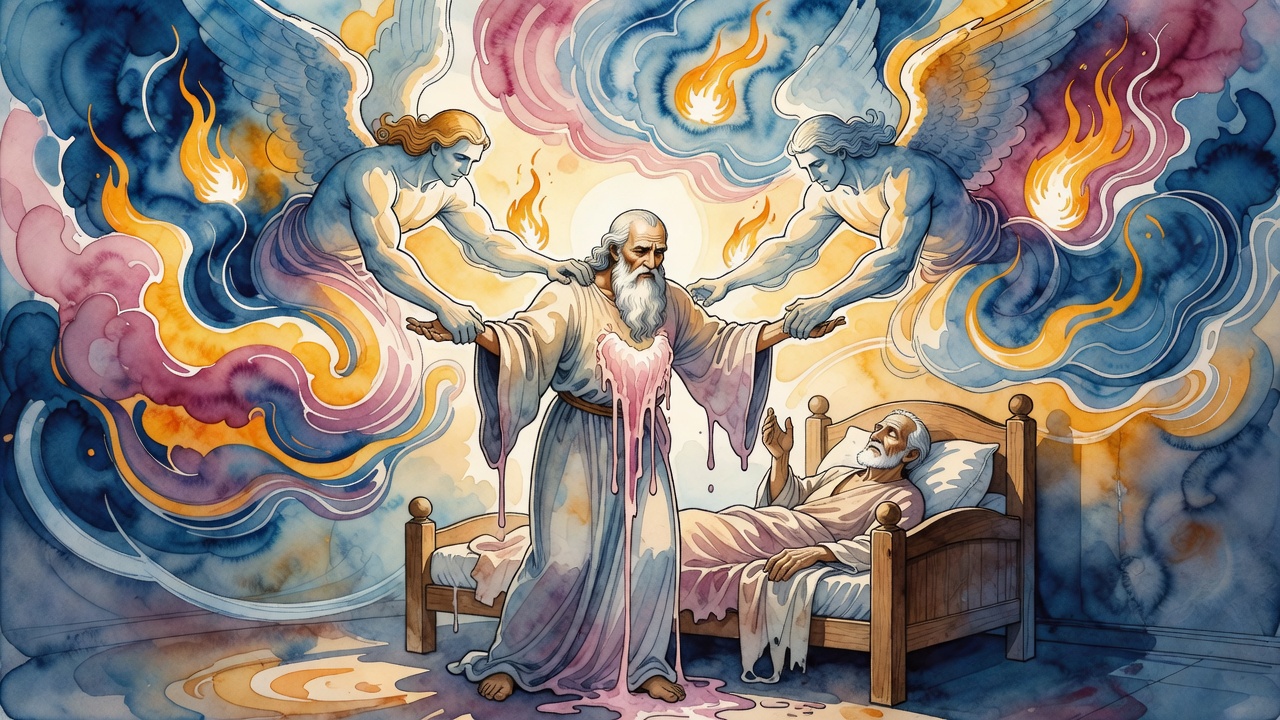
Jacob slept through the danger. His hands did not rise. His mouth did not pray. He did not know that the beings who had come to marvel at him were now closing around him. Then God stood over the sleeper. Not an angel. Not a message. God Himself took the place above Jacob's body, and the blow stopped before it reached him.

The Ladder Became Fire and Empire

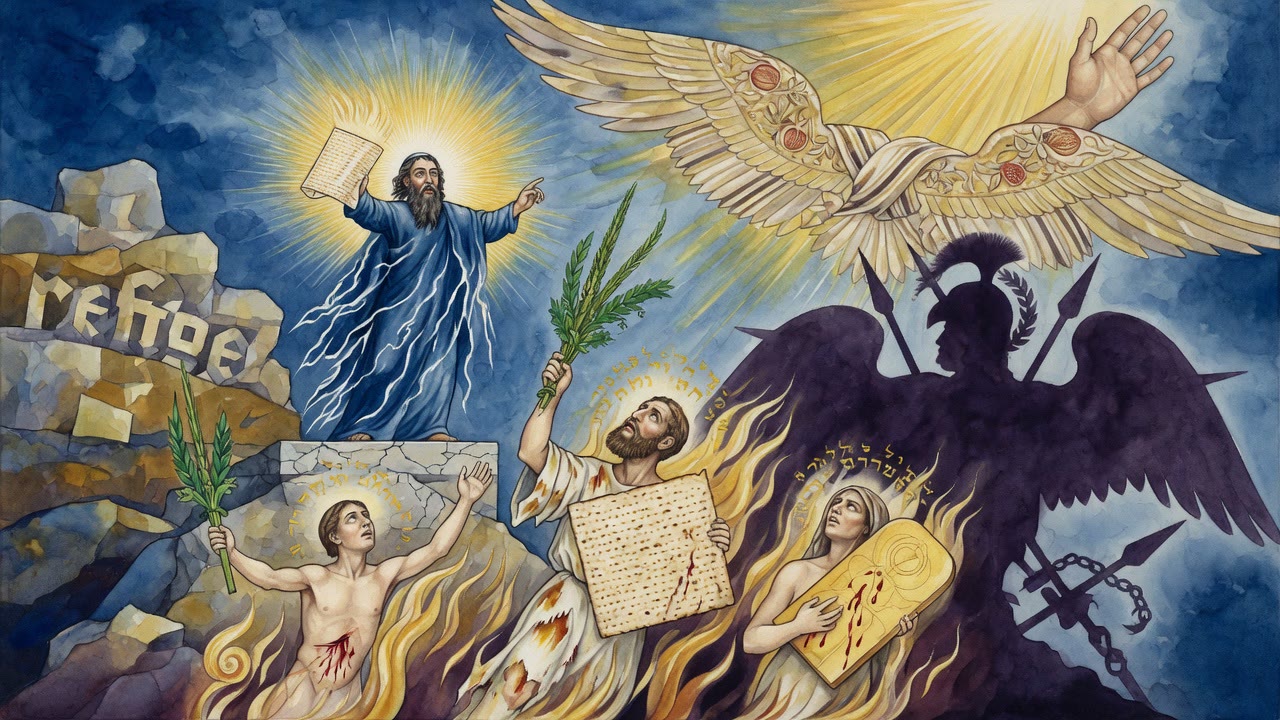
The ladder held more than angels. Its shape became the altar ramp, with earth below and offerings rising above. It became Sinai, its foot planted where Israel would stand and its top burning into heaven. The word for ladder weighed the same as the word Sinai, and the rungs turned into a mountain of fire.

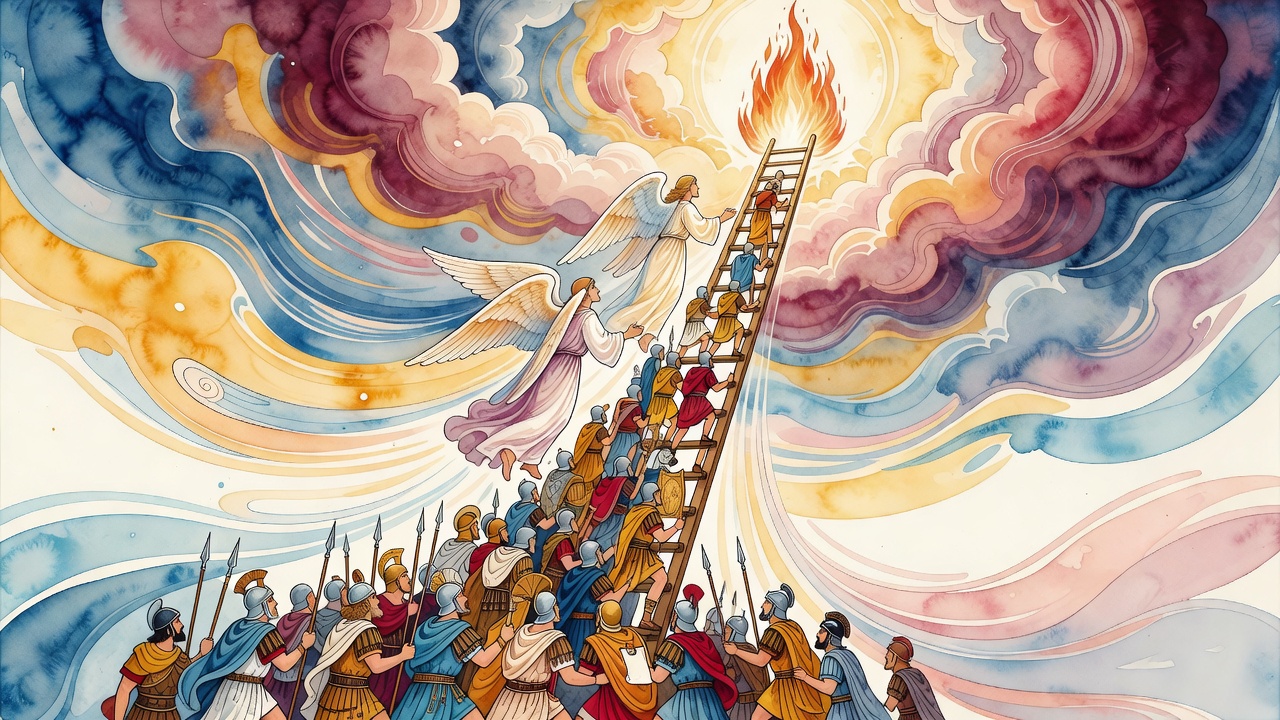
Then the dream widened into history. The angel of Babylon climbed seventy rungs. The angel of Media climbed fifty-two. The angel of Greece climbed one hundred eighty. Each ascent had a number, and each number had an end.

Then Edom climbed higher than all of them. The angel rose past the others and boasted that he would ascend above the clouds and make himself like the Most High. The ladder held him for a moment. Then the answer came from above: though the nest were set among the stars, God would bring it down.

Jacob woke where he had fallen asleep, but the stones were no longer only stones. They had touched a gate. The road still led away from home. The danger still waited ahead. But the fugitive had slept under his own face in heaven, while angels changed their watches and the proud climbed toward their fall.


← All myths

From the tradition

Sources

4 sources

The texts this telling draws on, in full. Open a card to read inline, or expand it for a wider, quieter read.

Legends of the Jews 6:100Legends of the Jews

The Torah tells us of Jacob's famous dream, but the Legends of the Jews fills in fascinating details. It wasn't just any ladder, you see. It was a ladder connecting earth and heaven, a visual representation of the connection between the mortal and divine realms. And who did Jacob see on this ladder? The very angels who had once visited Sodom!

In Ginzberg's retelling, these weren't just any angels. They’d been banished from heaven for 138 years after betraying their mission to Lot. Imagine carrying that burden for over a century! They’d been with Jacob since he left his father's house and were finally returning to their rightful place. Can you picture the scene? As they ascended, they called out to the other angels, beckoning them to witness the piety of Jacob, whose very likeness, they proclaimed, adorned the Divine throne. "Come ye and see the countenance of the pious Jacob, whose likeness appears on the Divine throne, ye who yearned long to see it," they cried. A powerful moment of validation and recognition.

The dream didn’t stop there. Jacob also saw the angels representing the four kingdoms ascending the same ladder. These weren't just messengers; they were symbolic representations of empires – Babylon, Media, Greece, and Edom (often interpreted as Rome). Each climbed a certain number of rungs, signifying their time and influence in the world. The angel of Babylon climbed 70 rungs, Media 52, and Greece a staggering 180.

Then came Edom. This angel ascended higher than all the others, boasting, "I will ascend above the heights of the clouds, I will be like the Most High!" This is where things get intense. the verse says, Jacob heard a divine voice immediately rebuking Edom’s hubris: "Yet thou shalt be brought down to hell, to the uttermost parts of the pit." It's a stark reminder of the dangers of unchecked ambition and the ultimate triumph of humility over arrogance.

God Himself then intervenes, echoing the sentiment: "Though thou mount on high as the eagle, and though thy nest be set among the stars, I will bring thee down from thence" (Obadiah 1:4). These powerful words emphasize the futility of seeking to usurp divine authority. No matter how high one climbs, or how seemingly secure one's position, ultimate judgment rests with the divine.

What are we to make of this dream? It seems to be a prophetic vision, a glimpse into the rise and fall of empires and the enduring power of faith. It highlights the importance of humility and warns against the dangers of unchecked ambition. Jacob’s ladder dream wasn't just a personal experience; it was a cosmic revelation, a evidence of the enduring struggle between good and evil and the ultimate triumph of divine justice. It leaves us pondering the forces that shape history, and the enduring importance of staying grounded, even as we reach for the heavens.

Full source
Targum Pseudo-Jonathan on Genesis 28:12Targum Pseudo-Jonathan on Genesis

Jacob dreamed, and a ladder stood from earth to heaven (Genesis 28:12). The Targum Pseudo-Jonathan fills the rungs with specific traffic.

The two angels on the ladder were not anonymous. They were the same pair who had gone to Sodom in Abraham's day (Genesis 19:1). The Targum says they had been expelled from the upper world for revealing the secrets of the Lord, they had told Lot that Sodom would burn before God's Word had officially commanded the strike. They had been walking the earth in exile since the days of Abraham, century after century, until Jacob left his father's house. Then they attached themselves to him and escorted him with kindness to Bethel.

That night, their exile ended. They ascended to the highest heavens and called out to the angelic host: Come, see Jacob the pious, whose likeness is inlaid in the throne of glory, and whom you have so greatly desired to behold.

Think about that image. The face of Jacob is already carved into the throne of God. The angels have been waiting generations to see the living man whose portrait they pass every day in their service. They rush down the ladder not to help him but to look at him. The ladder is a viewing platform.

This is a radical claim: the throne of glory itself carries a human face. Not a prince, not a king, not a warrior, the face of a man fleeing his brother's wrath, sleeping on stones.

The takeaway: what heaven finds most beautiful is not what earth celebrates. The angels came to see a refugee with a rock under his head.

Full source
Midrash Aggadah, Genesis 28:12Midrash Aggadah

The angels on Jacob's ladder were not sightseeing. They were furious, and they came to hurt him. The Sages read the dream from underneath. The ladder is loaded with meanings. Its number matches Sinai. Its rungs are the ramp of the altar. Its foot rests on the ground like the base of the mountain (Exodus 19:7), its top blazing into heaven like Sinai wrapped in fire (Deuteronomy 4:11).

The strangeness is the traffic on it, angels going up before any come down. The rabbis explain that the angels who escort a person inside the Land of Israel cannot leave it, so as Jacob departs they ascend, and a new set descends to guard him abroad. The ascending angels reach heaven and see Jacob's face carved into the Throne of Glory. Stunned, they look back down at the sleeping man. Is he not below? Then who is up here? Enraged at the doubling, they descend to strike him, and the verse says God stood over him (Genesis 28:13). God came down in person to shield the dreamer from the very messengers who carried him.

Full source
Bereshit Rabbah 68:12Bereshit Rabbah

Dreams have always held a special fascination, and Jewish tradition is no exception. Take the famous dream of Jacob in (Genesis 28:12): "He dreamed, and behold, a ladder was set on the earth, its top was reaching the heavens, and behold, the angels of God were ascending and descending on it.” What does it all mean?

Well, as Rabbi Abbahu wisely said, "The content of dreams has no effect." Or, as the Yedei Moshe commentary puts it, dreams shouldn't be taken literally. But that doesn't mean they're meaningless!

There's a story in Bereshit Rabbah about a man who dreamed he was told to inherit his father’s business in Cappadocia. He went to Rabbi Yosei bar Ḥalafta for guidance. The Rabbi asked if his father had ever been to Cappadocia. When the man said no, Rabbi Yosei told him to count twenty beams in his roof and he would find it. Why twenty? Well, Bar Kappara cleverly points out that Cappadocia (Kappodekiya) sounds a bit like "kappa," the Greek letter kaf, which has a numerical value of twenty, plus "dokiya" meaning beams in Greek! The man followed the Rabbi's instructions and found a hidden treasure. So, even the strangest dream might point to something real, just not in the way we expect.

Bereshit Rabbah offers some fascinating interpretations of Jacob’s ladder. One interpretation equates the ladder with the ramp in the Temple, used by the priests to ascend to the altar. The phrase "set on the earth" alludes to the altar itself, referencing (Exodus 20:21), "You shall make for Me an altar of earth." And the top reaching the heavens? That's the offerings, whose fragrance rises up to God. The angels, then, are the High Priests ascending and descending the ramp. This imagery connects Jacob's dream directly to Temple service and the relationship between earth and the divine.

But the Rabbis don't stop there. Another interpretation connects the ladder to Sinai, the mountain where God gave the Torah. The word for "ladder" in Hebrew, sulam, has the same numerical value (gematria) as the word "Sinai"! "Was set [mutzav] on the earth" mirrors the Israelites standing at the foot of the mountain ((Exodus 19:17)) and "Its top was reaching the heavens" reflects the fiery spectacle described in (Deuteronomy 4:11). The angels? Well, prophets are sometimes called angels (malakhim), and in this case, they're Moses and Aaron, ascending and descending the mountain as intermediaries between God and the people.

Rabbi Salmoni, citing Reish Lakish, adds another layer, suggesting that God showed Jacob a vision of the three-legged Throne of Glory, implying that Jacob himself would be the "third leg," solidifying the foundation of God's presence in the world. Rabbi Yehoshua of Sikhnin, quoting Rabbi Levi, reinforces this idea by connecting Jacob to the portion of the Lord, just as a rope requires at least three strands to be woven.

And then there's the intriguing idea about the angels themselves. Rabbi Berekhya suggests that one-third of the world. What? Apparently, this comes from the description of an angel in (aniel 10:6), with a body like beryl (tarshish). The Sea of Tarshish is described as two thousand cubits, while the world is six thousand cubits, making the angel's body one-third of the world's size! Talk about cosmic scale!

Finally, Rabbi Ḥiyya and Rabbi Yanai debate whether the "ascending and descending" refers to the angels on the ladder, or to the perception of Jacob himself. If it's about Jacob, then the angels are both honoring and denigrating him. They see his greatness, his likeness etched on High, but they also see him asleep, a frail human. It's a reminder that even the most righteous figures are still human, with limitations. It's like a king seen in majestic judgment and then, moments later, asleep in the courtyard.

All these interpretations, woven together, show us that Jacob's dream isn't just a simple vision. It's a many-sided symbol, reflecting the Temple, the giving of the Torah, the importance of the Patriarchs, and the complex relationship between the divine and the human.

So, the next time you have a strange dream, remember Jacob's ladder. Maybe it's not about what it seems. Maybe it's inviting you to climb higher, to connect more deeply, and to see the world, and yourself, in a new light.

Full source