Jacob Saw a Ladder Because Heaven Came Down
Jacob flees east from Esau, sleeps on the bare ground, and finds the place where a ladder connects earth to heaven in his own dream.
Table of Contents
 Click for full size
The Road East Was for People Who Could Not Go Back
Adam went east first. Not because east was safety, but because east was the only direction left. The cherubim were posted at Eden's eastern gate, and east of Eden was where human life would now unfold, harder, colder, farther from the garden. When Cain killed Abel and could not bear the weight of God's presence, he went east too, to the land of Nod, wandering without a fixed home.
Bereshit Rabbah reads that pattern as a law of mercy hidden inside exile. Rav says that in every place, the eastern direction offers refuge. Moses would later set three cities of refuge east of the Jordan, places where the person who had killed without intent could run and survive, protected from blood vengeance until a trial could be held. East was not punishment. East was survival for the person who had broken something and could not repair it alone.
Jacob entered that road carrying a different kind of brokenness. He had deceived his father, taken his brother's blessing, and fled before Esau's rage could reach him. He had not killed anyone. But something between him and his brother had shattered, and there was no fixing it tonight. His mother told him to go to her brother Laban in Paddan Aram, to wait until Esau's anger passed. Jacob walked east with nothing but a staff.
Fire Fell From Two Directions at Once
Sodom burned on the same map. Bereshit Rabbah treats the destruction of Sodom not as historical accident but as precise measure. A king with two rebellious provinces, the midrash says, punishes the lesser rebellion at the province's own expense. The greater rebellion he burns at the expense of the royal treasury. Edom, whose rivers turn to pitch in Isaiah's vision, burns from its own substance. Sodom burned from above and from below, because Sodom's sin was greater. The fire came from the Lord out of heaven and from the Lord out of the earth, from two heavens at once, the upper and the lower, both aimed at the same target.
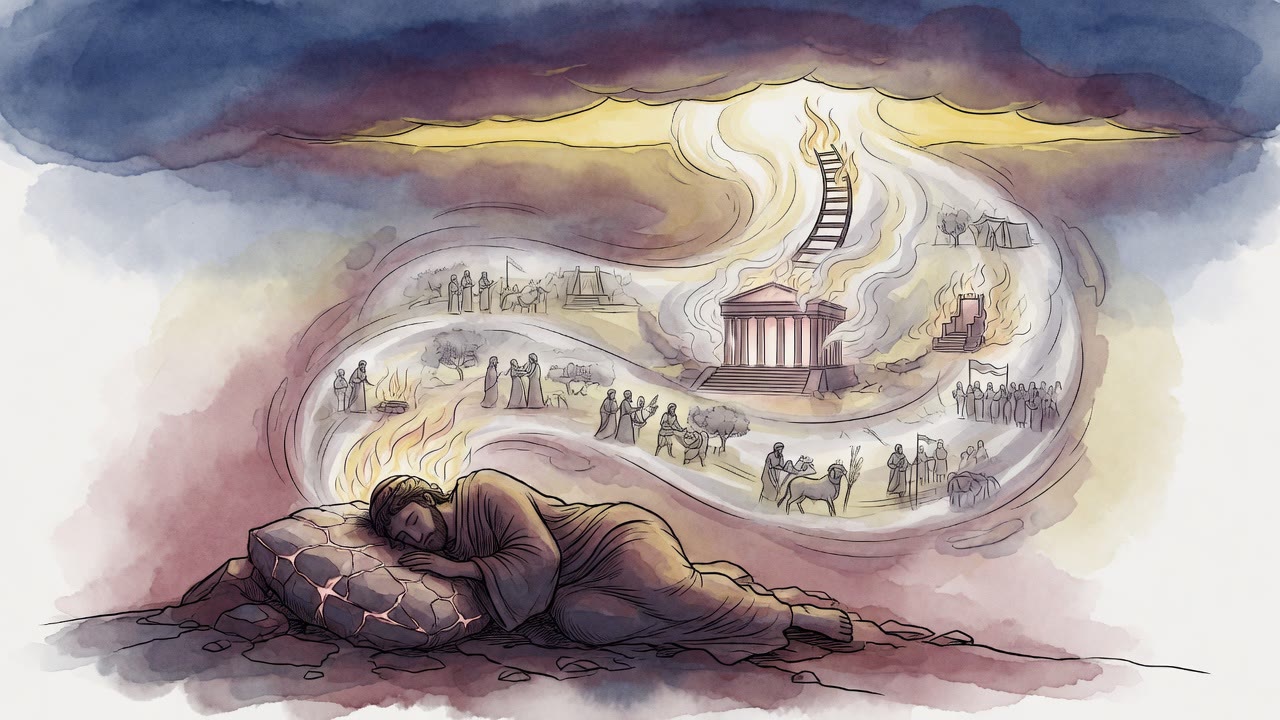
This matters in Jacob's story because Jacob was walking toward the place where heaven and earth were not always separate. He did not know this yet. He was tired, frightened, and alone. He found a place to sleep and gathered stones for a pillow. The text says he lay down in that place. Bereshit Rabbah notices the word, in that place. And hears inside it a hint that this particular ground had been waiting. The stones, the midrash says, quarreled among themselves, each one wanting to be the stone under the patriarch's head, until God fused them into one.
The Ladder Was Already Standing
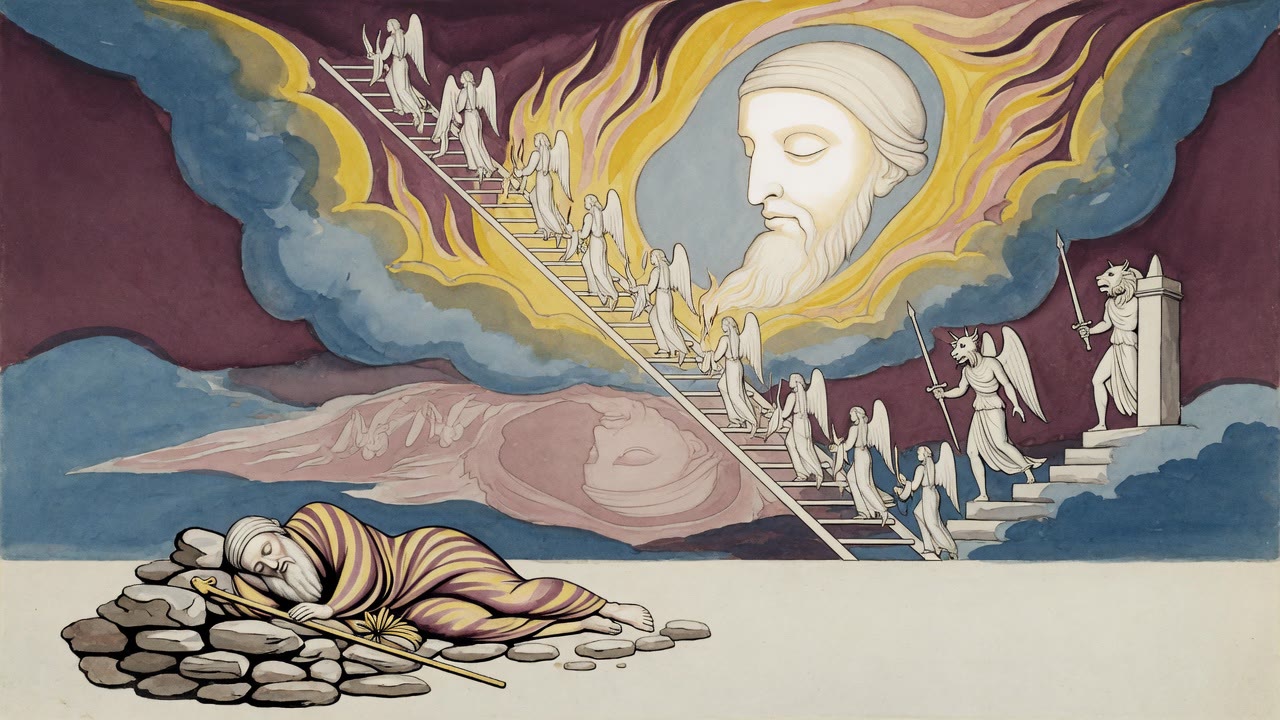
Jacob did not climb the ladder. The ladder was set on the earth and its top reached heaven. The angels were moving on it, ascending first, then descending. They went up before they came down, because they had escorted Jacob from Canaan and now returned to heaven to report, while the angels assigned to the lands outside Canaan came down to take their place beside him.
Rabbi Abbahu said that the content of dreams has no effect on waking life. But he did not say dreams are meaningless. The guidance belongs to interpretation, not to the literal image. When a man dreamed he was told to go to Cappadocia to claim his father's inheritance, Rabbi Yosei bar Halafta helped him find the meaning without leaving his home, the word Cappadocia could be broken open in Hebrew to reveal the hidden inheritance already around him. Jacob's ladder was like that. It was not a physical structure he could climb in daylight. It was the shape of the truth he was sleeping on top of.
God spoke to him at the top of that ladder and confirmed the promise made to Abraham and Isaac. The land. The descendants. The accompaniment through exile and return. Jacob woke up shaking. He said, surely God is in this place, and I did not know. He called the place Bet El, house of God. He had left home thinking he was alone, and discovered that the ground itself was a gate.
The Name Was Not Settled Until the End
Jacob's name changed twice. The stranger at the Jabbok gave him Israel, for you have striven with God and with men and prevailed. But then Genesis returns to call him Jacob again, as if the name had not stuck. Bereshit Rabbah wrestles with the repetition. When Abraham's name changed from Abram, the old name was forbidden. When Sarai became Sarah, the old form was retired. But Jacob kept both names. He remained Jacob as well as Israel.
The rabbis explain it this way: Abraham and Sarah received new names that replaced the old ones as a sign of irreversible transformation. Jacob received a new name that added to the old without canceling it. He was still the one who had gripped his brother's heel at birth, still the one who had walked east with a staff. Israel was layered on top of Jacob, not placed instead. The man who climbed toward Bet El on a wounded leg carried both names, both the one his parents gave him and the one God confirmed at the mountain.
← All myths